

The Meaning Density Model™
Why Modern Life Feels Empty — and How Coherence Is Restored
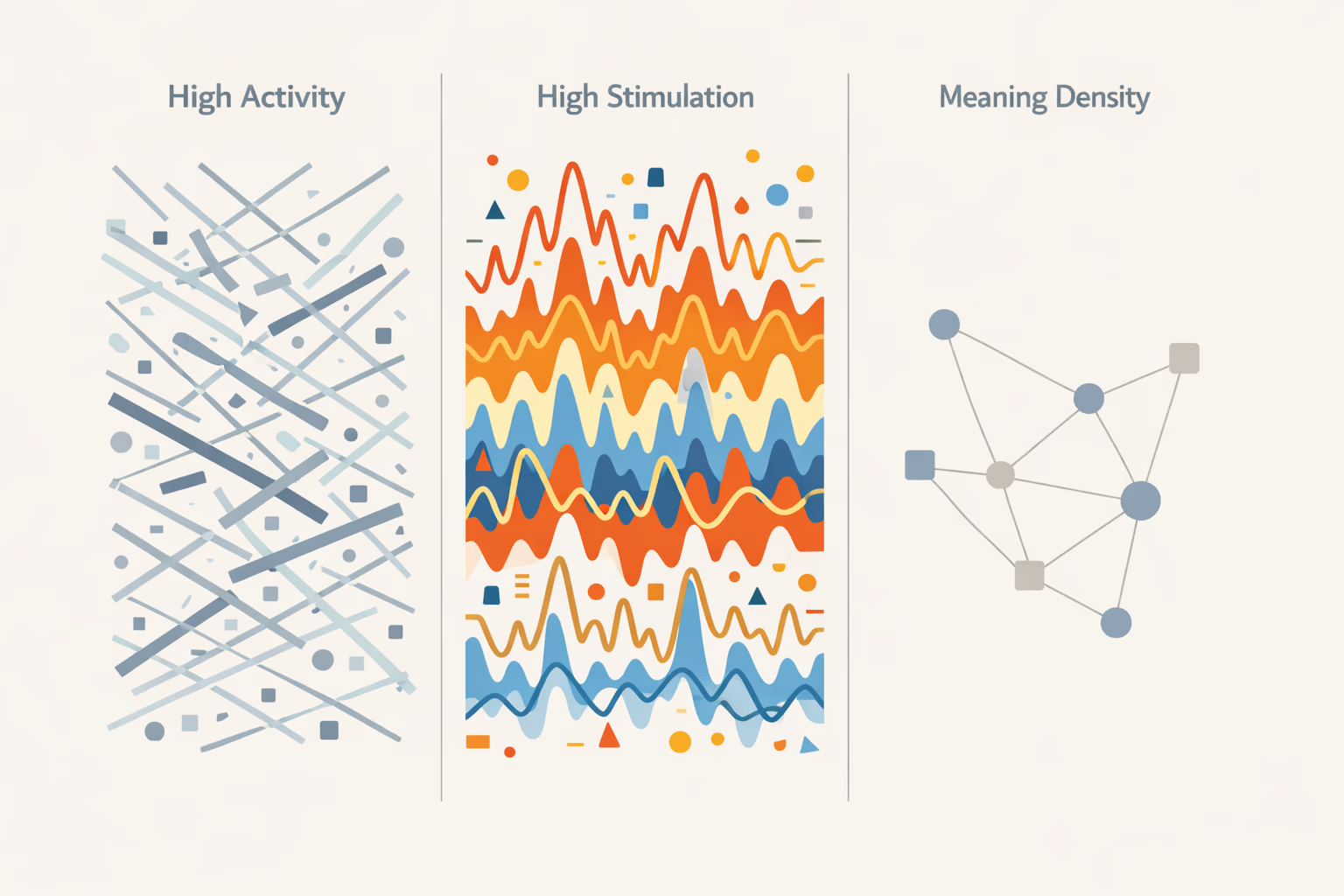
Evidence & intent (DojoWell standard)
This page is educational and non-clinical. It presents a conceptual framework grounded in established work on behavior, attention, stress physiology, and habit learning, alongside DojoWell’s original models (Meaning Density Model™ and loop architecture). Where DojoWell introduces original concepts, they are labeled as such—not presented as medical claims.
Document status
Meaning Density Model™ — Public conceptual framework (v1.0)
First published: January 2026
Scope: Conceptual architecture only. Measurement, scoring,
diagnostics, and implementation methods remain proprietary to DojoWell.
1 I. Executive Overview
1. The Core Insight: Why meaning is collapsing in modern life
The widespread sense of emptiness, restlessness, and chronic dissatisfaction that characterizes modern life is often described as a “loss of meaning.” This description is accurate—but incomplete. Meaning is not disappearing because people care less, believe less, or reflect less. It is collapsing because the conditions required for meaning to settle are no longer reliably present.
Human experience is organized in loops: need arises, action is taken, resistance is met, consequences unfold, and the experience integrates into memory and identity. For most of human history, these loops were finite and embodied. They ended. In contemporary life, loops are constantly triggered but rarely completed. Stimulation is abundant, feedback is continuous, and evaluation is perpetual, yet experiences fail to consolidate. As a result, life feels busy but insubstantial, intense but thin.
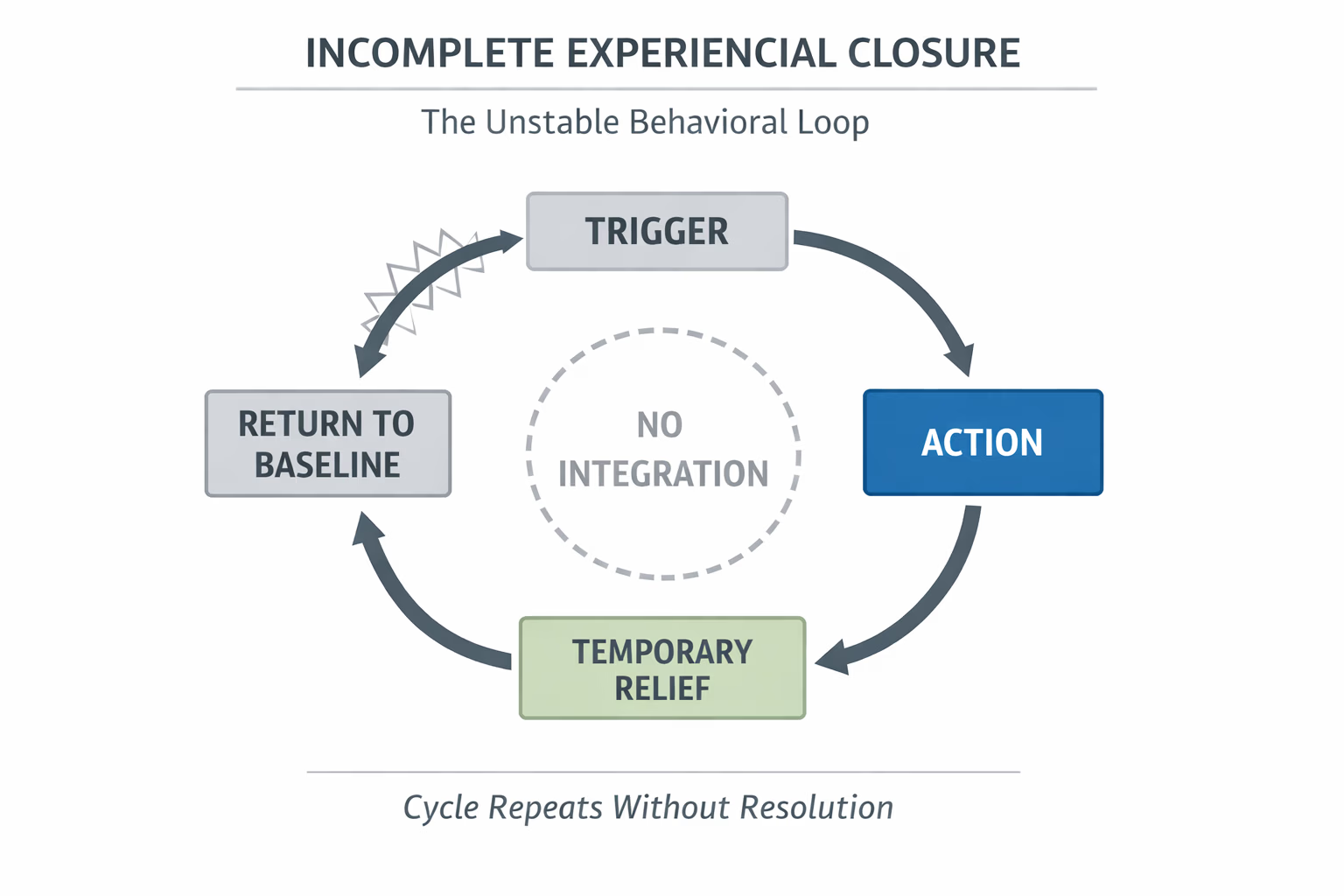
The core insight of the Meaning Density Model™ is simple and uncomfortable: meaning collapses when experiences do not integrate. Modern environments excel at initiating behavior but systematically undermine completion. What feels like a crisis of purpose is, at its root, a crisis of structural closure.
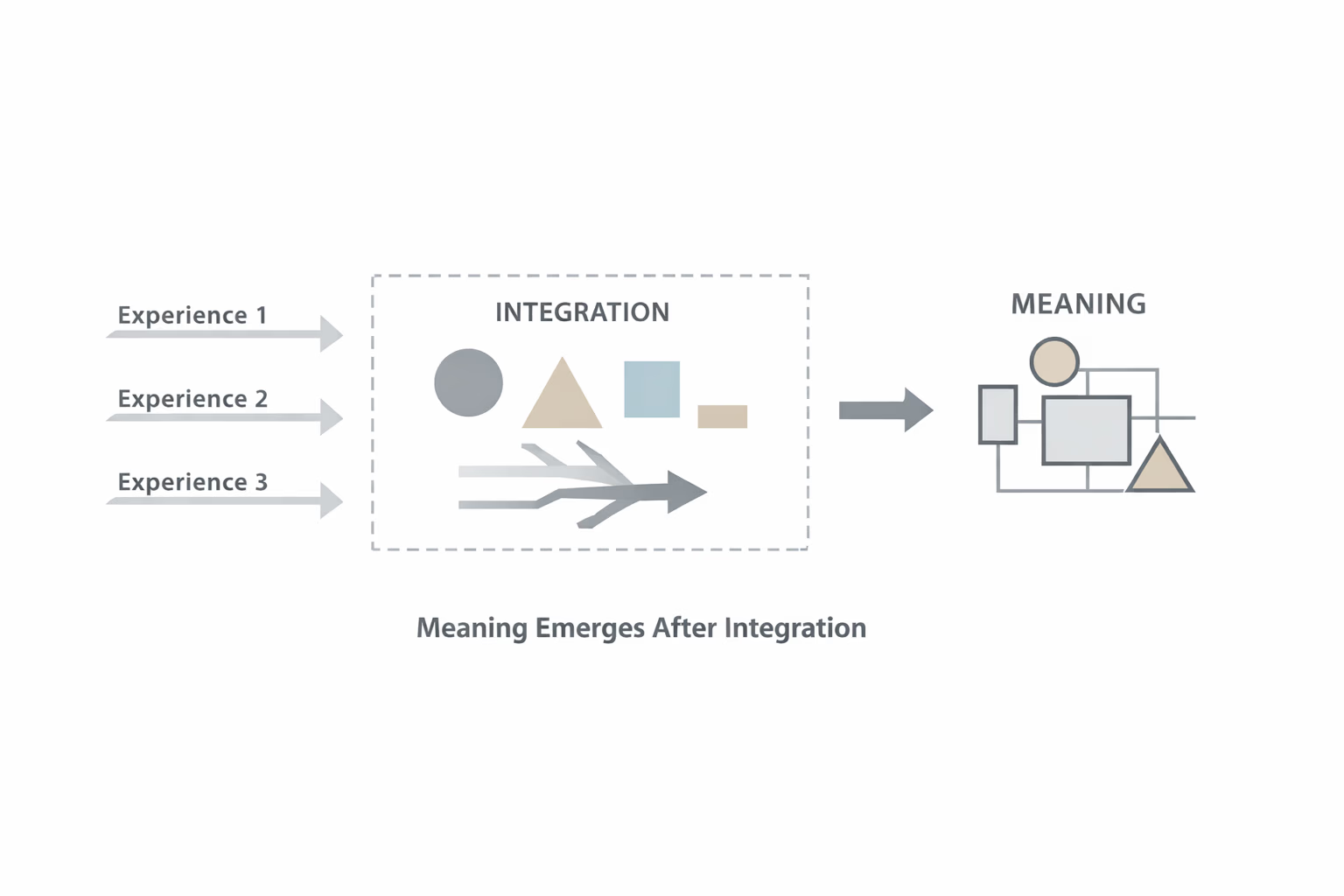
2. Meaning as structure, not motivation
Conventional explanations assume that meaning is generated by motivation, values, insight, or willpower. When meaning fades, the prescribed solutions are predictable: find your purpose, increase discipline, clarify goals, cultivate gratitude, or reconnect with passion. These approaches fail not because they are wrong, but because they address the wrong layer.
Meaning is not something the mind manufactures through effort. It is a neuro-structural byproduct of experiences that are allowed to finish and integrate under a regulated nervous system. Motivation can initiate action, but it cannot substitute for integration. Insight can explain experience, but it cannot consolidate it. Values can guide behavior, but they cannot force the nervous system to settle.
The Meaning Density Model™ reframes meaning as an output condition, not an input demand. When loops complete coherently, meaning accumulates quietly. When loops fragment or restart prematurely, meaning thins regardless of how motivated, intelligent, or values-driven a person may be. This shift—from motivational framing to structural framing—is foundational to the model.
3. The problem most systems misdiagnose
Most psychological, wellness, and productivity systems misdiagnose the modern meaning crisis in three recurring ways.
First, they moralize it. Meaning loss is framed as laziness, lack of discipline, insufficient gratitude, or poor mindset. This interpretation places responsibility entirely on the individual while ignoring the environmental and physiological conditions that make integration biologically unavailable.
Second, they individualize it. Solutions focus on inner states—beliefs, attitudes, emotions—without accounting for the loop architecture imposed by digital systems, metric-driven work, and constant interruption. Individuals are asked to adapt endlessly to environments that actively prevent closure.
Third, they intensify the very dynamics that caused the problem. Many interventions increase optimization, tracking, self-monitoring, or performance pressure, inadvertently feeding power and reward loops. The result is often temporary improvement followed by deeper exhaustion or relapse.
The Meaning Density Model™ identifies the true failure point not as character, cognition, or effort, but as the degradation of the integration process itself. When integration fails, repetition increases. When repetition increases, people assume something is wrong with them. The model breaks this cycle by relocating the problem to structure rather than self.
4. What the Meaning Density Model™ explains differently
The Meaning Density Model™ offers a unified explanation for a wide range of modern difficulties that are typically treated as separate problems: burnout, procrastination, addiction, compulsive optimization, status anxiety, and existential emptiness. Rather than viewing these as distinct pathologies, the model understands them as different expressions of the same structural breakdown.
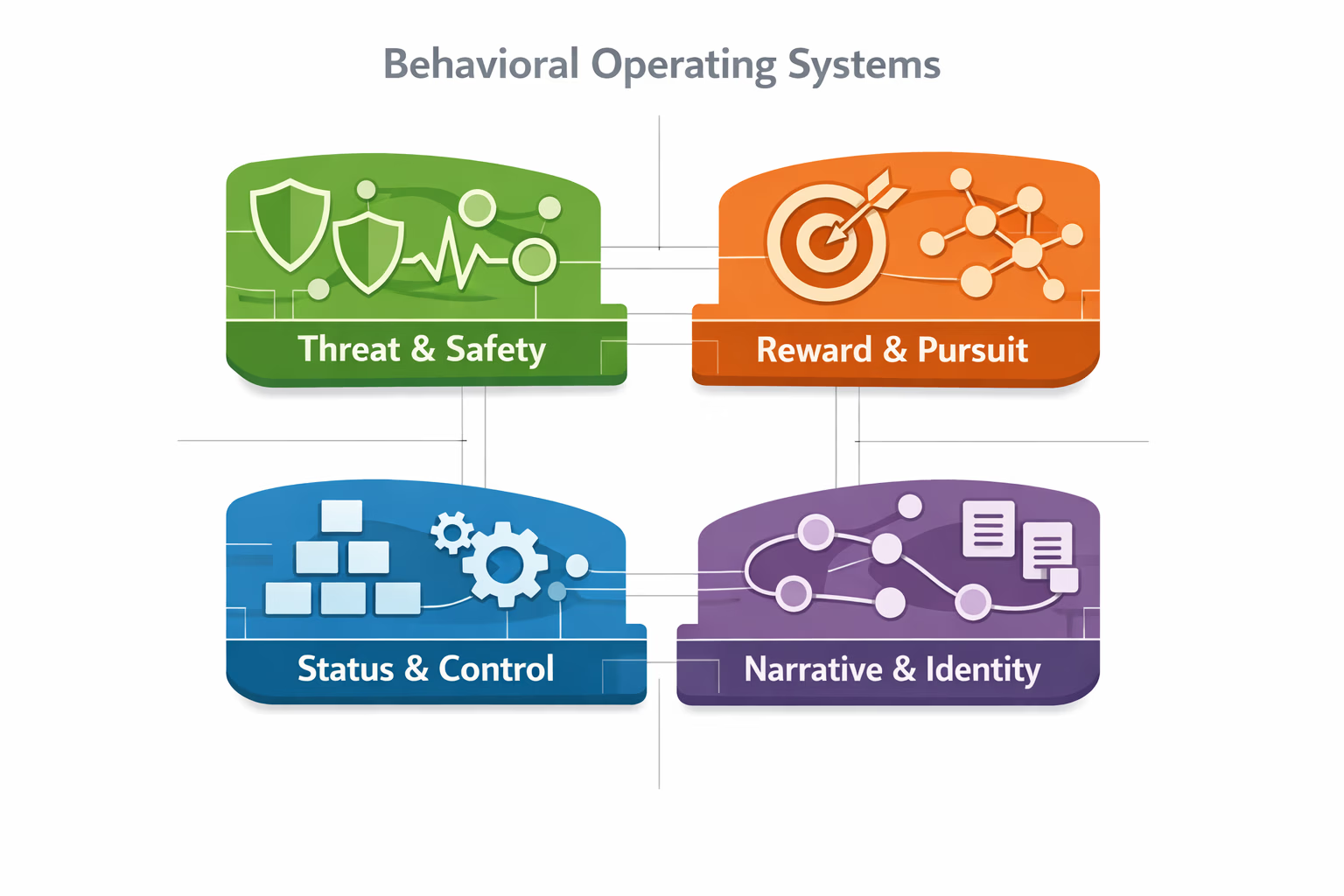
By mapping human behavior through four evolved systems—Threat & Safety, Reward & Pursuit, Status & Control, and Narrative & Identity—the model shows how modern tools amplify these systems beyond their capacity to resolve. From this amplification emerge three dominant loop patterns: pleasure loops, avoidance loops, and power loops. Each represents a compensatory attempt by the nervous system to regain stability when integration is blocked.
Crucially, the model explains why effort often fails to help, why insight does not stick, and why progress feels temporary. It introduces “meaning density” as a lens that captures not how much someone does or feels, but how much coherent identity reinforcement each loop produces. This allows modern dysfunction to be understood, diagnosed, and addressed at the level where it actually occurs.
5. One-paragraph positioning statement
The Meaning Density Model™ is a systems-level framework that explains why meaning collapses in modern life and how it can be restored without relying on motivation, belief, or moral pressure. It defines meaning as a neuro-structural outcome of completed and integrated behavioral loops, shows how contemporary environments disrupt this process, and maps the resulting pleasure, avoidance, and power loops that dominate modern experience. Rather than asking individuals to try harder or feel differently, the model restores coherence by repairing loop structure, protecting integration, and enabling narrative fluidity—so that meaning becomes a natural byproduct of lived completion, not a burden to be manufactured.
2 II. The Crisis of Structure
6. Why the modern “meaning crisis” is not moral, spiritual, or personal
The prevailing explanations for the modern meaning crisis tend to locate the problem inside the individual. People are told they lack discipline, clarity, faith, gratitude, resilience, or purpose. In spiritual language, the crisis is framed as disconnection from values or transcendence. In moral language, it becomes a failure of character. In psychological language, it is often reduced to mindset or motivation.
The Meaning Density Model™ rejects these framings not because values, spirituality, or personal responsibility are unimportant, but because they misidentify the level at which the failure occurs. The modern crisis of meaning persists even among highly motivated, reflective, values-driven individuals. It affects people who care deeply, think carefully, and actively pursue growth. This alone signals that the problem cannot be adequately explained by moral weakness or spiritual neglect.
At its core, the crisis is structural. It arises from a mismatch between how human experience is biologically organized and how modern environments are designed. Human nervous systems evolved to integrate experience through finite cycles with clear endings. Modern systems—digital platforms, metric-driven work, perpetual communication, and infinite content—systematically remove those endings. When the structure required for integration is absent, meaning cannot accumulate regardless of personal virtue or belief.
Framing the crisis as personal failure not only obscures the real mechanism, it compounds the damage. Individuals internalize blame for a condition that is produced by the architecture of their environment. The Meaning Density Model™ relocates the problem from character to structure, from guilt to design, and from self-criticism to systems literacy.
7. The modern paradox: more stimulation, less settlement
One of the defining paradoxes of contemporary life is that experience has intensified while meaning has thinned. People are exposed to more information, more opportunities, more feedback, and more stimulation than at any point in history. Yet subjective reports of emptiness, restlessness, and dissatisfaction have increased rather than decreased.
This paradox is resolved once stimulation and settlement are distinguished. Stimulation activates the nervous system; settlement allows it to integrate. Modern environments excel at the former and undermine the latter. Notifications, feeds, metrics, and constant connectivity ensure that behavioral loops are continuously triggered. However, these same systems fragment attention, accelerate transitions, and eliminate pauses—conditions that integration depends on.
As a result, experiences pile up without consolidating. Attention moves faster than memory can absorb. Consequences arrive without time to register. Evaluation replaces reflection. The nervous system remains active, but identity remains unchanged. The person feels engaged but not fulfilled, busy but not grounded.
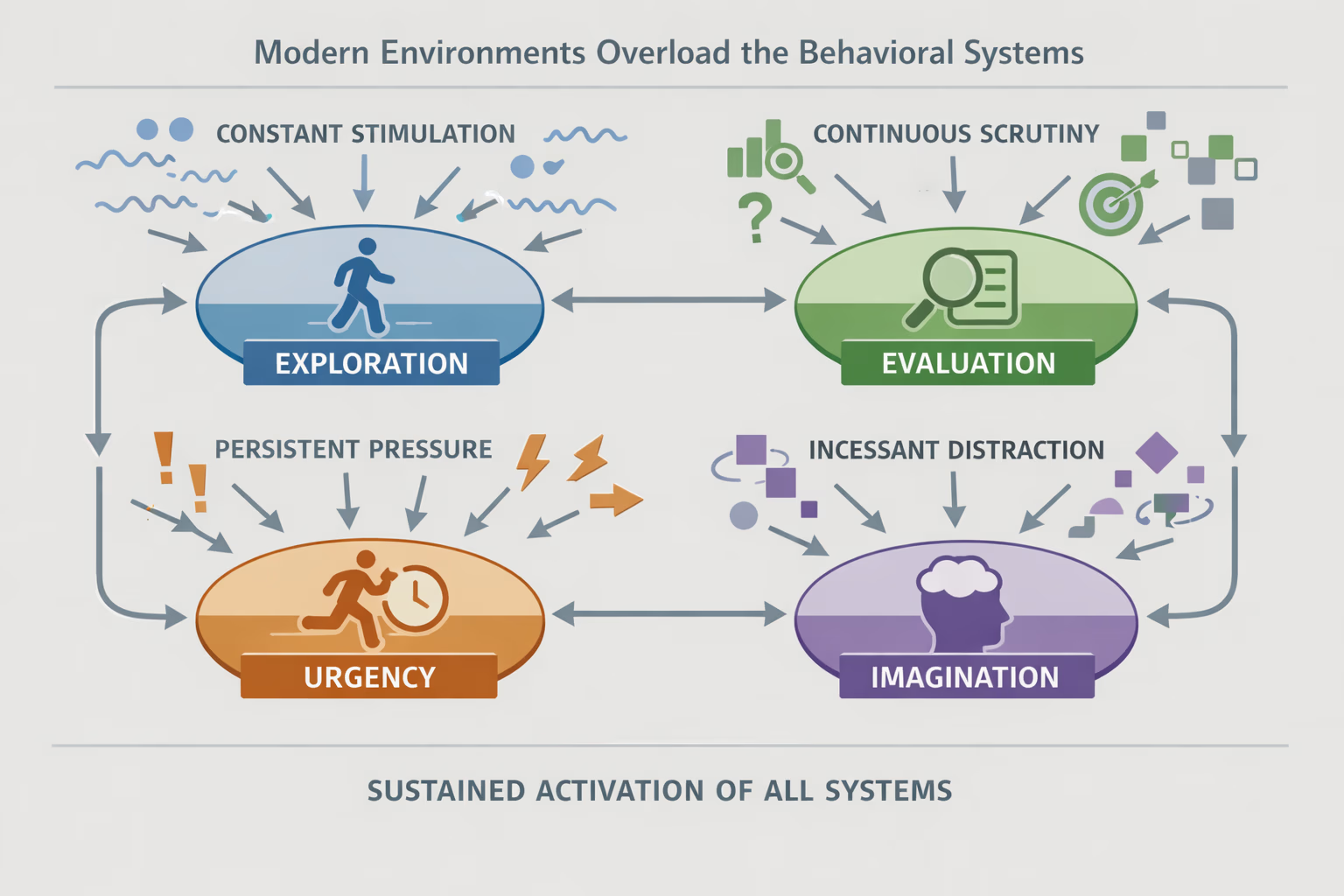
The Meaning Density Model™ describes this condition as high loop velocity paired with low integration capacity. The issue is not that people are doing too little, but that they are being pulled through experiences too quickly for those experiences to settle. Meaning requires not just activation, but resolution.
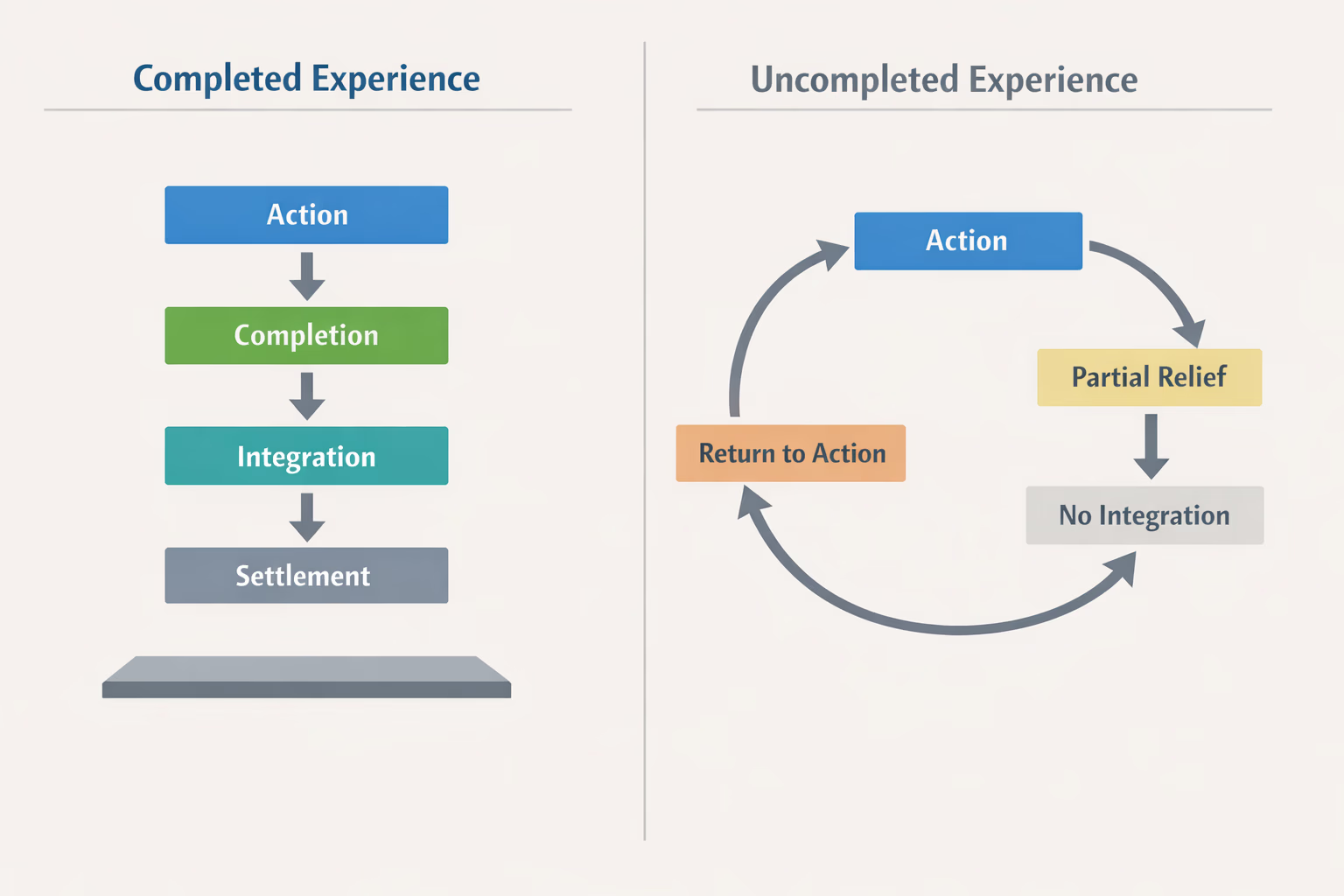
8. When life stops feeling “done”
A subtle but pervasive symptom of structural breakdown is the disappearance of the internal “done” signal. In environments that support integration, experiences end in a recognizable way. Effort gives way to completion, tension gives way to release, and attention can disengage without anxiety. The nervous system registers that something has finished.
In modern life, many experiences no longer terminate cleanly. Work tasks spill into evenings. Messages remain unanswered but visible. Feeds have no bottom. Goals are replaced before they conclude. Even leisure is interrupted by evaluation and comparison. The result is a chronic sense that nothing is fully complete.
When life stops feeling “done,” the nervous system remains partially activated. Attention hovers. Desire restarts. The impulse to check, optimize, or continue persists even when satisfaction is low. Over time, this state is misinterpreted as lack of motivation or discipline, when it is actually a failure of closure.
The Meaning Density Model™ treats this loss of “done” as a central diagnostic signal. Repetition, restlessness, and compulsive continuation are not signs of excess desire; they are signs that integration has not occurred. Meaning cannot accumulate when experiences never fully end.
9. What happens when integration disappears
Integration is the phase in which experience becomes part of memory, identity, and expectation. It is where effort registers as having mattered, where learning consolidates, and where the nervous system returns to baseline. When integration is disrupted or skipped, several predictable consequences follow.
First, repetition increases. The system reinitiates the loop in an attempt to obtain the closure it missed. This is experienced subjectively as craving, procrastination, or compulsive optimization. Second, identity destabilizes. Without integrated experiences to update the self, people rely more heavily on external metrics, narratives, or comparisons to define who they are. Third, regulation deteriorates. The nervous system remains in a semi-activated state, making rest feel unsafe and stillness uncomfortable.
Over time, the absence of integration produces a collapse in meaning density. Experiences may be intense, frequent, or even pleasurable, but they fail to reinforce a coherent sense of self. Life feels fragmented rather than cumulative. Progress feels temporary rather than durable.
The Meaning Density Model™ does not treat this as a psychological anomaly. It is the expected outcome of environments that initiate behavior faster than the nervous system can consolidate it.
10. What this framework does not claim (clear boundaries)
To remain precise and responsible, the Meaning Density Model™ establishes clear boundaries around what it does and does not claim.
It does not claim to replace clinical psychology, psychiatry, or psychotherapy. It is not a diagnostic system and does not assign mental health labels. It does not offer treatment for clinical conditions, nor does it substitute for professional care where such care is required.
It does not claim that meaning can be reduced to a single variable, nor that all suffering is caused by loop failure. Pain, loss, trauma, and injustice have realities that extend beyond structural models. The framework addresses how experience integrates, not whether experience is pleasant or fair.
It does not promote a particular belief system, moral code, or spiritual doctrine. While it is compatible with philosophical and contemplative traditions, it does not require adherence to any of them.
Finally, it does not promise happiness, optimization, or perpetual calm. Its aim is more modest and more fundamental: to restore the conditions under which experience can settle, identity can stabilize, and meaning can emerge naturally. The Meaning Density Model™ is a framework for structural coherence—not a prescription for how life should feel, but a guide for how it can once again complete.
3 III. The Four Behavioral Systems
Human behavior is not random, nor is it driven by a single motive such as pleasure, meaning, or survival. It emerges from the interaction of several evolved systems that operate continuously, often below conscious awareness. The Meaning Density Model™ organizes these forces into four primary behavioral systems. Each system evolved to solve a real problem in ancestral environments. Each still performs its function today. And each becomes destabilizing when amplified beyond its capacity to resolve.
Understanding these systems is essential not for self-judgment, but for structural literacy. Modern life does not invent new drives; it overstimulates ancient ones.
11. Threat & Safety — how urgency collapses time
The Threat & Safety system is the most ancient of the four. Its function is simple: detect danger and restore safety. When activated, it prioritizes speed, certainty, and immediate relief. Attention narrows, time horizons shrink, and the nervous system prepares for action.
In environments where threats are concrete and short-lived, this system is adaptive. A danger appears, a response occurs, and once safety is restored, the system stands down. Time expands again. Reflection becomes possible. Integration can occur.
In modern environments, however, threat signals are often abstract, social, and persistent. Evaluation, instability, overload, and constant comparison repeatedly activate the threat system without providing clear resolution. The result is chronic urgency. When urgency becomes the default state, time collapses. Everything feels immediate. Waiting feels dangerous. Friction feels intolerable.
From the perspective of meaning, this has a profound consequence. Integration requires time. When the threat system dominates, experiences are rushed or aborted. Relief becomes more important than completion. The system seeks safety now, even if it undermines coherence later. Meaning does not disappear because life is difficult, but because it never gets the chance to settle.
12. Reward & Pursuit — why desire keeps restarting
The Reward & Pursuit system energizes exploration, learning, and progress. It highlights what might be valuable and mobilizes effort toward it. Contrary to popular belief, this system did not evolve to produce happiness. It evolved to sustain directed effort over uncertainty.
In environments where reward is coupled to effort and delay, pursuit eventually quiets. The reward arrives, the system registers completion, and desire subsides. The loop ends.
Modern environments radically alter this pattern. Rewards are often fast, abundant, and detached from meaningful effort. Novelty is endless. Feedback is immediate. As a result, the pursuit system is repeatedly activated without reaching a biologically recognizable endpoint.
When desire keeps restarting, it is not because people are greedy or insatiable. It is because the reward system has learned that stimulation does not equal completion. The system continues to seek not because it wants more pleasure, but because it has not received the signal that the loop has finished.
In this state, satisfaction becomes thin and temporary. Desire outpaces settlement. Meaning erodes not from excess wanting, but from unfinished pursuit.
13. Status & Control — why “enough” disappears
Humans are social beings. The Status & Control system tracks position, belonging, predictability, and influence within a group. Its function is to reduce uncertainty by ensuring access to resources, cooperation, and protection. In small, stable communities, this system calibrates naturally. Signals are limited. Roles are visible. Contribution is recognizable.
In modern contexts, status signals are abstracted, quantified, and globalized. Metrics, rankings, visibility, and performance indicators expose individuals to constant evaluation across infinite reference groups. The result is a system that rarely settles.
When the Status & Control system is overstimulated, “enough” becomes elusive. Control behaviors intensify. Optimization replaces contribution. Identity becomes performative. People work harder not to create, but to stabilize their position. Even success fails to satisfy, because it does not reduce uncertainty.
From a meaning perspective, this system becomes problematic when action is driven primarily by external validation rather than internal coherence. Effort continues, but identity does not consolidate. Meaning thins because experience reinforces performance rather than self.
14. Narrative & Identity — how the self is constructed across time
The Narrative & Identity system binds experience into continuity. It answers the questions “Who am I?” and “What does this mean over time?” Through narrative, humans connect past actions, present choices, and future possibilities into a coherent sense of self.
Narrative is not an illusion to be discarded, nor a truth to be defended at all costs. It is a functional tool. When supported by integrated experience, narrative stabilizes identity, enables commitment, and gives life a sense of direction.
Problems arise when narrative detaches from lived completion. In such cases, the mind compensates by simulating coherence rather than embodying it. Stories multiply. Self-analysis intensifies. Identity becomes fragile because it is no longer updated by integrated action.
In modern environments, narrative is constantly stimulated—through comparison, reflection, branding, and self-monitoring—while integration is undermined. The result is a self that is busy explaining itself but rarely settling. Meaning becomes something to justify rather than something that accumulates naturally.
Closing note on the four systems
None of these systems are pathological. Each is necessary. Each evolved to serve human survival and flourishing. The crisis arises not from their existence, but from their chronic overactivation without resolution.
4 IV. A Short History of Meaning Density
The Meaning Density Model™ does not seek to suppress these systems. It seeks to restore the conditions under which they can complete their function and stand down. Only then can experience integrate, identity stabilize, and meaning re-emerge—not as an aspiration, but as a byproduct of a life that is once again allowed to finish.
The Meaning Density Model™ begins with a deceptively simple observation: meaning accumulates when life comes in loops that actually finish. A loop is not mystical. It is the basic unit of lived experience: a need arises, action is taken, resistance is met, consequences unfold, and—crucially—something settles. The nervous system registers completion. Memory consolidates. Identity updates. The body receives the internal signal: done.
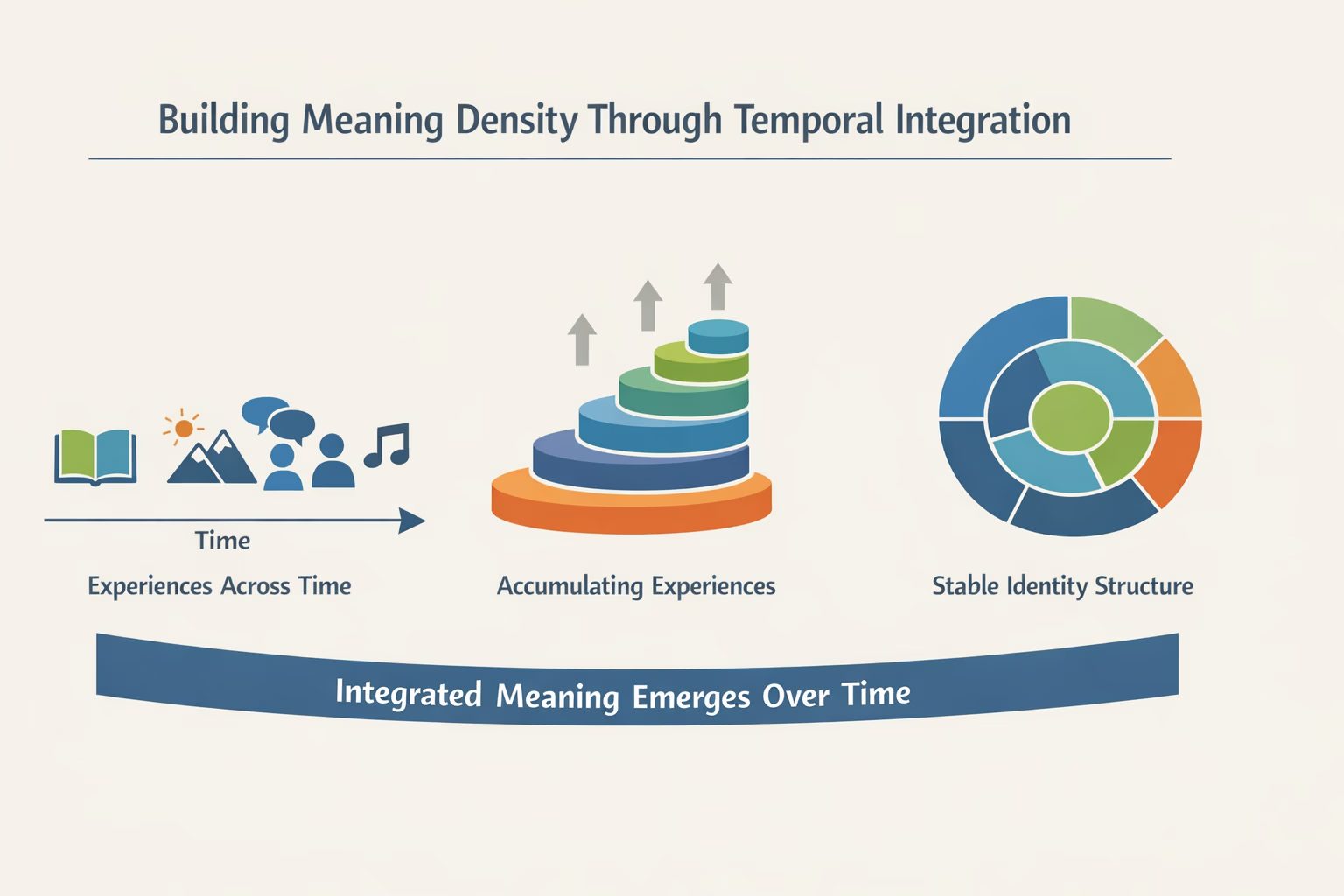
When loops finish reliably, meaning becomes a quiet byproduct. People do not need to “find their purpose” every morning. They feel anchored because their days contain coherent endings. When loops do not finish—when they fragment, restart prematurely, or never terminate—meaning thins. Life can feel full, even intense, and still feel strangely unreal or empty because it doesn’t consolidate.
To make this framework intuitive, it helps to see history not only as a timeline of technology and culture, but as a timeline of loop architecture. Across four broad eras, the structure of loops changed. And as loops changed, meaning density changed with them.
This is not nostalgia. The goal is not to romanticize the past. It is to clarify what our nervous systems were built for, what we lost, and what must be deliberately rebuilt.
15. The Ancestral Era: when loops closed naturally
In the ancestral era, the world was hard—but it was legible. Needs were concrete. Actions were embodied. Consequences were immediate. And loops ended.
This matters because meaning density was naturally high not due to philosophy, but due to closure.
What loop closure looked like (simple example: hunger)
Need: hunger is felt.
Action: you forage, hunt, prepare.
Resistance: effort, weather, skill, danger.
Consequence: you eat.
Integration: hunger stops; the body settles; the mind quiets.
There is a clean ending. The system learns. The loop finishes. It becomes unnecessary to keep “seeking” because the need is met in a way the body recognizes as real completion.
Another example: skill and contribution
A person makes a spear, repairs a shelter, gathers water, or prepares food. The feedback is visible and embodied.
You see the shelter stand.
You feel the tool in your hand.
You watch someone benefit from what you did.
In modern life, we often measure success through abstraction (a number, a like, a KPI). In ancestral life, success was sensory and relational. It registered in the body and in the tribe. This is precisely the kind of feedback that strengthens integration.
Example: social conflict resolution had endpoints
Even conflict tended to have a form of closure. In small groups:
disagreements were visible,
reputations were stable,
consequences were local,
reconciliation was possible because you couldn’t disappear into anonymity.
The nervous system doesn’t need a perfect world. It needs a world where consequences and endings are perceivable. In the ancestral era, endings were built into the environment because the environment was finite.
Meaning as a byproduct, not a pursuit
In this context, people did not wake up asking, “What is my purpose?” Not because they were less intelligent, but because life itself provided structural meaning. Survival demanded participation. Participation produced completion. Completion produced integration. Integration produced coherence. That coherence is what we now describe as meaning.
Even grief and suffering had loop structure. Loss was real, but it was processed communally with ritual-like patterns: gathering, storytelling, mourning, reorientation. This did not eliminate pain, but it prevented fragmentation from becoming permanent. The loop ended enough to allow the nervous system to continue living.
Ancestral meaning density was high because life came with endings.
16. The Mythic Era: meaning as a shared container
As humans formed larger societies, the loop architecture changed. Life became more complex and more abstract. Needs were no longer only biological; they were social, political, and symbolic. You could plant seeds and wait months. You could trade with people you barely knew. You could serve an institution rather than a small tribe.
This complexity created a new problem: the nervous system cannot sustain coherence when it must continually generate meaning alone. In response, cultures built what can be called a shared container—myths, rituals, religions, and symbols.
The key shift in the mythic era is this: meaning became ambient. It was not something individuals manufactured. It was something they lived inside.
Example: ritual as an engineered ending
Consider a harvest ritual.
Before the ritual: anxiety, uncertainty—Will we have enough?
During the ritual: collective action; symbolic meaning; shared attention.
After the ritual: a boundary is drawn—“the harvest is done,” “the season has turned,” “we are safe for now.”
Even if life remained hard, the ritual created a structured ending that the nervous system could register. It closed loops that would otherwise remain open.
Or consider a rite of passage: childhood → adulthood.
In modern life, identity transitions are often ambiguous and prolonged. People can feel “not yet” for decades. In mythic cultures, initiation rites created sharp boundaries. The individual passed through a structured sequence and emerged with a new social identity. The nervous system received a powerful integration signal: a chapter ended; another began.
Example: identity was carried by role
In the mythic era, identity was embedded in function and belonging. You were:
a farmer,
a healer,
a craftsperson,
a parent,
a member of a clan,
a participant in a sacred story.
This reduced the burden of self-definition. Modern people often believe that freedom requires self-invention, but self-invention has a cost: it demands constant narrative labor. Mythic cultures outsourced much of that labor to shared narratives. This often limited personal agency—but it stabilized meaning density for many.
Example: symbols as psychological compression
Symbols compress complexity into a graspable form. A myth is not merely a story; it is a cognitive technology. It tells you:
what matters,
what pain means,
what roles exist,
what virtue looks like,
what sacrifice is for.
This is a kind of structural relief. Instead of interpreting life from scratch each day, you inherit a meaning architecture. That architecture provides closure through seasons, ceremonies, and collective rhythms.
The cost and the benefit
The mythic era did not necessarily produce “true” meaning; it produced coherent meaning. The container could be rigid, oppressive, or exclusionary. But it did something biologically crucial: it stabilized loop completion through shared structure.
In Meaning Density terms: complexity increased, but integration remained possible because cultures built external loop management systems—ritual, role, seasonality, sacred time. Meaning density remained relatively stable because closure remained visible.
17. The Modern Era: when meaning became a personal burden
Then came the major fracture: industrialization, bureaucracy, and large-scale modernity. The shared container weakened. Traditional narratives became less binding. The individual was increasingly required to generate meaning through choice rather than inheritance.
This was not purely negative. It created freedom. But it also created a heavy psychological burden: meaning became something you had to produce.
Example: work without loop closure (the “alienation” problem)
In pre-industrial craft:
you make a chair,
you see it completed,
you deliver it to someone,
you receive direct feedback.
In industrial labor:
you tighten one bolt all day,
you never see the final product,
your effort is abstracted into wages,
your contribution is invisible.
The loop doesn’t close in a way the nervous system recognizes. You worked, but did you complete something? This gap produces a subtle emptiness: the body knows it exerted effort, but it doesn’t receive an integration signal that the effort “counted” in a coherent way.
Many modern jobs still contain this problem even when they are prestigious. People produce spreadsheets, presentations, emails, and meetings that dissolve into systems. The work is real, but the closure is weak. The nervous system lives in constant partial completion.
Example: the fragmentation of social belonging
Modernity often replaced stable local belonging with mobility, privacy, and individualism. People gained autonomy but lost certain containers:
fewer communal rituals,
weaker intergenerational roles,
less predictable social identity.
Where meaning used to be ambient, it became optional. Optional meaning sounds liberating, but it has a hidden cost: when meaning is optional, it becomes unstable. Many people respond by overcompensating—overworking, overachieving, or clinging to identity narratives.
The Frankl moment: meaning after collapse
The 20th century intensified this. War, mechanized bureaucracy, and large-scale violence damaged confidence in inherited narratives. Viktor Frankl’s response was not to restore myth, but to compress meaning into something portable:
meaning is not inherited,
meaning is chosen,
meaning is lived through responsibility and stance.
This modern move is powerful precisely because it accepts collapse. Yet it still assumes something that modern life increasingly undermines: that individuals have enough stability, attention, and integration capacity to carry meaning through sheer choice.
Frankl gave meaning dignity. But modernity did not supply stable loop closure. People were told to choose meaning while living in environments that increasingly broke the conditions for integration.
Example: “purpose” becomes pressure
In the modern era, you begin to hear a new kind of suffering:
“I don’t know what I want.”
“I don’t know who I am.”
“I should be doing something meaningful.”
“I’m wasting my life.”
These are not ancestral questions. They emerge when the shared container collapses and the individual becomes responsible for meaning-making. Meaning becomes a personal project. And once meaning becomes a project, it can become a burden—another thing to optimize, prove, and defend.
In Meaning Density terms: modernity increased freedom but decreased structural closure. Meaning became personal, but loop completion became fragile. People could choose meaning, but their lives increasingly made it hard for meaning to settle.
18. The Hypermodern Era: infinite triggers, no endings
If modernity fractured meaning, hypermodernity collapses it. This is the digital acceleration era: smartphones, feeds, constant connectivity, metrics, and algorithmic attention systems.
Hypermodern life doesn’t merely make loops shorter. It often deletes the integration phase entirely.
Example: the feed has no bottom
Consider the simplest hypermodern loop:
Trigger: boredom, discomfort, uncertainty, notification.
Action: open phone, scroll.
Reward: novelty, social signal, micro-validation.
Integration: missing.
End: missing.
The loop does not finish because the environment was engineered not to finish. The nervous system remains in pursuit mode—seeking the next update that might finally produce closure. The result is craving without satisfaction. The person is not weak; the loop is structurally endless.
Example: work without boundaries, life without endings
In hypermodernity, work is not confined to work:
messages arrive at night,
tasks remain visible on apps,
calendars are always editable,
“inbox zero” becomes a fantasy.
Even leisure becomes porous:
you watch a video while checking messages,
you relax while thinking about metrics,
you consume while comparing your life to others.
Endings disappear because transitions disappear. And when transitions disappear, integration disappears.
Example: identity outsourced to metrics
In earlier eras, identity was reinforced through role and relationship. In hypermodernity, identity is often shaped by:
views,
likes,
follower counts,
performance dashboards,
algorithmic relevance,
social comparison at global scale.
These signals are powerful because they constantly activate the Status & Control system. But they are unstable because they never provide “enoughness.” The metrics always invite more. The nervous system remains in evaluation mode. Identity becomes reactive rather than integrated.
This is why people can be constantly “building themselves” yet feel increasingly unsure who they are.
Example: meaning inflation
Hypermodernity produces a strange effect: the appearance of meaning everywhere—quotes, hot takes, threads, self-help content, motivational reels—yet the felt substance of meaning declines.
This is meaning inflation: more meaning-like signals per day, less integrated coherence per life.
You can watch fifty videos about purpose and still feel empty because meaning does not arise from content consumption. It arises from integrated experience. Hypermodern environments offer endless symbolic stimulation but rare completion.
Infinite triggers, no “done”
The core mechanism of hypermodern collapse is not moral decay. It is simple architecture:
triggers are infinite,
feedback is constant,
comparison is global,
endings are absent,
integration windows are crowded out.
This creates the signature hypermodern psychological state: restlessness without resolution. People carry dozens of open loops simultaneously. The nervous system remains half-activated. The mind searches for closure and substitutes it with compulsions—pleasure loops, avoidance loops, power loops.
Meaning density falls not because life is meaningless, but because life does not complete.
Bringing the four eras together (the simplest summary)
Ancestral Era: meaning is high because loops end naturally.
Mythic Era: meaning is stable because cultures build shared containers that create endings.
Modern Era: meaning becomes personal because inherited narratives weaken; loop closure becomes fragile.
Hypermodern Era: loops are triggered endlessly; endings disappear; integration collapses; meaning thins.
This historical view is not an argument for regression. We cannot return to ancestral hardship or mythic rigidity. The point is diagnostic clarity: if we understand what meaning density depended on historically—closure, transition, integration, and identity reinforcement—we can rebuild those conditions intentionally in modern life.
The next step in the Meaning Density Model™ is therefore not “find meaning,” but restore the architecture that allows meaning to emerge: protect integration, design endings, and regain sovereignty over loops that were never meant to be infinite.
5 V. The Three Modern Loop Traps
The Meaning Density Model™ describes three dominant “loop traps” that appear when modern life repeatedly triggers our behavioral systems faster than we can complete and integrate experience. These are not moral failures. They are compensations—ways the nervous system tries to regain stability when it cannot reach closure.
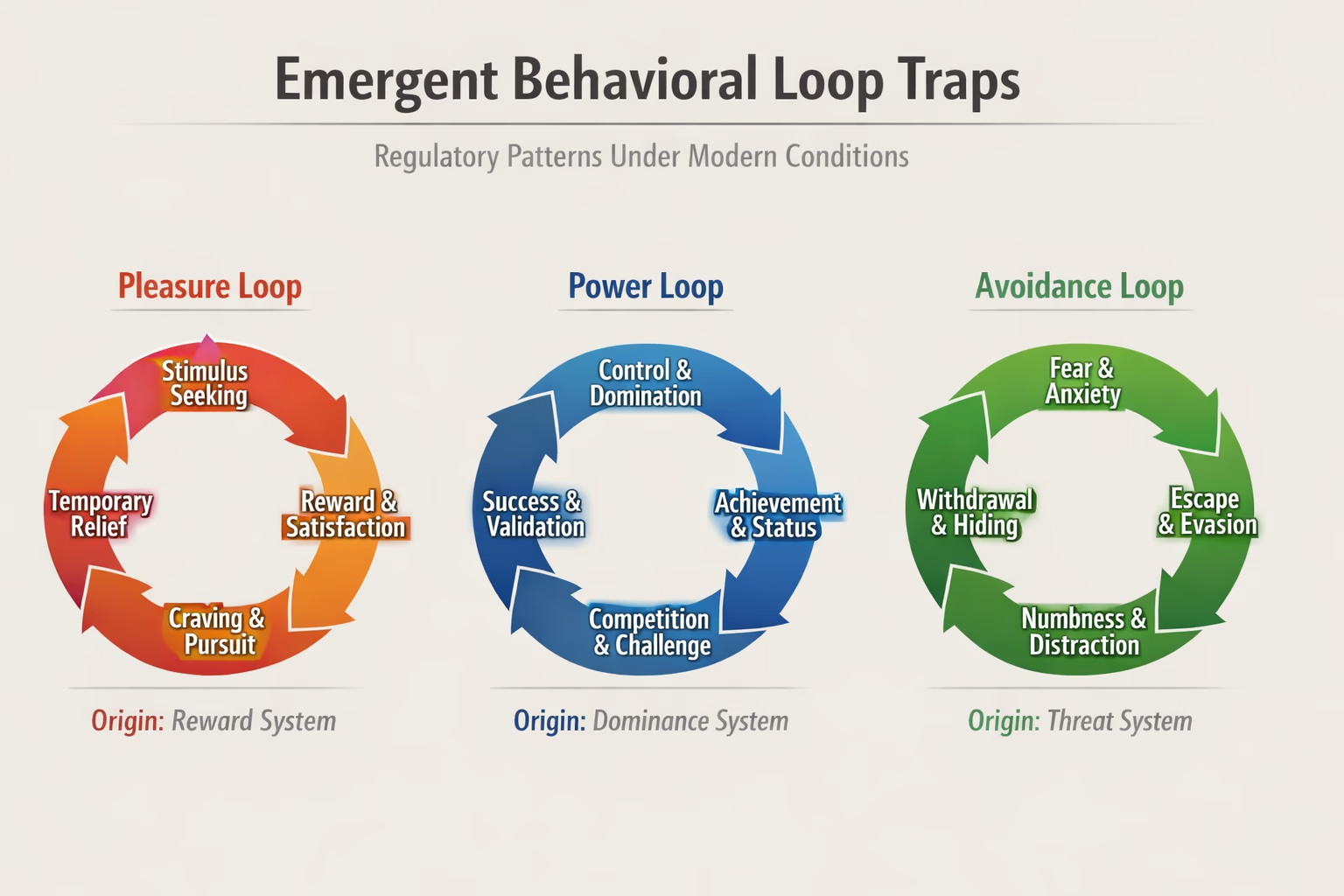
They feel different on the surface: one looks like craving, one looks like procrastination, one looks like perfectionism. But structurally, they share a common feature: the loop closes without integration, so the system keeps restarting.
19. The Pleasure Loop: craving without satisfaction
The Pleasure Loop is what happens when the Reward & Pursuit system is activated repeatedly without a true “completion” signal. Modern environments supply endless novelty and variable reinforcement—exactly the cues that the pursuit system evolved to chase—while removing the friction, consequence, and endings that would normally allow the system to settle.
The felt experience
You want something—content, snacks, shopping, entertainment, an update.
You get it quickly.
You feel a brief shift: relief, stimulation, uplift.
And then… it fades.
You want the next one.
Not because the pleasure wasn’t real. It was real. But it was thin—it didn’t consolidate into “done.”
Example A: The scrolling loop You open your phone for “a minute.” You scroll. You find something mildly interesting. You keep going. Ten minutes later you feel strangely underfed—like you ate but didn’t nourish. You close the app, and within minutes your hand reaches for the phone again.
This is not weak will. It’s loop structure:
Trigger → Swipe → Novelty hit → no endpoint → no integration → retrigger.
Example B: The snacking loop You’re not hungry in a clean biological way. You’re restless. You open the fridge. You eat something small. There’s a brief calming shift. Then the unease returns. You snack again.
The system isn’t seeking food; it’s seeking closure. The snack changes state but doesn’t settle the loop.
Example C: The “one more episode” loop You finish an episode and the next one starts automatically. Your body wants an ending—an integration moment. The platform removes it. You keep watching, not necessarily because it’s amazing, but because stopping feels oddly uncomfortable.
That discomfort is the nervous system noticing: the loop never closed.
Why craving persists even when enjoyment declines
The Pleasure Loop creates the signature modern contradiction: you do the thing, but it stops feeling good—yet you keep doing it. That’s because the system isn’t pursuing joy; it’s pursuing completion. When completion is missing, repetition becomes the default.
In Meaning Density terms: stimulation increases, but integration decreases, so meaning density drops. Pleasure does not become “bad.” It becomes structurally incomplete.
20. The Avoidance Loop: relief now, life later
The Avoidance Loop emerges when the Threat & Safety system becomes chronically active. Modern threats are rarely predators or storms. They are evaluation, overload, uncertainty, social conflict, financial pressure, and the invisible weight of too many open commitments.
When the threat system is activated, the nervous system prioritizes immediate relief. If regulation is low, even small friction feels dangerous. The system chooses escape—not because you love avoidance, but because the body interprets initiation as threat.
The felt experience
You have something important to do.
You feel a tightening, fog, dread, or heaviness.
You “just need a break” first.
You do something easy (scroll, snack, clean, browse).
You feel relief—immediately.
Later, you feel worse, because life is still waiting.
Avoidance feels like relief now and debt later. The loop aborts before completion, so the task remains open, the threat remains active, and the system becomes even more avoidance-prone.
Example A: Procrastination before an email You need to send one difficult email. You open your laptop. Your chest tightens slightly. You tell yourself, “I’ll do it after I check something quick.” You check five things. An hour passes. The email still isn’t sent. Now the threat is larger, because time is shorter and guilt has added pressure.
This is not laziness. It’s threat mechanics: initiation carries too much perceived cost, so the system chooses relief.
Example B: Avoiding a conversation You need to have a real conversation with someone—your partner, colleague, family member. You delay. You stay polite. You keep it surface-level. You feel temporary safety. But the unresolved tension continues to leak into your nervous system. The loop never closes, so the threat never settles.
Example C: “I’ll start tomorrow” Starting a health habit, a project, or a plan requires uncertainty and friction. If the system is already overloaded, uncertainty feels intolerable. “Tomorrow” is not a time choice; it’s a safety strategy. It creates immediate relief by postponing threat.
Why avoidance is self-reinforcing
Avoidance works in the short term. That’s why it repeats. Relief is a powerful reinforcement signal for the threat system. But because the underlying loop remains open, avoidance increases future threat—creating a trap.
In Meaning Density terms: the loop collapses early, integration never happens, and meaning cannot accumulate. A person can be busy all day avoiding and still feel like nothing happened because nothing completed.
21. The Power Loop: pressure without enoughness
The Power Loop is driven by the Status & Control system under modern amplification. Humans evolved to track status within small groups using direct social signals: respect, trust, role, contribution. In hypermodern environments, status is quantified and broadcast through metrics: followers, performance dashboards, rankings, achievements, public comparisons.
This creates a system that rarely reaches enoughness. Control becomes the strategy for safety. Optimization becomes the method. Performance becomes identity.
The felt experience
Even when you succeed, it doesn’t land.
You’re praised, but you don’t feel settled.
You move immediately to the next target.
Rest feels unsafe because you might fall behind.
You tighten systems, plans, routines, image, standards.
You feel pressure, not peace.
Example A: The “more proof” loop You complete a big project. There’s a moment of relief, then the thought: “Okay, what’s next?” Not out of ambition alone, but because stillness exposes a fear: If I stop proving, I disappear.
So you reopen the loop. You start another. You chase another marker. The system never consolidates “I am enough” because it’s waiting for an impossible endpoint.
Example B: Perfectionism as safety You rewrite the slide deck ten times. You keep adjusting the details. You are not driven by excellence alone; you’re driven by threat: “If I miss something, I’ll be judged.” Control becomes the way you manage uncertainty. But uncertainty is infinite, so control never ends.
Example C: Metrics and self-worth You post something online. You check views and likes. You refresh. You feel a brief lift or drop. Even when it performs well, you keep checking. Why? Because the metric is not an ending. It is an ongoing evaluation channel.
The loop becomes: Post → check → interpret → adjust identity → recheck. No closure. No settling.
Why “enoughness” disappears
The Status & Control system wants stability. Modern comparison systems offer endless evaluation but no stable resolution. That produces pressure without enoughness.
In Meaning Density terms: action can be intense and high-effort, but if it is driven by external tethering rather than internal coherence, integration remains weak. The person may “achieve,” yet identity does not stabilize.
22. What all three loops share
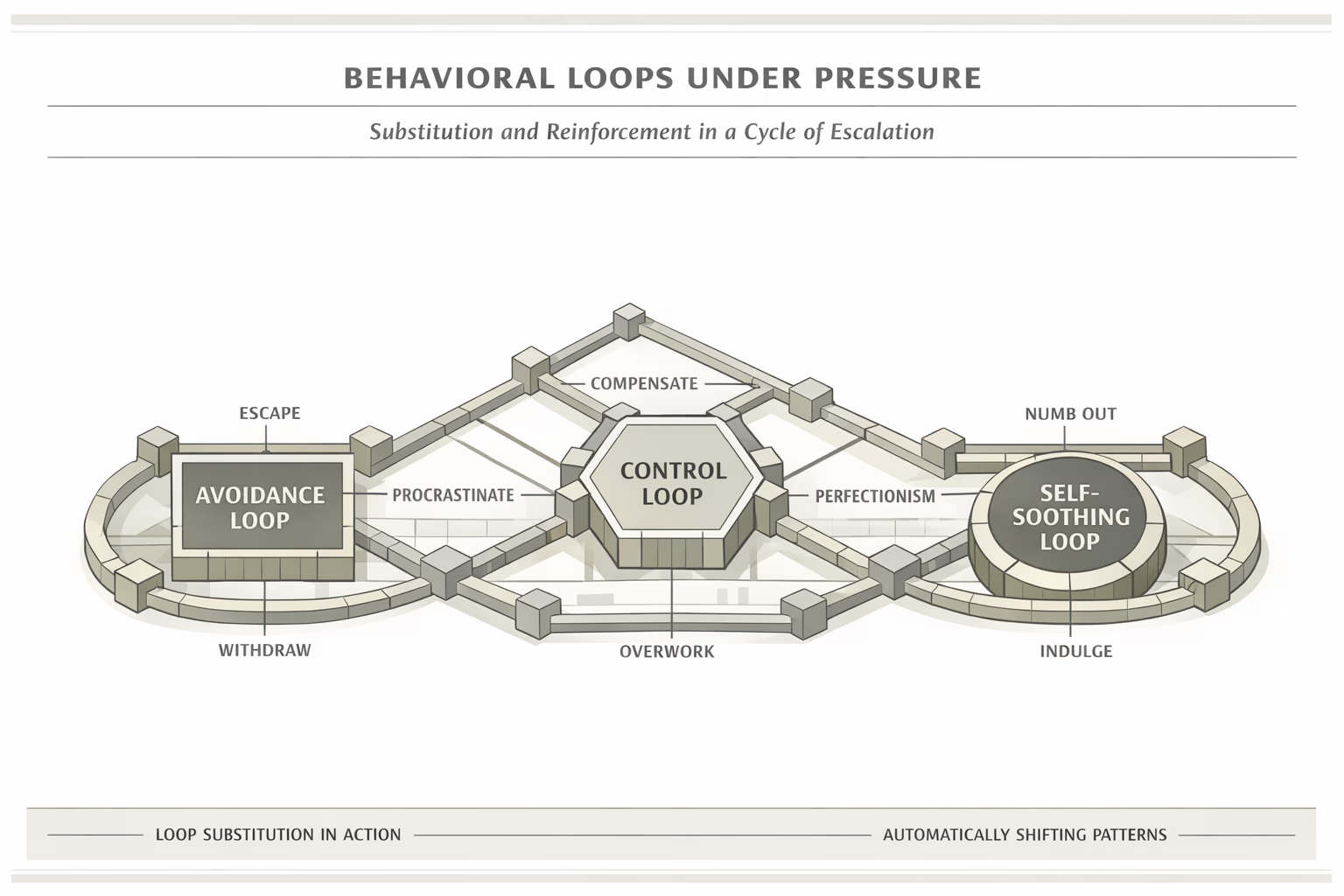
Although the Pleasure, Avoidance, and Power loops look different, they share a single architecture:
A. The loop closes without integration
Pleasure loop: it ends with stimulation, not settling.
Avoidance loop: it ends early through escape, not completion.
Power loop: it ends with performance, not enoughness.
In all cases, the nervous system does not receive the “done” signal. The experience does not consolidate into a stable internal update.
B. Repetition is a symptom of incompletion
People often ask: “Why do I keep doing this?” The Meaning Density Model™ answers: because the system is trying to finish a loop that never integrated.
Repetition is not always addiction. It is often a biological attempt to obtain closure.
C. The trap is structural, not personal
These loops are not evidence that someone lacks values. They are evidence that the environment and nervous system are interacting in a way that prevents closure. That’s why motivation and insight alone often fail. You can understand the pattern and still repeat it if the integration conditions are missing.
D. All three reduce meaning density in the same way
Meaning density drops when:
attention is fragmented,
transitions are unclear,
endings are absent,
identity updates don’t occur.
So the person can live a high-output life and still feel empty, restless, or pressured. The issue is not how much is happening. The issue is how much of what happens becomes integrated coherence.
If you recognize yourself in any of these loops, the goal is not to attack the behavior first. The goal is to restore what the loop is missing:
Pleasure loop → restore endings and integration space
Avoidance loop → restore safety and tolerable friction
Power loop → restore internal coherence and enoughness signals
The deeper claim is the same across all three:
Modern life doesn’t just make us distracted or stressed. It makes us structurally unfinished. The recovery path begins when we rebuild completion—not as motivation, but as architecture.
6 VI. What a “Behavioral Loop” Really Is
23. The Anatomy of a Human Loop (Plain-Language Definition)
A behavioral loop is the smallest unit of experience that can produce learning, stability, and meaning. It is not a habit, a routine, or a repeated action. It is a complete arc of engagement with reality that reaches an internal sense of resolution.
In plain terms, a human loop involves five elements:
A need or signal that something is missing, uncertain, or required
An attempt to respond through action, effort, or engagement
Resistance from reality, such as difficulty, delay, uncertainty, or friction
An outcome or consequence that reflects what actually happened
A phase of integration, where the experience settles into memory and identity
A loop is only complete when the final phase occurs. Until then, the experience remains open, regardless of how much effort was invested or how intense the activity felt. Completion is not defined by stopping, success, or reward alone—it is defined by whether the nervous system registers that something has fully occurred and can now be released.
Meaning emerges at this point of integration. Without it, activity accumulates but coherence does not.
24. Why Loops Fail Even When Effort Is High
One of the most confusing aspects of modern life is that people can exert enormous effort and still feel internally unfinished. Tasks are completed, goals are pursued, responsibilities are met—yet the sense of “done” never arrives.
This happens because effort alone does not complete a loop. Loops fail when the conditions required for integration are disrupted, even if action is sustained. Common reasons include:
Fragmentation of attention, where experiences are interrupted or multitasked before they can settle
Premature reward or relief, which changes state without allowing consolidation
Chronic urgency or threat, which keeps the nervous system activated past the endpoint
Continuous evaluation, where the self is judged mid-process rather than allowed to experience closure
In these conditions, effort becomes decoupled from integration. The person does the work, but the work does not register internally. This is why modern exhaustion often coexists with a sense of emptiness: energy is spent, but nothing feels finished.
From the perspective of the Meaning Density Model™, this is not a failure of discipline or character. It is a failure of loop structure.
25. The Missing “Done” Signal
The defining feature of a completed loop is not pleasure, success, or relief—it is a subtle internal signal of completion. This signal is often described as “done,” “settled,” or “landed.” It is the nervous system recognizing that an experience has fully resolved and no further action is required.
In modern environments, this signal is frequently missing.
Experiences are extended indefinitely, interrupted before completion, or immediately replaced by the next demand. Digital systems remove natural stopping points. Work rarely has visible endings. Evaluation persists after action. Stimulation continues without pause. As a result, the nervous system remains in a partially activated state, unable to close the file.
Without a “done” signal, the system does what it is designed to do: it keeps searching for resolution. This search is often mistaken for restlessness, lack of focus, or dissatisfaction. In reality, it is unfinished experience asking to be completed.
When the “done” signal disappears at scale, meaning density collapses—not because life lacks content, but because it lacks endings.
26. Why Repetition Is a Signal, Not a Flaw
Repetition is one of the most misunderstood features of human behavior. When people find themselves repeating the same actions, habits, or patterns—often without satisfaction—it is commonly framed as weakness, addiction, or poor self-control.
The Meaning Density Model™ interprets repetition differently.
Repetition is a signal that a loop has not integrated. When an experience fails to settle, the nervous system re-initiates behavior in an attempt to reach completion. This is not compulsion for its own sake; it is unfinished business.
This is why repetition often persists even when enjoyment fades or consequences worsen. The system is no longer seeking pleasure, relief, or control—it is seeking closure. Without structural completion, repetition becomes the default strategy.
Seen through this lens, repetition is diagnostic rather than moral. It points to where integration is blocked, where endings are missing, and where meaning density cannot accumulate. Addressing repetition therefore requires restoring completion, not increasing pressure or self-judgment.
When loops are allowed to finish, repetition naturally quiets. Not because it is suppressed, but because it is no longer needed.
7 VII. Meaning Density™
27. What “Meaning Density” Means (Without Metrics)
Meaning Density™ is a way of describing how much coherence a person’s life produces relative to how much experience they live through. It does not refer to how inspiring someone feels, how successful they appear, or how positive their emotions are. It refers to something quieter and more structural: the degree to which experiences actually settle into the nervous system as completed, integrated, identity-updating events.
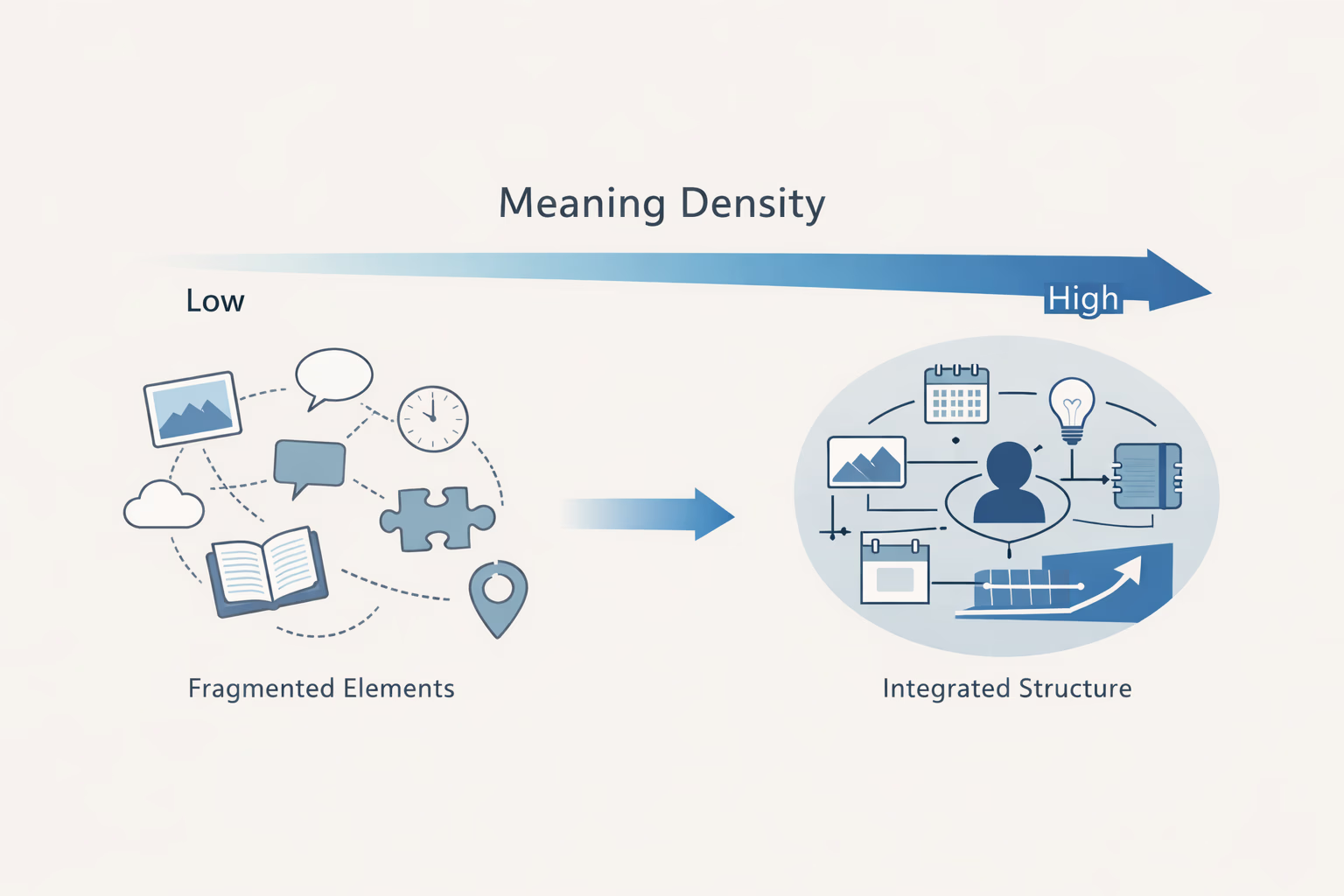
In everyday language, meaning density answers a simple question:
After you live through a day, do you feel like your life is landing—or leaking?
When meaning density is high, even ordinary days leave a subtle residue of settlement. Effort registers as having counted. Choices accumulate into identity. Experiences feel owned, metabolized, and internally “stored.” A person can still face hardship, uncertainty, or grief—yet their life continues to integrate. Their internal narrative becomes more stable not because they forced a story, but because lived reality keeps producing proof.
When meaning density is low, even busy or stimulating days feel thin. Time passes, but nothing consolidates. Actions happen, but they do not become internal stability. The person may have many inputs—content, goals, conversations, metrics, tasks—yet feel strangely unchanged. They may describe this as emptiness, numbness, restlessness, or a sense of “I’m doing everything, but nothing is sticking.”
Meaning Density™ names that difference without moralizing it. It does not say “you lack purpose.” It says: your experience is not integrating.
This is why meaning density is not a personality trait. It is not a belief system. It is not a virtue. It is a structural outcome of how modern life organizes experience—how often loops reach completion, how frequently the nervous system gets a “done” signal, and how reliably identity is reinforced through lived closure rather than continuous self-evaluation.
Meaning density can rise in simple lives and collapse in impressive ones. It can increase through small, coherent acts and decrease through constant acceleration. It is not about how much you do. It is about how much of what you do becomes part of you.
28. Why Happiness, Insight, and Productivity Don’t Solve This
Modern culture offers three dominant substitutes for meaning: happiness, insight, and productivity. Each can be valuable. None reliably restores meaning density.
Happiness is a state. It can be genuine, nourishing, and important. But happiness is not the same as integration. A person can experience frequent pleasure and still feel that their life is not settling. In many modern environments, happiness is delivered in rapid, repeated bursts—stimulation that changes state without consolidating into identity. This is why people can feel “fine” and still feel empty. The nervous system is not asking for constant positivity; it is asking for closure.
Insight is understanding. It clarifies patterns, explains behavior, and can reduce confusion. But insight does not guarantee integration. In fact, modern life often produces a surplus of insight and a deficit of embodiment. People can name their wounds, describe their loops, explain their childhood dynamics, and articulate their values—yet still repeat the same patterns. This is not hypocrisy. It is structural. The mind can interpret experience faster than the nervous system can absorb it. Insight becomes another form of cognitive motion, not a completion event.
Productivity is output. It creates results and often improves life circumstances. But productivity does not necessarily create coherence. Modern productivity systems frequently increase fragmentation, self-monitoring, and performance pressure. They reward busyness over completion and optimization over settlement. Many people finish tasks all day without ever feeling done, because the internal completion signal never arrives. They produce outputs, but they do not produce integration. The result is a distinctive modern phenomenon: high-functioning emptiness.
Happiness, insight, and productivity fail as meaning substitutes because they operate at the wrong layer. Meaning density is not primarily a mood problem, a knowledge problem, or an efficiency problem. It is a completion problem.
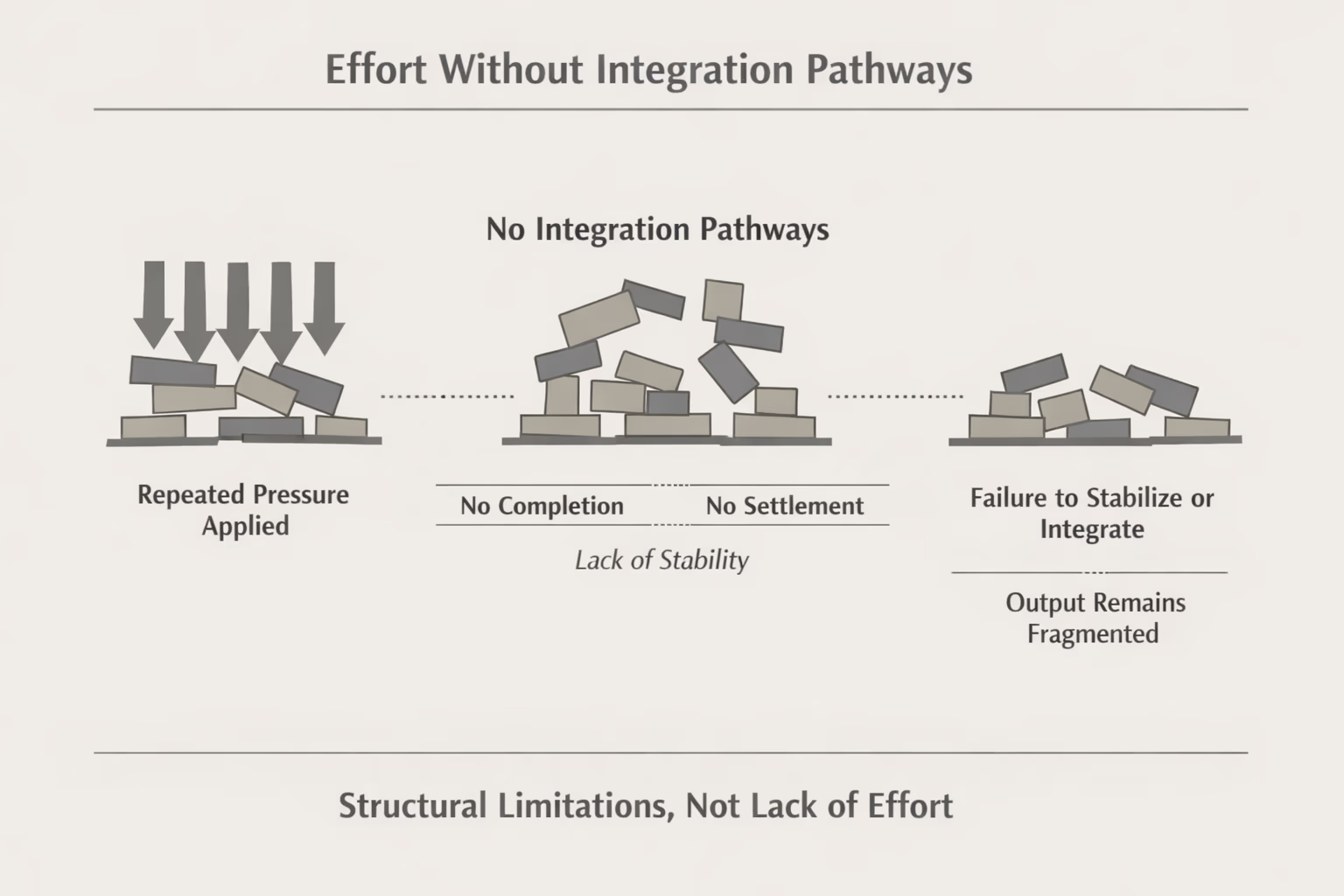
The nervous system does not measure the value of a day by how much you achieved, how good you felt, or how well you understood yourself. It measures something more basic: Did my lived experience reach a form that can be integrated?
When it does not, the system remains restless—regardless of success, intelligence, or comfort.
29. Meaning as Coherence, Not Achievement
The Meaning Density™ lens proposes a quiet but radical shift: meaning is not something you earn by achieving more. Meaning is something that accumulates when your life becomes internally coherent.
Achievement is external. Coherence is internal.
Achievement can be genuine and meaningful, but it is not inherently meaning-producing. Many achievements arrive in ways that do not integrate: they happen too fast, are immediately replaced by new standards, or are contaminated by evaluation and comparison. In these cases, achievement becomes an unstable fuel. It produces momentary uplift, followed quickly by pressure, emptiness, or the need for the next proof.
Coherence is different. Coherence is the felt alignment between:
what you do and what you value
what happens and what you can metabolize
what you pursue and what you can finish
what you experience and who you are becoming
Coherence makes life feel real. It produces continuity across time. It turns action into identity reinforcement rather than identity negotiation. It reduces the internal sense of contradiction. It creates a form of settlement that does not depend on applause or outcomes.
This is why meaning density can rise in lives that look ordinary. A person who completes small loops with integrity—showing up, following through, closing the day, integrating emotions, making aligned choices—often experiences a deeper sense of “this is my life” than someone living in perpetual acceleration and evaluation.
In the Meaning Density Model™, meaning is not an abstract narrative you tell about your life. It is the structural coherence your life produces as it is actually lived.
When coherence rises, meaning becomes less dramatic and more stable. It stops feeling like something you must chase and starts feeling like something that quietly accompanies you.
30. Why Integration Matters More Than Intensity
Modern systems train people to seek intensity as proof of value. Intense emotions, intense experiences, intense productivity, intense transformation—these are often treated as markers that life is meaningful. But intensity is not integration. In many cases, intensity is a sign that integration is failing.
An experience can be intense and still leave no lasting coherence. It can be dramatic and still not settle. It can be emotionally powerful and still not translate into stable change. This is why people can have breakthroughs that fade, retreats that evaporate, conversations that inspire but don’t alter behavior, and achievements that feel strangely unreal the next day.
Integration is the phase in which experience is absorbed into the system. It is where arousal returns toward baseline. It is where learning becomes memory. It is where emotional experience becomes metabolized rather than stored as tension. It is where identity updates quietly: I did that. I endured that. I became something through that.
Without integration, intensity becomes noise. It becomes a spike that demands repetition. The nervous system becomes trained to seek bigger hits—bigger feelings, bigger goals, bigger disruptions—because smaller experiences are no longer registering as complete.
This is one reason modern life can become addictive even when it is not pleasurable. The system is searching for a completion signal, but it keeps receiving stimulation instead. So it escalates. It chases intensity as a substitute for closure.
Meaning density restores a different priority: not more intensity, but more integration.
Integration requires conditions that modern environments often delete: endings, pauses, reduced interruption, lower evaluative pressure, and the ability to remain present through friction long enough for experience to consolidate. This does not mean life must become slow or minimal. It means life must regain the capacity to land.
When integration is protected, intensity becomes optional. Experiences no longer need to be dramatic to matter. Ordinary acts begin to count again. Days stop disappearing. The nervous system starts receiving completion signals more frequently, and retrigger pressure begins to fall.
In this sense, meaning density is the opposite of modern stimulation culture. It is not “more life.” It is more absorbed life. More life that becomes yours.
Meaning Density™ is therefore not a motivational slogan. It is a structural description of how human experience becomes meaningful: through coherence produced by integration. When that structure is restored, meaning does not need to be hunted. It returns as a natural byproduct of a life that can finally complete.
8 VIII. Recovery at the Structural Level
31. Why Forcing Motivation Backfires
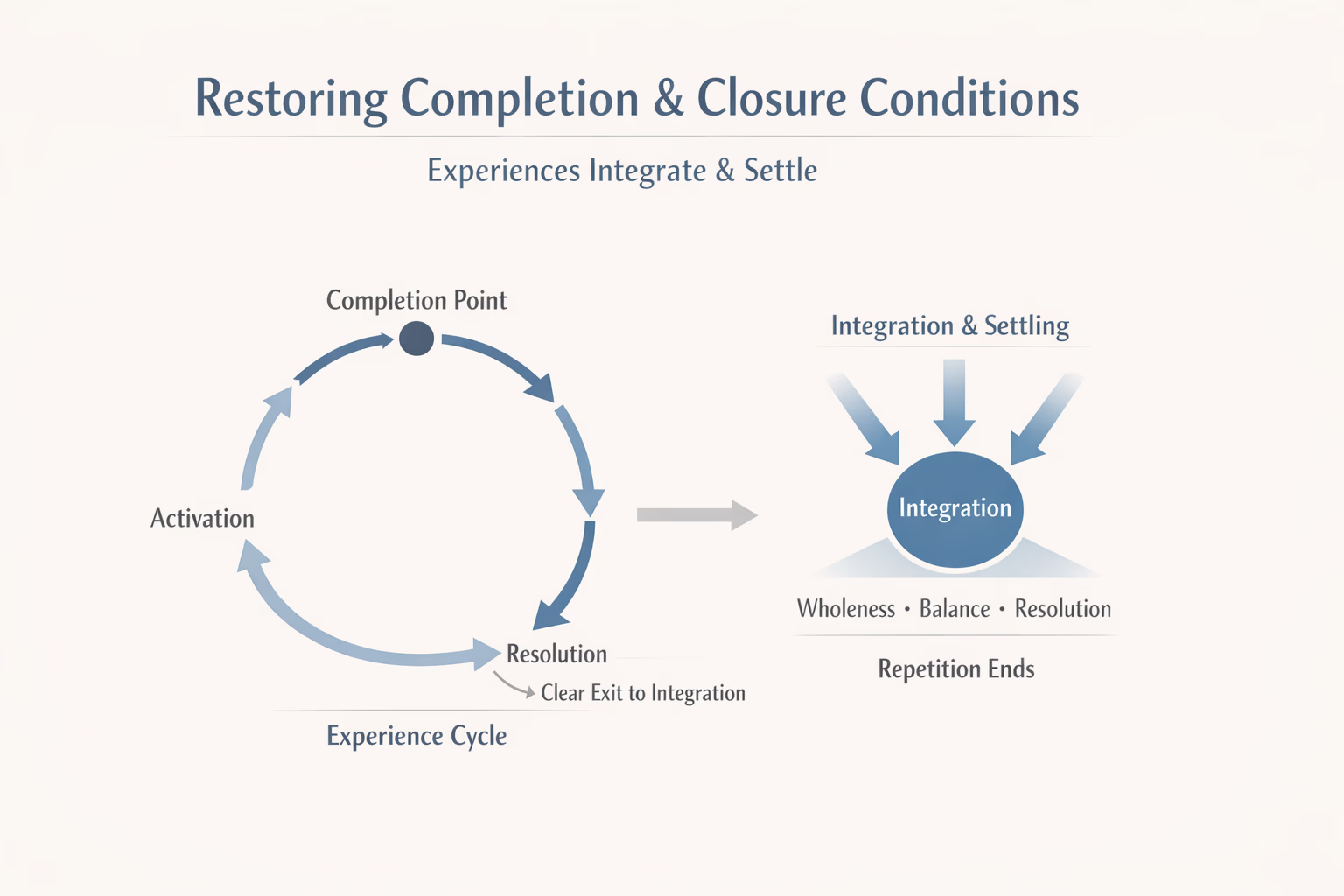
When meaning collapses, the most common response is to try harder. People attempt to “get motivated,” rebuild discipline, increase willpower, or restore drive through pressure. This instinct is understandable, but it often backfires—because the underlying problem is not lack of effort. It is lack of integration.
Motivation is an activation signal. It mobilizes energy toward pursuit. In a healthy environment, that activation moves through a loop and ends in completion. In a modern environment where loops rarely finish, increasing motivation often increases the rate of initiation without improving the rate of integration. The person starts more, tries more, consumes more strategies, and adds more goals—while the nervous system remains unable to settle. This produces a predictable result: a brief surge of action followed by deeper exhaustion, resentment, or collapse.
Forcing motivation also tends to intensify the very systems that block completion. Pressure increases threat activation. Self-judgment increases identity instability. Constant goal pursuit increases reward and status reactivity. The mind becomes more evaluative mid-loop, and attention fragments further. In other words, pushing harder often widens the gap between effort and settlement.
This is why many people experience a cycle of “new plan energy” followed by relapse. They were not lazy. They were structurally overloaded. A system that cannot integrate does not need more activation. It needs a different architecture—one that restores the conditions for completion so motivation no longer has to carry the entire burden.
Recovery, in this framework, begins by removing the assumption that meaning is earned through force. Meaning returns when loop completion becomes reliable again. Motivation becomes useful only after structure is repaired.
32. Why Calm Alone Is Insufficient
If forcing motivation is one common misdiagnosis, the other is the opposite: “Just calm down.” Modern wellness culture often assumes that distress is primarily a dysregulation problem and that regulation alone will restore meaning. Calm is valuable. It is often necessary. But calm is not completion.
A person can be calm and still feel empty. They can meditate daily and still feel that life is not landing. They can reduce anxiety and still experience stagnation. This is not because calm is ineffective. It is because calm is a state condition, not an integration outcome.
Calm helps the nervous system become capable of integrating. It opens the gate. But the gate is not the destination.
If calm becomes the primary goal, people can unintentionally drift into a low-friction existence where nothing resolves. They avoid difficulty, avoid endings, avoid accountability, and avoid the friction that turns experience into identity proof. This produces a softer version of the same problem: less distress, but still no consolidation. Life becomes smooth but thin.
The Meaning Density Model™ treats regulation as necessary but incomplete. Calm is not meaning. Calm is capacity. Meaning returns when capacity is used to complete loops—through engagement, contact with resistance, and closure. Regulation makes recovery possible; completion makes recovery real.
33. The Role of Friction, Endings, and Closure
Modern systems are optimized for continuity: infinite feeds, endless work, always-available stimulation, permanent reachability, constant updates. This continuity feels like convenience, but structurally it creates a hidden crisis: it removes endings.
Meaning density depends on endings because integration depends on endings. The nervous system cannot consolidate an experience that never resolves. It cannot produce a “done” signal when the environment refuses to stop. So recovery must reintroduce what modern life deletes: friction, endings, and closure.
Friction is the resistance that makes an experience real. It slows loops down enough for attention to remain contiguous. It forces contact with reality. It creates the conditions under which effort can become identity reinforcement rather than mere motion. Not all friction is helpful—excess friction becomes suffering—but the right friction is structurally necessary. Without it, experience collapses into stimulation.
Endings are the boundary markers that tell the nervous system a loop has concluded. In ancestral and pre-digital life, endings were built in: fatigue, darkness, seasons, rituals, physical limits. In modern life, endings must often be designed deliberately. Without endings, loops bleed into each other: work bleeds into rest, stimulation bleeds into sleep, identity evaluation bleeds into every action. Nothing consolidates.
Closure is the internal completion event that endings enable. Closure is not a thought. It is a physiological settling. It is the moment the system stops reaching. It is the quiet recognition that the experience has been metabolized enough to release.
Recovery at the structural level therefore means restoring the conditions under which closure can occur—not by adding more strategies, but by restoring loop integrity.
34. Why Fewer Loops Create More Meaning
One of the most counterintuitive claims of this framework is that meaning often increases not when life becomes fuller, but when life becomes less fragmented.
In modern life, people often live inside a high-loop-count condition: dozens of micro-initiations per hour, constant task switching, constant narrative evaluation, constant stimulus sampling. The result is a day filled with activity but low in consolidation. Experience becomes shallow by necessity because integration bandwidth is limited.
Meaning density rises when the system completes fewer loops more fully.
This is not minimalism as ideology. It is structural realism. The nervous system can only integrate so much. When loop volume exceeds integration capacity, the integration node is skipped. So the recovery move is not to “do more of the right things.” It is to create a life in which fewer loops are opened, fewer are left unfinished, and more reach genuine resolution.
Fewer loops produce more meaning because they reduce loop-bleed. They reduce residue. They reduce background incompletion. They reduce the silent cognitive load of “I’m behind.” In that reduced noise, completion becomes visible again. Actions start to land. Identity starts to stabilize through lived proof rather than constant self-assessment.
This is also why modern people can feel the most peace not during maximal achievement, but during moments of completed simplicity: a finished conversation, a closed day, a resolved task, a coherent ritual. These moments feel meaningful because they create the missing condition: closure.
35. What “Completion” Actually Feels Like
Completion is often misunderstood as stopping, resting, or achieving success. But completion, in the meaning-density sense, is neither laziness nor accomplishment. It is a distinct internal state.
Completion feels like:
settlement without numbness
relief without escape
quiet without emptiness
satisfaction without craving
closure without avoidance
It is the feeling of an internal file closing. The mind stops searching for what it missed. The body downshifts. Attention widens. The next action no longer feels like an urgent continuation of the last one.
Importantly, completion does not require perfection. It does not require dramatic transformation. It simply requires enough integration for the system to stop retriggering.
This is why completion is so rare in modern life: not because people are incapable, but because the environment trains perpetual reopening. Notifications reopen attention. Metrics reopen identity. Stimulation reopens reward pursuit. Threat cues reopen urgency. Work reopens responsibility. The nervous system becomes trapped in a state of partial continuation.
Structural recovery restores completion by restoring endings, protecting integration capacity, and reducing unnecessary retriggering. When completion returns, meaning returns with it—not as a belief to adopt, but as a felt coherence that accumulates naturally.
9 IX. Level-7 Transcendence: Narrative Fluidity
36. Meaning as Optional, Coherence as Default
Most people approach meaning as a requirement—something they must feel, find, or maintain in order to be okay. In modern life, this turns meaning into pressure. The question “What’s the point?” becomes a chronic background demand, and the inability to answer it becomes a source of anxiety or shame.
At the highest level of recovery, the relationship to meaning changes. Meaning becomes optional. Coherence becomes default.
This does not imply nihilism. It implies structural security. When a person’s loops complete reliably and experiences integrate, their life gains internal continuity even when emotions fluctuate and narratives thin out. They no longer need meaning to be constantly present in consciousness because coherence is already embodied. The nervous system is not starving for resolution, and identity is not scrambling for justification.
In this state, meaning is not something to chase. It becomes something that appears naturally at times—and disappears at other times—without destabilizing the person. Coherence remains, because it has become structural rather than interpretive.
37. Using Narrative Without Being Trapped by It
Narrative is one of the most powerful human capacities. It allows people to connect events across time, construct identity, and assign significance to suffering. But narrative can also become a trap. When meaning density is low, the mind often tries to compensate by producing more story: more explanation, more self-analysis, more identity framing, more justification.
This is the modern paradox: people can become intensely narrative while feeling less real.
Narrative becomes trapping when it stops being a tool for integration and becomes a substitute for it. In that mode, people live inside interpretation rather than experience. They attempt to think their way into settlement. They polish identity instead of allowing identity to be reinforced by completed loops. They become dependent on explanation, and when explanation fails, they collapse into confusion or emptiness.
Narrative fluidity is the capacity to use narrative without requiring it. It means story is available when helpful, but not compulsory. The person can tell a coherent story about their life, but they are not dependent on story to feel stable. They can hold meaning lightly, rather than using meaning as a scaffold to prevent internal collapse.
At this level, narrative returns to its proper function: not to manufacture stability, but to express it.
38. Entering and Exiting Roles Intentionally
Much of modern stress is role entrapment. People become fused with identities: the achiever, the caretaker, the performer, the victim, the protector, the optimizer, the provider. These roles begin as functional adaptations, but over time they harden into selfhood. The person is no longer playing a role—they are trapped inside it.
When roles become rigid, life loses flexibility. Every situation demands the same response. Every challenge threatens identity. Every failure becomes personal. The nervous system remains activated because identity is always at stake.
Narrative fluidity introduces a different capacity: the ability to enter and exit roles intentionally.
This does not mean abandoning responsibility or becoming detached from life. It means recovering choice. A person can engage fully in a role when needed—leader, parent, builder, learner, protector—while retaining the internal freedom to step out of it when the moment is over. The role becomes an instrument, not a prison.
This is a form of transcendence because it loosens the grip of identity-based compulsion. It restores the ability to respond rather than react, to engage rather than defend. It allows life to contain many roles without collapsing into fragmentation.
39. Peace Without Identity Pressure
Many people pursue peace through control: controlling emotions, controlling outcomes, controlling perceptions, controlling routines. Others pursue peace through escape: numbing, distraction, withdrawal. Both approaches are attempts to reduce internal activation, but neither resolves the deeper pressure: the pressure to be someone consistently, convincingly, and continuously.
Identity pressure is the hidden tax of modern life. It comes from constant exposure, constant comparison, constant performance, and constant evaluation. The self is treated as a project that must be maintained and defended. In that state, peace becomes difficult because the nervous system is never fully off-duty.
At the level of narrative fluidity, peace becomes possible without identity pressure.
This peace is not the absence of problems. It is the absence of chronic self-defense. The person is no longer trying to prove their worth, justify their path, or resolve their existence through performance. Their identity stabilizes through lived coherence rather than external validation. They can be uncertain without collapsing, imperfect without shame, unfinished without panic.
This is what structural recovery makes possible: peace that is not dependent on life going well, but on the self no longer being continuously threatened by its own evaluation.
40. Direction Without Attachment
Direction is not the same as attachment. In modern life, direction is often fused with outcomes: “If I don’t get there, I’m nothing.” Goals become identity. Progress becomes proof. Failure becomes collapse. This is why ambition so often carries anxiety: it is not simply pursuit—it is self-definition.
Narrative fluidity allows a different relationship to direction. A person can move toward aims, values, and commitments without binding their identity to the outcome. They can work, build, lead, create, and strive—without needing success to validate existence.
Direction without attachment is not passivity. It is clarity without grip.
In this state, effort becomes cleaner. It is less frantic, less performative, less self-referential. A person can pursue what matters while remaining internally unthreatened by uncertainty. They can change course without humiliation. They can be devoted without being rigid. They can care deeply without turning care into self-pressure.
This is why the final expression of recovery is not constant meaning, constant calm, or constant motivation. It is flexibility. The ability to live coherently across changing conditions, to use narrative without dependency, and to move through life with direction that does not imprison the self.
10 X. Implications for Modern Life
41. Why Productivity Culture Is Structurally Incomplete
Productivity culture is built on an assumption that human beings are primarily output machines. If performance increases and goals are reached, life should feel better. If efficiency improves, stress should decrease. If time is optimized, satisfaction should rise.
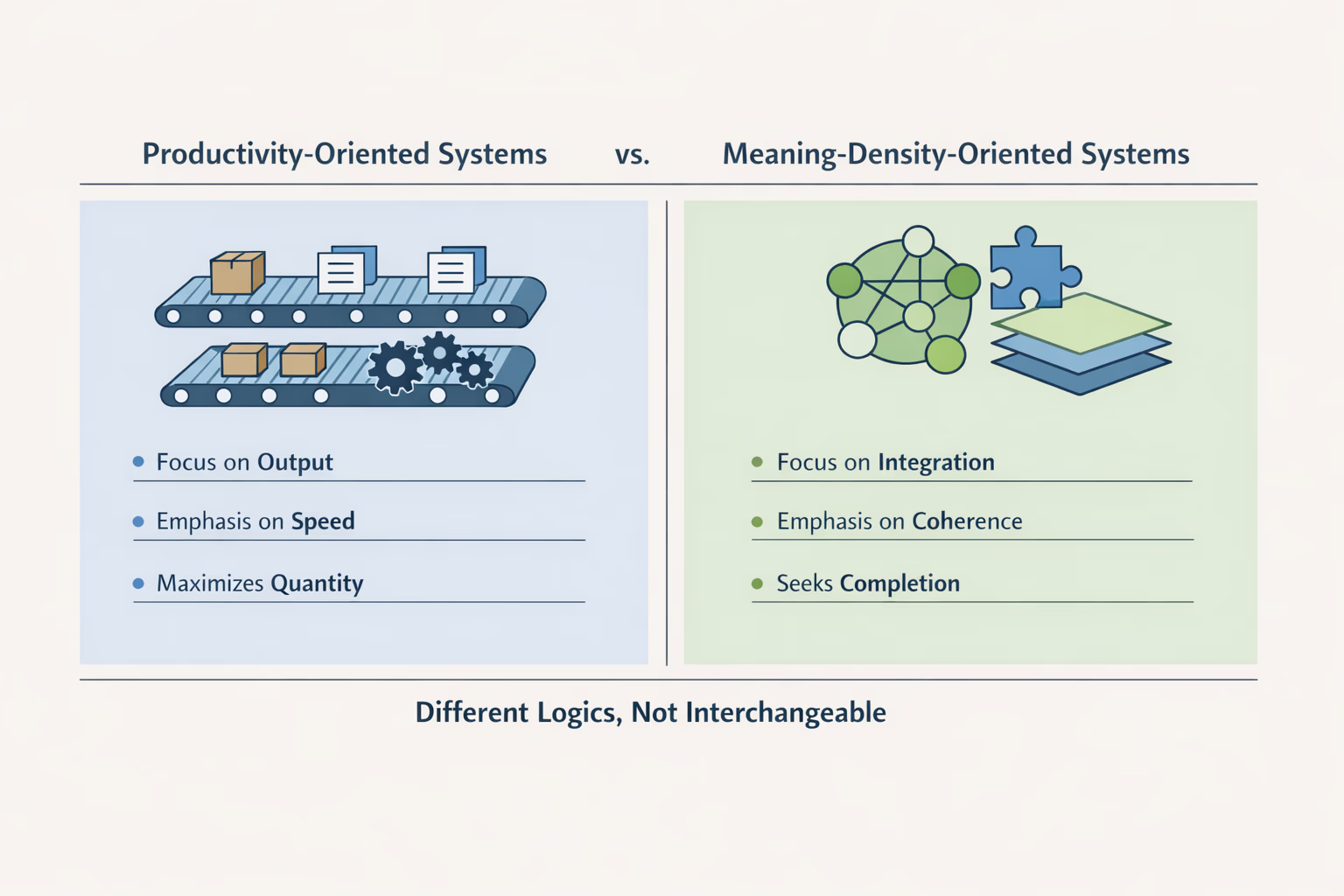
Yet the lived reality is often the opposite: people become more productive and feel less complete.
From the perspective of the Meaning Density Model™, productivity culture is structurally incomplete because it privileges initiation over integration. It is designed to generate motion, not settlement. It measures what can be counted—tasks completed, hours worked, goals hit—while ignoring what actually determines coherence: whether experience consolidates into a “done” signal and updates identity in a stable way.
Most modern productivity systems do not include built-in closure. They encourage infinite work streams, persistent inbox states, rolling backlogs, and continuous evaluation. The day ends not because loops complete, but because energy collapses. Work is paused, not finished. The nervous system remains partially activated, carrying open loops forward into rest, relationships, and sleep.
This is why “being on top of things” so rarely produces peace. The structure is not designed to finish. It is designed to continue.
The result is a distinctive modern pattern: high output paired with low internal settlement. People become efficient at producing results while becoming less capable of experiencing completion. Productivity increases, meaning density decreases.
42. Why Burnout Persists Despite Wellness Efforts
Burnout is often treated as a simple resource problem: too much stress, not enough rest. Wellness efforts then focus on regulation—sleep, hydration, exercise, breathwork, meditation, vacations, digital detox. These interventions can help. But burnout persists because the core driver is often structural rather than purely physiological.
Burnout is not only exhaustion. It is prolonged exposure to incompletion.
When the nervous system operates under chronic loop-open conditions—continuous demand, constant evaluation, endless urgency—recovery becomes shallow. Rest may reduce activation temporarily, but the moment life resumes, the system re-enters the same architecture: open loops that do not resolve. The person is not only tired; they are structurally unable to finish.
This is why wellness practices sometimes become strangely ineffective. People learn to calm down, yet their life still does not land. They “recover,” but the recovery never translates into renewed coherence. They return to the same incomplete loop environment, and burnout returns with it.
In many cases, wellness efforts fail because they are applied as coping strategies inside a structure that continues to prevent closure. Regulation improves capacity—but capacity is then immediately consumed by systems that initiate faster than they integrate.
Burnout persists not because people refuse to rest, but because modern life rarely allows completion to accumulate. Recovery becomes maintenance rather than restoration.
43. Why Attention Economics Worsen Meaning Collapse
Attention economics is not merely a cultural issue. It is a structural meaning-collapse engine.
Digital systems are designed to do one thing exceptionally well: keep loops open. They generate continuous initiation—new information, new comparisons, new triggers, new micro-rewards—while undermining the conditions required for completion. They remove endings, reduce friction, and fragment attention into short cycles that rarely consolidate.
In earlier eras, attention naturally organized around embodied loops: tasks had boundaries, environments had limits, and experience was shaped by physical reality. In attention economics, experience is shaped by infinite continuation. The mind is constantly pulled into new starts without resolution.
This shifts human life toward chronic partial engagement. People consume, react, scan, and sample—while rarely arriving at closure. The nervous system adapts by remaining in a semi-activated monitoring state. Identity becomes more performance-sensitive because social comparison is constant. Desire becomes more restless because stimulation is continuous. Avoidance becomes easier because discomfort can be bypassed instantly.
Under these conditions, meaning density collapses through sheer loop fragmentation. It is not that people become shallow. It is that the environment makes depth structurally expensive.
The economic incentive is misaligned with human integration. Platforms profit when the mind keeps reaching. Meaning requires that the mind stops reaching. This conflict is not personal. It is built into the design.
44. What Closure-Respecting Systems Would Look Like
If meaning collapse is structural, recovery must also become structural. The most important shift is not adding more self-improvement tools, but redesigning environments—personal, organizational, and digital—so that completion becomes normal again.
Closure-respecting systems share several characteristics:
They build in endings. Work, communication, and consumption have defined stop points. The day includes intentional closure moments. Tasks do not bleed indefinitely into rest. Projects have real completion phases rather than perpetual iteration.
They reduce unnecessary initiation. Not everything becomes a loop. Attention is protected from constant triggers. Systems are designed to prevent the chronic “always starting” condition that overwhelms integration bandwidth.
They protect integration time. There is space for experiences to settle. This does not require long retreats. It requires structural room: fewer interruptions, fewer simultaneous loops, and fewer evaluative demands during consolidation.
They limit continuous evaluation. Metrics and feedback are periodic rather than perpetual. Identity is not constantly audited. People are allowed to act without being continuously measured mid-loop.
They use friction intelligently. They include the right amount of resistance to allow experience to become real and metabolizable—without creating unnecessary suffering. Friction becomes a tool for completion, not punishment.
In closure-respecting systems, meaning is not manufactured through motivation campaigns or inspirational narratives. It emerges naturally because life is allowed to finish. People do not need to chase purpose when their days consistently produce settlement. They do not need to force discipline when loop architecture supports completion. They do not need to overthink identity when identity is reinforced by coherent lived outcomes.
The future of meaning is not a new ideology. It is a new structural literacy—one that redesigns modern life to respect the integrity of the human loop.
11 XI. What the Meaning Density Model™ Enables
45. A New Way to Understand Modern Dysfunction
Modern dysfunction is often treated as a collection of separate problems: burnout, anxiety, distraction, addiction, procrastination, loneliness, shame, compulsive optimization, emotional numbness. Each problem is given its own explanation, its own vocabulary, and its own treatment pathway.
The Meaning Density Model™ reveals a different picture: many of these struggles are not separate conditions, but varied expressions of the same structural breakdown—the loss of reliable loop completion and integration.
From this perspective, modern dysfunction is less about broken people and more about broken feedback architecture. The nervous system is exposed to environments that initiate behavior continuously while undermining the biological conditions needed to finish. When loops don’t integrate, repetition increases. When repetition increases, pressure increases. When pressure increases, the system becomes more reactive and more fragmented. A person begins to look disordered, even though they are responding predictably to an incoherent environment.
This reframing matters because it changes the emotional tone of recovery. If the problem is moral, the response becomes shame. If the problem is motivational, the response becomes force. If the problem is purely emotional, the response becomes endless regulation attempts. But if the problem is structural, the response becomes design: redesigning loop conditions so completion becomes possible again.
In this sense, the model doesn’t merely describe modern dysfunction—it removes the illusion that dysfunction is primarily a personal failure. It explains why so many people feel “off” without being clinically unwell, why high-functioning lives can still feel empty, and why effort often fails to create settlement. It returns the conversation to the level where the real failure occurs: the architecture of experience.
46. A Shared Language for Loops, Pressure, and Completion
One of the most powerful outcomes of the model is that it gives people a language that is neither clinical nor moral, neither self-help nor ideological. It offers a vocabulary that describes what modern life feels like with unusual precision—without requiring diagnosis, blame, or identity labels.
Most people can recognize the following experiences:
“I keep restarting the same patterns.”
“I’m doing a lot, but nothing feels like it’s landing.”
“I’m calm, but still empty.”
“I know what’s happening, but it doesn’t stick.”
“I can’t stop scanning for what’s next.”
“I can’t feel done.”
Without a structural language, people interpret these experiences as personal defects: laziness, weakness, lack of gratitude, poor discipline, flawed personality. The model replaces that distortion with clarity. It makes it possible to say:
“My loops are opening faster than they can close.”
“My system is lacking completion signals.”
“This repetition is a structural signal, not a character flaw.”
“My environment is high-initiation and low-integration.”
This shared language changes how people relate to themselves and to one another. It reduces self-attack. It reduces confusion. It reduces vague motivational advice. It also makes conversations more accurate—between partners, teams, leaders, educators, and communities—because the issue can be named without pathologizing.
In practical terms, shared language is the beginning of shared reality. When people can name the mechanism of collapse, they stop searching for false explanations. They stop escalating pressure. They start restoring conditions.
47. Structural Literacy for Individuals and Organizations
The Meaning Density Model™ is not only personal. It is organizational and cultural. It explains why modern institutions—workplaces, schools, platforms, and systems of coordination—often produce outcomes that feel productive on paper but corrosive in human experience.
Structural literacy means learning to see life not only through outcomes, but through loop architecture:
How many loops are being opened per day?
How often do they close?
Where does evaluation interrupt integration?
Where does urgency override completion?
Where does constant stimulation fragment attention?
Where are endings absent by design?
For individuals, this literacy enables a shift away from self-blame and toward structural correction. People stop trying to fix themselves through more intensity and start protecting integration conditions: coherent sequencing, fewer open loops, reduced evaluation during action, more real endings.
For organizations, structural literacy exposes why certain cultures create chronic burnout even with wellness budgets and good intentions. It reveals why constant metrics, continuous availability, and interruption-heavy workflows degrade coherence. It clarifies why some high-performance environments feel emotionally hollow, why people lose trust in their own effort, and why creativity collapses under perpetual evaluation.
Importantly, structural literacy does not oppose ambition, excellence, or growth. It opposes incoherent architectures that force human nervous systems to operate in permanent continuation states. It creates the possibility of designing systems that produce sustainable output and sustainable settlement—work that finishes, learning that integrates, and lives that don’t require chronic self-repair.
48. Why This Model Requires Responsible Use
Because the Meaning Density Model™ reframes distress in structural terms, it can be both clarifying and disruptive. It changes how people understand their life, their environment, and their identity. Used wisely, this shift reduces shame and restores coherence. Used carelessly, it can become another tool of pressure, superiority, or avoidance.
Responsible use matters for four reasons.
First, the model can be misused as a label. If people turn loop patterns into identity (“I am avoidance,” “I am power-looped”), the framework becomes another self-concept trap. The model is meant to increase flexibility, not create new categories of self-judgment.
Second, the model can be weaponized socially. Structural language can be used to pathologize others: to diagnose partners, criticize colleagues, or claim insight as superiority. This recreates the very evaluative pressure that reduces meaning density in the first place.
Third, the model can be used to bypass reality. Some may use “structure” as an excuse to avoid responsibility, discomfort, or genuine repair. But structural framing is not an escape from agency. It is a clearer basis for it.
Fourth, the model invites operationalization. Any framework that describes patterns of behavior, coherence, and collapse can be turned into tools. Tools amplify impact, but they also increase the risk of misuse, oversimplification, and false certainty. This is why the public version of the model must remain conceptual—and why applied instruments require careful containment, ethical standards, and disciplined interpretation.
Ultimately, the model is not a new ideology. It is a form of structural clarity. It should reduce pressure, not increase it. It should restore completion, not generate endless self-analysis. It should produce humility, not certainty—because its purpose is not to control human life, but to help human life land.
12 XII. Closing Perspective
49. The Recovered Meaning Era
The modern meaning crisis is often spoken about as if it were a philosophical problem—an absence of belief, a collapse of values, or a loss of spiritual orientation. Yet the deeper pattern is simpler and more practical. Meaning has not vanished because people became shallow. It has thinned because modern life has become structurally hostile to completion.
A recovered meaning era does not require a new ideology. It requires a new architecture.
For much of human history, life contained built-in boundaries. There were natural endings: daylight, fatigue, seasons, travel limits, scarcity, community rituals, and bodily constraints. These boundaries did more than restrict behavior—they supported integration. They made experience metabolizable. They produced closure signals without needing them to be engineered. Meaning accumulated as a quiet byproduct of loops that regularly finished.
Modern life removed many of those boundaries while dramatically increasing initiation. It multiplied triggers, expanded comparison, accelerated feedback, and introduced infinite continuation. The nervous system adapted as it always does: it kept reaching for completion. But in an environment that does not end, reaching becomes permanent. What follows is not merely stress, but a long-term thinning of coherence—where the self becomes less reinforced by lived settlement and more defined by evaluation, urgency, and repetition.
The recovered meaning era begins when this mismatch is recognized as structural rather than personal. It begins when culture stops treating humans as endlessly scalable attention engines and starts acknowledging integration as a limiting factor. It begins when the design of work, technology, education, and wellness shifts from initiation-maximization to completion-respect.
This era would not look like retreat from modernity. It would look like maturity within it: a civilization capable of building systems that do not require chronic self-repair to survive. Meaning would no longer be marketed as a feeling to chase. It would return as the natural residue of a life that can finish.
50. Tools That Serve the Nervous System
Modern tools are not neutral. They shape the structure of experience. They determine how loops open, how quickly they restart, and whether they close. In a meaning-density framework, tools are evaluated not by novelty or popularity, but by a single question:
Do they support integration—or do they amplify initiation?
Many tools that appear helpful are structurally extractive. They increase monitoring, accelerate feedback, and deepen evaluation. They add “should” pressure. They intensify the sense of falling behind. They make identity feel measurable and therefore perpetually at risk. Even wellness tools can become initiation engines when they focus on constant self-tracking rather than structural closure.
Tools that serve the nervous system do the opposite. They reduce unnecessary triggers. They preserve attention continuity. They protect completion bandwidth. They restore endings and prevent loop bleed. They create conditions for experience to settle into the body and identity rather than evaporate into the next stimulus.
This does not imply a single set of techniques. It implies a design principle: the nervous system must be treated as the primary integrator of life, not as a machine to be overridden.
A meaning-respecting tool environment would make “done” easier to access. It would reduce the number of loops opened by default. It would stop equating constant availability with virtue. It would not demand continuous performance proof. It would treat attention as a finite resource and closure as a necessary outcome.
This principle applies at every level:
Personal tools and habits
Work systems and management practices
Social norms and communication patterns
Platforms and product design
In a recovered meaning era, “better tools” does not mean more features. It means better structural alignment with human integration. The most advanced tool is not the one that drives more engagement. It is the one that allows engagement to end cleanly and become owned.
51. Restoring the Integrity of the Human Loop
The central claim of the Meaning Density Model™ is that human life becomes meaningful when loops complete coherently and integrate into identity. This is the integrity of the human loop: a cycle of engagement that reaches closure, updates the self, and releases the nervous system back into open awareness.
Restoring this integrity is not a motivational project. It is a structural repair.
The human loop breaks when any of the following become chronic:
initiation without closure
stimulation without consolidation
evaluation without settlement
urgency without resolution
identity without embodiment
When these conditions persist, the system becomes trapped in repetition. It continues to pursue, avoid, control, and explain—not because the person is flawed, but because the nervous system is searching for the missing completion signal.
Restoring integrity means restoring the link between effort and settlement. It means reestablishing that when a person gives energy to something, it can actually land as internal stability. It means returning to a reality where action creates identity reinforcement rather than identity pressure.
This restoration does not demand perfection or simplicity. It demands coherence. It demands that life be organized in ways that allow experiences to finish rather than endlessly restart. It demands that closure be treated not as an indulgence, but as a foundational human requirement.
At the individual level, restoring loop integrity changes the inner climate. When completion becomes reliable, the background sense of incompletion quiets. When incompletion quiets, compulsion decreases. When compulsion decreases, attention returns. When attention returns, meaning becomes possible again—not as an idea, but as a felt continuity across time.
At the organizational level, restoring loop integrity becomes a new definition of sustainable performance. It means building cultures where work can end, where evaluation has boundaries, where people are not perpetually “on,” and where productivity is not purchased through the erosion of human completion capacity. It means treating humans as integrators, not as scalable nodes.
At the cultural level, restoring loop integrity is a corrective to the dominant logic of attention economics. It is a rejection of infinite continuation as the default shape of life. It is a quiet insistence that human lives require endings to become coherent.
When the integrity of the human loop is restored, meaning density rises naturally. Not because life becomes easier, but because life becomes metabolizable. Experience stops evaporating. Identity stops scrambling. The nervous system stops reaching for what it cannot finish.
52. Final Reflection
The deepest tragedy of the modern meaning crisis is not that life is hard. Life has always been hard. The tragedy is that people are increasingly taught to interpret structural collapse as personal deficiency.
They are told to try harder, believe more, optimize further, and improve their mindset—while living inside environments that systematically prevent completion. They are encouraged to chase meaning as a feeling, while their nervous system remains trapped in unfinished loops. They are offered stimulation as relief, then blamed for becoming addicted to it. They are given endless information, then shamed for not changing.
The Meaning Density Model™ offers a different invitation.
Not to strive harder. Not to manufacture purpose. Not to build a perfect narrative. But to recover the structural conditions under which meaning forms on its own.
Meaning is not a trophy for the disciplined. It is not a reward for the productive. It is not a belief the mind can force into existence. Meaning is what remains when life is allowed to finish—when experiences integrate, when the nervous system settles, and when identity updates through lived coherence rather than constant self-defense.
In that sense, meaning is less about adding something to life and more about removing what prevents life from landing.
A recovered meaning era begins when completion becomes normal again. When endings return. When attention becomes contiguous. When evaluation loses its constant grip. When the human loop regains integrity.
This is not a retreat from modernity. It is the maturation of modernity—an evolution toward systems that respect the human integrator.
And perhaps that is the most hopeful implication of all: if meaning collapses structurally, then meaning can be restored structurally. Not by asking humans to become stronger than their environment, but by designing environments worthy of human nervous systems.
When that happens, meaning does not need to be demanded. It returns—quietly, steadily—as the natural byproduct of a life that can finally complete.
52 Matrix of Loops™ vs Meaning Density™ (Scope Boundary)
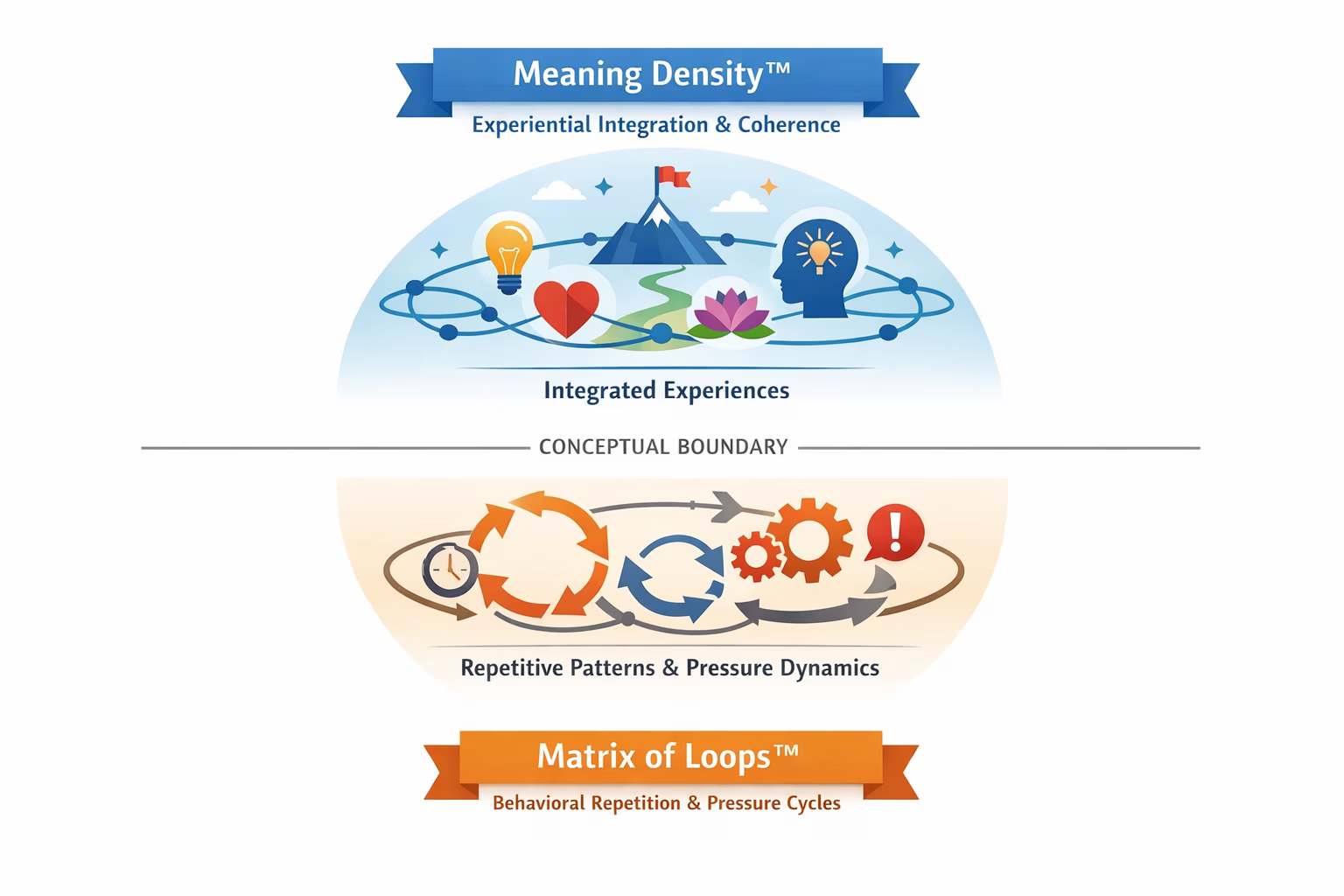
Meaning Density™ describes how coherent, integrated, and settling a life becomes when behavioral loops complete and update identity over time. Matrix of Loops™ describes how incomplete loops reinforce and repeat across behavioral domains under modern conditions.
The two frameworks are related but not interchangeable. Matrix of Loops™ explains why repetition persists; Meaning Density™ explains what accumulates when repetition resolves.
References
This public document presents conceptual architecture only. Diagnostic tools, scoring systems, algorithms, therapeutic methods, and software implementations remain proprietary to DojoWell.
- Frankl, V. E. Man’s Search for Meaning (1946/1959).
- Deci, E. L., & Ryan, R. M. Self-Determination Theory (2017).
- Baumeister, R. F., & Tierney, J. Willpower (2011).
- Kahneman, D. Thinking, Fast and Slow (2011).
- Simon, H. A. “Designing Organizations for an Information-Rich World” (1971).
- Duckworth, A. Grit (2016).
- Eyal, N. Hooked (2014).
- Zuboff, S. The Age of Surveillance Capitalism (2019).