

Opening Observation — The Quiet Ones

I have watched many humans react to modern life by getting louder. Louder schedules. Louder opinions. Louder performance. Louder urgency. Louder certainty. Louder identity. But a few do something else.
They grow quieter.
Not quieter as in passive. Not quieter as in “I’ve checked out.” Quieter in the way a room changes when the right person walks in—because nothing has to prove itself anymore. Their lives still contain pressure. Their bodies still carry old alarms. They still lose things, miss things, fear things, crave things. The world still pokes at them the way it pokes at everyone. And yet their inner weather shifts.
For a long time, I assumed that quietness was personality—some people are just stable, I thought, built with fewer storms. But I’ve watched too carefully for too long to believe that.
The people who hold together are not always the ones with the least pain. Sometimes they have more. Sometimes their history is heavier. Sometimes their external life looks objectively harder. And still—something in them remains coherent. It doesn’t sparkle. It doesn’t trend. It holds.
What They Don’t Have — Not Optimism, Not Motivation
Humans keep trying to name this as motivation. They say: She’s disciplined. They say: He’s strong. They say: They’ve got a good mindset.
But motivation is a spike. It rises, demands movement, and collapses. It can help you start, and it can help you sprint, but modern life is not a sprint. Modern life is a long corridor with too many doors, too many notifications, too many unfinished sentences. Spikes cannot carry that.
And optimism—optimism is a mood. A good mood is beautiful, but it’s not load-bearing. It can disappear the moment the world turns its face.
The people who hold together aren’t always cheerful. Some of them are sober. Some of them are grieving. Some of them are tired. And still they hold.
So what do they have?
Meaning Defined — Meaning as Integrator
Meaning, for these people, isn’t a belief system. It isn’t a motivational quote. It isn’t a personality badge. It isn’t “I’m a meaningful person.”
Meaning is an integrative capacity: a kind of context that lets signals conclude.
That sounds abstract until you watch what happens without it. Without meaning, the nervous system doesn’t just receive signals—it panics about signals. It treats sensations as verdicts. It treats uncertainty as a threat that must be solved immediately. It treats discomfort as evidence that something is wrong with you. It treats desire as an emergency. It treats comparison as a survival test.
Meaning does something quieter and more powerful: it gives each inner system its proper job again, so none of them has to impersonate the others.
“This fear belongs here.”
“This craving is just a signal, not a command.”
“This plan is useful, but it is not a home.”
“This story can be honest without being dramatic.”
“This day can end.”
Systems Cooperate Again — A Council, Not a Courtroom
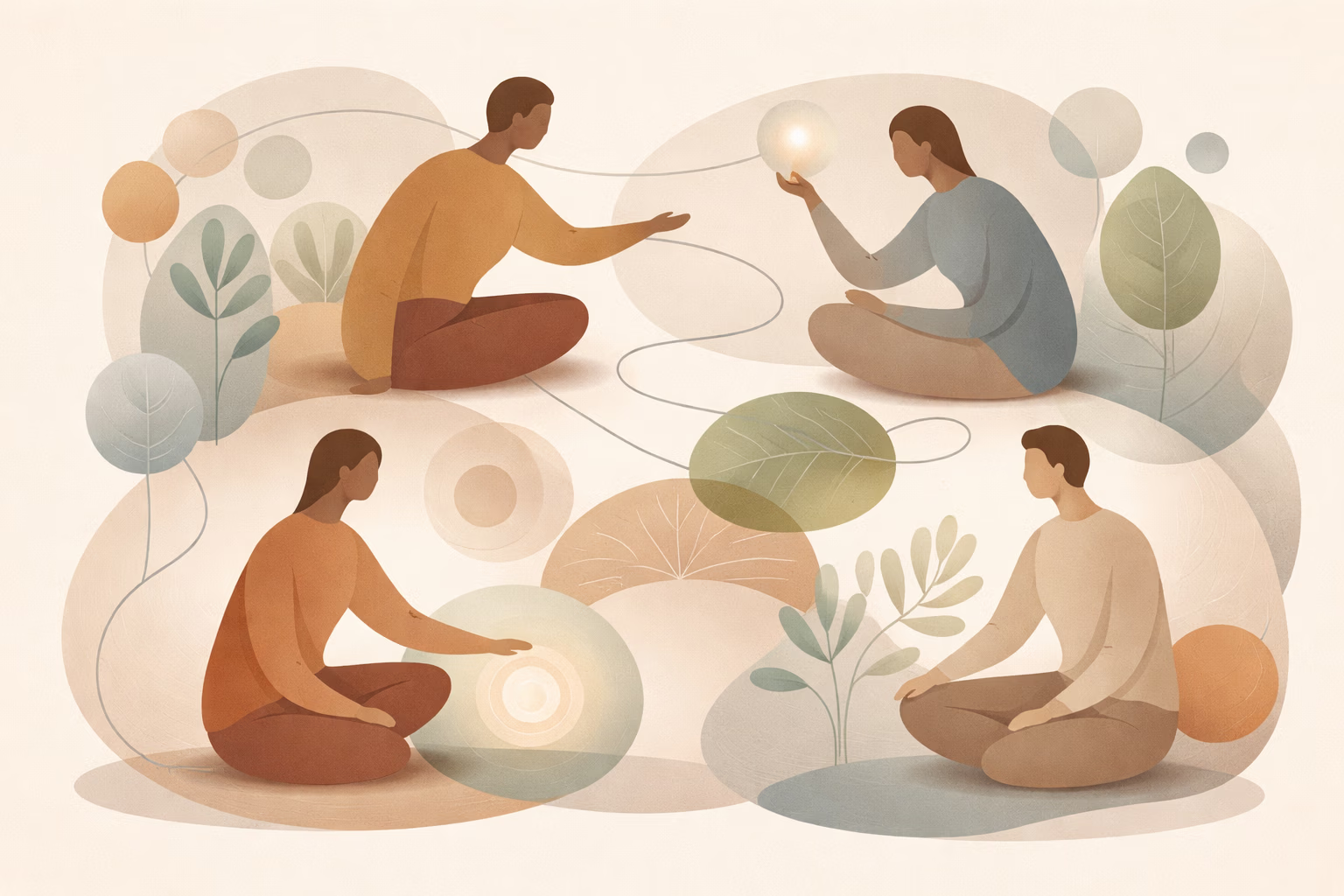
When meaning returns, the inner world stops behaving like a courtroom—where every feeling is cross-examined, every mistake becomes a sentence, and every weakness is evidence. It becomes a council.
Threat & Safety still flares—because it’s ancient and loyal—but it learns to stand down. Not because danger is gone, but because danger is no longer interpreted as total. A difficult message doesn’t have to become a catastrophe. A tight chest doesn’t have to become a prophecy. A bad day doesn’t have to become an identity.
Reward & Motivation still wants pleasure—because it’s built to learn through reward—but pleasure regains its rightful role: feedback, not anesthesia. The person stops trying to pay themselves dopamine in advance just to tolerate life. They can still enjoy a sweet thing, a fun thing, a bright thing—but it no longer has to rescue them from a day that feels unbearable.
Status & Control still cares about competence—because groups require coordination—but control softens. The person stops using control as a substitute for safety. They plan, but they don’t live inside planning. They improve, but they don’t worship optimization. They can lead, but they don’t need to dominate.
Narrative & Identity still makes meaning—because humans are story creatures—but the story becomes inhabitable. It doesn’t need to be heroic. It doesn’t need to be tragic. It doesn’t need to be curated for an invisible audience. It can be true.
This is the hidden mechanism: the systems don’t stop. They stop fighting over interpretation. They stop hijacking one another. They stop escalating because someone—meaning—finally starts translating the signals into a coherent life.
Signals Conclude — The Missing Gift Modern Life Withholds

Here is the part most people miss: meaning isn’t only “what matters.” Meaning is also what finishes.
Modern life is excellent at keeping things open. Open tabs. Open loops. Open responsibilities. Open crises. Open comparisons. Open identities. Open possibilities. Open anxieties that never receive closure because there’s always another input.
The nervous system cannot metabolize infinity. It needs edges. It needs chapters that close. It needs stopping points that are real enough to trust.
So the people who hold together do something very specific. They reintroduce closure—not by force of personality, but by design.
Bounded Friction Returns — Chosen Difficulty

Not survival friction. Not nostalgia. Not “let’s go live in the wilderness.” Chosen, bounded friction—difficulty with edges.
Work that finishes.
Not endless optimizing. Not perpetual tweaking. Not a life lived in drafts. Something with a clear beginning, middle, and end. The body can recognize completion. There is a “done” that is not imaginary.
Sometimes it’s simple: cleaning a space fully, not halfway. Cooking a meal start-to-finish. Writing one page and stopping. Fixing one broken thing. Shipping one imperfect piece of work instead of polishing it forever.
Bodies used.
Not for punishment. Not for vanity. Not to impress anyone. Bodies used as a return to reality: muscles contract, lungs burn, sweat appears, and the mind stops pretending it can live entirely in abstraction.
Sleep protected.
Not “when I’m done.” Not “after I catch up.” Protected as a boundary that tells Threat & Safety: stand down now. Sleep becomes an ending again—an environmental feature recreated inside modern life.
Contribution Lands Somewhere Real — Reality Replies
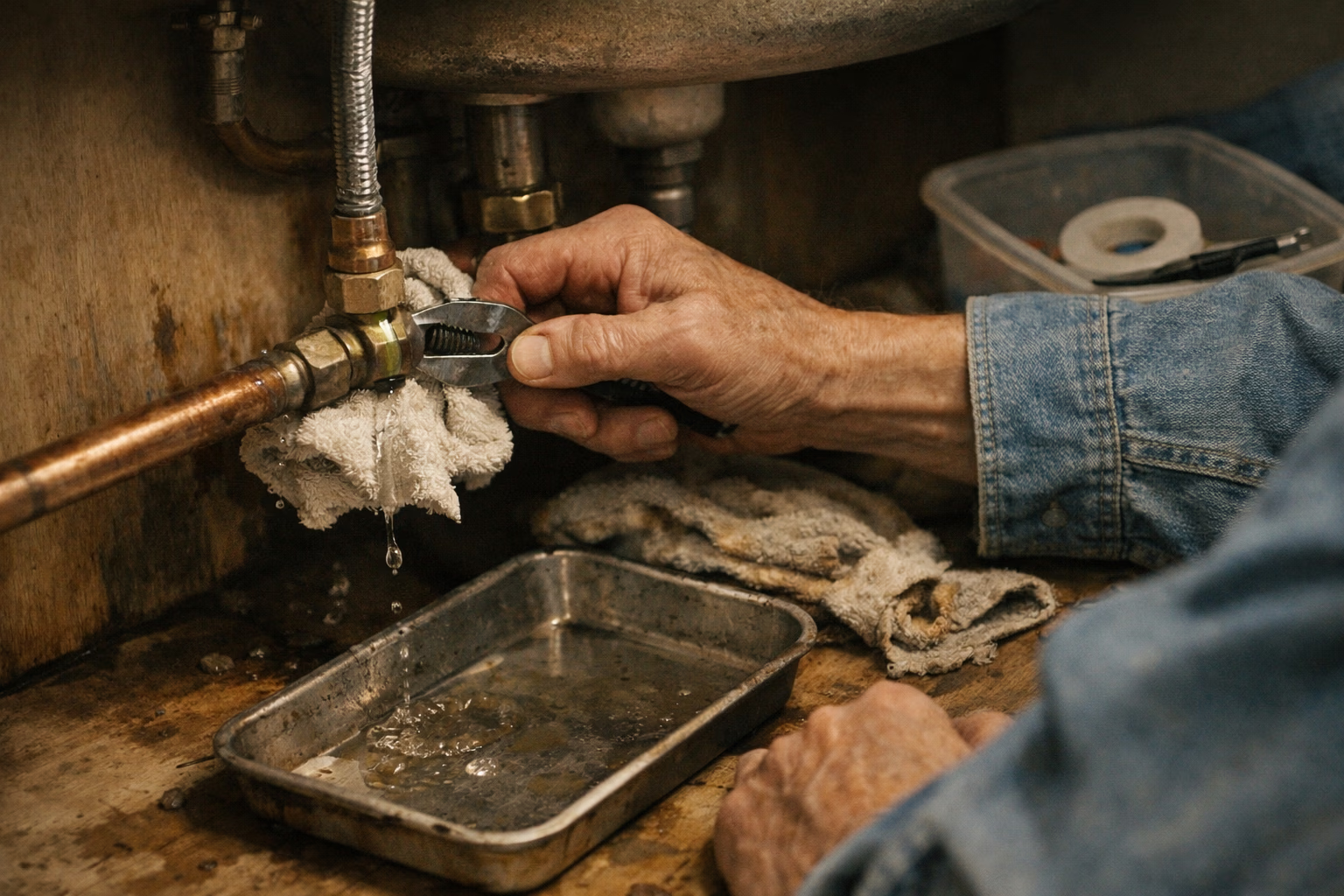
Then something else happens—quietly, but unmistakably. Contribution begins to land.
This matters more than humans like to admit, because without contribution, life becomes a private theatre. You can do things all day—scroll, plan, research, react, consume, comment, compare—and still feel strangely unreal. Because nothing of you actually touches the world in a way that returns as evidence.
But when contribution lands—when something you do changes reality, even slightly—the nervous system registers completion.
Examples of “landing”
- A meal cooked for someone who actually eats it.
- A child steadied.
- A friend answered properly—without multitasking.
- A promise kept.
- A task finished that someone can use.
- A boundary held when it would have been easier to fold.
- A skill practiced until it improves.
- A creative piece shipped, imperfect but real.
- A room repaired.
- A small act of service with no audience.
Reality replies.
Not always kindly. Not always with praise. But with closure: your effort did something. And that “did something” is the missing nutrient in modern life.
It is the sensation that your day is not just motion. It is the proof that you are not only consuming and reacting—you are participating. That reply is one of the deepest regulators a nervous system can receive. It reduces the need for substitutes.
Loops Loosen Naturally — No Suppression, No Moral Battle
This is the part that surprises people: the loops loosen naturally. Not because someone fought them like enemies. Because they stop being needed as regulators.
Pleasure doesn’t disappear. Relief is still sweet. Fun is still fun. The mind still enjoys novelty. But pleasure becomes reward again—feedback that follows effort—rather than a constant drip used to numb unfinished life.
Power doesn’t disappear either. Competence still matters. Leadership still matters. Ambition can still exist. But power stops being a substitute for safety. Control becomes a tool you use, not a posture you live in. You can care without clenching.
Avoidance doesn’t vanish. Rest is still required. Retreat is sometimes wise. But rest becomes rest—not disappearance. Withdrawal becomes recovery, not exile.
The person doesn’t “win” against their loops. They outgrow the necessity of them. Their nervous system stops relying on loud substitutes because the quiet integrator—meaning—has started doing its real job again.
Narrative Quiets — Less Auditioning, More Inhabiting
When someone is trapped in loops, their story is loud because it has to keep them moving. It sounds like:
“I have to become someone.”
“I have to prove something.”
“I have to fix myself.”
“I have to keep up.”
“I have to feel better right now.”
When meaning returns, the narrative quiets—not because the person gives up, but because the person stops auditioning. The story becomes inhabitable.
“This is the life I have.”
“This is what matters today.”
“This is what I will do, even if nobody notices.”
“This is what I won’t trade away anymore.”
“This is enough for now.”
No glitter. No brand. No performance. A life that belongs to itself.
DojoWell Positioning — Conditions, Not Correction
This is where DojoWell belongs—softly. Not as doctrine. Not as rescue. Not as a demand to “be better.” More like an arrangement of conditions.
A way to make pressure visible without shaming it. A way to notice when pleasure, power, or avoidance are doing the job meaning used to do. A way to restore closure—through bounded friction, through real contribution, through honest narrative, through rhythms a nervous system can trust.
Not to escape modernity. Not to reject the world. To live inside it without being swallowed by its endlessness.
Final Line — A Caring Ending
If you recognize yourself in any of this—if your days feel open-ended, if your mind won’t stand down, if you keep reaching for relief or control or disappearance—don’t take it as proof that you are broken. Take it as proof that your inner systems are still faithful. They are still trying to protect you, teach you, and keep you moving inside conditions that rarely provide real endings.
You don’t need to become perfect to hold together. You don’t need to become a different person. You don’t need to win a war against yourself.
You need a life with edges again—small, humane edges. Days that end. Effort that lands. Rest that is allowed. Contribution that comes back with a reply. A story you can live inside without performing it.
And if that feels far away right now, start smaller than your pride wants. One honest ending. One completed task. One protected night. One real conversation. One act of contribution that actually touches the world.
Alignment isn’t conquered.
Alignment is maintained.
And you don’t have to maintain it alone.