Habits as Proof of Who You’re Becoming
In short: Micro-habits are often described as “small enough to succeed,” and they can be genuinely helpful for getting momentum. But many people quietly notice something else: the habit can be kept for a while, then it fades, and the deeper pattern underneath remains unchanged.
Micro-habits are often described as “small enough to succeed,” and they can be genuinely helpful for getting momentum. But many people quietly notice something else: the habit can be kept for a while, then it fades, and the deeper pattern underneath remains unchanged.
What if the problem isn’t your discipline—what if the habit never connected to the part of you that makes things stick?
From a nervous-system and meaning-based perspective, stability doesn’t come from constant effort. It comes from experiences that complete, settle, and integrate into identity—so your actions start to feel like “this is what I do” rather than “this is what I’m trying to force.”
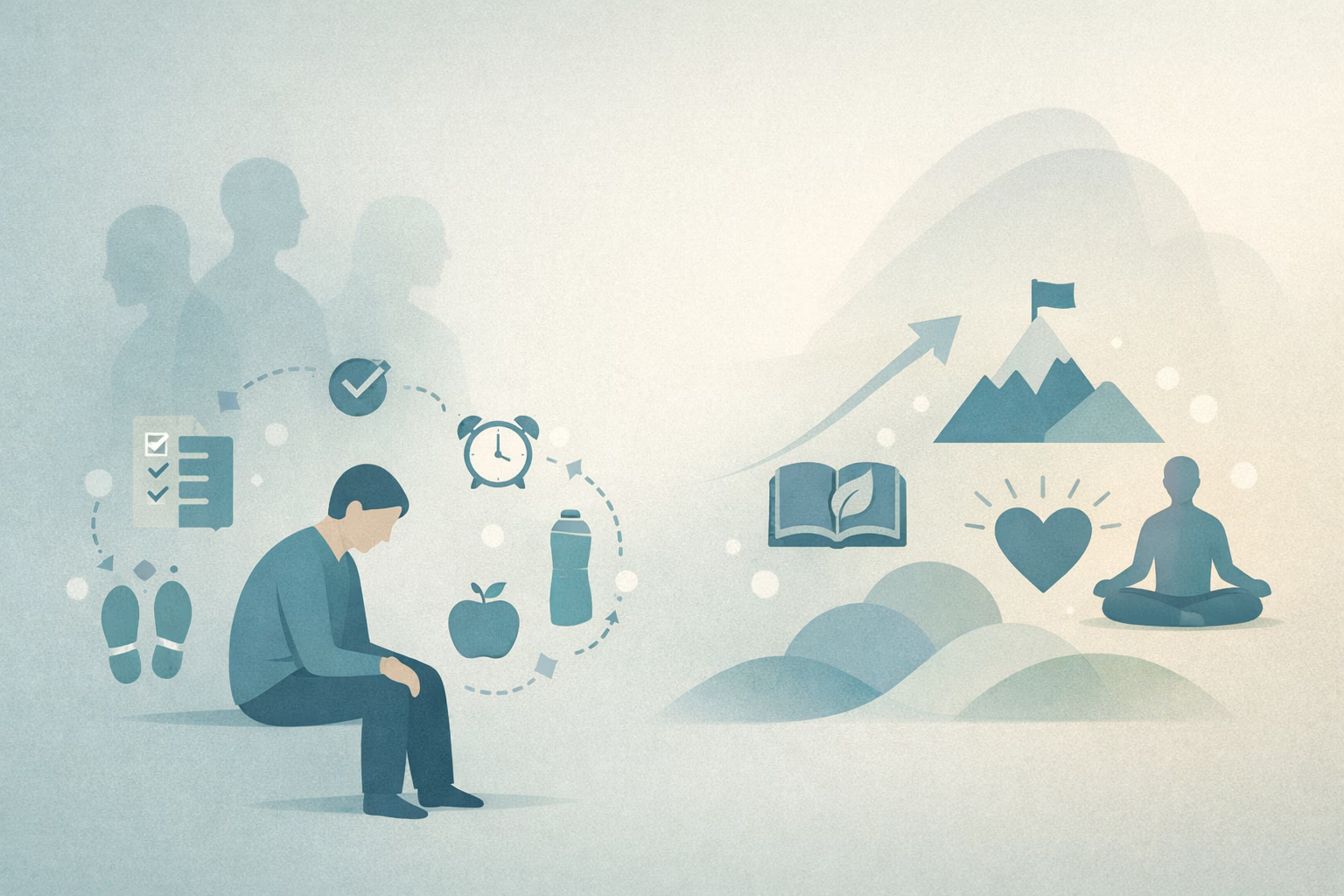
A micro-habit can be consistent and still feel strangely temporary—like it’s sitting on top of your life instead of becoming part of it. You might do the two-minute action, check it off, and yet notice that your bigger choices don’t reorganize around it.
This can create a particular kind of frustration: you’re not failing at the habit, but you’re also not becoming someone different. The nervous system often reads that gap as unfinished business—more effort, more tracking, more pressure—because it hasn’t received a “done” signal.
In that state, micro-habits can start acting like relief behaviors: quick, containable, and easy to restart. They soothe the discomfort of “I should change,” without necessarily delivering the closure that allows your system to stand down. [Ref-1]
Identity habits aren’t bigger or harder by default. They’re behaviors that repeatedly confirm a coherent self-story: “This is the kind of person I am,” “This is how my life works,” “This is what I protect.” When a behavior is linked to that level of meaning, it gains durability because it belongs somewhere.
That “belonging” is partly biological. The brain is built to conserve energy by turning repeated, context-linked actions into automated patterns. But automation happens more reliably when the action is supported by stable cues—social, environmental, and narrative cues that say, “Yes, this fits here.” [Ref-2]
In other words, identity habits don’t just ask for repetition. They create a sense of inevitability: a settled alignment between context, value, and self-definition.
Humans don’t only learn by reward and repetition. We also learn by meaning—by building a story that connects past, present, and future into a workable identity. That story isn’t a motivational poster; it’s an organizing system that reduces uncertainty and helps the nervous system predict what happens next.
When life is pressured, fragmented, or rapidly changing, the identity system becomes even more important. It provides continuity when conditions don’t. That’s why many “habit struggles” aren’t really about the habit; they’re about the instability of the narrative that would hold it.
If a micro-habit doesn’t feed that narrative system—if it doesn’t help you recognize yourself—it may remain a task, not a transformation. [Ref-3]
Micro-habits offer something modern nervous systems are often desperate for: a clear finish line. You do the small thing, you get a quick “completion” signal, and the body briefly softens. That’s not shallow—that’s regulation.
They also provide fast feedback: a sense of progress, a measurable win, a tiny burst of reward. In a high-load environment, those quick loops can temporarily increase capacity by reducing uncertainty and offering predictability. [Ref-4]
The complication is that quick completion isn’t the same as deep closure. A checkbox can calm the system for a moment, while the larger meaning loop—what this changes about your life and identity—remains open.
There’s a common promise in habit culture: start tiny and it will naturally scale. Sometimes that happens. But often, the scaling fails not because the person lacks willpower, but because the habit is disconnected from the identity and context that would make it self-reinforcing.
When a behavior doesn’t attach to a stable “why,” it relies on repeated initiation. That means you have to keep deciding, keep remembering, keep recommitting—an expensive process for a nervous system already managing stress load.
So the habit fades, not as a moral collapse, but as an energy-conservation move. The system drops what doesn’t integrate. [Ref-5]
Micro-habits can quietly become a kind of self-management theater: evidence that you’re trying. The effort itself becomes the product—tracking, streaks, optimization—while the underlying identity question stays unanswered: “What am I building a life around?”
Under constant evaluation (internal or external), the nervous system often prefers controllable tasks. A micro-habit is controllable. Identity change is not as controllable—it requires real-world completion: choices that have consequences, relationships that respond, environments that change.
In that mismatch, people can end up with a pattern of repeated starts. Not because they’re flaky, but because the loop they’re running is about short-term relief, not long-term integration. [Ref-6]
When a habit is not anchored to identity and values, the system tends to treat it like an optional add-on—easy to drop when stress rises. This often shows up as patterns that look like “motivation problems,” but are more accurately coherence problems.
From a self-determination lens, behaviors tend to stabilize when they support autonomy, competence, and connection—when they feel self-endorsed and socially real, not just imposed by goals. [Ref-7]
Repeatedly attempting change at the surface level can create a subtle injury: not shame, exactly, but a thinning of self-trust. Each restart becomes evidence that “I don’t stick,” even when the real issue is that the habit never had a stable home in your identity.
Over time, this can reduce meaning. Your system learns that effort is loud but outcomes don’t consolidate. Without consolidation—without experiences that complete and become part of lived identity—change remains effortful and temporary.
Research on personality and volitional change suggests that enduring change typically involves broader shifts in patterns, contexts, and self-concept over time—not just isolated behaviors. [Ref-8]
Sometimes the most discouraging part isn’t stopping. It’s realizing you were working hard without getting the “this is who I am now” feeling that lets the body relax.
When micro-habits are attempted and abandoned repeatedly, the nervous system learns a predictable sequence: enthusiasm → effort → friction → drop. Even if the habit was “tiny,” the repeated opening and closing of the loop without integration can create fatigue.
This is where discouragement becomes structural. It’s not just a thought like “why bother,” but a learned expectation that effort won’t consolidate into identity. The future self you’re aiming for starts to feel less reachable—not because you lack potential, but because the bridge between “possible self” and “current action” never becomes stable. [Ref-9]
In that state, abandoning a habit can function as load reduction. The system chooses coherence (dropping a floating task) over continued fragmentation.
Identity habits tend to last because they reduce internal contradiction. When an action expresses a value you actually live by, it stops being a “should” and becomes a form of self-consistency. That consistency is calming: fewer internal debates, fewer resets, fewer emergency motivation tactics.
This is also where executive function often looks stronger. Not because you suddenly became a different kind of person, but because the behavior is supported by intrinsic alignment—autonomy (“I endorse this”), competence (“this fits my capabilities”), and relatedness (“this connects me to people or purpose”). [Ref-10]
What changes when a habit stops being a task and starts being a signal of who you are?
Often, the felt experience shifts from compliance to coherence. The nervous system gets clearer cues that the loop is completing, not just repeating.
Identity is not built in isolation. Humans calibrate “who I am” through mirroring, belonging, and shared norms. When a habit is reflected back by your environment—noticed, modeled, welcomed—it gains weight. It becomes socially real, not just privately intended.
This doesn’t have to look like public accountability or performative tracking. It can be as simple as being around people whose lives make the behavior feel normal, or having relationships where your values are legible.
Self-determination research consistently highlights relatedness as a core nutrient for sustained behavior—connection that supports self-endorsement rather than pressure. [Ref-11]
When habits are integrated at the identity level, the most noticeable change is often not intensity—it’s reduced friction. The action requires fewer negotiations. The day organizes around it more naturally because it has a place in the story of your life.
People often describe a steadier kind of agency: not “I’m finally motivated,” but “I know what I’m doing and why.” That clarity can increase capacity, because less energy is spent forcing decisions that don’t match lived values.
In frameworks that emphasize values and committed patterns, consistency tends to improve when actions are organized by what matters, not by short-term relief or external evaluation. [Ref-12]
In a compliance-based mode, habits function like rules: they’re maintained through monitoring and pressure, and they collapse when load rises. In an identity-first mode, habits function more like expressions: they are part of how you relate to yourself, other people, and your future.
That shift changes where energy comes from. Instead of relying on short bursts of activation (new plan, new app, new streak), behavior is supported by coherence: the sense that your actions are completing something meaningful rather than adding another obligation.
Over time, this can look like a reallocation of attention—from “Did I do the task?” to “Is my life shaped by what I stand for?” In value-based models, that orientation is associated with more flexible, sustainable patterns under pressure. [Ref-13]
When a micro-habit doesn’t last, it can be tempting to interpret it as a character flaw. But another interpretation is often more accurate and more humane: the habit didn’t connect to a stable identity loop, so it couldn’t receive the kind of closure that creates long-term stand-down.
Micro-habits can still be meaningful—especially as small, kind signals of care. The key distinction is whether the behavior is helping your life cohere, or whether it’s simply offering a brief sense of progress while the deeper story remains unchanged.
Seen this way, “not sticking” can be feedback about fit: fit with values, fit with context, fit with the self you’re becoming. Even planning tools like if–then structures tend to work best when they serve a coherent intention rather than trying to replace it. [Ref-14]
Real change is often quieter than we expect. It’s less about dramatic effort and more about what becomes normal—what your nervous system recognizes as coherent, what your relationships reinforce, what your days make room for without constant negotiation.
Micro-habits can open a door. Identity habits are what make the new room feel like home. And over time, repeated, well-fitted patterns are more likely to consolidate into lasting habits when they are anchored in a meaningful self-narrative and supported by completing loops in real life. [Ref-15]
From theory to practice — meaning forms when insight meets action.
Because micro-habits can be consistent and still feel temporary — sitting on top of your life instead of becoming part of it. You do the two-minute action, check it off, and your bigger choices don't reorganize around it. The nervous system reads that gap as unfinished business, so micro-habits start acting like relief behaviors: quick, containable, easy to restart. They soothe the discomfort of 'I should change' without delivering closure. The Done Signal arrives at the task level but not at the identity level, which is where consolidation actually happens. The habit is real; it just hasn't connected to the part of you that makes things stick.
Identity habits aren't bigger or harder by default. They're behaviors that repeatedly confirm a coherent self-story: 'this is the kind of person I am, this is what I protect.' That belonging is partly biological — the brain conserves energy by automating context-linked actions, and automation happens more reliably when the action is supported by stable narrative cues. Identity habits don't just ask for repetition. They create a sense of inevitability. They require fewer initiations, fewer recommitments, fewer emergency motivation tactics, because the loop is held by who you are rather than how disciplined you feel today.
Usually not. It's often feedback about fit. When a habit isn't anchored to identity and values, the system treats it as an optional add-on — easy to drop when stress rises. Repeated cycles of enthusiasm, effort, friction, drop can create structural discouragement: not the thought 'why bother,' but a learned expectation that effort won't consolidate. Abandoning a floating habit can actually function as load reduction: the system choosing coherence (dropping a disconnected task) over continued fragmentation. The pattern isn't proof of weakness. It's information that the habit needs to attach to a stable 'why' before it can stay.
By reducing internal contradiction. When an action expresses a value you actually live by, it stops being a 'should' and becomes a form of self-consistency. That consistency is calming — fewer internal debates, fewer resets, fewer arguments before starting. Executive function looks stronger not because you became a different person, but because the behavior is supported by autonomy ('I endorse this'), competence ('this fits me'), and relatedness ('this connects me to others'). The Meaning Loop closes more easily because completion is reinforced at the identity level. The action isn't being maintained against the system. It's being maintained by it.
From Science to Art.
Understanding explains what is happening. Art allows you to feel it—without fixing, judging, or naming. Pause here. Let the images work quietly. Sometimes meaning settles before words do.
One Quiet Window, one insight, one reflection — every Sunday