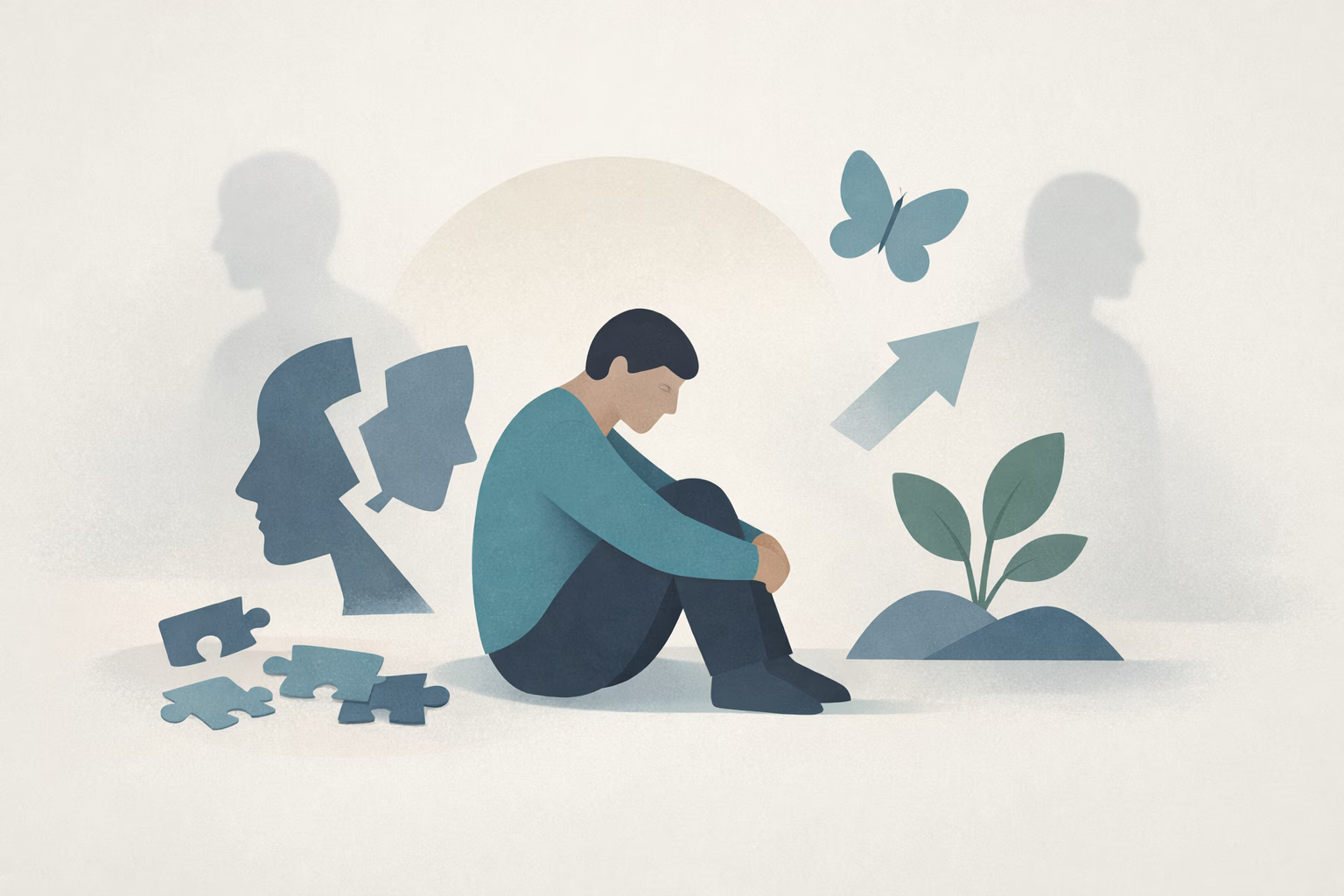
Identity Disruption: When Life Events Force Reinvention
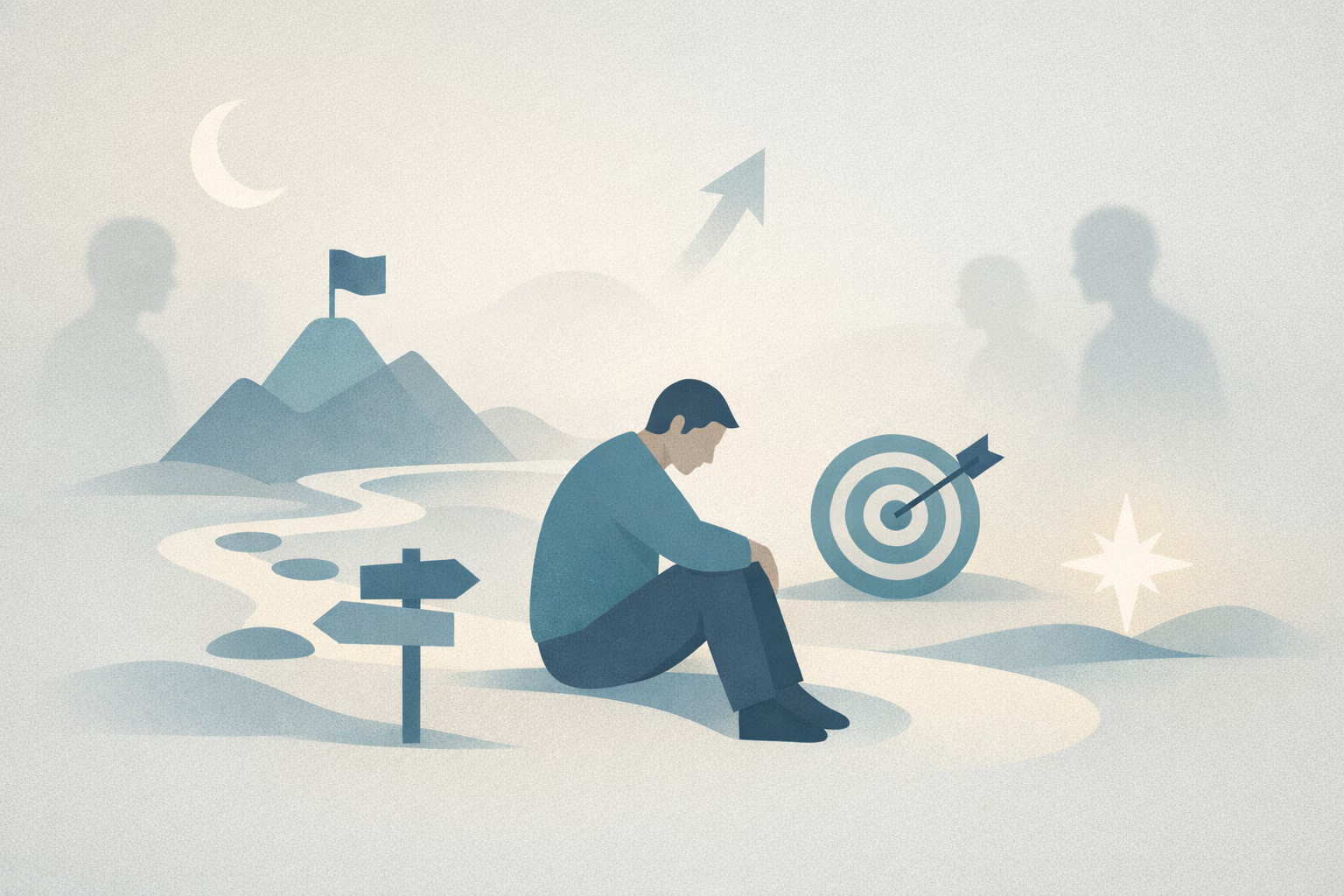
In short: There are seasons when your old motivations stop working. The goals you once chased feel oddly distant. Even your preferences can feel flattened, as if the inner compass that used to point somewhere has lost its signal.
There are seasons when your old motivations stop working. The goals you once chased feel oddly distant. Even your preferences can feel flattened, as if the inner compass that used to point somewhere has lost its signal.
What if “feeling lost” is not a personal failure, but a predictable nervous-system state?
Purpose recovery isn’t usually a dramatic return of certainty. It’s more like a gradual restoration of direction after collapse, disruption, or prolonged meaning erosion—when your system has been carrying too much, for too long, without enough closure to stand down.
People often describe purpose loss as a sudden disappearance: “I don’t recognize myself,” “I don’t know what I want,” “I can’t picture my future.” This can happen after major change, prolonged stress, grief, chronic illness, burnout, betrayal, parenting strain, relocation, or any stretch of life where demands outpace capacity.
In those conditions, the system prioritizes immediate management: getting through the day, reducing friction, keeping things from getting worse. That shift is not a character flaw. It’s regulation. When the body and mind are tasked with stabilizing, the “long-range planning” parts of identity can go quiet because they require more continuity and safety cues than the moment currently provides. [Ref-1]
Sometimes losing direction is what it looks like when your system is reorganizing around what it can actually carry.
Purpose isn’t only an idea. It’s also a felt orientation that depends on reliable internal signals: energy, interest, values, consequence, and a sense of “this matters.” Under high load, those signals become noisy or muted. Attention gets pulled into short loops—urgent tasks, scrolling, coping, managing—because they are measurable and immediate.
Fragmentation makes it harder to form a continuous story of self. When experiences don’t get to complete—when conversations, losses, decisions, and transitions stay half-processed—the system doesn’t receive a clear “done” signal. Without that closure, the nervous system stays partially activated, and the mind struggles to build a stable narrative bridge from past to future. [Ref-2]
Purpose recovery, then, is less about finding the perfect answer and more about the gradual return of coherent signaling—when inner information can be trusted again because it isn’t being constantly interrupted or overridden.
Human identity is not just a list of traits. It’s an organized narrative: where you came from, what you’re doing, what you’re for, what you won’t do, who you belong to, what counts as “finished,” and what remains open.
This narrative coherence is practical. It supports long-term planning, delayed gratification, relationship stability, and the ability to tolerate uncertainty without collapsing into chaos. When meaning is intact, actions feel connected to a larger thread; when meaning erodes, life can start to feel like unrelated episodes. Research on meaning in life repeatedly links purpose and coherence with well-being and resilience—not as inspiration, but as structure. [Ref-3]
So when your story gets disrupted by overload or upheaval, the loss of purpose isn’t mysterious. It’s what happens when the organizing function of narrative can’t keep up with the volume of unfinished material.
One of the most painful parts of purpose loss is the feeling of groundlessness: decisions feel arbitrary, effort feels unrewarding, and future thinking can feel blank or threatening. But the nervous system doesn’t require total certainty to stabilize. It often responds to partial orientation—small areas where meaning feels clear enough to stand on.
When there is even a modest thread of direction, the system can allocate energy differently. You may still feel tired or uncertain, but the internal experience shifts from “floating” to “standing somewhere.” That shift matters because it reduces the total load of ambiguity your system has to hold. In studies of meaning-centered approaches, even incremental increases in perceived meaning are associated with improved functioning and reduced distress. [Ref-4]
Not “everything makes sense,” but “something is true enough to lean on” can be a real turning point.
A common cultural myth is that purpose arrives as a clean revelation: a single insight, a dramatic decision, a perfect calling. That story is compelling, but it can make normal recovery feel like failure—especially when your current capacity is limited.
In reality, purpose often re-forms through gentle reorientation: meaning gathers when life starts to provide more completion, more continuity, and fewer ruptures between what you value and what you’re able to do. Many reviews of meaning-related interventions emphasize that meaning tends to strengthen through ongoing engagement and coherence-building, not through one-time epiphanies. [Ref-5]
This matters because insight can happen while the body is still overloaded. Integration is different: it’s when the system settles, and the direction becomes livable—less like a concept and more like a stable “yes” you can inhabit.
When purpose is weakened, life can slide into a drift loop. Not because you “don’t care,” but because orientation has become costly. If inner signals are unreliable, people naturally lean on external cues: what’s urgent, what’s rewarded, what keeps discomfort down, what fills time.
In drift, the mind may become busy while meaning becomes thin. Days fill, but they don’t resolve. The system stays active without arriving anywhere—lots of motion, little closure. Over time, the narrative thread can feel even harder to find, because the story is no longer being updated through completed experiences. Work on personal narrative under stress and trauma highlights how disrupted storytelling and continuity can maintain disorganization until experiences can be more coherently held. [Ref-6]
Purpose loss often has a recognizable texture. People may assume it means they’re “apathetic” or “lazy,” but these are usually signs of a system that can’t access stable orientation right now.
Some common patterns include:
These patterns often reflect a protective narrowing: when the system can’t safely hold big questions, it reduces complexity. Narrative work in resilience contexts often notes that identity becomes more coherent when experiences can be organized into a story that feels real and inhabitable—not merely understood. [Ref-7]
Humans are meaning-making creatures, but we’re also closure-seeking creatures. When purpose doesn’t provide a stabilizing “why,” the system often looks for other ways to create completion or relief. Some substitutes are socially praised (overwork, relentless self-improvement). Others are stigmatized (compulsive scrolling, numbing behaviors, dependency patterns). Structurally, they can function similarly: they reduce uncertainty for a moment.
Unresolved purpose loss can increase vulnerability to burnout because effort becomes detached from coherence. It can also increase dependency on external validation because internal direction isn’t reliably available. And it can lead to “meaning substitution,” where intensity replaces integration—big feelings, big plans, or big distractions standing in for a settled sense of self.
In identity research following major disruption, a consistent theme is that recovery involves rebuilding continuity—linking experiences into a narrative that can be carried forward—rather than simply accumulating new activities. [Ref-8]
Agency isn’t just willpower. It’s the felt sense that your choices connect to outcomes and to identity. When purpose is unclear, choices can feel unanchored: why choose this over that if nothing holds meaning? The result is often a quiet narrowing of reach—fewer bids, fewer risks, fewer commitments—because the system can’t justify the cost.
This is one reason purpose loss can feel self-reinforcing. The less you can sense direction, the less your actions generate coherent feedback, and the harder it becomes to trust your own signal. Narrative-based perspectives emphasize that a workable story helps organize experience into “I can act, and it matters,” which strengthens agency over time. [Ref-9]
When the future doesn’t feel reachable, it’s not laziness. It’s often a system that can’t find a safe path from here to there.
One helpful reframe is that purpose is not always absent; sometimes it’s simply offline. Under chronic pressure, the system learns that “wanting” creates strain: wanting implies effort, risk, disappointment, evaluation. So the nervous system may reduce wanting itself to conserve capacity.
When safety cues increase and pacing becomes more tolerable, purpose signals can begin to reappear as small, low-drama indicators: a return of preference, a clearer “no,” a sense that something is complete, a modest pull toward what fits. This is not the same as insight. It’s more like internal reception improving—less static, more signal.
Resources on meaning loss often describe how direction becomes accessible again when life feels less punishing and more navigable, allowing values to come back online without being forced. [Ref-10]
Identity is personal, but it doesn’t form in isolation. Humans regulate through relationship: being seen, being oriented with others, and having our experience reflected in a way that restores continuity. When you’ve felt lost for a long time, supportive presence can function like a stabilizing reference point—something steady enough to help your own signals return.
Shared meaning also reduces fragmentation. When your life is witnessed in coherent terms—what you’ve carried, what changed, what mattered—your system can begin to file experiences into a story that has sequence and dignity. This isn’t about being “fixed” by someone else; it’s about the nervous system receiving enough steadiness to complete loops that were held open alone. [Ref-11]
Sometimes direction returns first as belonging, not as a plan.
When purpose recovery is underway, it may not feel like excitement. More often, it feels like increased capacity for signal return: you notice what you prefer, what costs too much, what fits, what feels finished. The inner experience can become less brittle and less urgent.
People often describe a few subtle shifts:
Importantly, this is not simply “understanding yourself better.” It’s a physiological settling that comes with completion—when your system starts to trust that experiences can end, resolve, and become part of you rather than remain open tabs. Descriptions of reconnecting with purpose often emphasize this gentle return of inner steadiness and direction-sensing capacity. [Ref-12]
After losing yourself, it’s common to believe the task is to recover an old version of you. But purpose recovery often looks more like a new orientation forming—one that includes what happened without being organized around repairing it.
As coherence returns, the future can become thinkable again, not as pressure, but as possibility. The question shifts from “What’s wrong with me?” to “What matters enough to build around now?” In many recovery contexts, meaning is described as something that grows through lived alignment over time—less about erasing the past and more about creating a future that can hold it. [Ref-13]
When your story changes, your direction can change too—and that can be a form of healing, not a loss.
Purpose is often portrayed as a peak state: clarity, passion, certainty. But for many people, purpose returns as something humbler and more stabilizing: a sense of internal agreement, a workable next horizon, a life that generates more “done” moments and fewer open loops.
In that light, purpose recovery isn’t a race to feel inspired. It’s the gradual restoration of coherence—when your actions start to match your values often enough that identity can settle around them. And when identity settles, agency tends to follow. Meaning-centered writing in recovery contexts frequently frames this as a patient rebuilding of alignment, not a dramatic turnaround. [Ref-14]
Losing yourself can be a signal that the old structure could no longer hold what life was asking of you. That signal deserves respect, not shame.
Meaning is not always something you can summon on demand. Often it reappears when your system has had enough closure to stand down—and when a truer orientation has room to take shape. In long-term recovery narratives, this is a common arc: not the return of a past self, but the emergence of a life that fits more honestly. [Ref-15]
From theory to practice — meaning forms when insight meets action.
Because when life demands outpace capacity, the system prioritizes immediate management — getting through the day, reducing friction, keeping things from getting worse. The 'long-range planning' parts of identity go quiet because they require more continuity and safety cues than the moment provides. Sometimes losing direction is what it looks like when your system reorganizes around what it can actually carry. Purpose isn't only an idea; it's a felt orientation that depends on reliable inner signals — energy, interest, values, consequence, the sense of 'this matters.' Under high load, those signals become noisy or muted. Feeling lost is a regulation state, not a failure of character.
Rarely. The lightning-strike calling is a cultural myth that makes normal recovery feel like failure. Purpose more often re-forms through gentle reorientation — meaning gathers when life starts to provide more completion, more continuity, and fewer ruptures between what you value and what you're able to do. Insight can happen while the body is still overloaded; integration is different — it's when the system settles and direction becomes livable, less like a concept and more like a stable 'yes' you can inhabit. The nervous system doesn't need total certainty to stabilize. It often responds to partial orientation: small areas where meaning feels clear enough to stand on.
Because if inner signals are unreliable, people lean on external cues — what's urgent, what's rewarded, what keeps discomfort down, what fills time. The mind becomes busy while meaning stays thin. Days fill but don't resolve. The system stays active without arriving anywhere. Short-term relief becomes the main organizer, unfinished loops accumulate in the background, and identity feels like a set of reactions instead of a direction. This isn't apathy or laziness. It's the structural cost of orientation being too expensive to maintain right now. The drift isn't pulling you off course; it's what happens when there's no course to be on.
Often quiet rather than dramatic. Decisions require less internal debate. Time feels more continuous instead of disconnected segments. Values feel more obvious in daily choices. Rest and effort become distinguishable again. This isn't 'understanding yourself better' — it's a physiological settling that comes with completion, when the system starts to trust experiences can end, resolve, and become part of you rather than remain open tabs. Purpose returns first as belonging more often than as a plan. Sometimes it's a return of preference, a clearer no, a sense that something is finished, a modest pull toward what fits. Less static, more signal. The future becomes thinkable again, not as pressure but as possibility.
From Science to Art.
Understanding explains what is happening. Art allows you to feel it—without fixing, judging, or naming. Pause here. Let the images work quietly. Sometimes meaning settles before words do.
One Quiet Window, one insight, one reflection — every Sunday