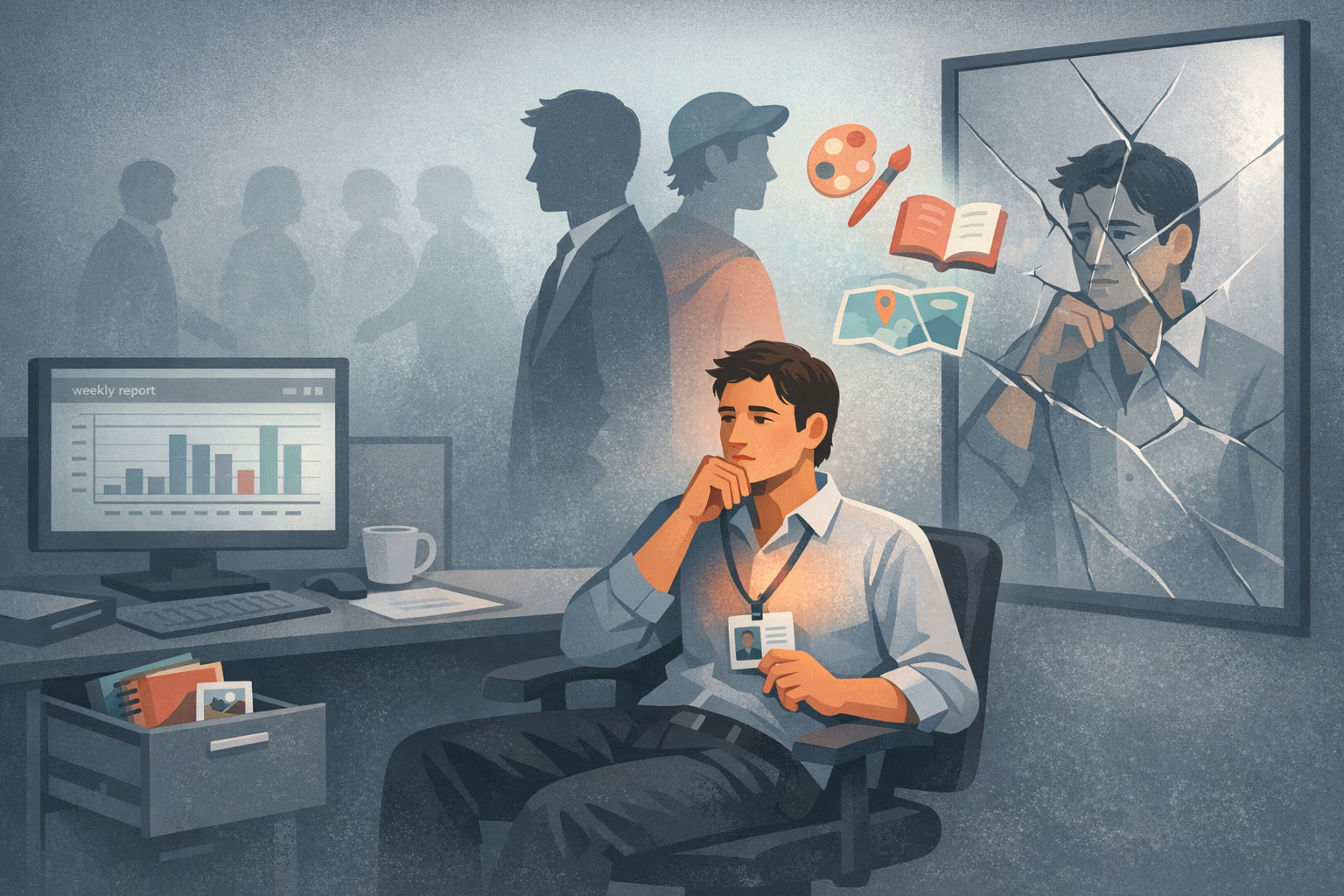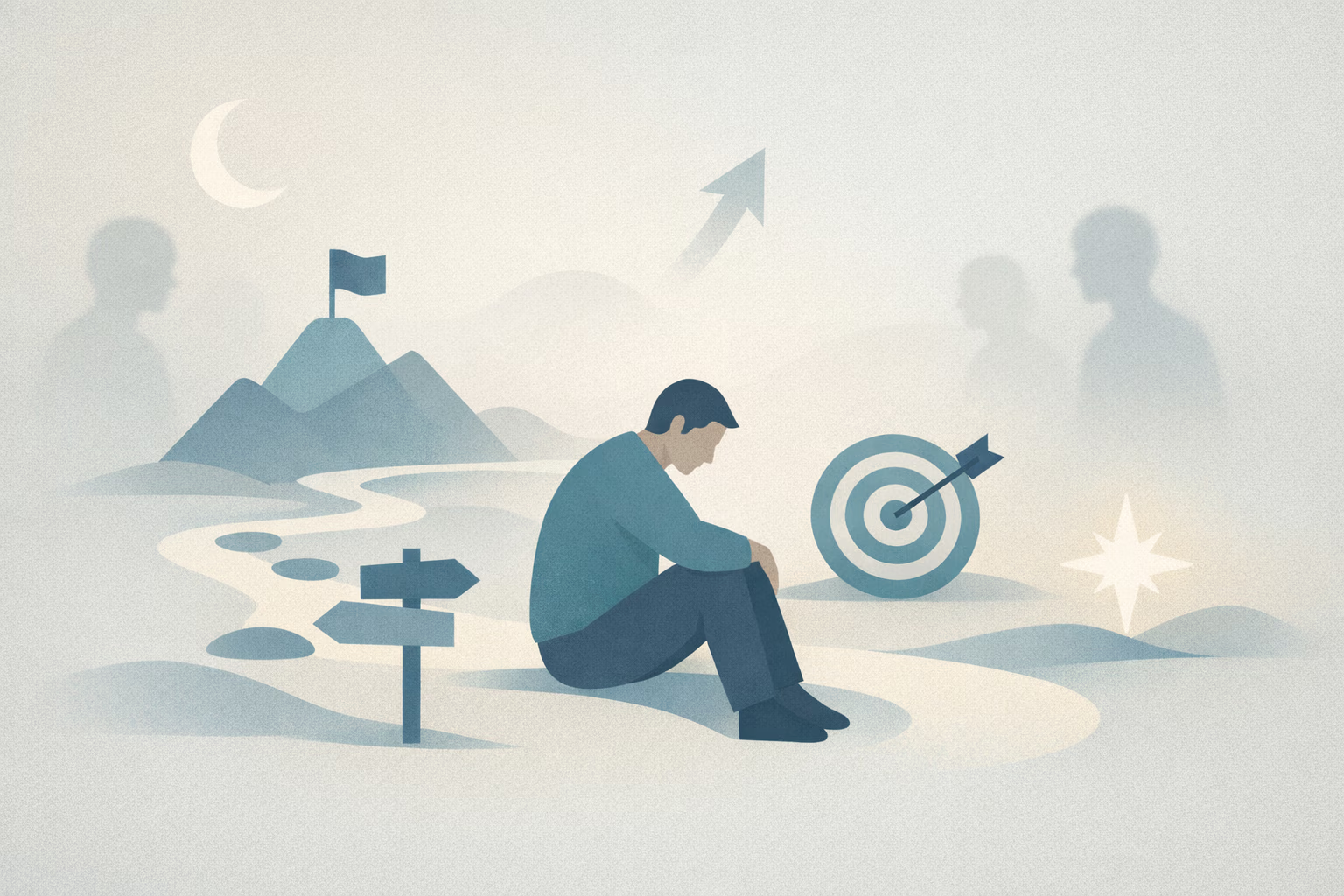
Career Identity Crisis in a Fast-Changing World
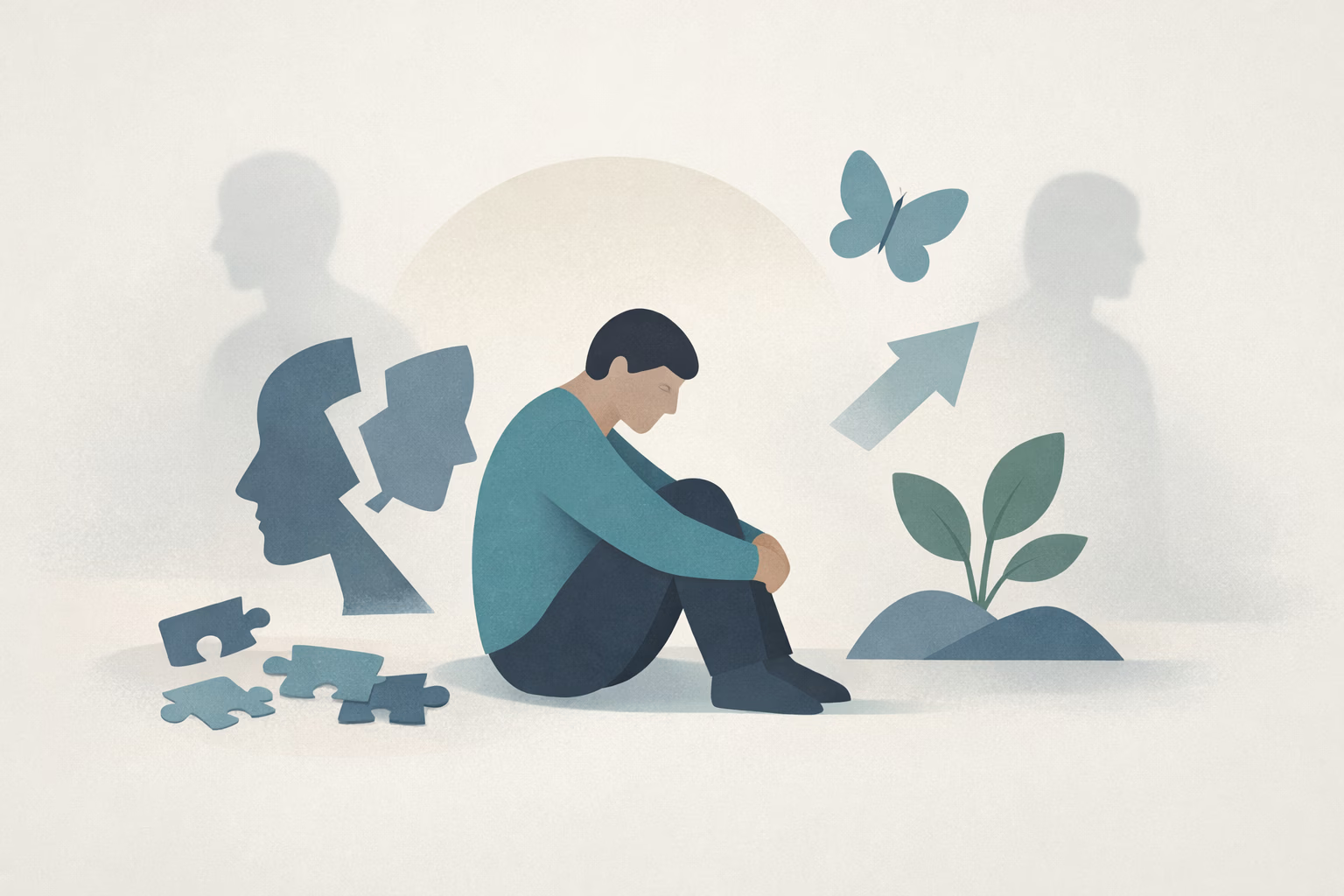
In short: Some life events don’t just change your schedule or your surroundings. They change the internal “map” you use to make sense of yourself—your roles, your priorities, what you can count on, and what you’re here to do.
Some life events don’t just change your schedule or your surroundings. They change the internal “map” you use to make sense of yourself—your roles, your priorities, what you can count on, and what you’re here to do.
What happens when the version of you that used to guide your choices no longer fits the life you’re living?
Identity disruption can feel like confusion, numb urgency, or a strange sense of being untethered. In the Meaning Density Model™ view, this isn’t a personal defect. It’s what a human system does when old coherence has been broken and new coherence hasn’t fully formed yet.
Identity is not only an idea about who you are. It’s a coordination system—an internal set of expectations that helps your nervous system predict what’s next, choose behaviors, and recognize what “done” feels like.
After a major change, that system can lose traction. You might still be capable and intelligent, yet everyday decisions feel heavy or strangely unclear. The tension isn’t always emotional in a dramatic way; it’s often physiological: a background load, an unfinished feeling, a sense that actions don’t “land.” [Ref-1]
This is why people often describe identity disruption as disorientation rather than sadness. The issue is less about what you feel and more about whether your internal signals can reliably return to baseline after choices, interactions, and days.
Humans stabilize through repeated loops: role → action → feedback → meaning → identity. When your environment changes suddenly—job loss, relocation, illness, divorce, becoming a caregiver, graduating, retirement—those loops can break mid-cycle.
The nervous system doesn’t interpret this as “growth.” It interprets it as uncertainty. Even positive change can create the same biological problem: fewer familiar cues, fewer predictable outcomes, fewer reliable “completion signals.” That uncertainty increases stress load and can make you feel like your story is scattered. [Ref-2]
In this state, it’s common to oscillate: one day you feel ready to reinvent, the next day you feel blank or irritated. That swing is not inconsistency; it’s a system searching for stable reference points.
Humans don’t just survive by reacting—we survive by being legible to ourselves and to others. Narrative identity is part of how we maintain social predictability (“Who am I in this group?”) and internal stability (“What do I do when X happens?”). [Ref-3]
When your narrative identity is intact, many choices are automated. You don’t debate every email, every boundary, every next step. When that narrative is disrupted, you lose efficient defaults—and your system has to spend more energy to decide what used to be obvious.
This is one reason identity disruption can be so tiring. The exhaustion isn’t a lack of motivation; it’s the cost of running life without a settled organizing story.
When coherence drops, the nervous system often reaches for what previously reduced uncertainty: familiar roles, familiar rules, familiar performance standards. Clinging to the old identity can temporarily lower activation because it restores predictability, even if it no longer matches current circumstances. [Ref-4]
This can look like overcontrol (“I’ll just do it the way I always did”), overexplanation (“I need to justify who I am now”), or rigid self-judgments (“I shouldn’t be struggling—this shouldn’t be hard”).
But the relief is usually short-lived, because the environment keeps sending contradictory data. The mismatch itself becomes a source of ongoing activation: you’re trying to complete today’s life using yesterday’s operating system.
One of the hardest parts is that outdated identity patterns can still feel morally or logically valid. “I’m the dependable one.” “I’m the high achiever.” “I’m the helper.” “I don’t need anything.”
These identities often formed for good reasons—social belonging, survival, family dynamics, cultural expectations. The problem isn’t that they were wrong. The problem is that a major life event can change what they cost you, and what they prevent you from integrating. [Ref-5]
When identity disruption is present, the question underneath is rarely “What’s wrong with me?” It’s closer to: “What part of my old story no longer creates closure in the life I have now?”
Identity disruption often becomes self-reinforcing. The change happens, but it doesn’t fully resolve inside the body’s meaning-making system—so the system keeps scanning for completion.
That scanning can show up as avoidance, indecision, or constant mental rehearsal. Not because you’re afraid of the future in a simple psychological sense, but because the loop hasn’t reached a settled endpoint: the consequences and new reference points are still muted, incomplete, or inconsistent.
Over time, “not-yet-closed” becomes a living condition. You can function, but it can feel like you’re living beside your life instead of inside it. [Ref-6]
“I’m doing the things, but none of it clicks into place.”
Because identity is a coordination system, disruption tends to affect multiple domains at once—goals, relationships, time sense, and self-trust. People often recognize themselves less by emotion and more by pattern.
These aren’t identities. They’re regulatory responses—ways a system tries to reduce uncertainty, conserve energy, or find a temporary anchor. [Ref-7]
When identity disruption persists, resilience often drops—not because you “can’t handle life,” but because your baseline load is higher. With fewer internal completion signals, even ordinary demands can feel like they require more force than they should.
The longer the mismatch continues, the more likely you are to drift from what actually matters to you. Not from lack of values, but because values need a stable identity channel to reliably express themselves in behavior.
Over time, the system may protect itself by narrowing: smaller goals, fewer risks, more defaulting to what’s familiar. This is an adaptive conservation strategy—but it can delay the formation of a new, workable coherence. [Ref-8]
Two forces often coexist in identity disruption: the pull to preserve the old story and the pull to postpone the new one. This isn’t hypocrisy. It’s what happens when the old identity still offers structure while the new identity hasn’t generated stable closure yet.
Clinging can look like returning to old standards, old relationships, or old definitions of worth. Avoiding can look like postponing decisions, staying “in research,” or keeping future plans abstract. Structurally, both moves reduce immediate uncertainty—and that reduction can be reinforcing even when it increases long-term instability.
In this way, disconnection can last longer than the event itself. The life change is over, but the meaning loop is still open. [Ref-9]
People often assume the turning point is understanding: naming the pattern, gaining clarity, realizing what happened. That can be helpful, but insight alone rarely creates the physiological “stand-down” that marks completion.
Coherence returns when a revised narrative becomes usable in the real world—when it can organize choices, relationships, and self-recognition without constant effort. This is less like “thinking your way into a new you” and more like your system gradually accepting a new set of reference points because they reliably match what life now requires. [Ref-10]
What would it mean for your identity to feel true because it produces closure, not because it sounds convincing?
When the story fits, signals return: decisions become simpler, boundaries become less dramatic, and daily actions start to register as complete rather than endlessly pending.
Identity isn’t built in isolation. Because humans are social, our nervous systems often take cues from relationship contexts: being seen accurately, receiving stable feedback, and experiencing predictability with other people.
In identity disruption, supportive relationships can function like scaffolding: they provide continuity while the internal map is being rebuilt. Mentorship and grounded feedback can reduce the need for constant self-monitoring and help new roles become less hypothetical and more embodied. [Ref-11]
This isn’t about being told who you are. It’s about having enough relational stability that your system can stop bracing and start consolidating what’s real now.
As a renewed identity consolidates, many people notice changes that are practical before they are emotional: fewer spirals around decisions, less effort to start, and more consistency across contexts. It can feel like your life has handles again.
Confidence here is not hype. It’s the nervous system’s recognition that actions lead to predictable outcomes—and that those outcomes match who you understand yourself to be. Clarity becomes less of a mental achievement and more of an internal alignment that holds under stress. [Ref-12]
When identity disruption resolves, the biggest shift is often where your energy goes. Instead of being spent on vigilance—checking, comparing, rehearsing—you have more capacity for deliberate movement. Not hustle. Not constant self-improvement. Just cleaner direction.
A coherent identity also changes how you relate to your past. The event that forced reinvention becomes part of your narrative without staying an active wound or a permanent alarm. This kind of integration is often supported by relational history and present-day connection: being able to locate yourself in a wider story, not just a single rupture. [Ref-13]
Purpose, in this frame, is not a grand statement. It’s what your system can reliably organize around—what creates follow-through and completion in ordinary days.
Identity disruption can feel like you’ve lost yourself, but often it’s more accurate to say: the old coherence has ended, and the new coherence is not yet complete. That in-between is uncomfortable because it removes automatic guidance—yet it’s also where a more honest alignment can form.
In a non-pathologizing view, the goal isn’t to force a new persona or to “move on” fast. The deeper human task is closure: allowing the change to become integrated enough that your life stops feeling like a series of open tabs.
When identity is reconstructed with dignity, it tends to be less brittle and more real—less dependent on constant validation, more anchored in what you can stand behind. In that sense, disruption can become a site of conscious growth, not because it was desired, but because it made a new coherence necessary. [Ref-14]
It’s easy to interpret identity disruption as personal failure—especially in cultures that reward certainty and continuous forward motion. But humans are meaning-making organisms. When life changes, it’s normal for the system to pause, renegotiate, and rebuild.
Over time, a coherent identity isn’t something you “convince yourself” into. It’s what remains when experiences have reached enough completion that your nervous system can stop arguing with reality. That settling strengthens autonomy: you become easier to live with from the inside, and your behavior aligns more naturally with what matters. [Ref-15]
From theory to practice — meaning forms when insight meets action.
Because identity isn't only an idea about who you are — it's a coordination system that helps your nervous system predict what's next, choose behaviors, and recognize what done feels like. After a major change, that system loses traction. Even positive change creates the same biological problem: fewer familiar cues, fewer predictable outcomes, fewer reliable completion signals. People often describe identity disruption as disorientation rather than sadness. The issue is less about what you feel and more about whether your internal signals can reliably return to baseline after choices, interactions, and days. The story is still being rewritten.
Because when narrative identity is intact, many choices are automated. You don't debate every email, every boundary, every next step. When that narrative is disrupted, you lose efficient defaults — your system has to spend more energy to decide what used to be obvious. The exhaustion isn't lack of motivation; it's the cost of running life without a settled organizing story. With fewer internal completion signals, even ordinary demands feel like they require more force than they should. Baseline load goes up because every loop has to be reconstructed from scratch.
Because when coherence drops, the nervous system reaches for what previously reduced uncertainty: familiar roles, familiar rules, familiar performance standards. Clinging to the old identity temporarily lowers activation by restoring predictability — even if it no longer matches current circumstances. Two forces coexist: the pull to preserve the old story and the pull to postpone the new one. Both reduce immediate uncertainty, which makes them reinforcing. You're trying to complete today's life using yesterday's operating system, and the mismatch itself becomes a source of ongoing activation.
Not through insight alone — through lived coherence. People often assume the turning point is naming the pattern or gaining clarity, but insight rarely creates the physiological stand-down that marks completion. Coherence returns when a revised narrative becomes usable in the real world — when it can organize choices, relationships, and self-recognition without constant effort. What would it mean for your identity to feel true because it produces closure, not because it sounds convincing? Reinvention isn't a performance; it's a return of coherence — what remains when experiences have reached enough completion that your system can stop arguing with reality.
From Science to Art.
Understanding explains what is happening. Art allows you to feel it—without fixing, judging, or naming. Pause here. Let the images work quietly. Sometimes meaning settles before words do.
One Quiet Window, one insight, one reflection — every Sunday