Career Identity Crisis: When Your Job Stops Feeling Like You

In short: A career identity crisis isn’t just “not knowing what you want.” It’s the specific disorientation that can happen when the role you’ve been using to locate yourself—your contribution, status, routines, and future storyline—stops feeling reliable. What if the problem isn’t you, but the loss of a coherent “who am I in the world?” signal?
A career identity crisis isn’t just “not knowing what you want.” It’s the specific disorientation that can happen when the role you’ve been using to locate yourself—your contribution, status, routines, and future storyline—stops feeling reliable.
What if the problem isn’t you, but the loss of a coherent “who am I in the world?” signal?
In a fast-changing economy, your nervous system may be responding to an environment that keeps rewriting the rules faster than identity can settle. What looks like procrastination, indecision, detachment, or overthinking is often a regulatory response to missing closure—not a character flaw.
Many people describe a career identity crisis as a strange mix of urgency and numbness: you feel pressure to “figure it out,” while also feeling oddly unable to move. The old role might still be on your resume, but it no longer gives you the internal signal of fit.
This can bring a specific kind of ungroundedness: not just worry about money or tasks, but a loss of orientation—like your life map no longer matches the terrain. It’s common to grieve the stability of a previous professional self, even if you chose the change. [Ref-1]
When the label stops working, it can feel like the person wearing it disappears for a while.
Human identity is partly a narrative system: it organizes your past, present, and future into a story that makes sense. Work roles often serve as “story anchors” because they structure time, relationships, skills, and social recognition.
When roles erode (industry shifts, layoffs, AI disruption, reorgs, contract work, constant reskilling), the narrative has fewer stable threads to weave. That doesn’t just create confusion; it increases nervous system load. Without a workable storyline, the brain keeps scanning for what matters, what’s safe, and what to prioritize. [Ref-2]
In other words: if your story can’t complete, your system can’t fully stand down.
Across cultures, humans track belonging and contribution. Work becomes a convenient container for that: “This is how I help,” “This is what I’m good at,” “This is what others can count on.”
Because of that, unstable work structures can feel personally destabilizing even when nothing is “wrong” with you. The nervous system treats unclear contribution as unresolved information, which keeps attention and energy mobilized—looking for the next cue that restores coherence. [Ref-3]
When career identity feels shaky, engagement can start to carry too much weight. Every choice can feel like it “decides your life,” and every uncertainty can feel like evidence that you’re behind. Under that load, withdrawal can temporarily reduce activation.
This is not because you’re incapable or because you secretly don’t care. It’s because stepping away dampens incoming demands and reduces immediate consequence: fewer decisions, fewer comparisons, fewer moments that force the question, “Who am I now?” In the short term, the system gets a quieter channel. [Ref-4]
But quiet isn’t the same as closure. Without completion signals, the uncertainty often stays in the background—still open, still unresolved.
In a culture that treats confidence as a prerequisite, it’s easy to assume clarity should arrive first. Many people end up waiting for an internal green light: a clean vision, a perfect fit, a sudden certainty.
The difficulty is that identity usually stabilizes after experiences become coherent—after reality provides enough information for a story to complete. When avoidance stretches on, the system gets fewer closing cues: fewer feedback loops, fewer lived confirmations, fewer “done” signals. The result isn’t rest; it’s extended ambiguity.
So the wait can start to feel like safety, while quietly deepening the sense of being unmoored. [Ref-5]
One helpful way to understand this state is as a loop rather than a trait. Uncertainty increases nervous system load. Under load, the system reduces exposure to ambiguity by withdrawing. And withdrawal reduces the very experiences that could update identity.
This creates a predictable pattern: the longer the loop runs, the more the self-story starts to thin out. You may still be doing tasks, but without the sense of “this adds up.”
The loop isn’t laziness. It’s a short-term regulation strategy that becomes long-term disorientation. [Ref-6]
When the identity system can’t find stable anchors, it often shifts into substitutes: analysis, external scoring, or emotional distance. These are not moral failures; they’re ways of lowering volatility when the inner story isn’t settling.
Notice how many of these reduce immediate consequence and keep the system from having to commit to one storyline long enough for completion to occur. [Ref-7]
When identity uncertainty persists, it often erodes capacity before it erodes ambition. People may still care deeply—yet feel increasingly unable to engage. This can look like low motivation, but it’s often depleted regulation: the system is carrying too many open loops at once.
Over time, the cost can show up as reduced focus, more irritability, flattened interest, sleep disruption, or a brittle sense of confidence. Not because you’re “falling apart,” but because sustained ambiguity taxes the body’s ability to return to baseline.
After job loss or major role disruption, this can also resemble a grief-like process: the loss isn’t only income or routine, but a familiar self. [Ref-8]
In a stable environment, action produces feedback, and feedback helps identity update. In an unstable environment, action can feel disproportionately risky, so action shrinks. Then the system gets fewer confirming signals that would support self-trust.
This is how self-doubt becomes structural. It’s not a mysterious inner flaw; it’s what happens when the brain repeatedly receives “inconclusive” outcomes:
The loop tightens: instability fuels doubt, doubt reduces engagement, and reduced engagement leaves identity diffuse. [Ref-9]
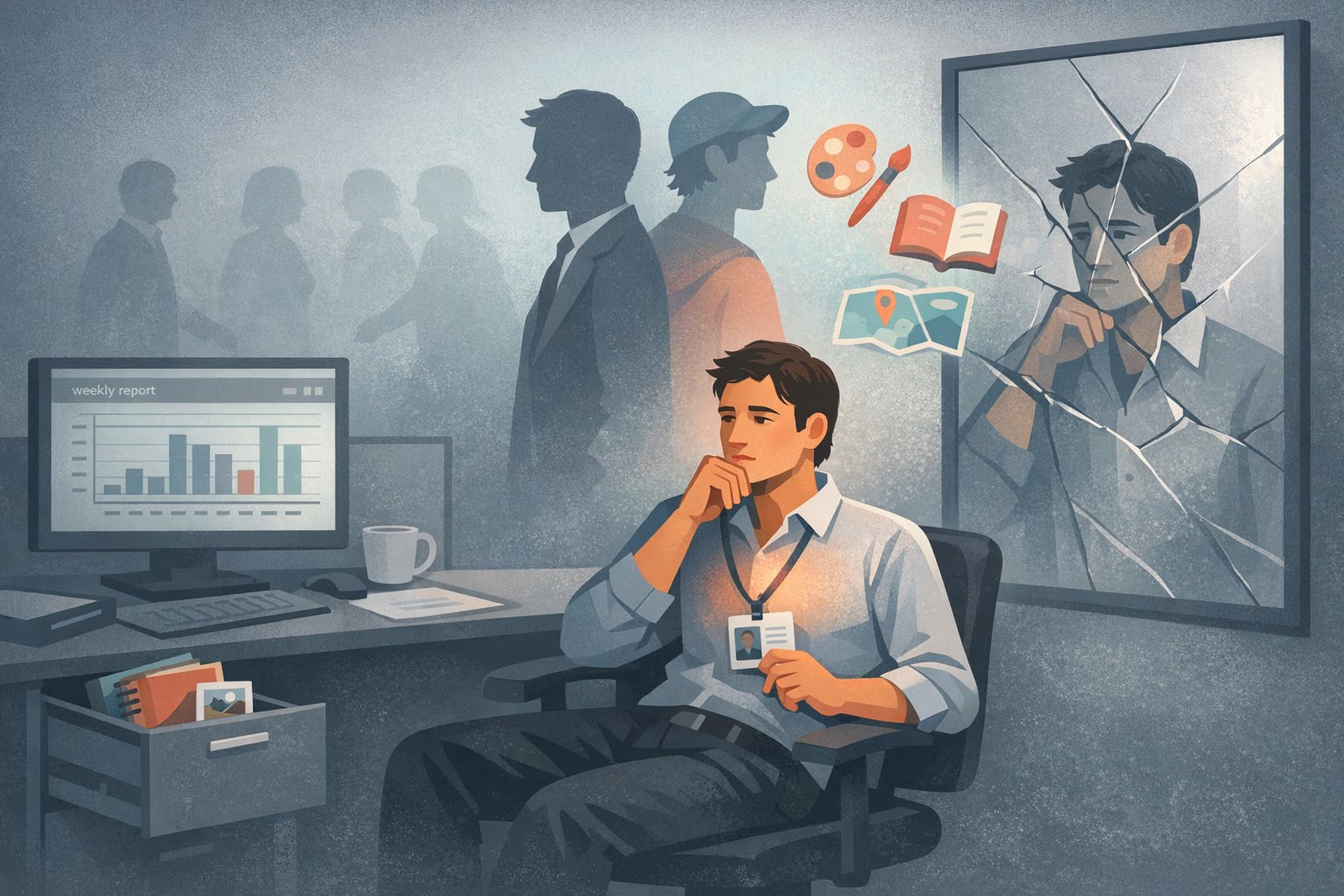
Roles are external containers. Values and capacities are internal anchors. When identity is built mostly from containers—title, company, status—it stays vulnerable to whatever the market does next. When identity is also grounded in what you reliably bring (skills, patterns of contribution, ways of relating, what you refuse to trade away), it has more continuity.
This isn’t positive thinking, reframing, or a motivational speech. It’s a different stabilizing architecture: the self-story stops depending on one label to prove you exist.
When values and capacities become the anchor, the nervous system often shows it first: less scanning, fewer internal courtroom arguments, more ability to stay present with uncertainty without immediately needing it to resolve. [Ref-10]
Professional labels don’t only organize your own story; they also organize how other people respond to you. When your identity is fused with a role, social feedback can feel like a verdict: respect or dismissal, admiration or pity.
As identity becomes less dependent on professional naming, relationships often become simpler. Conversations can hold more reality and less performance. You can be in connection without constantly translating yourself into a marketable pitch.
This doesn’t mean relationships become perfect. It means the social system has more room to provide useful feedback—feedback that supports coherence rather than just evaluation. [Ref-11]
Coherence is not the same as understanding what happened. Many people can explain their career story brilliantly and still feel unsettled. Coherence is when the story has enough completion that the body stops treating it as unfinished business.
When narrative coherence returns, it often shows up as steadier self-trust and more consistent energy—not because everything is solved, but because the identity thread is continuous again. The system can hold change without losing the plot.
In research on role transitions, identity work isn’t just cognitive; it’s the ongoing process of forming a livable narrative that can actually be inhabited. Over time, that “inhabited” quality is what makes the self feel real again. [Ref-12]
When the nervous system is less dominated by identity threat, work can shift from “Who am I?” to “How do I want to contribute?” That shift is subtle but profound: choices become less about protecting a fragile self-story and more about expressing a stable one.
This doesn’t require a perfect career narrative. It requires enough internal grounding that exploration is tolerable—because uncertainty is no longer interpreted as personal collapse.
In that state, career moves can become experiments in contribution rather than high-stakes identity verdicts. That’s often when direction starts to emerge in a durable way—through lived coherence, not forced certainty. [Ref-13]
A career identity crisis can feel like a malfunction, but it often makes sense as a signal: a system that used to organize meaning through roles is asking for a sturdier foundation. Not because roles are bad, but because the world has become too volatile to let roles carry the entire weight of selfhood.
When meaning is rebuilt from values, capacities, and real contribution—things that can travel with you across industries and seasons—identity tends to become more resilient. Titles can then become descriptors, not verdicts.
In that frame, the crisis isn’t evidence that you’re behind. It’s evidence that your system is trying to re-establish coherence in an environment that keeps changing the map. [Ref-14]
It’s understandable to feel disoriented when the world asks you to reinvent faster than a nervous system can settle. But a shifting career landscape doesn’t erase who you are.
What you do matters. And who you are is larger than any single role. Over time, direction tends to appear where identity becomes internally anchored—where your story can complete enough to be lived, not just explained. [Ref-15]
From theory to practice — meaning forms when insight meets action.
Work roles function as story anchors. They organize your past, present, and future into a narrative — what you contribute, who counts on you, what happens next. When that anchor erodes through layoffs, AI disruption, or industry shifts, the narrative loses stable threads to weave. The Identity & Meaning System treats unclear contribution as unresolved information, which keeps attention and energy mobilized scanning for what matters. This is why a role change brings a specific ungroundedness, not just worry about money. It's grief for a familiar self. If your story can't complete, your system can't fully stand down — that's biology, not weakness.
Uncertainty increases nervous system load. Under load, the system reduces exposure to ambiguity by withdrawing — fewer decisions, fewer comparisons, fewer moments forcing the question who am I now. That's an Avoidance Loop: uncertainty triggers withdrawal, withdrawal reduces the very experiences that could update identity, and identity stays diffuse. The longer the loop runs, the more the self-story thins out. You may still be doing tasks, but without the felt sense of this adds up. It's not laziness; it's a short-term regulation strategy that becomes long-term disorientation. Closure requires lived experiences, not more analysis.
Identity stabilizes after experiences become coherent — after reality provides enough information for a story to complete. Waiting for an internal green light leaves the system with fewer feedback loops, fewer lived confirmations, fewer Done Signals. So the wait can feel like safety while quietly deepening the sense of being unmoored. In stable environments, action produces feedback that helps identity update. In unstable environments, action feels disproportionately risky, so action shrinks — and self-doubt becomes structural. The exit isn't more certainty before moving; it's enough movement that the body starts receiving confirming signals again.
Roles are external containers. Values and capacities are internal anchors. When identity is built mostly from titles, company, or status, it stays vulnerable to whatever the market does next. When identity is also grounded in what you reliably bring — skills, patterns of contribution, ways of relating, what you refuse to trade away — it has continuity across industries and seasons. This isn't reframing or motivational thinking; it's a different stabilizing architecture. The nervous system shows it first: less scanning, fewer internal courtroom arguments, more capacity to stay present with uncertainty. Meaning Density grows when work shifts from proof of self to expression of self.
From Science to Art.
Understanding explains what is happening. Art allows you to feel it—without fixing, judging, or naming. Pause here. Let the images work quietly. Sometimes meaning settles before words do.
One Quiet Window, one insight, one reflection — every Sunday