Cognitive Overload: When Your Brain Reaches Its Limit
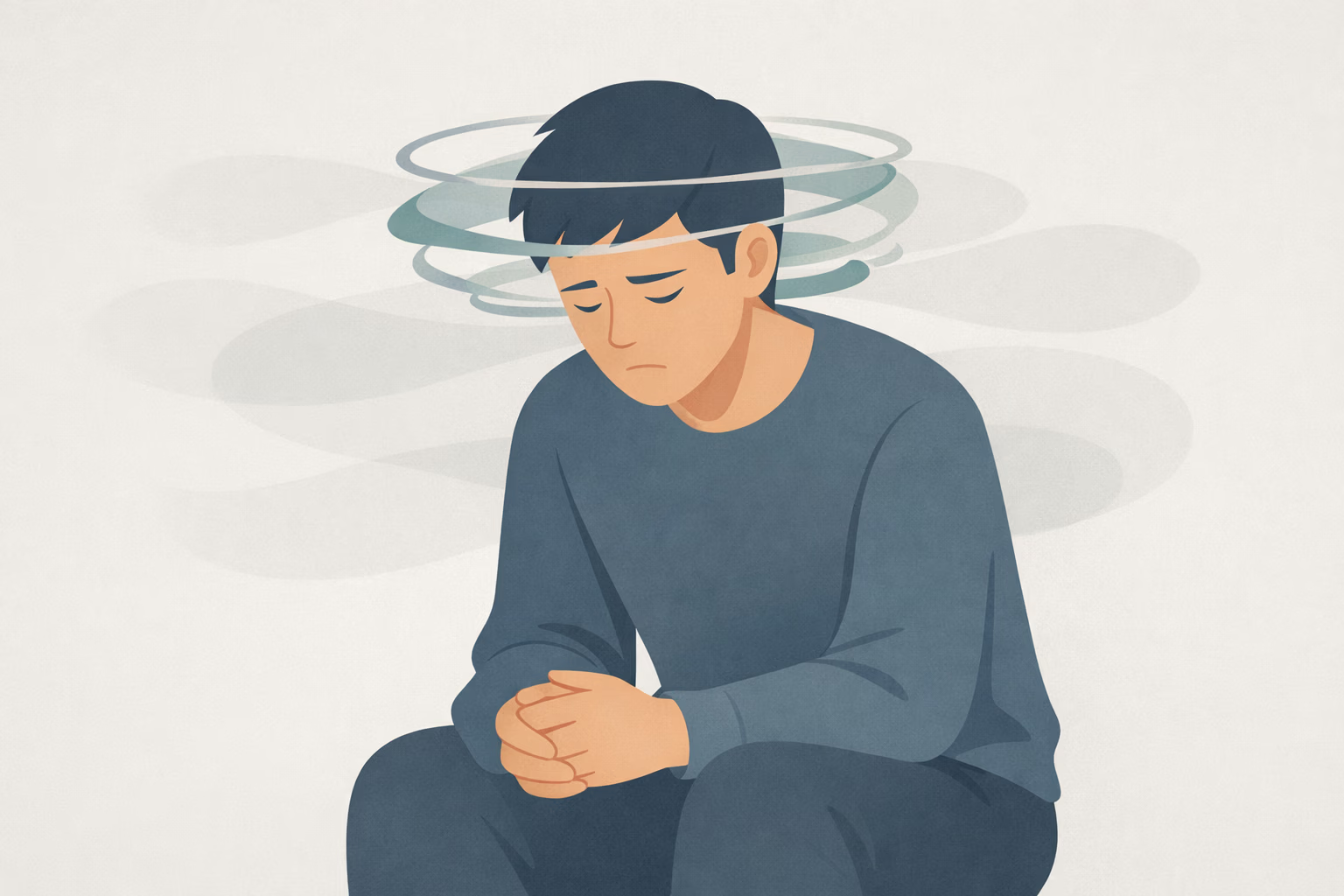
In short: Some days, thinking doesn’t feel like a wide landscape. It feels like a small room with low ceilings—ideas bump into each other, options look limited, and even simple choices take effort.
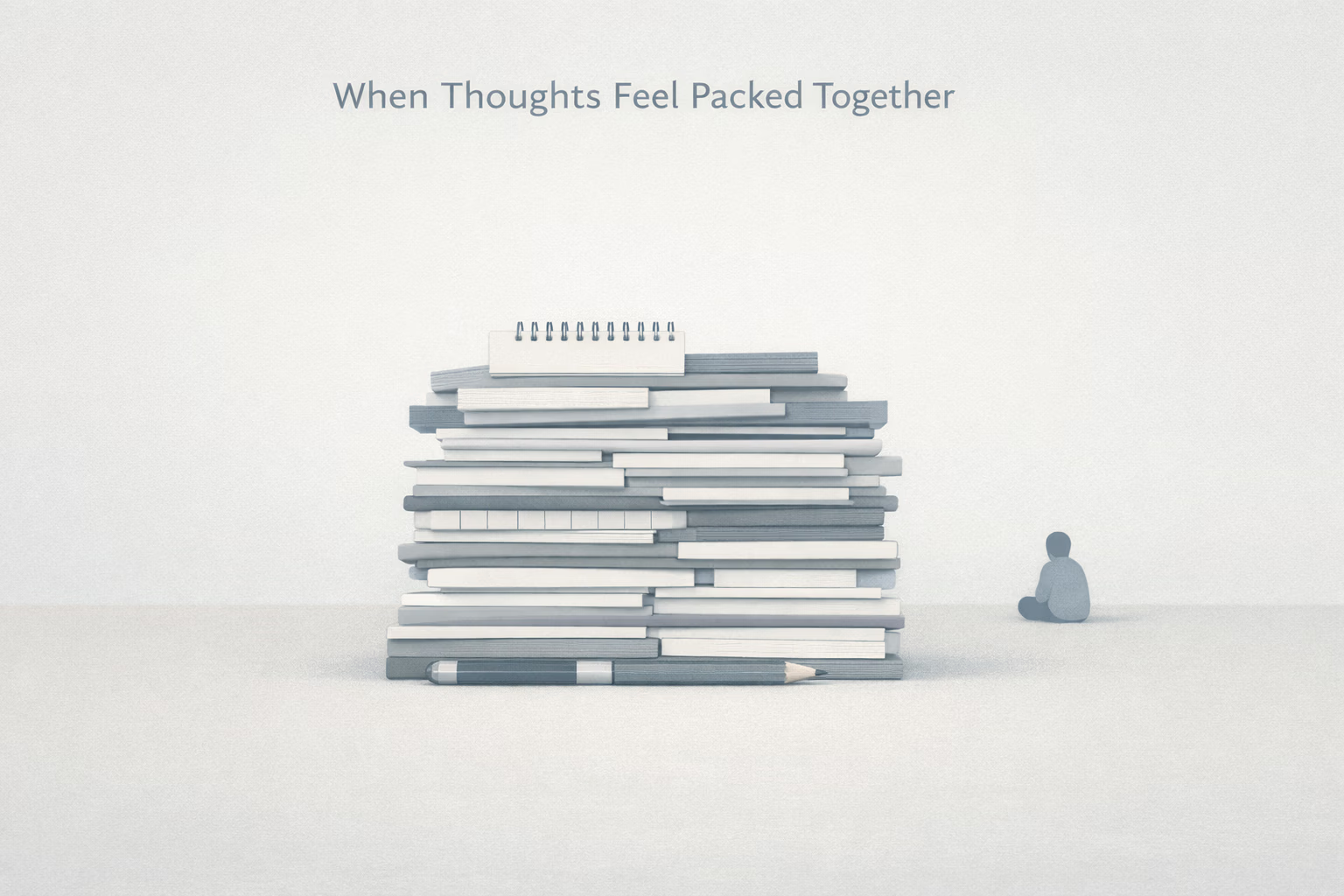
Some days, thinking doesn’t feel like a wide landscape. It feels like a small room with low ceilings—ideas bump into each other, options look limited, and even simple choices take effort. You may still be “functioning,” but your mind feels compressed: tight, rigid, and unusually serious.
What if this isn’t you becoming worse at life—what if it’s your system trying to create safety by narrowing the field?
Cognitive tightness is less about character and more about conditions. Under sustained pressure, nervous systems tend to trade flexibility for immediacy. That swap can be useful in short bursts. In modern life, it can become a long-running state that quietly drains meaning, identity coherence, and a sense of agency.
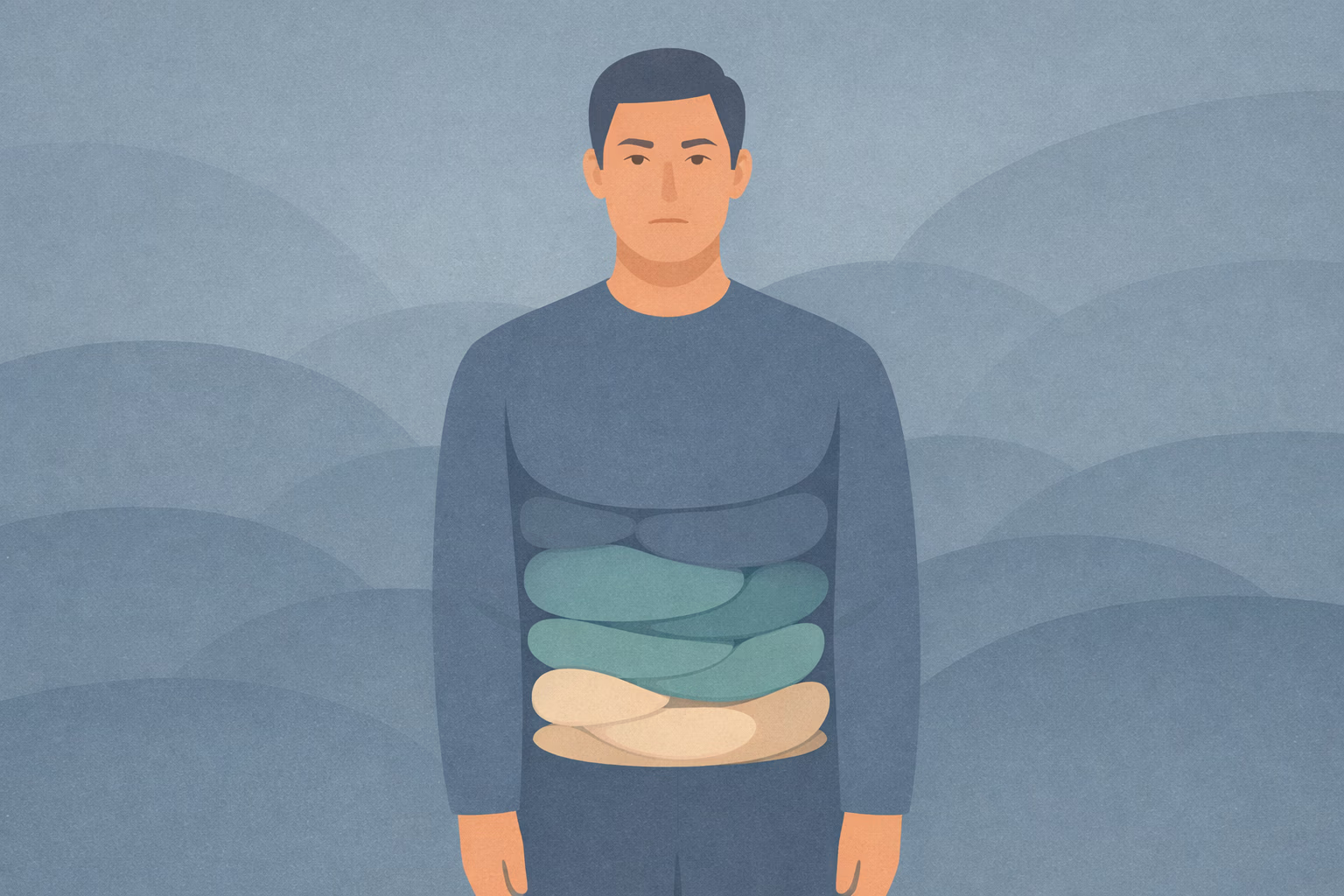
Cognitive tightness is a felt sense of mental contraction: fewer options seem real, nuance is harder to access, and thoughts arrive with a clenched quality—as if the mind is bracing. It can feel like you’re trying to think through a narrow tube rather than from a spacious perspective.
This often shows up as a subtle shift in mental posture: faster conclusions, less curiosity, less tolerance for ambiguity, and more urgency to “lock in” the right answer. The world can start to look like a series of problems to control rather than experiences to move through.
Importantly, this state can exist even when nothing is “wrong” with you. The prefrontal system that supports perspective-taking and flexible planning is sensitive to stress load and context. When it’s strained, cognition can tighten the way muscles do under sustained effort. [Ref-1]
Under stress, the body releases neurochemicals that prioritize survival-relevant processing. In the short term, that shift can help you respond quickly. But it also changes how the prefrontal cortex operates—the region most associated with working memory, impulse regulation, and flexible reasoning. [Ref-2]
When stress signals are high, the brain tends to rely more on faster, more automatic circuits and less on slower, integrative ones. The result isn’t “bad thinking.” It’s narrower thinking: fewer mental simulations, reduced capacity to hold multiple perspectives at once, and less room for nuance.
That’s why cognitive tightness can feel effortful even when you’re trying hard. The system isn’t failing from lack of willpower; it’s reallocating resources under load.
In evolutionary terms, mental narrowing is part of a threat-response package. When danger is plausible, scanning wide horizons and entertaining multiple possibilities can be inefficient. A tightened cognitive field helps prioritize quick decisions, rapid pattern recognition, and immediate action.
In that context, “compressed thinking” is not a glitch—it’s an adaptive configuration. Stress-affected executive processes often show reduced flexibility and increased reliance on habitual or dominant responses, which can be protective when time is short. [Ref-3]
The challenge is that modern threats are often abstract, prolonged, and socially evaluated—deadlines, uncertainty, financial strain, constant updates. The body can treat these as ongoing signals, keeping the mind in a contracted stance long after the moment that originally triggered it has passed.
Cognitive tightness can be mistaken for productivity or decisiveness. When options collapse, a decision can feel easier: fewer variables, less deliberation, a strong sense of “this is the only way.” That can create a temporary feeling of control.
But this kind of clarity often comes from reduced bandwidth, not increased insight. Stress can degrade the prefrontal cortex’s fine-grained coding for goal-directed behavior, meaning the mind may lock onto a plan with less adaptability and less sensitivity to changing information. [Ref-4]
So the experience might be: fast certainty paired with brittleness—confidence that doesn’t feel peaceful, and decisions that require constant maintenance to hold together.
Many environments reward tightness. Fast turnaround, confident answers, and constant availability can look like competence. Over time, it’s easy to internalize the belief that the mind should stay “on,” crisp, and narrowed—especially when others are watching.
Yet stress-related changes in brain structure and function are associated with reduced creativity and flexibility, not enhanced long-range reasoning. The brain becomes more biased toward threat detection and short-term certainty, while integrative thinking becomes harder to access. [Ref-5]
This mismatch creates a trap: the more you rely on tightness to meet demands, the more tightness becomes the default state—less because it’s effective, more because it’s the only mode that still feels available under chronic load.
It can help to view cognitive tightness as a loop, not a personality trait. In an avoidance loop, the system contracts to reduce immediate uncertainty and contact with complexity. Not because you “don’t want to face things,” but because expansion can be metabolically expensive when capacity is already taxed.
Research on acute stress suggests it can increase “shielding” of action goals—holding tightly to a chosen direction—at the expense of cognitive flexibility. [Ref-6] In everyday life, this can look like: locking onto one plan, repeating one line of reasoning, or clinging to a single interpretation because it reduces the burden of re-evaluating.
In other words, contraction becomes a substitute for closure. The mind narrows to stop the internal branching of possibilities that it doesn’t have the resources to carry.
Cognitive tightness often appears as a cluster of patterns that are less “psychological” than structural: the system is running with reduced flexibility, reduced working space, and heightened consequence sensitivity. Stress is associated with changes in cognitive control and flexibility, which can shape how rigidly thoughts organize. [Ref-7]
These patterns can be surprisingly rational in the moment. They lower complexity fast. The cost is that they often keep the system from reaching a true “done” signal.
When cognitive tightness becomes prolonged, it can start to feel like you’ve lost access to your fuller intelligence. Not because it disappeared, but because the system is operating in a constrained mode that doesn’t easily permit exploration, play, or spacious synthesis.
Chronic stress is commonly linked with prefrontal strain and reduced top-down regulation, which can erode problem-solving range and increase mental fatigue over time. [Ref-8] The mind may become both more effortful and less effective—working harder for less usable output.
There’s also an identity cost. If your days are spent bracing and narrowing, you may feel less like “yourself,” not in an emotional sense, but in an orientation sense: fewer lived pathways, fewer completed experiences, fewer settled conclusions that integrate into who you are.
A tightened cognitive field tends to shrink perceived choices. When the mind can’t easily generate alternatives, everything starts to carry more weight: the decision you make, the message you send, the way you phrase something. Small moments feel high-stakes because there are fewer imagined routes out.
This can create a self-reinforcing spiral. Reduced options increase pressure; increased pressure further narrows cognition. Under pressure, executive decision-making often becomes more constrained, emphasizing speed and certainty over flexibility. [Ref-9]
When the mind can’t find a wider path, it treats the narrow one like the only road—and every step feels irreversible.
In this loop, “overthinking” isn’t extra thinking. It’s thinking that can’t complete. The mind cycles because it can’t arrive at closure that feels safe enough to release.
Cognitive space tends to reopen indirectly. Not through forcing more insight, and not through trying to out-argue the tightness. The shift usually begins when the nervous system receives enough safety cues—enough reduction in load, enough predictability, enough relational steadiness—that it can afford to widen attention again. [Ref-10]
This widening is not the same as “understanding what’s going on.” Insight can happen inside tightness. What changes is the body-level permission to hold complexity without bracing. The mind starts to tolerate “unfinished” without needing to clamp down immediately.
When that happens, meaning becomes more available. Not as motivation, but as coherence: experiences can start to complete, settle, and belong to your story rather than remaining as open tabs in the background.
Humans don’t regulate in isolation. The nervous system reads other people as context—tone, pacing, facial signals, and the overall sense of being met. When that context is steady, the brain often reduces defensive narrowing, because the environment feels more navigable.
Supportive dialogue can also function structurally: it introduces alternative framings without requiring you to generate them alone. Perspective-sharing can loosen the sense that there is only one viable interpretation or one acceptable outcome. This is one reason black-and-white thinking can soften in the presence of grounded conversation and social support. [Ref-11]
It’s not that someone “fixes” your mind. It’s that shared reality provides external scaffolding—enough to let your cognition widen without risking overload.
When cognitive tightness begins to release, the change is often subtle but unmistakable. Thoughts don’t necessarily become positive; they become roomier. You can hold two truths at once. You can imagine an option without committing to it. You can revise without feeling like revision equals failure.
All-or-nothing thinking tends to lose its grip as the system regains bandwidth for gradations and mixed outcomes. [Ref-12] The mind starts to generate “both/and” pathways again—multiple acceptable routes, multiple ways something could unfold.
How do you know it’s real space, not just a good mood?
Real space is quieter in the body. It has less urgency. It carries a sense of completion potential—like tasks and conversations can actually reach a natural endpoint, rather than requiring constant mental guarding.
As cognition expands, orientation changes. Instead of scanning for what could go wrong or what must be controlled, the mind starts to notice what could be built, repaired, clarified, or concluded. Possibility isn’t fantasy here—it’s the simple return of options.
Black-and-white constriction tends to reduce agency by making life feel like a narrow corridor with a few high-stakes doors. When that constriction loosens, you can locate yourself again: what matters, what fits, what you’re willing to carry, what can be released. Persistent rigid thinking is widely recognized as limiting for relationships and decision-making because it collapses nuance and choice. [Ref-13]
In Meaning Density terms, this is where coherence grows: when experiences complete and begin to belong to your identity as lived evidence, not as ongoing mental negotiations. The sense of “I can move from here” returns—not as effort, but as orientation.
Cognitive tightness is often your system’s attempt to reduce complexity until things feel safer. It’s a contraction designed for passage—something the body uses when the environment feels too fast, too evaluative, or too unfinished.
When people live in constant assessment, it makes sense that thinking can become polarized and rigid; black-and-white patterns can be a quick way to create certainty when the middle feels unstable. [Ref-14] Seen this way, the tightness isn’t a verdict about you. It’s information about load, context, and the absence of closure.
Agency tends to return alongside coherence: when fewer loops are left hanging, when consequences feel more proportionate, and when your mind is allowed to come to rest at natural endpoints.
There is a version of your mind that can hold complexity without bracing, choose without self-threat, and adapt without collapsing into urgency. That version doesn’t appear because you push harder; it appears when the conditions support flexibility and completion.
Over time, psychological flexibility is associated with lower burnout and more resilient functioning—not as a personality badge, but as a state the system can access when it isn’t overloaded. [Ref-15]
And when thinking becomes spacious again, meaning doesn’t need to be manufactured. It tends to gather naturally—through lived closures, aligned choices, and the quiet relief of a nervous system that no longer has to compress your world to keep you moving.
From theory to practice — meaning forms when insight meets action.
Cognitive tightness is a felt sense of mental contraction: fewer options seem real, nuance is harder to access, and thoughts arrive with a clenched quality — as if the mind is bracing. It's less about character and more about conditions. Under sustained pressure, nervous systems trade flexibility for immediacy, and the prefrontal cortex that supports perspective-taking and flexible planning shifts to faster, more automatic circuits. The result isn't bad thinking; it's narrower thinking. Cognition can tighten the way muscles do under sustained effort. Importantly, this state can exist even when nothing is wrong with you — it's the Threat & Safety System reallocating resources under load.
Cognitive tightness can be mistaken for productivity or decisiveness. When options collapse, decisions feel easier — fewer variables, less deliberation, a strong sense of this is the only way. That creates a temporary feeling of control. But this kind of clarity comes from reduced bandwidth, not increased insight. Stress can degrade the prefrontal cortex's fine-grained coding for goal-directed behaviour, so the mind locks onto a plan with less adaptability and less sensitivity to changing information. The experience is fast certainty paired with brittleness — confidence that doesn't feel peaceful, and decisions that require constant maintenance to hold together.
An Avoidance Loop forms when the system contracts to reduce immediate uncertainty and contact with complexity — not because you don't want to face things, but because expansion is metabolically expensive when capacity is already taxed. Acute stress increases shielding of action goals (holding tightly to a chosen direction) at the expense of cognitive flexibility. So you lock onto one plan, repeat one line of reasoning, or cling to a single interpretation because it reduces the burden of re-evaluating. Contraction becomes a substitute for closure. Overthinking here isn't extra thinking — it's thinking that can't complete, cycling because it can't arrive at a Done Signal that feels safe to release.
Space tends to reopen indirectly — not through forcing more insight or out-arguing the tightness. The shift begins when the nervous system receives enough safety cues: enough reduction in load, enough predictability, enough relational steadiness — including co-regulation through grounded conversation — that it can afford to widen attention again. This widening isn't the same as understanding what's going on. Insight can happen inside tightness. What changes is body-level permission to hold complexity without bracing. The mind starts tolerating unfinished without clamping down. As that capacity returns, both/and pathways reappear and Meaning Density grows through experiences that can finally complete.
From Science to Art.
Understanding explains what is happening. Art allows you to feel it—without fixing, judging, or naming. Pause here. Let the images work quietly. Sometimes meaning settles before words do.
One Quiet Window, one insight, one reflection — every Sunday