Internal Chaos: When Your Thoughts Pull in Every Direction

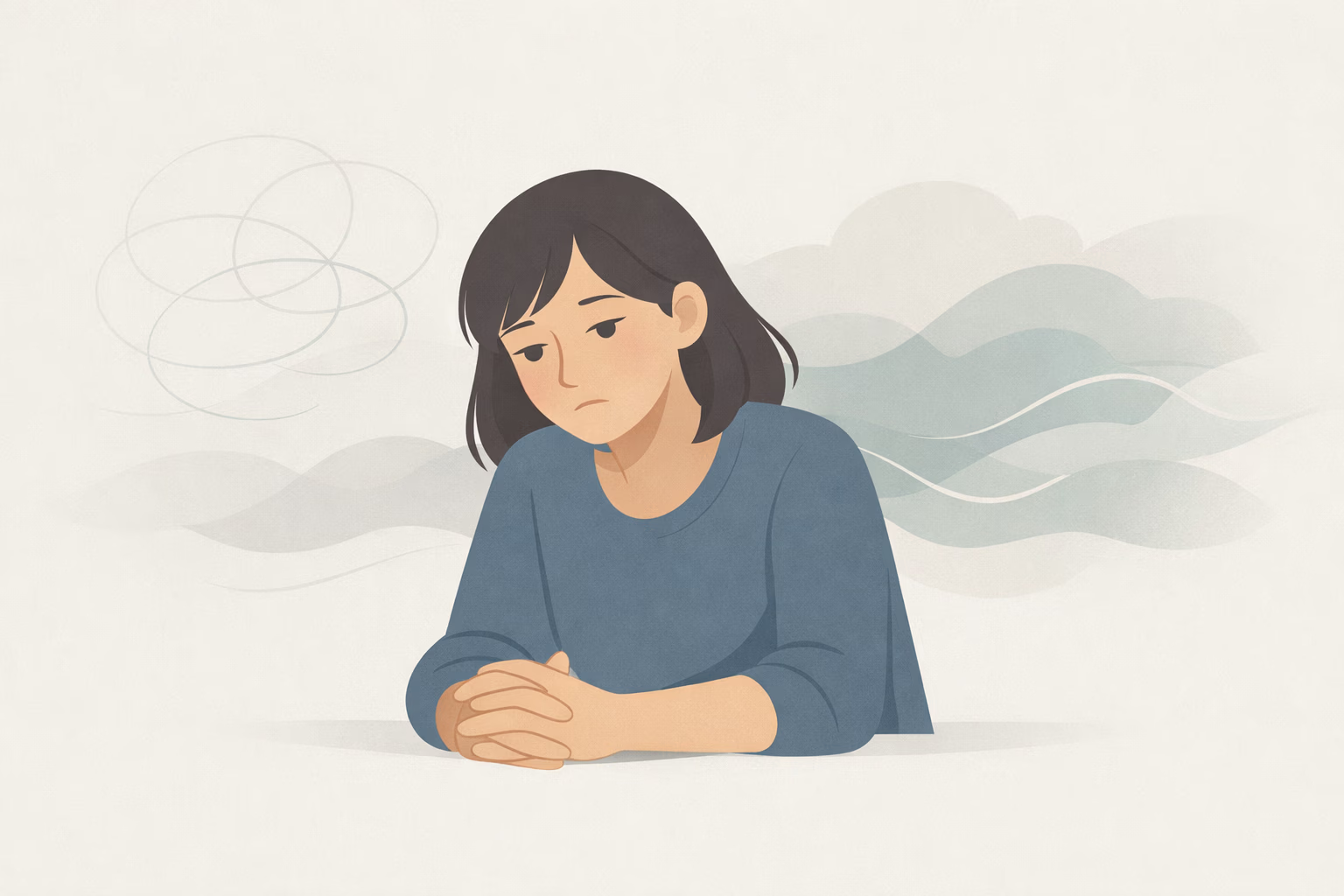
In short: Ambivalence is the experience of receiving conflicting emotional signals at the same time—wanting something and resisting it, feeling drawn in and pulled away. The result is often not a clean “yes” or “no,” but inner static: confusion, mental replay, and a sense that your own reactions have become unreliable.
Ambivalence is the experience of receiving conflicting emotional signals at the same time—wanting something and resisting it, feeling drawn in and pulled away. The result is often not a clean “yes” or “no,” but inner static: confusion, mental replay, and a sense that your own reactions have become unreliable.
What if the confusion isn’t a character flaw, but a sign your system is trying to hold more than one truth at once?
In a nervous system under load, mixed signals can feel intolerable. But ambivalence often appears when multiple needs, risks, and values are active simultaneously. It’s less like “not knowing what you want” and more like “more than one part of life is asking to be included.”
Ambivalence can feel like standing at a doorway with one foot forward and one foot back. You might experience urgency and resistance together: anticipation paired with dread, relief paired with grief, attachment paired with irritation. This tension can be mentally exhausting because it prevents the “done” signal that usually comes when a direction is clear.
When the mind can’t settle, it often tries to compensate by collecting more certainty: more thinking, more checking, more reviewing. But the distress isn’t proof you’re broken—it’s proof your system is carrying competing inputs at the same time. [Ref-1]
Why does it feel so personal?
Because the conflict is inside you. When signals don’t line up, it’s easy to conclude “I’m inconsistent” or “I’m dramatic.” In reality, ambivalence is often what it looks like when your internal guidance is working with complex, real-world trade-offs.
Humans don’t make decisions from a single, unified “emotion center.” Multiple cognitive–emotional systems evaluate the same situation through different lenses: safety, attachment, status, fairness, opportunity, future consequences, belonging. When more than one lens is activated, you can get mixed feelings that are each coherent within their own logic.
For example, one signal might be oriented toward protection (prevent loss, avoid regret), while another is oriented toward expansion (pursue growth, move toward meaning). Neither signal is “wrong.” They’re reporting from different internal dashboards.
This is why ambivalence can show up even when you understand the situation intellectually. It isn’t a lack of insight. It’s a simultaneous activation of competing needs and evaluations that have not yet reached completion. [Ref-2]
From an evolutionary perspective, inner conflict isn’t a design mistake. It’s a feature that helps humans weigh trade-offs before acting—especially in social and high-stakes environments where choices can create ripple effects. A system that can only feel one thing at a time would be fast, but not necessarily wise.
Executive attention—the part of cognition that holds options, compares outcomes, and inhibits premature action—often becomes more active when the stakes are complex. Ambivalence can be the subjective experience of that holding pattern: your mind keeping multiple possibilities online long enough to evaluate them. [Ref-3]
So the “stuck” feeling may not mean you’re incapable of deciding. It may mean your system is refusing to collapse complexity into a simple story too early.
Ambivalence often functions like a psychological pause button. When a choice would close doors—changing a relationship, leaving a job, moving cities, setting a boundary—the system may delay commitment so that more information can surface: consequences, relational impact, personal cost, long-term fit.
This delay isn’t always comfortable, but it can be protective. Holding opposing signals keeps the mind from locking into a decision that later feels misaligned or dissonant. In other words, ambivalence can be a mechanism that prevents “false closure,” where you decide just to escape discomfort. [Ref-4]
Sometimes the conflict isn’t asking to be eliminated. It’s asking to be taken seriously long enough for the real shape of the choice to appear.
Many people interpret emotional conflict as dysfunction: “If I were healthy, I’d feel certain.” But mixed emotions are common in normal human life—especially around endings, transitions, and commitments that matter. [Ref-5]
Ambivalence tends to arise where there is real value on both sides: what you gain and what you lose, what you protect and what you risk. The presence of conflict can actually indicate that you’re oriented to meaning—because only meaningful situations generate meaningful trade-offs.
When the mind treats ambivalence as proof of defect, it adds a second layer of pressure. Now you’re not only holding two signals; you’re also trying to get rid of one to feel “normal.” That pressure often intensifies the loop.
Ambivalence becomes painful when it stops functioning as a temporary holding pattern and turns into a closed circuit: endless evaluation without completion. Overthinking can replace integration—not because you’re afraid of feelings, but because the system is searching for a consequence-free path through a consequence-full choice.
In an avoidance loop, the mind keeps swapping interpretations instead of letting the situation reach an internal “settled” state. The resistance that would normally clarify a boundary gets bypassed. The cost that would normally help a decision land gets muted by more analysis. The result is motion without closure. [Ref-6]
Over time, the person doesn’t just feel uncertain about the decision—they feel uncertain about themselves. That’s not an identity problem. It’s what prolonged non-closure does to a nervous system.
When mixed signals persist, the mind often tries to force coherence by tightening control or chasing certainty. The patterns can look different person to person, but they often share the same structure: repeated mental movement that doesn’t deliver completion.
None of these patterns mean you’re incapable of commitment. They often mean your system is holding more variables than it can metabolize at once. [Ref-7]
Ambivalence isn’t just a “thinking problem.” When a decision stays open, the body can remain in a state of low-grade activation: scanning, bracing, preparing. Over time, this can lead to decision fatigue, irritability, sleep disruption, and a sense of being internally crowded.
As load rises, your capacity for nuance often drops. The mind becomes more black-and-white, not because you’ve become rigid, but because complexity is expensive when your system is tired. The longer the loop runs, the more tempting it becomes to grab any answer that offers immediate relief—even if it doesn’t truly resolve the underlying trade-offs. [Ref-8]
Why does it get harder to “hear yourself” over time?
Because the signal-to-noise ratio shifts. Under sustained activation, subtle internal cues are harder to register, and the loudest signal (urgency, dread, pressure) can drown out quieter but important information (values, long-term fit, relational reality).
One of the fastest ways to intensify ambivalence is to judge it. When mixed feelings are labeled as immaturity, inconsistency, or “overreacting,” the system loses a sense of safety to process complexity. The mind then works even harder to produce a single, defensible answer—often by arguing with itself.
This is where rumination can take over: not because you lack insight, but because the internal environment becomes adversarial. Each signal has to justify its existence. That stance can keep the experience from reaching closure, because closure requires that the competing inputs are allowed to fully register as real data. [Ref-9]
When you’re busy proving one side is illegitimate, the other side never gets to become genuinely settled.
Ambivalence often softens when interpretation slows down. Not through “positive thinking,” and not through forcing a new story, but through allowing the two signals to stand side by side long enough to reveal what each is protecting.
This is a different posture than solving. It’s more like organizing: noticing that one signal might be about preserving dignity, stability, or attachment, while another is about honesty, freedom, or growth. Coexistence reduces internal friction because the system no longer has to erase one truth to validate the other. [Ref-10]
What changes when you stop demanding immediate certainty?
The nervous system often de-escalates from emergency mode. The question shifts from “Which feeling wins?” to “What is the full shape of what matters here?” That shift doesn’t equal integration by itself—but it can reduce the churn that prevents completion.
Because ambivalence is multi-signal, it can be hard to hold it cleanly in working memory. Dialogue—being witnessed, naming both sides aloud, hearing yourself in a relational space—can help organize the inputs without forcing them into a premature conclusion.
External reflection (with a trusted person, a structured conversation, or a skilled professional) can also reduce the hidden “performance” layer that often fuels inner confusion: the pressure to sound certain, to justify your choice, to be consistent. When that pressure drops, signals often become easier to distinguish. [Ref-11]
Importantly, the value here isn’t someone giving you the answer. It’s the way a steadier container can reduce load, making it more likely that your own internal cues return with clearer resolution.
Coherence doesn’t always arrive as a dramatic moment of certainty. More often, it arrives as a quiet reduction in internal argument. The same facts are present, but the system stops spinning. The choice may still carry cost, but it becomes less mentally noisy.
In this shift, nuance becomes more tolerable. You can hold “I want this” and “this is hard” without needing one to cancel the other. Ambivalence doesn’t necessarily disappear; it becomes integrated into a larger, steadier orientation—where complexity is allowed, and the nervous system isn’t forced to resolve it through urgency. [Ref-12]
What’s a subtle sign of restored capacity?
When your attention returns from repetitive evaluation to the rest of your life—sleep, appetite, connection, concentration—without constant internal checking. That return is often a clue that some form of closure has begun to take hold.
When competing signals become clearer, decision-making tends to shift from “escaping discomfort” to “choosing what fits.” Values become easier to access—not as slogans, but as lived priorities: what you’re willing to carry, what you’re no longer willing to trade away, what kind of person you’re trying to be in the situation.
In that state, agency often feels different. It’s less like forcing yourself and more like standing in a direction. Even when a decision includes loss, the internal system can settle because the choice reflects a coherent identity rather than a temporary mood. [Ref-13]
Ambivalence, then, is not the opposite of meaning. For many people, it’s the doorway—because it highlights where multiple meaningful needs are asking to be acknowledged before life can move forward.
Ambivalence often points to layered needs: safety and growth, loyalty and truth, rest and ambition, belonging and independence. Instead of being evidence that you “don’t know yourself,” it can be evidence that you’re perceiving the real complexity of a situation that matters. [Ref-14]
When modern life demands fast answers—hot takes, immediate closure, constant self-certainty—ambivalence can feel like failure. But in many cases, it’s your system refusing to pretend. It’s a signal that more than one consequence is real, and more than one value is active.
Agency doesn’t come from crushing one side. It tends to emerge when the internal signals become organized enough that a direction can land and stay landed—without constant re-litigation.
Clarity often arrives when each feeling is understood as protective of something: a boundary, a bond, a hope, a history, a future self. You don’t have to be a perfectly consistent person to be a coherent one.
In many lives, the most meaningful decisions are the ones that carry mixed feelings—because meaning rarely comes without cost. And sometimes what looks like inner confusion is simply a nervous system waiting for a choice that can be completed all the way into identity. [Ref-15]
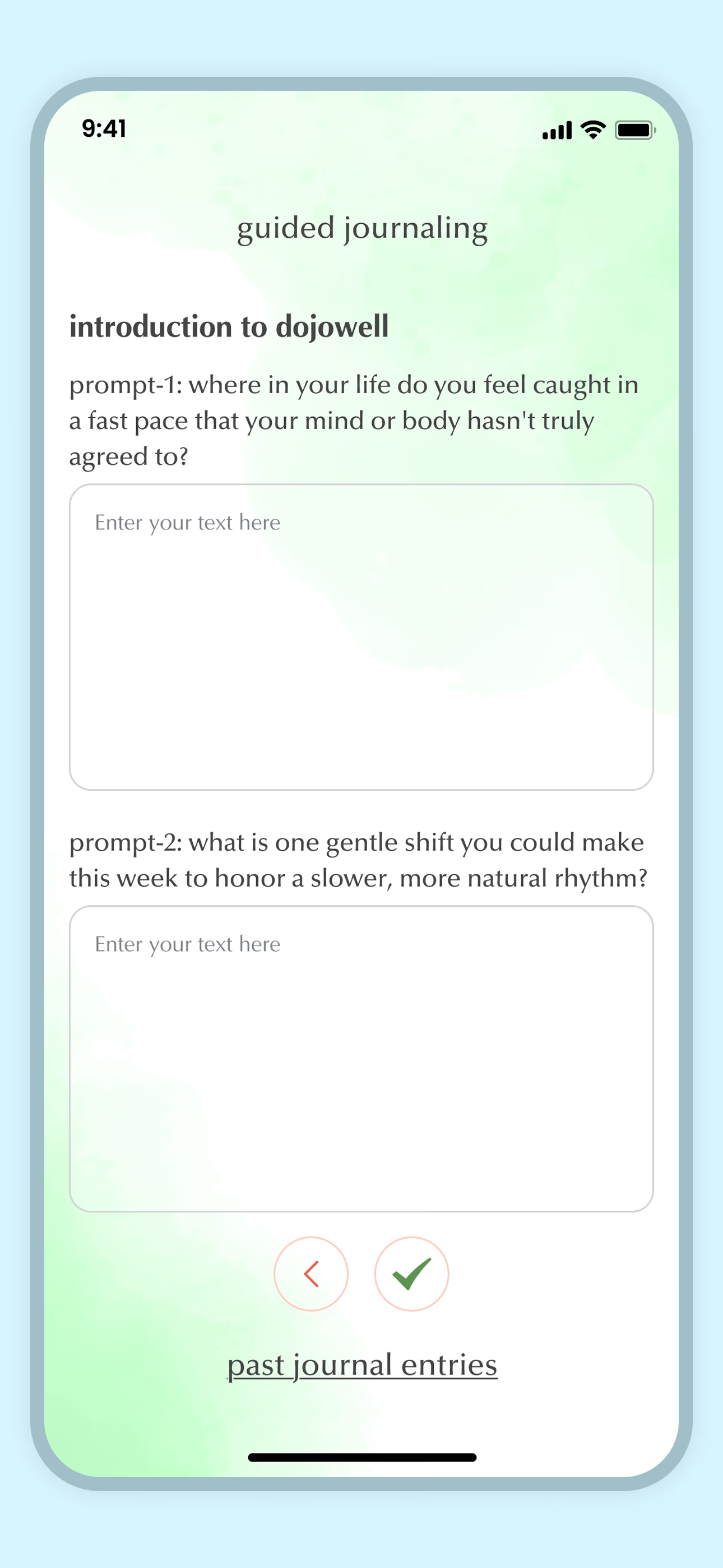
From theory to practice — meaning forms when insight meets action.
No — the article reframes it as your system holding more than one truth at once. Ambivalence appears when multiple needs, risks, and values are active simultaneously: safety and growth, loyalty and truth, rest and ambition, belonging and independence. It's less 'not knowing' and more 'more than one part of life is asking to be included.' Different cognitive-emotional systems evaluate the same situation through different lenses, and each signal can be coherent within its own logic. The presence of conflict often indicates you're oriented to meaning, because only meaningful situations generate meaningful trade-offs.
Because it prevents the Done Signal that usually arrives when a direction is clear. The article describes the strain as standing at a doorway with one foot forward and one foot back. Urgency and resistance run together, anticipation pairs with dread. The body stays in low-grade activation — scanning, bracing, preparing — which leads to decision fatigue, irritability, and a sense of being internally crowded. As load rises, capacity for nuance drops, so the mind goes black-and-white not from rigidity but because complexity is expensive when the system is tired. That's why subtle internal cues get harder to hear.
When holding multiple signals stops being a temporary pause and turns into endless evaluation. The article is specific: the mind keeps swapping interpretations instead of letting the situation reach a settled state. Resistance that would clarify a boundary gets bypassed; cost that would help a decision land gets muted by more analysis. Motion replaces closure. Reassurance temporarily calms, then re-opens the loop. Over time, the person doesn't just feel uncertain about the decision — they feel uncertain about themselves. That's not an identity problem; it's what prolonged non-closure does to a nervous system carrying too many unresolved variables at once.
By letting the two signals coexist long enough to reveal what each is protecting. The article calls this organizing rather than solving. One signal might guard dignity, stability, or attachment; another might serve honesty, freedom, or growth. Coexistence reduces internal friction because the system no longer has to erase one truth to validate the other. Coherence usually arrives quietly — not as dramatic certainty, but as a reduction in internal argument. The same facts are present; the system stops spinning. Clarity isn't the absence of contradiction. It's understanding each feeling as protective of something real.
From Science to Art.
Understanding explains what is happening. Art allows you to feel it—without fixing, judging, or naming. Pause here. Let the images work quietly. Sometimes meaning settles before words do.
One Quiet Window, one insight, one reflection — every Sunday