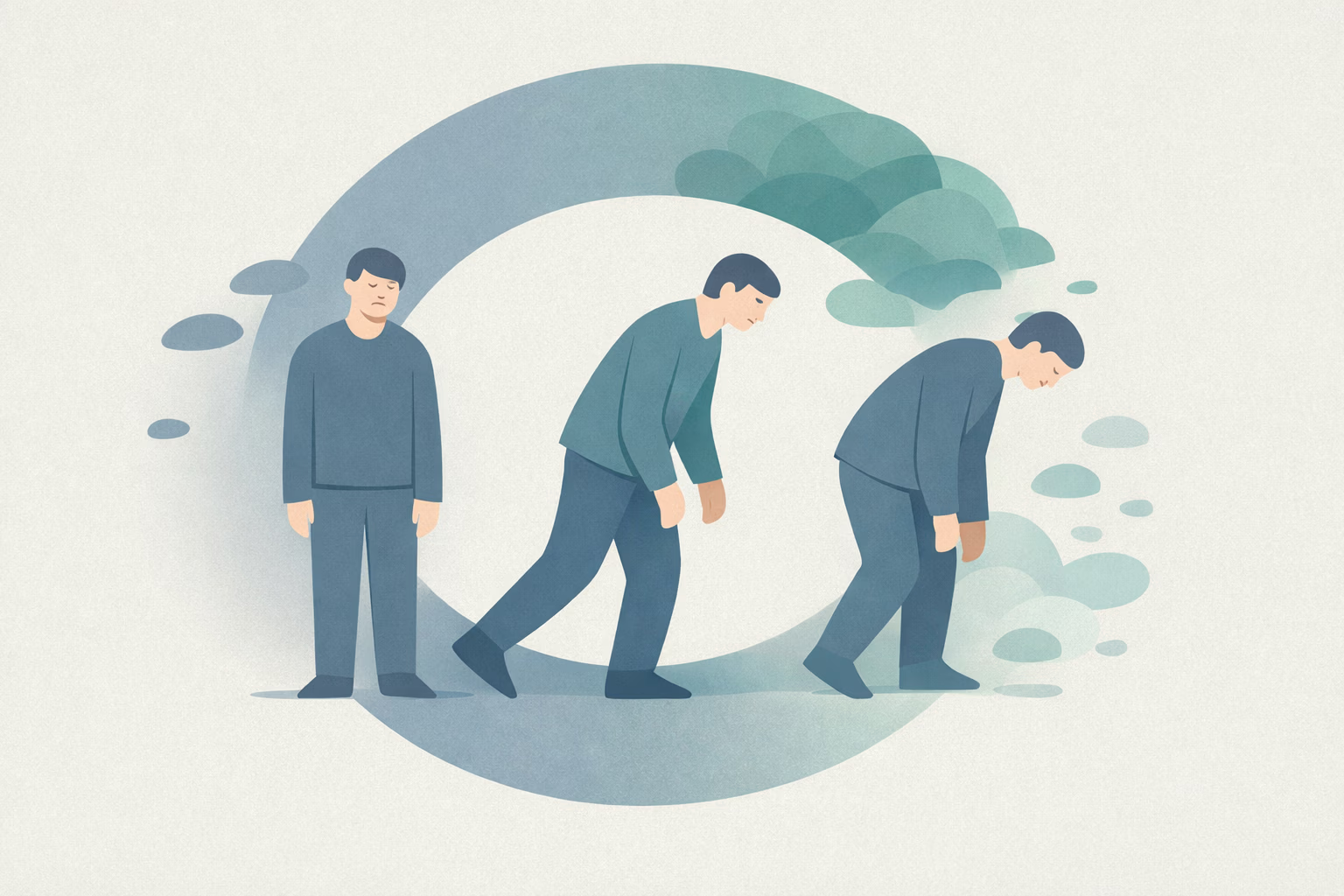
The Numb–Crave–Crash Cycle: Modern Life’s Emotional Loop

In short: Most people can name at least one activity that looks fine on paper—useful, entertaining, even “productive”—but reliably ends the same way: a hollow aftertaste, a flatness, a strange fatigue that doesn’t match the time spent. These are often drain cycles : repeatable loops where stimulation or effort is high, but restoration is low because the experience doesn’t land as coherent, completed, or identity-relevant.
Most people can name at least one activity that looks fine on paper—useful, entertaining, even “productive”—but reliably ends the same way: a hollow aftertaste, a flatness, a strange fatigue that doesn’t match the time spent.
These are often drain cycles: repeatable loops where stimulation or effort is high, but restoration is low because the experience doesn’t land as coherent, completed, or identity-relevant. The body can register this as “still on,” even after the activity ends.
What if the emptiness isn’t about you being ungrateful or broken—but about your system not getting a real “done” signal?
Drain cycles often have a signature: you finish the show, the scroll, the meeting, the gaming session, the cleaning spree, the inbox sweep—and instead of satisfaction there’s depletion. Not the clean fatigue of effort, but a muted, restless, emotionally thin feeling.
It can be confusing because the activity may not be objectively intense. Yet your system responds as if it has spent something important without getting anything stabilizing back. When value fit is low, the body tends to pay more to keep going—attention, inhibition, self-monitoring—without receiving the replenishing sense of completion that would let it stand down. [Ref-1]
“I did the thing, but it didn’t count as living.”
Two forces commonly converge in drain cycles: misalignment and overstimulation. Misalignment means the activity doesn’t match what your identity and values recognize as meaningful or self-respecting. Overstimulation means the activity delivers frequent cues, novelty, or evaluation that keep the nervous system engaged.
When both are present, regulatory systems work overtime. You may be tracking impressions, staying “on,” managing micro-decisions, or absorbing rapid inputs—while the deeper self doesn’t register the experience as worth the cost. Over time, this mismatch can show up as lowered well-being and increased exhaustion, even when the calendar doesn’t look extreme. [Ref-2]
Humans aren’t only regulated by calories, comfort, or dopamine hits. We are also regulated by narrative coherence—the sense that what we do forms a legible story about who we are and what matters. This isn’t a philosophical luxury; it’s a stabilizing function.
When an experience fits your values and identity, it tends to integrate as a completed “chapter.” When it doesn’t, the mind may keep it open: replaying, justifying, comparing, or trying to extract a lesson. That ongoing processing is load. And load—especially the kind that never resolves—can feel like emotional emptiness rather than visible stress.
Is it possible to be busy all day and still have nothing in you that feels settled?
A drain cycle isn’t always chosen because it’s enjoyable. Often it functions as a structural bypass: it reduces friction, quiets unanswered questions, or fills a gap in time that would otherwise expose uncertainty. The relief is real—just not the kind that completes anything.
In this way, a draining activity can operate like a short-term stabilizer. It offers predictable inputs and predictable roles (consumer, responder, achiever), which can temporarily reduce the strain of ambiguity. But because it doesn’t close the deeper loop—identity, values, belonging, direction—the system doesn’t get a stand-down signal afterward. Emotional exhaustion is a common downstream effect when value mismatch persists within relationships or roles. [Ref-4]
Modern culture often treats “full” as a proxy for “alive.” But busyness is a measurement of activity, not of coherence. A day can be packed with tasks and still fail to deliver the internal experience of completion.
Value congruence matters here. When what you’re doing aligns with what you consider important, effort is more likely to resolve into satisfaction. When it doesn’t, the same effort can feel like a tax—time spent without meaning returned. Research linking value congruence and burnout patterns suggests that mismatch can contribute to exhaustion even when people are succeeding externally. [Ref-5]
“I’m doing a lot, but none of it is feeding me.”
It’s tempting to frame drain cycles as “self-sabotage” or “avoidance because of fear.” But often the mechanism is simpler and more humane: the activity offers immediate structure and reduced consequence. It’s a reliable way to stay moving without having to metabolize the dissonance of an unfinished life question.
In an avoidance loop, a substitute activity stands in for meaningful engagement. It can be socially approved, even rewarded, while still leaving the internal story unformed. Values mismatch is frequently discussed as a hidden driver of burnout because it keeps people spending energy in places that don’t return stability. [Ref-6]
Drain cycles tend to announce themselves through patterns rather than one dramatic moment. These patterns are regulatory responses—your system’s attempt to manage load when completion is missing.
These can resemble burnout, but the felt sense is often: “I can function, but I can’t refill.” Misalignment-based exhaustion is increasingly described as a distinct experience—less about sheer hours, more about the gap between role and purpose. [Ref-7]
When drain cycles repeat, the system starts budgeting. Not consciously, but biologically: less tolerance for complexity, less patience for nuance, fewer available resources for connection. You may notice that even small decisions feel heavy, or that you default to the most automatic option.
This is not a lack of character; it’s what low capacity looks like. When your internal compass is repeatedly overridden, purpose signals can get quiet—not because they’re gone, but because the system is conserving energy. Work and life values that aren’t being lived tend to reduce the sense of meaning, and meaning is one of the strongest stabilizers for sustained engagement. [Ref-8]
When you’re depleted, do you start choosing what’s easiest to maintain—not what feels most like you?
One of the most disorienting effects of drain cycles is how they narrow agency. Reflection takes energy. Choosing differently takes energy. Even imagining a change takes energy. When your system is already taxed, the path of least resistance becomes the path of repetition.
This is how the loop self-perpetuates: depletion reduces the capacity for meaning-making and decision-making, which increases reliance on the same familiar, draining regulators. Over time, the person may feel “stuck,” not because they lack insight, but because their system is operating under chronic load with too few closure points. Misalignment has been described as a quiet factor that maintains burnout-like patterns by keeping life organized around what doesn’t truly fit. [Ref-9]
Energy often returns when activities stop being merely consumptive or performative and start becoming coherent—connected to values, roles that feel legitimate, and outcomes that actually land as complete. This doesn’t mean every moment becomes inspiring. It means your system can recognize what you’re doing as part of a life that makes sense.
In alignment, effort is more likely to convert into a settled internal signal: “that mattered,” “that’s me,” “that is done.” The shift is not a pep talk or a mindset change; it’s a physiological lowering of background strain when the story and the behavior match. This is why misalignment burnout can persist even with rest—rest changes state, but alignment changes the structure that keeps the loop open. [Ref-10]
“I don’t need more intensity. I need my actions to belong to my life.”
Because drain cycles can become “normal,” they’re easier to see in relational mirrors: conversations, teams, communities, or trusted observers who reflect back what seems to energize you versus what seems to thin you out. This isn’t about being told what to do; it’s about having your experience witnessed clearly enough that it becomes legible.
Shared meaning also reduces load. When the context signals purpose, belonging, and contribution, the nervous system tends to spend less energy on self-protection and self-justification. Environments that emphasize meaningful work and supportive feedback loops are often associated with stronger engagement—because people can locate themselves in the story of what they’re doing. [Ref-11]
When drain cycles loosen, the change is often subtle before it is dramatic. Not a constant high, but a return of signal: you can tell what matters again. You can finish something and feel the “done” land. Your attention comes back from scattered places.
People often describe this as vitality, steadier engagement, and clearer emotional weather—not because they are forcing themselves to care, but because caring no longer costs as much. When work and life feel meaningful, engagement tends to become more sustainable and less brittle, because it’s anchored in coherence rather than constant stimulation. [Ref-12]
Over time, many people notice they have a reliable internal metric: not “did I do enough?” but “did that leave me more coherent or more scattered?” Energy becomes information—about fit, pacing, and the presence (or absence) of closure.
This is important because even genuinely engaging roles can become exhausting when the system never gets to complete cycles—when demands are endless, boundaries are porous, or evaluation is constant. Research on engagement and exhaustion suggests the relationship is complex: engagement isn’t automatically protective if recovery and closure are missing. [Ref-13]
When your day contains experiences that close—conversations that resolve, tasks that end, contributions that feel real—the nervous system learns it is safe to stand down. That stand-down is where meaning becomes stable.
When success or activity feels empty, it can be tempting to interpret that as ingratitude, weakness, or failure. A kinder and more accurate frame is that your system is giving feedback: the inputs are high, but the coherence return is low.
Drain cycles aren’t proof that you’re incapable of meaning. They’re a sign that meaning is being asked to live in an environment that fragments attention, rewards constant responsiveness, and postpones completion. When you name the pattern as structural rather than moral, the experience often becomes less shameful and more navigable. [Ref-14]
Emotional energy is not only a fuel tank; it’s also a coherence signal. When what you do aligns with what you value, and when experiences actually complete, the body often stops bracing against its own days.
If certain activities leave you empty, that emptiness may be pointing to misalignment rather than inadequacy—an invitation to treat meaning as a basic human requirement, not a luxury. In many contexts, distinguishing misalignment from simple overwork can change the whole story of what’s happening. [Ref-15]
From theory to practice — meaning forms when insight meets action.
Because the body distinguishes between activity and coherence. Drain cycles are loops where stimulation or effort is high but restoration is low — the experience doesn't land as completed or identity-relevant, so the system never gets a real Done Signal. When value fit is low, the body pays more to keep going (attention, inhibition, self-monitoring) without receiving anything stabilizing back. Misalignment plus overstimulation is the typical combination: high input, low closure, low congruence. The fatigue afterward isn't proportional to the time spent because what's tired isn't your muscles — it's the part of you that needed the activity to mean something.
It's more accurate to read it as feedback than as a moral verdict. The article is direct: emptiness is information about fit and closure, not evidence that you're broken or ungrateful. A day can be packed with tasks and still fail to deliver the internal experience of completion. Value congruence matters here — when what you're doing aligns with what you consider important, effort is more likely to resolve into satisfaction. When it doesn't, the same effort feels like a tax: time spent without meaning returned. 'I'm doing a lot, but none of it is feeding me' is a structural signal worth listening to.
Because rest changes state, but alignment changes the structure that keeps the loop open. Drain cycles often function as a substitute regulator inside an Avoidance Loop — the activity offers structure and reduced consequence, predictable inputs and roles that temporarily reduce the strain of ambiguity. The relief is real, just not the kind that completes anything. Because the deeper loop (identity, values, belonging, direction) stays open, the system doesn't get a stand-down signal afterward and reaches for the same regulator again. Restoration tends to require the activity itself to start matching what your identity recognizes as worth the cost.
Fatigue from genuine effort tends to feel clean and convertible into satisfaction once the task lands. Drain cycles produce a different texture: emotional flatness after entertainment, irritability after 'normal' obligations, motivation that returns briefly with novelty then drops, overcontrol that doesn't satisfy, a sense of 'I can function but I can't refill.' Energy becomes a reliable internal metric — not 'did I do enough?' but 'did that leave me more coherent or more scattered?' When activities start aligning with what you value and actually complete, the system stops bracing against its own days, and that's when meaning becomes stable.
From Science to Art.
Understanding explains what is happening. Art allows you to feel it—without fixing, judging, or naming. Pause here. Let the images work quietly. Sometimes meaning settles before words do.
One Quiet Window, one insight, one reflection — every Sunday