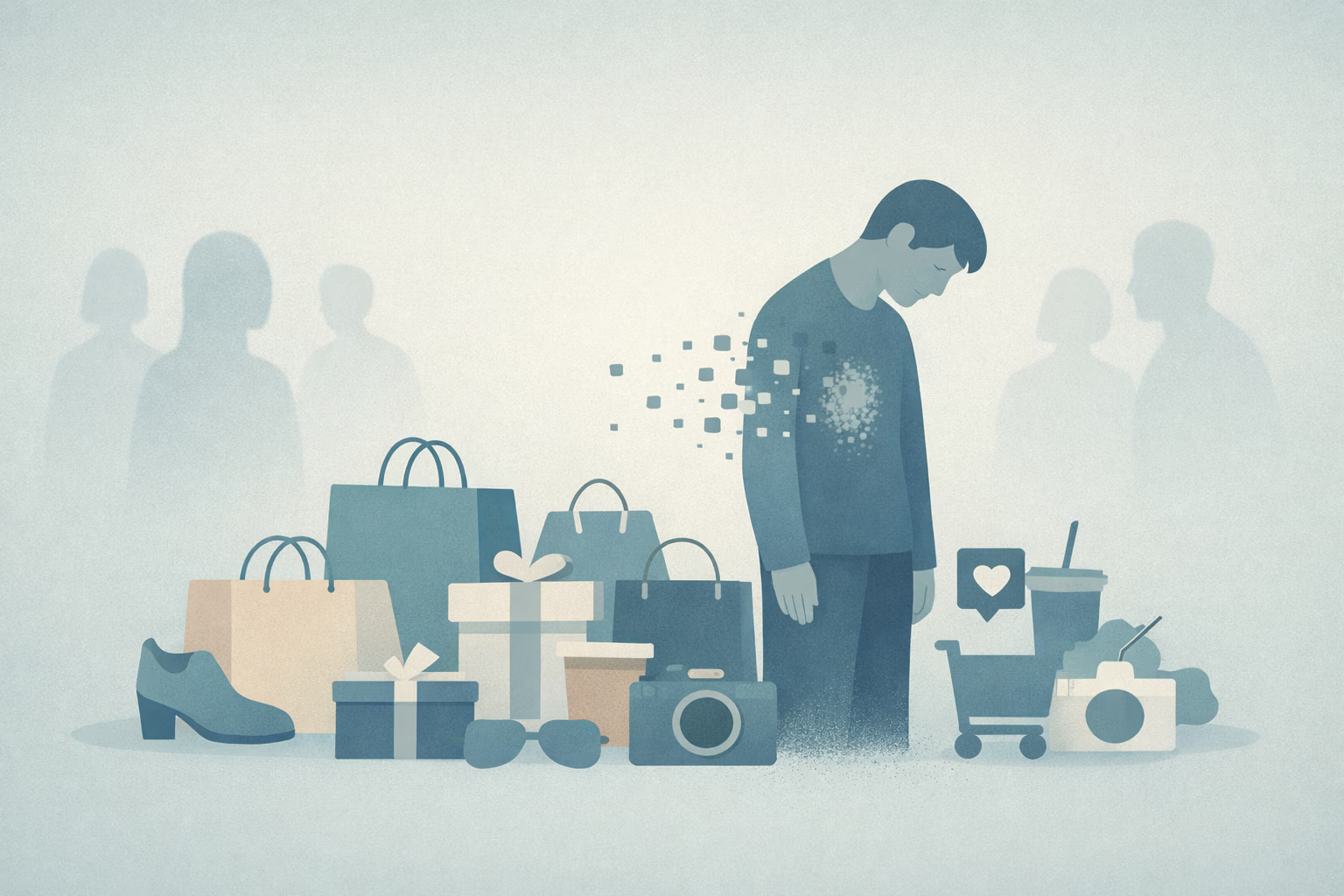
Identity Draining Through Overconsumption
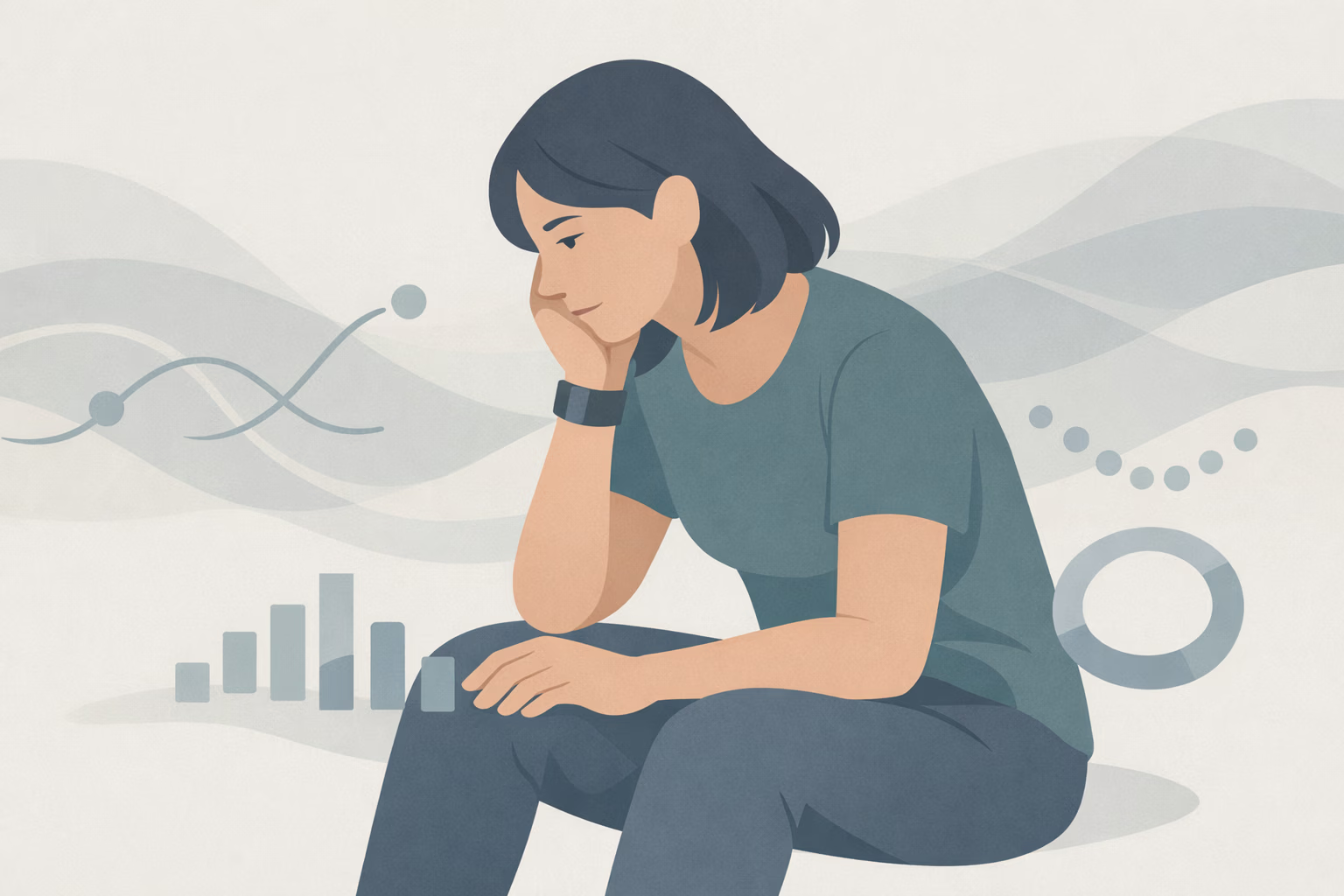
In short: Wearables can be genuinely helpful. They can reveal patterns, support consistency, and make health feel more tangible. The trouble begins when the numbers stop being information and start acting like authority—when a daily score feels more believable than your own internal signals.
Wearables can be genuinely helpful. They can reveal patterns, support consistency, and make health feel more tangible. The trouble begins when the numbers stop being information and start acting like authority—when a daily score feels more believable than your own internal signals.
This isn’t a character flaw or a “too obsessive” personality. It’s a predictable response to a world that rewards certainty, speed, and proof. When life is fragmented and evaluated, it’s understandable that a nervous system would prefer a dashboard to ambiguity.
What happens when the body becomes a project to measure, instead of a relationship to live in?
A common sign that tracking has become more than a tool is the specific discomfort that appears when data is unavailable: the watch didn’t record, the battery died, the sleep score looks “off,” the step count didn’t sync. The body might feel fine, but the mind can’t settle.
This restlessness isn’t irrational. Measurement can become a kind of safety cue—evidence that things are under control. When that cue disappears, the system stays slightly activated, scanning for what it can’t confirm. People often describe a subtle self-doubt that wasn’t there before tracking became central. [Ref-1]
Your body has built-in sensing: breath, temperature, fatigue, tension, appetite, steadiness, recovery. This internal sensing can guide pacing and choices—especially when life is stable enough for signals to be noticed and trusted.
Tracking can shift the center of gravity outward. Over time, the “answer” starts to live in the app: alerts, rings, readiness, zones, streaks. Regulation becomes outsourced. Instead of “What do I notice?” the question becomes “What does it say?” This is not a mindset issue—it’s a training effect. Attention goes where consequences and reassurance live. [Ref-2]
When a number is treated as the final word, the body’s signals aren’t necessarily gone—they’re simply no longer the deciding vote.
Humans are built to reduce uncertainty. In unpredictable conditions, prediction and control keep you safe: you track, compare, anticipate, adjust. Modern tracking technology fits beautifully into this ancient system, offering the feeling of clarity in a complex world.
When health becomes one of the few areas that seems trackable, it can quietly become the main place where certainty is pursued. The tracker doesn’t just record behavior—it can become a way to negotiate uncertainty, status, and self-trust in a culture that constantly ranks and evaluates. [Ref-3]
It can feel like the numbers are keeping you honest—until you realize they’re also keeping you on alert.
Quantified feedback offers immediate structure: a target, a boundary, a decision made. That structure can reduce cognitive load. Instead of carrying a dozen ambiguous body sensations, you get one clean output: good/bad, ready/not ready, on track/off track.
This is why metrics can feel soothing even when they create pressure later. They deliver quick closure—temporary completion—by telling the nervous system, “We know what’s happening.” Consumer wearables are designed to do this well, and many people experience genuine short-term relief from the clarity. [Ref-4]
But short-term reassurance can have a long-term cost when it replaces the slower, more context-sensitive closure that comes from lived completion: finishing a workout and noticing the after-state, sleeping and noticing restoration, eating and noticing steadiness.
More data can mean more information—but not always more wisdom. The body’s reality is contextual: stress load, relationships, weather, hormones, illness exposure, workload, season of life. A single metric rarely carries that whole picture.
When more measurement becomes the default response, adaptability can erode. You may become less able to navigate normal variability without a scoreboard. What used to be “a normal tired day” becomes “a problem to solve,” because the system has learned to interpret deviation as risk. [Ref-5]
Data can be precise without being complete.
In a power loop, regulation comes from dominance over uncertainty: tighter rules, more monitoring, more certainty. Tracking can slide into this loop because it offers a sense of mastery—an external proof that you are managing yourself correctly.
The issue isn’t caring about health. The issue is when health becomes synonymous with compliance to metrics, and the internal relationship with the body becomes secondary. In that shift, the body is treated less like a living system and more like a dataset to keep within range. This dynamic—where autonomy is negotiated through self-tracking—shows up in discussions of quantified-self culture and its promises of control. [Ref-6]
And once control becomes the stabilizer, letting go can feel like losing safety, even if the original goal was well-being.
Metric reliance often looks ordinary at first: checking steps, logging workouts, noting sleep. It becomes more disruptive when the tracker begins to govern choices that would normally be guided by lived signals.
Sleep is a clear example: people can become more restless when chasing a “perfect” sleep score, even as the pursuit undermines actual rest. [Ref-7]
When regulation lives outside the body, internal cues can start to feel less legible—not because the body stopped signaling, but because signal-return requires capacity. If stress load is high and attention is fragmented, subtle cues don’t register clearly. The app feels louder and more dependable.
This can increase anxiety over time. The system gets trained to treat internal sensation as insufficient evidence. A normal fluctuation becomes suspicious until verified. In sleep tracking, this can contribute to patterns where monitoring and perfectionism around sleep create more arousal, not less. [Ref-8]
In other words: the tracker can become a substitute for closure. It keeps the loop open—always checking, always updating—when the nervous system most needs a clean “done” signal.
Once a tracker becomes the primary source of certainty, anxiety can naturally increase when certainty is threatened. And the most available way to restore certainty is… more tracking. More checks. More rules. More interpretation.
This is how dependence forms without anyone deciding it should. The cycle can look like:
Sleep perfectionism is one place this spiral is being publicly discussed, but the same structure shows up with training readiness, calorie targets, and “recovery” scores. [Ref-9]
There’s a different kind of stability available—one that doesn’t come from tighter monitoring, but from a relationship that can settle. In that stability, data can be informative without being commanding.
Re-attunement isn’t an insight like “I should listen to my body.” It’s a gradual return of signal credibility after load decreases and experiences complete: movement that ends with a clear sense of enough; rest that lands; nourishment that registers as steadying. Over time, the nervous system begins to accept internal cues as usable information again. [Ref-10]
When the body is allowed to finish its own sentences, the urge to constantly check starts to soften.
Body trust doesn’t rebuild in a vacuum. It rebuilds when the surrounding environment provides safety cues: less evaluation, less comparison, fewer penalties for variability. In supportive contexts, it becomes easier to notice what is actually happening rather than what should be happening.
Shared movement spaces that normalize pacing, rest, and adaptation can reduce the feeling that every day must be proven. When people feel less watched—externally or internally—signals return with more clarity. Research discussions on integrating wearable data in care often emphasize that physiological data is best used alongside lived context, not as a standalone verdict. [Ref-11]
When the culture around you allows “enough,” the body is more likely to believe it.
When internal guidance returns, it often shows up as simplicity. Decisions require less negotiation. Movement becomes more flexible. A low-energy day can be interpreted as information rather than failure.
This doesn’t mean numbers disappear; it means their emotional weight changes. Tracking can become optional again—something you consult, not something you answer to. In studies of self-tracking and well-being, benefits tend to be strongest when tracking supports autonomy and interpretation rather than rigid control. [Ref-12]
At its best, fitness is not a daily test—it’s a way of living with your body over time. Values like vitality, steadiness, play, longevity, recovery, and connection can guide choices more reliably than a streak.
When actions align with values, the nervous system gets a different kind of closure: “This is who I am and how I live,” not “I passed today.” That identity-level coherence tends to be stabilizing. Data can still participate, but as one input among many—alongside sensation, context, and lived experience. [Ref-13]
Numbers can describe your day. They don’t have to define your relationship with yourself.
If you’ve felt pulled into constant checking, it doesn’t mean you’re vain, weak, or broken. It means your system found a fast way to create certainty in an uncertain world. That makes sense.
But health is bigger than measurement. It includes trust, adaptability, and the ability to let experiences complete so the body can stand down. In that frame, tracking is not the driver; it’s a tool that can either support autonomy and meaning—or quietly replace them. [Ref-14]
When the relationship comes first, the numbers can take their proper size.
Wearables are good at counting. Bodies are good at integrating. A stable, meaningful approach to movement often emerges when the body is allowed to register completion—effort, recovery, nourishment, rest—so guidance comes from lived coherence, not constant verification.
In that steadier relationship, data can be a helpful description rather than a daily verdict. And fitness can return to what it was always meant to be: a supportive partnership with your own physiology over time. [Ref-15]
From theory to practice — meaning forms when insight meets action.
Because measurement has become a safety cue — evidence that things are under control. When that cue disappears, the system stays slightly activated, scanning for what it can't confirm. The body might feel fine, but the mind can't settle. This restlessness isn't irrational; it's what happens when regulation has been outsourced to an external dashboard. The article frames this as the center of gravity moving outward: instead of 'What do I notice?' the question becomes 'What does it say?' Without the data, the Threat & Safety System reads the absence as risk, even when nothing has actually changed in your body.
Not always, but the article points to a specific pattern where it can. Tracker obsession can become a Power Loop: regulation by dominance over uncertainty — tighter rules, more monitoring, more compliance — instead of relationship with the body. Sleep is the clearest example, where chasing a perfect score creates more arousal and less actual rest. The same structure shows up with training readiness, calorie targets, and recovery scores. The issue isn't caring about health; it's when health becomes synonymous with compliance to metrics, and the internal relationship with the body becomes secondary to keeping numbers in range.
Because quantified feedback offers immediate structure — a target, boundary, decision made — and that structure reduces cognitive load. Instead of carrying ambiguous body sensations, you get one clean output: good/bad, ready/not ready. Metrics deliver quick closure by telling the nervous system 'we know what's happening.' The short-term reassurance is real. But data can be precise without being complete: the body's reality is contextual, shaped by stress load, relationships, hormones, illness, season of life. A single metric rarely carries that whole picture, and over-reliance on it erodes adaptability — normal variability starts registering as risk.
Not by force of insight ('I should listen to my body') but through the gradual return of signal credibility after load decreases and experiences complete. Movement that ends with a clear sense of enough; rest that lands; nourishment that registers as steadying. Over time, the nervous system begins to accept internal cues as usable information again. Numbers can still participate, but their emotional weight changes — they become something you consult, not something you answer to. When the body is allowed to finish its own sentences, the urge to constantly check softens. Health becomes relationship rather than compliance.
From Science to Art.
Understanding explains what is happening. Art allows you to feel it—without fixing, judging, or naming. Pause here. Let the images work quietly. Sometimes meaning settles before words do.
One Quiet Window, one insight, one reflection — every Sunday