
Internal Stillness: Finding Silence in a Loud Inner World
In short: Enough room for a thought to form, a choice to appear, a moment to land without immediately being crowded out by the next demand. People often describe this as “finally being able to think,” but it isn’t about becoming smarter or more motivated.
Internal expansion is the lived sense that there’s space inside you again: enough room for a thought to form, a choice to appear, a moment to land without immediately being crowded out by the next demand.
People often describe this as “finally being able to think,” but it isn’t about becoming smarter or more motivated. It’s what your system does when the noise floor lowers—when attention isn’t constantly pulled outward, and when inner signals can return to baseline instead of staying braced.
What if the problem isn’t you—what if your mind is simply operating without enough closure?
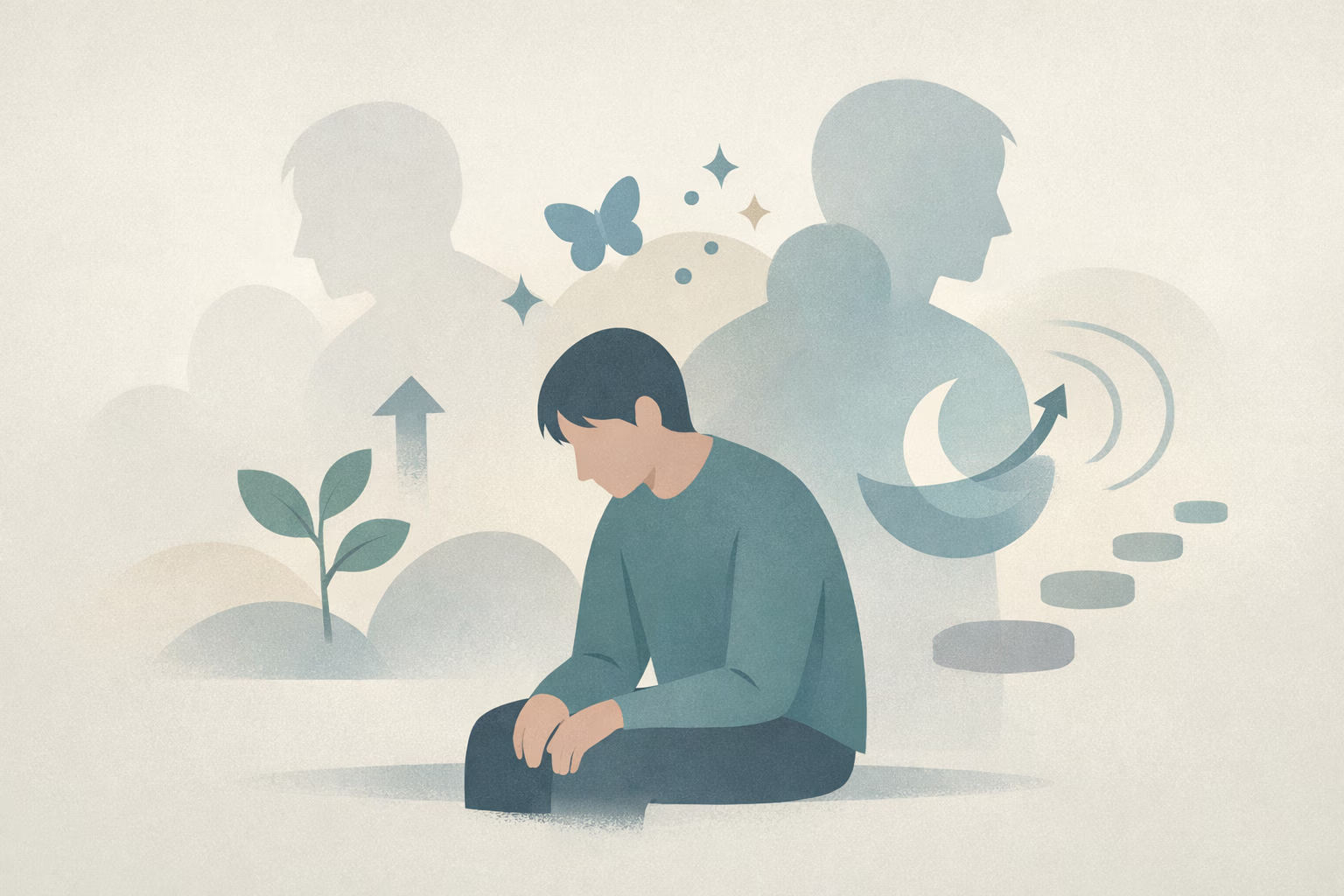
When internal space shrinks, it can feel like living in a crowded room where every surface is already covered. Thoughts arrive already urgent. Decisions feel heavy before you’ve even made them. Even small tasks can carry a faint sense of pressure, as if everything must be handled right now.
This is not a character flaw. It’s often a sign of cognitive overload: more inputs, more open loops, and more micro-demands than working attention can hold at once. When load stays high, the nervous system doesn’t get the “done” signal it needs to stand down, so the mind remains in a tight, scanning posture. [Ref-1]
When there isn’t enough room inside, even neutral moments can feel like they’re asking something from you.
Internal expansion isn’t created by forcing calm or “thinking positively.” It tends to show up when the volume of competing cues decreases and the executive system can sort what matters from what doesn’t. In that state, fewer signals fight for the same limited bandwidth, and attention can reallocate without constant friction.
Modern “always-on” conditions reliably increase cognitive noise: alerts, tabs, shifting priorities, and the subtle pressure to respond quickly. Over time, this can keep the mind in a semi-activated state where it’s hard to feel finished with anything, even after you stop working. [Ref-2]
Spaciousness is often a capacity issue, not an effort issue.
Human attention evolved to track change: movement, novelty, social cues, potential risk. That bias toward scanning is protective in uncertain environments. The challenge is that modern life supplies “change” continuously—new headlines, new messages, new metrics, new comparisons—so the scanning system rarely gets to complete its cycle.
When the brain is asked to process too many competing elements, it doesn’t just get tired; it gets narrower. It prioritizes speed, salience, and immediate signals over depth and integration. That narrowing can feel like restlessness, mental buzzing, or a sense that you can’t quite “land” on a thought long enough to finish it. [Ref-3]
When internal space returns, relief can arrive quickly—not because life is suddenly easy, but because the mind is no longer forced to multitask at the level of identity. You can hold one thing without five other things elbowing their way in. Your attention stops ricocheting, and your system gets a clearer signal about what is actually happening right now.
Digital multitasking has been associated with costs to attention and executive functioning, including a more “twitchy” attentional style. When that twitchiness eases, people often report clearer thinking and a softer emotional tone—not as a breakthrough, but as a natural consequence of reduced interference. [Ref-4]
Relief isn’t the same as integration—but relief can create the conditions where completion becomes possible.
It’s understandable to reach for more input when you feel uncertain. More research, more opinions, more tabs—because clarity seems like it should be “out there,” waiting to be collected. But information adds weight unless something inside you can organize it into a finished story.
Even when offloading information boosts short-term performance, it can weaken the internal sense of ownership and recall—the feeling that you genuinely have the thing, rather than having access to it. That can keep the mind leaning outward, searching again and again, instead of settling. [Ref-5]
Sometimes the mind isn’t asking for more data. It’s asking for enough quiet to make something real.
Meaning isn’t produced by intensity. It emerges when experience can be processed to completion—when events, choices, and values connect into a coherent “this is what happened, and this is who I am in it.” When internal space is constrained, that loop can’t complete. Not because you’re avoiding anything, but because there isn’t enough room to metabolize what’s already present.
In overload, reflection gets replaced by management: keeping up, tracking, responding, bracing. Cognitive offloading can help with immediate strain, but it can also leave life feeling less internally held—more like a set of external dependencies than a lived, integrated narrative. [Ref-6]
When the meaning loop can’t close, the system keeps scanning for what’s missing.
Internal crowding often shows up as patterns that look psychological, but are frequently structural: too many active threads competing for limited working memory and executive control. Working memory is a narrow workspace; when it’s packed, even ordinary life can feel like a juggling act. [Ref-7]
These are regulatory responses: the mind attempting to create order when the environment keeps re-opening loops faster than they can close.
When cognitive load stays high, it doesn’t only make you tired. It can thin out judgment, reduce flexibility, and make creativity harder to access—not because you “lost your spark,” but because the system is conserving resources. Mental fatigue from prolonged cognitive load is linked with reduced performance and altered self-regulation, which can make everything feel more effortful than it “should” be. [Ref-8]
In that state, the mind tends to default to what’s immediate and loud. Subtler signals—values, long-term priorities, relational nuance—can be harder to detect. It’s not that they disappear. They just can’t compete with the volume.
One of the hardest parts of internal crowding is that it can self-reinforce. When regulation capacity drops, the mind becomes more distractible. When it becomes more distractible, tasks take longer. When tasks take longer, more loops remain open. And open loops keep the nervous system oriented toward “not finished yet.”
Digital overload adds another layer: the environment keeps supplying new prompts before the previous ones have been digested. Over time, the mind can start to feel like it’s always catching up—even during rest—because rest is still filled with input. [Ref-9]
It’s not that you can’t focus. It’s that focus is being repeatedly interrupted before it can complete.
Internal expansion tends to return through conditions that support attentional pacing—fewer abrupt transitions, clearer edges, and less simultaneous demand. This isn’t about “discipline.” It’s about containment: having experiences that start, proceed, and end in a way the nervous system can register as complete.
When pacing improves, the mind doesn’t have to hold everything at once. It can sequence. It can finish. And as more moments reach a natural endpoint, the body receives more stand-down cues. That’s often when people notice space returning—not as a technique, but as a physiological shift toward coherence. [Ref-10]
Spaciousness is what it feels like when your attention is allowed to have edges.
Internal space is not created only “inside.” It’s strongly shaped by what surrounds you: the clarity of expectations, the number of active channels, the ambiguity in relationships, and how often you have to guess what someone means.
Supportive environments reduce cognitive load by decreasing inference and rework. Clear communication, fewer competing priorities, and predictable rhythms can function as safety cues—signals that you don’t have to keep scanning for hidden requirements. When that scanning eases, bandwidth returns. [Ref-11]
As internal space returns, people often describe a simple shift: thoughts become less sticky and less urgent. There’s more room between stimulus and response—not as a moral victory, but as increased capacity. You may notice more natural pauses, more coherent recall, and a quieter background hum.
Some of this relates to how the brain uses downtime. When the system isn’t constantly tasked with active control, it can shift into modes that support consolidation and narrative stitching—linking experiences into a more continuous sense of self. Rest and “non-doing” states have been discussed as supportive of these integrative background processes. [Ref-12]
It’s not emptiness. It’s enough space to let a thought finish its sentence.
Meaning-guided living doesn’t usually arrive as a dramatic revelation. It shows up as orientation: you can sense what matters and what doesn’t, because your attention isn’t saturated. In that state, values become usable—not as slogans, but as lived criteria that shape decisions.
With more internal room, the mind can wander in a healthier way—connecting distant ideas, revisiting experiences, and forming new coherence. Creativity and mind-wandering networks are often discussed as important for recombination and insight, especially when the brain is not locked into constant task-switching. [Ref-13]
Space is what lets identity become a compass instead of a battleground.
Internal expansion is less about “getting better at life” and more about restoring the conditions where life can be held inside you without constant spillage. When load decreases and loops can close, the nervous system has a chance to complete cycles, and meaning becomes easier to sense—not because you forced it, but because you finally have room for it.
In that room, agency tends to return in a quieter form: not frantic control, not constant searching, but a steadier ability to choose what you give your attention to and what you let pass. Mind wandering, when not hijacked by endless prompts, can be part of how the mind regains continuity and mental health—another way the system reorganizes when pressure drops. [Ref-14]
When the inner world becomes more spacious, you don’t become a different person—you become easier to live with from the inside. There is more room for nuance, more room for completion, and less need for constant bracing.
And over time, that spaciousness can feel like a kind of letting go that actually holds: not forgetting, not bypassing, but a quieter sense that things have found their place. Even simple acts of sorting and releasing can be beneficial when they truly reach an endpoint—when the system registers, finally, that it’s done. [Ref-15]
From theory to practice — meaning forms when insight meets action.
It's the lived sense that there's room inside you again — enough for a thought to form, a choice to appear, a moment to land without immediately being crowded out by the next demand. It isn't about becoming smarter or more motivated; it's what happens when the noise floor lowers and inner signals can return to baseline instead of staying braced. When that space is missing, even neutral moments feel like they're asking something from you. Spaciousness is a capacity issue, not an effort issue. The mind isn't malfunctioning; it's operating without enough closure to settle.
Because clarity isn't usually outside waiting to be collected. Information adds weight unless something inside you can organize it into a finished story. Even when offloading to external sources boosts short-term performance, it can weaken the internal sense of ownership — the feeling that you genuinely have the thing rather than having access to it. That keeps the mind leaning outward, searching again and again, instead of settling. Sometimes the mind isn't asking for more data; it's asking for enough quiet to make something real. Clarity tends to reduce options into a coherent next reality; noise multiplies possibilities without completion.
Because the scanning system rarely gets to complete its cycle. Modern life supplies change continuously — new headlines, messages, metrics, comparisons — so the brain stays narrow, prioritizing speed and salience over depth and integration. Cognitive offloading helps with immediate strain but can leave life feeling less internally held. The mind defaults to what's immediate and loud; subtler signals like values and long-term priorities can't compete with the volume. When working memory is packed, ordinary life feels like juggling — racing thoughts, decision fatigue, mental urgency, overcontrol. These are regulatory responses to too many open loops, not personal defects.
Through pacing and containment, not discipline. Internal expansion tends to return when conditions support attentional pacing — fewer abrupt transitions, clearer edges, less simultaneous demand. The point isn't to force calm; it's to have experiences that start, proceed, and end in a way the nervous system can register as complete. As more moments reach a natural endpoint, the body receives more stand-down cues. Restored space shows up as thoughts becoming less sticky and less urgent, more room between stimulus and response, more coherent recall. Spaciousness is what it feels like when your attention is allowed to have edges.
From Science to Art.
Understanding explains what is happening. Art allows you to feel it—without fixing, judging, or naming. Pause here. Let the images work quietly. Sometimes meaning settles before words do.
One Quiet Window, one insight, one reflection — every Sunday