Why Silence Feels Unbearable After Constant Noise
In short: Internal stillness is often misunderstood as “having no thoughts.” For most people, it’s closer to something physiological: a state where the nervous system registers enough safety and completion that mental noise doesn’t need to keep generating alerts. In a loud inner world, the mind can feel like it’s doing commentary, planning, replay, and scanning all at once—especially when life has been fast, demanding, or uncertain.
Internal stillness is often misunderstood as “having no thoughts.” For most people, it’s closer to something physiological: a state where the nervous system registers enough safety and completion that mental noise doesn’t need to keep generating alerts.
In a loud inner world, the mind can feel like it’s doing commentary, planning, replay, and scanning all at once—especially when life has been fast, demanding, or uncertain. That doesn’t mean you’re broken. It can mean your system is trying to create stability in the only way it currently can: staying active.
What if the problem isn’t that you can’t force silence—but that your system hasn’t gotten a “done” signal yet?
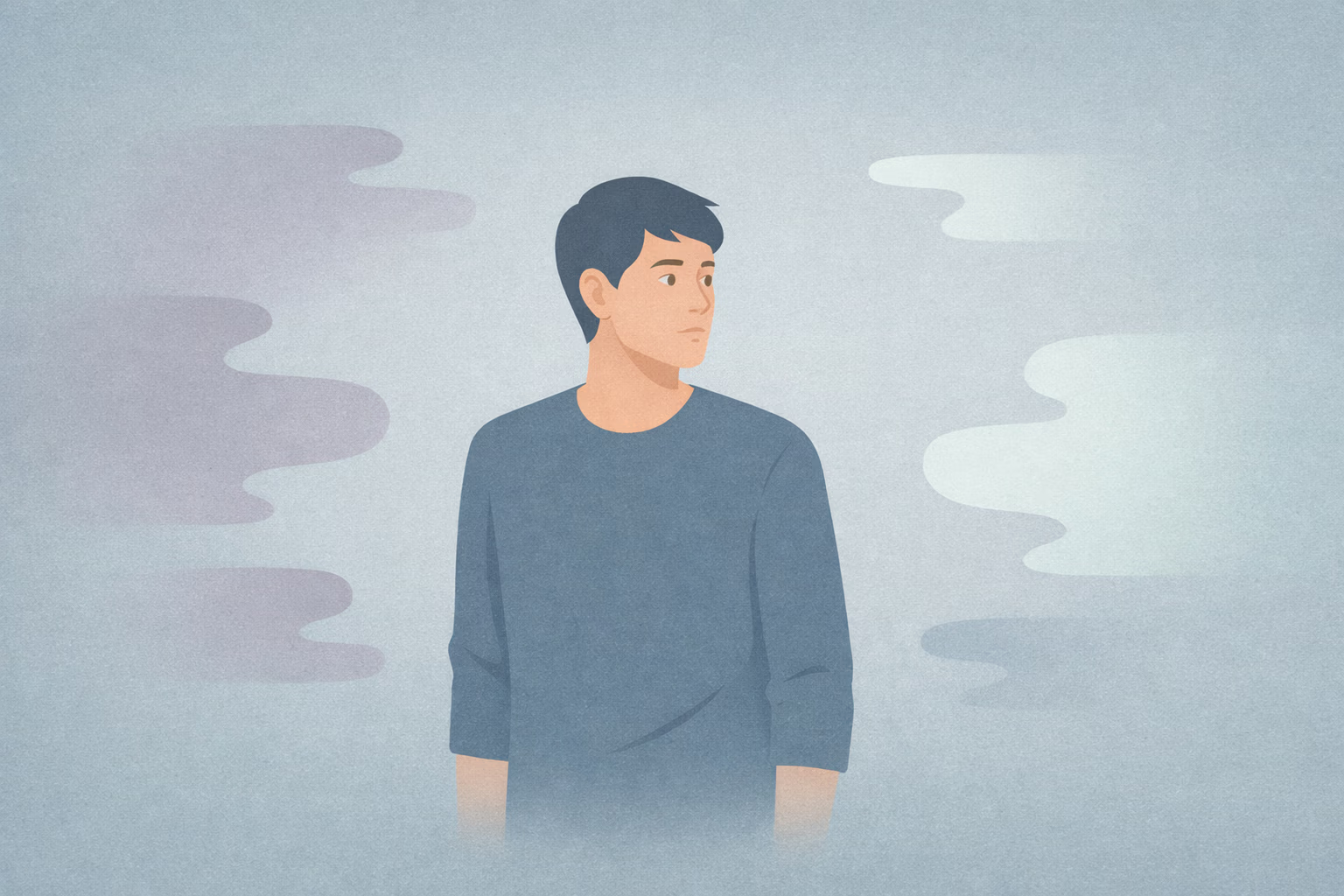
A “noisy mind” can be deeply frustrating because it resists the very strategies that seem like they should help. You sit down to rest and the internal volume rises. You decide to be present and suddenly you’re thinking about everything you forgot, everything that could go wrong, and everything that needs sorting.
This pattern is common under stress load: the brain networks that support self-talk and scanning stay more active, and the system has trouble stepping out of monitoring mode even when you’re physically safe. [Ref-1]
When that happens, stillness isn’t a skill you failed to master. It’s a state your biology doesn’t currently feel permitted to enter.
Internal quiet isn’t created by effort alone; it tends to appear when the system has enough capacity to reduce monitoring. High cognitive load changes what your brain treats as “relevant,” keeping attention sticky and internally oriented.
Even at rest, the mind can wander more when internal variability and background activation stay high, which can make “doing nothing” feel strangely busy. [Ref-2]
In other words: the noise isn’t just “thoughts.” It’s a state of readiness. When readiness remains elevated, silence can feel inaccessible—not because you lack discipline, but because your baseline hasn’t returned.
Human nervous systems evolved to prioritize detection over tranquility. In uncertain environments, ongoing internal narration—reviewing, predicting, scanning—was protective. The brain’s default-mode activity is strongly linked with self-referential thinking and mind-wandering, which can intensify when there’s unresolved complexity in the background. [Ref-3]
This doesn’t mean your mind is “negative.” It means your system is trying to keep coherence: to connect past, present, and future into something that feels manageable.
Stillness, in this frame, is not a moral achievement. It’s what can happen when vigilance is no longer required.
When life feels uncertain, thinking can become a substitute for certainty. The mind can generate plans, explanations, and analyses that create a short-lived sense of grip—even if nothing actually resolves.
That makes mental activity understandable: it can mimic closure without delivering it. Identity also gets pulled into this loop—“I’m the one who stays on top of things,” “I’m the one who figures it out”—and the system leans on thinking to protect that role when conditions feel unstable. [Ref-4]
Sometimes the mind isn’t trying to ruin rest. It’s trying to prevent a future problem by staying early.
Many people are taught—explicitly or implicitly—that more analysis equals more safety. But in a threat-leaning state, thinking often becomes faster and narrower, not wiser. The system scans for gaps and keeps reopening questions because it hasn’t received the cues that the situation is settled.
This is why hypervigilant patterns can include racing thoughts, constant scanning, and difficulty relaxing: the mind stays “on call” because it doesn’t trust the stand-down signal. [Ref-5]
What changes when you stop measuring yourself by the amount of quiet you can produce—and start noticing the conditions that allow quiet to arrive?
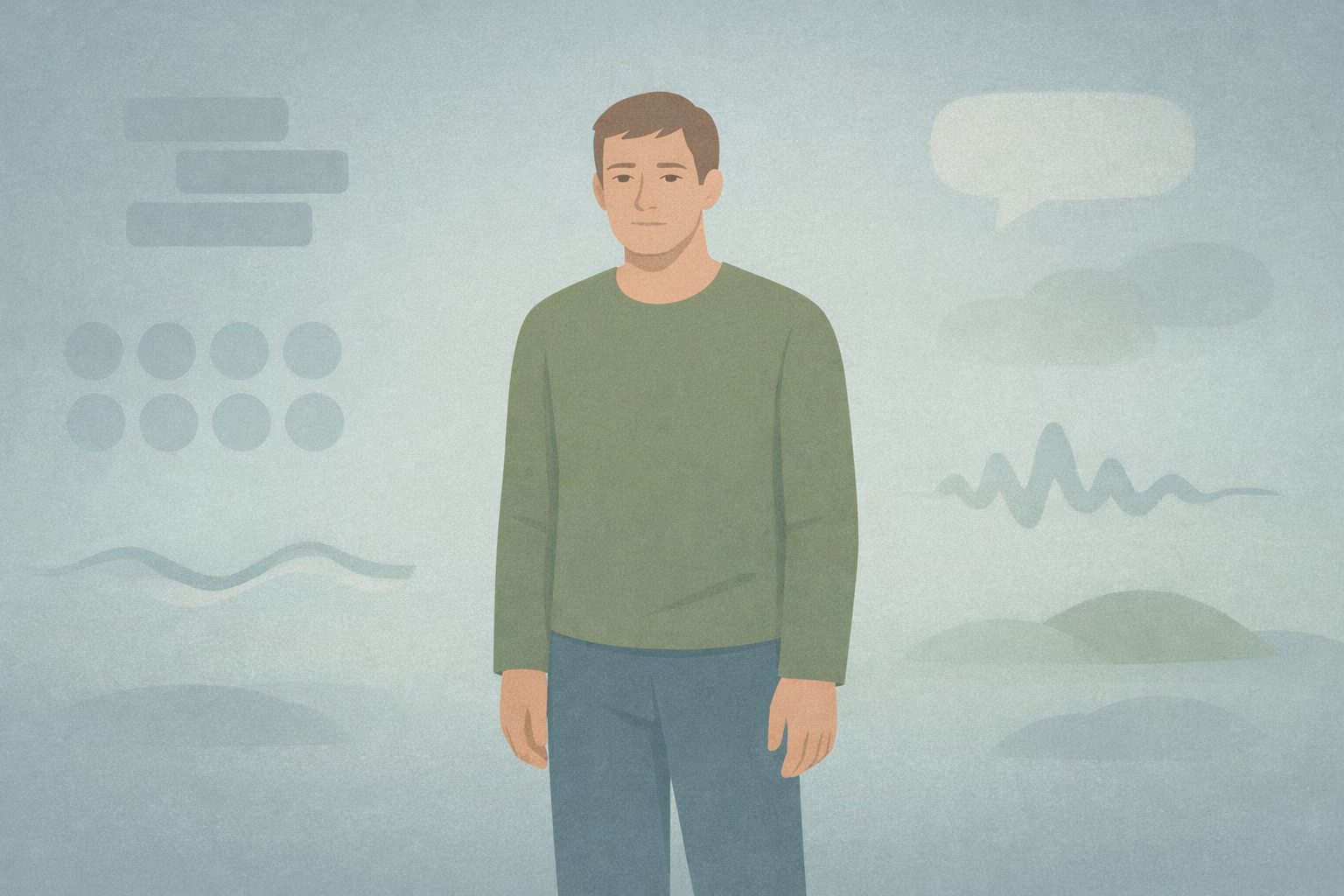
Modern life offers endless state-changers: feeds, videos, podcasts, news, messaging, problem-solving, even “helpful” self-improvement content. None of these are inherently harmful. The mismatch is structural: quick stimulation can keep interrupting the nervous system’s chance to complete cycles and return to baseline.
Over time, inner noise can become a loop where stimulation acts like a bridge over silence—so the system rarely discovers that stillness can be safe. Hypervigilance can start to feel like the default setting, like a quiet alarm that never fully switches off. [Ref-6]
This isn’t about blaming technology or blaming yourself. It’s about recognizing that the environment often prevents the “done” signal your biology needs.
Internal noise is not one thing. It can present as multiple regulatory patterns that keep the system ready, occupied, or buffered from silence.
These are widely recognized features of hypervigilant activation—patterns that can develop under ongoing stress, uncertainty, or high demand. [Ref-7]
A nervous system that can’t settle has fewer opportunities to restore. The costs aren’t always dramatic; they’re often cumulative. When mental noise is constant, attention fragments, recovery becomes shallow, and the threshold for irritation or shutdown lowers.
Over time, the system may swing between overactivation (busy, urgent, wired) and underactivation (foggy, numb, flat). Both are coherent responses to load. They’re different routes toward the same goal: reducing overwhelm when closure is missing.
Chronic hypervigilant activation is associated with long-term strain on wellbeing and the ability to regulate. [Ref-8]
In a high-alert baseline, silence removes the external structure that keeps the system oriented. Without input, the nervous system may interpret the gap as risk: “No new information—keep scanning.” Then the mind generates activity to fill the gap, not because you’re afraid in a psychological sense, but because the system is preventing an unprotected pause.
This creates a reinforcing pattern: the more silence triggers internal activation, the more stimulation becomes the default remedy, and the less often the body learns that quiet can equal safety. Over time, stimulation-seeking and cognitive overactivity become stabilizers—imperfect ones, but stabilizers nonetheless. [Ref-9]
For some systems, calm isn’t neutral yet. It’s unfamiliar—and unfamiliar can read as unsafe.
It can help to distinguish between relief and integration. Relief changes state quickly; integration is what happens when loops complete and the nervous system no longer needs to keep something online. Stillness belongs more to that second category: it’s an after-effect of completion, not a performance.
Many downregulating influences work by providing safety cues to the body—signals of slower rhythm, steadier breathing, and reduced threat activation. Research and clinical education often point to pathways like vagal tone support and gentle attention training as mechanisms that can reduce physiological arousal and support calm. [Ref-10]
In this framing, “practices” are not willpower tools. They are contexts where the body is more likely to register, over time, that it can stand down.
Humans regulate in connection. A steady, non-demanding relational environment can act like a borrowing of stability: your system detects cues of safety in someone else’s tone, pace, and predictability, and it reduces its own scanning.
This is one reason calm presence—safe company, gentle conversation, unpressured togetherness—can sometimes soften inner noise more effectively than trying to “fix your thoughts.” It’s not magical. It’s physiology: co-regulation shapes up- and down-regulation patterns. [Ref-11]
What if the inner volume isn’t lowered by winning an internal argument—but by receiving enough safety that arguing is no longer necessary?
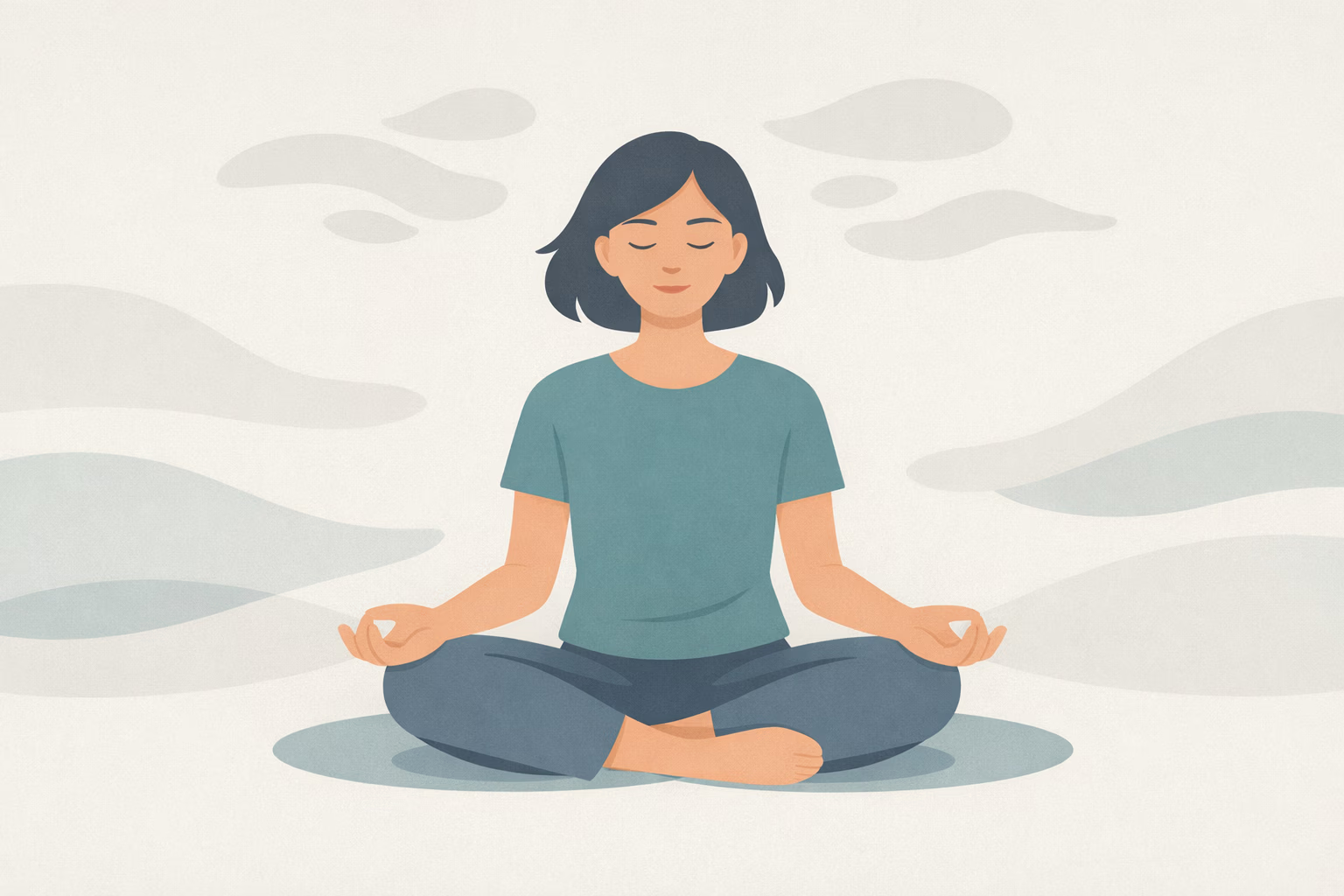
Stillness is often subtle at first. It may show up as fewer mental interruptions, longer gaps between thoughts, or a sense that thoughts are present but no longer gripping the steering wheel.
People often describe it as spaciousness and simplicity: the system is alert enough to function, but not compelled to keep scanning. Education on nervous system regulation often describes this as a shift toward a more balanced window of tolerance—where signals can rise and return without sticking. [Ref-12]
When the system can access quiet, something important changes: you’re not just managing inputs—you can sense direction. Stillness makes room for values to become felt and lived, not merely thought about. In that space, choices can align with identity in a way that stabilizes behavior over time.
This is one reason “meaning” often returns alongside quiet. Not as a new belief system, but as coherence: actions feel more connected to who you are, and life stops feeling like a series of urgent fragments.
Resources that discuss calming the nervous system often emphasize that as arousal drops, clarity and reflective capacity increase—less because you’re trying harder, and more because the background alarm is quieter. [Ref-13]
Internal stillness can be misread as blankness, boredom, or loss of edge. But for many people, it’s better understood as a biological “all clear”—the nervous system recognizing enough safety and completion to stop generating extra noise.
And if calm feels uncomfortable, that can be a normal paradox: a system trained by pressure and vigilance may treat quiet as unfamiliar, and unfamiliar can register as risk. [Ref-14] In that light, the absence of stillness is not evidence of failure; it’s evidence of a system doing its best to stay oriented.
Agency often begins here: not by forcing silence, but by understanding what your inner noise has been protecting—and what kind of coherence helps it finally rest.
Inner silence is rarely something you seize. More often, it’s what remains when the system no longer needs to stay alert—when enough loops have completed and the body can return to baseline without losing orientation.
If your mind has been loud, it may have been loyal to survival. Stillness isn’t a new personality trait to earn. It’s a physiological permission slip that arrives when vigilance is no longer required. [Ref-15]
From theory to practice — meaning forms when insight meets action.
Because internal stillness isn't a skill you force — it's a physiological state that arrives when the nervous system registers enough safety and completion to stop generating alerts. Stillness isn't a skill you failed to master; it's a state your biology doesn't currently feel permitted to enter. Trying harder often increases activation because effort itself can read as another demand. The mind isn't being defiant — it's a vigilance system doing its job, keeping coherence between past, present, and future. Silence becomes accessible when the conditions for it are present, not when you push for it.
Because at rest, the brain's self-referential and mind-wandering networks become more active, especially when there's unresolved complexity in the background. Modern life offers endless state-changers — feeds, videos, messaging — that act like bridges over silence. The system rarely discovers that quiet can be safe. So when you finally pause, the system fills the gap: it doesn't trust the unprotected pause and generates activity. This isn't fear in a psychological sense; it's the nervous system preventing a perceived risk gap. For some systems, calm isn't neutral yet — it's unfamiliar, and unfamiliar reads as unsafe.
Because in a high-alert baseline, silence removes external structure that keeps the system oriented. Without input, the nervous system may interpret the gap as risk: no new information, keep scanning. The mind generates activity to fill the gap. This creates a reinforcing pattern — the more silence triggers internal activation, the more stimulation becomes the default remedy, and the less often the body learns that quiet equals safety. A system trained by pressure and vigilance may treat quiet as unfamiliar territory. The discomfort isn't proof you're doing it wrong; it's evidence of how loyally your system has stayed alert.
By creating conditions where the system receives safety cues. Stillness emerges as an after-effect of completion, not a performance. Co-regulation works powerfully here — a steady, non-demanding relational environment lets your system borrow stability from someone else's tone, pace, and predictability. Calm presence often softens inner noise more effectively than trying to fix your thoughts. The shift isn't winning an internal argument; it's receiving enough safety that arguing is no longer necessary. Silence becomes natural when the alarm can stand down — when vigilance is no longer required, not because you earned quiet but because the conditions finally allow it.
From Science to Art.
Understanding explains what is happening. Art allows you to feel it—without fixing, judging, or naming. Pause here. Let the images work quietly. Sometimes meaning settles before words do.
One Quiet Window, one insight, one reflection — every Sunday