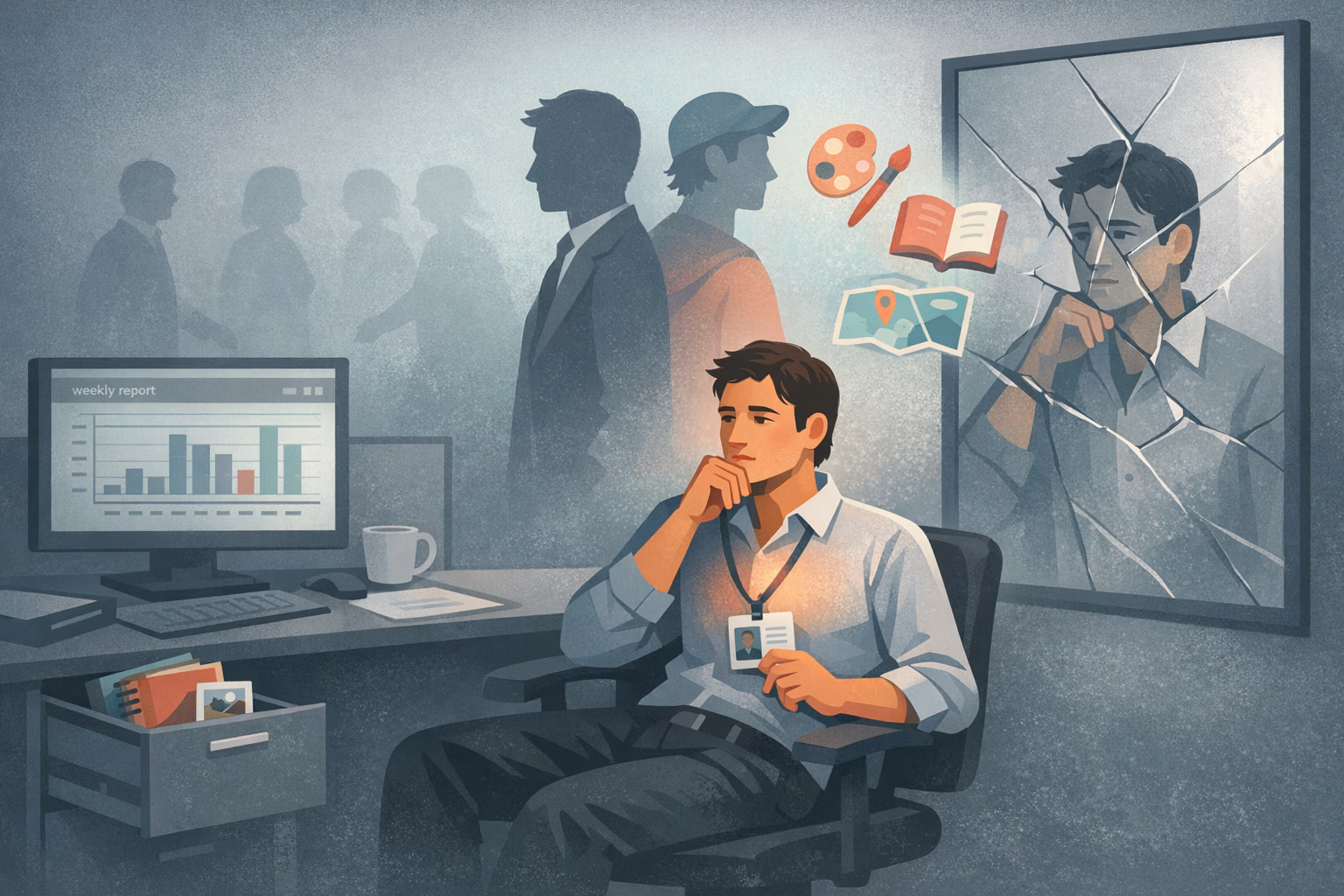
Career Identity Crisis: When Your Job Stops Feeling Like You

In short: Job hopping is often described as ambition, restlessness, or a lack of commitment. But for many people, repeated role changes are less about chasing novelty and more about searching for stability that never quite arrives—socially, practically, and internally.
Job hopping is often described as ambition, restlessness, or a lack of commitment. But for many people, repeated role changes are less about chasing novelty and more about searching for stability that never quite arrives—socially, practically, and internally.
In a world where workplaces reorganize fast, relationships reset often, and performance is continuously evaluated, the body can stay on alert. When alertness becomes the baseline, leaving can feel like the cleanest way to reduce load—at least temporarily.
What if the impulse to move on is not “running away,” but a system trying to find a place where life can finally settle?
Many job-hopping stories share a similar rhythm: the new role brings relief. There’s fresh momentum, a reset of reputation, and the sense that this time will be different. For a while, the nervous system reads novelty as possibility.
Then the familiar tone returns. The early clarity blurs into unclear expectations, social friction, or a workload that never feels complete. The body doesn’t register “done,” and instead stays in a state of ongoing readiness—scanning, bracing, and recalibrating. Over time, the urge to leave can start to feel like the only reliable off-switch. [Ref-1]
“It’s not that I hated the job. It’s that I couldn’t ever land in it.”
Work is not only a task environment; it’s a social environment. Even when we tell ourselves “it’s just a job,” the nervous system still tracks safety cues: who notices you, who backs you up, whether conflict resolves, and whether your place feels secure.
When teams are transient, managers change frequently, or feedback arrives mainly as correction, attachment systems can remain partially unmet. That doesn’t always look like sadness or insecurity; it can look like constant evaluation of alternatives, a low-grade readiness to detach, or a persistent sense that you’re “not really in” with anyone. The system keeps searching for a safer social arrangement because it hasn’t received enough signals that this one will hold. [Ref-2]
For most of human history, stability came from repeated contact with the same people, shared roles, and predictable contribution. In that context, identity wasn’t something you had to invent; it emerged through lived participation—over seasons, not quarters.
Frequent disconnection can register as social instability. Even if a move is voluntary and strategic, the body still has to re-map status, trust, and belonging from zero. When this happens repeatedly, the system may treat “workplace” as a temporary camp rather than a place where long-term meaning can accumulate. [Ref-3]
When your social world keeps resetting, how would your nervous system ever learn it can stand down?
A job change can provide immediate relief because it creates closure—at least on paper. The old tensions stop demanding daily attention, the narrative becomes simple (“I’m starting fresh”), and the environment offers quick feedback through onboarding and early wins.
Novelty also compresses time. When everything is new, identity feels more flexible: you can present a cleaner version of yourself, step out of a stuck loop, and regain a sense of movement. That reset can be real, even if it’s temporary—especially when the prior role carried unresolved friction, ambiguity, or chronic pressure. [Ref-4]
It’s understandable to hope that the next role will finally provide the right culture, the right manager, the right pace, the right respect. Sometimes it does. But the deeper problem many people run into is that belonging and identity can’t stabilize on external conditions alone.
When identity is overly role-dependent, every workplace change becomes a full-body referendum: Am I valued here? Do I fit? Is there a future? If those questions stay unanswered, commitment can’t consolidate. What looks like indecision may be a nervous system that hasn’t found enough relational and meaning-based continuity to settle into place. [Ref-5]
An Avoidance Loop isn’t about “being afraid.” It’s about load management in a system that hasn’t found completion. When a role starts to generate unresolved friction—unclear expectations, ongoing conflict, constant measurement, or low trust—leaving can reduce immediate strain.
The catch is structural: repeated exits can also bypass the stage where experiences metabolize into stable identity. Without enough time for consequences to resolve, relationships to deepen, and contribution to become recognized, the nervous system doesn’t receive the long-term “this holds” signal. The move provides relief, but it can also reinforce the feeling that stability is always elsewhere. [Ref-6]
Not everyone who changes jobs often is in a loop. Industries, contracts, caregiving demands, and economic shifts matter. Still, certain patterns suggest the nervous system is using movement as regulation rather than moving from grounded choice.
These patterns can be adaptive responses to an environment that rarely offers closure—especially when the person’s work life has become one long series of beginnings. [Ref-7]
When life keeps restarting, trust becomes harder to build—not because someone is untrustworthy, but because continuity keeps getting interrupted. You don’t just lose colleagues; you lose the shared history that makes work feel less effortful.
Over time, repeated transitions can thin out identity continuity: it becomes harder to answer “What am I building?” or “Who am I in this domain?” The nervous system can stay in a semi-activated state—always orienting, always proving, always adjusting—without the restorative benefit of settled rhythm. Chronic stress load and burnout risk tend to rise when recovery and social support are inconsistent. [Ref-8]
“I’m good at starting. I’m tired of starting.”
If internal anchoring is thin, external changes do more than update a resume—they provide state change. A new job offers a different set of cues, a different social map, and a new story about who you are. That can temporarily lower distress because it reduces the friction of unfinished loops.
But frequent transition also adds its own load: uncertainty, onboarding pressure, and repeated relationship rebuilding. Organizational change and instability can contribute to exhaustion and depletion, especially when the body never gets to register “safe and steady” long enough for capacity to return. The cycle becomes self-reinforcing: moving is exhausting, but staying feels impossible. [Ref-9]
There is a different kind of stability that doesn’t depend on a perfect workplace. It’s the stability that forms when a person’s identity has a clear through-line—what they stand for, how they want to treat people, what kind of contribution feels honest.
This doesn’t mean “thinking positively” or finding the right label. It’s more like an internal organizer that makes experiences easier to integrate: even if the job changes, the self doesn’t fully reset. Belonging becomes less like a prize you earn and more like a capacity you can carry—because it’s linked to values-based coherence rather than constant external confirmation. [Ref-10]
If your title disappeared, what would still be true about the way you work and relate?
One of the most regulating elements in work life is not the role—it’s the relationship network that makes the role livable. When there is even one steady connection (a mentor, a trusted peer, a supportive manager), the nervous system receives more consistent safety cues.
These relationships provide continuity across change: someone who knows your strengths, reflects your growth, and helps your efforts feel witnessed rather than constantly evaluated. This kind of social stability can increase affective commitment and reduce the feeling that leaving is the only way to regain control. [Ref-11]
When a system has carried chronic uncertainty, “commitment” can feel like exposure. Not because of a personal limitation, but because commitment requires enough safety to let time do its work. Without that safety, the body treats waiting as risk.
As belonging becomes more reliable—through stable cues, supportive relationships, and a coherent identity through-line—capacity can return. People often describe a quieter mind, less urgency to monitor options, and a greater ability to stay present with the normal imperfections of work life. Social support is consistently linked with lower burnout risk, in part because it reduces load and increases the sense that strain is shared rather than solitary. [Ref-12]
When job changes come from escape pressure, the decision is usually urgent: the priority is to get out. When choices come from coherence, the decision tends to feel more spacious: the priority is alignment—skills, values, relationships, and long-range contribution.
This doesn’t mean staying forever. It means that movement is no longer the main regulator. The career becomes a place where meaning can accumulate because experiences have time to complete: projects reach real endpoints, relationships develop history, and identity gains continuity. In a labor market where tenure patterns vary widely, “roots” often form less from staying put and more from having a steady internal and relational foundation that can travel with you. [Ref-13]
If you’ve moved jobs repeatedly, it may not be evidence that you’re incapable of stability. It may be evidence that your system has been trying to locate conditions where work can become integrated—where effort turns into recognized contribution, where relationships become real, and where your identity doesn’t have to restart every year.
From this view, the question shifts from “What’s wrong with me?” to “What hasn’t been able to complete?” Because completion is what gives the nervous system permission to stand down. Without it, leaving can feel like the only available closure—even if it creates more fragmentation in the long run. [Ref-14]
Not every change is avoidance. But many changes are a search for a life that can finally feel whole.
Stability tends to arrive when what you do, who you are, and what matters to you begin to match—consistently enough that your system stops bracing for the next reset. That kind of coherence can exist inside many careers and many industries, but it rarely comes from acceleration alone.
When you can stand on what matters, work becomes less of a proving ground and more of a place where identity can settle into lived continuity. Belonging, then, is not something you chase indefinitely—it’s something life starts to confirm over time. [Ref-15]
From theory to practice — meaning forms when insight meets action.
Because the relief is real but the underlying loop often stays open. A new role brings fresh momentum, reset reputation, novelty as possibility. Then the early clarity blurs into unclear expectations, social friction, or workload that never feels complete. The body doesn't register Done; instead it stays in ongoing readiness — scanning, bracing, recalibrating. Over time, the urge to leave can feel like the only reliable off-switch. 'It's not that I hated the job. It's that I couldn't ever land in it.' The repeating arc — hope, effort, fade-out, the same unease — points to a system seeking conditions where work can finally settle.
Because work isn't only a task environment — it's a social environment. Even when you tell yourself 'it's just a job,' the nervous system tracks safety cues: who notices you, who backs you up, whether conflict resolves, whether your place feels secure. When teams are transient and feedback arrives mainly as correction, attachment systems remain partially unmet. That doesn't always look like sadness; it can look like constant evaluation of alternatives, low-grade readiness to detach, a persistent sense of 'not really in.' The system keeps searching for a safer social arrangement because it hasn't received enough signals that this one will hold.
Often, structurally. When a role generates unresolved friction — unclear expectations, conflict, low trust — leaving reduces immediate strain. The catch is that repeated exits bypass the stage where experiences metabolize into stable identity. Without enough time for consequences to resolve, relationships to deepen, and contribution to be recognized, the nervous system doesn't receive the long-term 'this holds' signal. The move provides relief but reinforces the feeling that stability is always elsewhere. Common signs: short tenures across very different workplaces, fast engagement followed by rapid detachment, constant scanning. The system uses movement as regulation.
Internal anchoring — values and a clear identity through-line that doesn't fully reset when the job changes. This isn't 'thinking positively' or finding the right label. It's an internal organizer that makes experiences easier to integrate. Belonging becomes less like a prize you earn and more like a capacity you carry, linked to values-based coherence rather than constant external confirmation. Even one steady relational connection (a mentor, trusted peer, supportive manager) provides continuity across change. Stability isn't found by moving faster; it forms when what you do, who you are, and what matters begin to match consistently.
From Science to Art.
Understanding explains what is happening. Art allows you to feel it—without fixing, judging, or naming. Pause here. Let the images work quietly. Sometimes meaning settles before words do.
One Quiet Window, one insight, one reflection — every Sunday