
Identity Pressure: When Expectations Shape Your Personality

In short: Most people don’t struggle because they “lack motivation.” They struggle because their life is carrying too many goals that don’t fully belong to them. When a goal is built from an external “should,” it can look responsible and impressive, yet still feel strangely heavy—like pushing a boulder that never quite reaches a stopping point.
Most people don’t struggle because they “lack motivation.” They struggle because their life is carrying too many goals that don’t fully belong to them. When a goal is built from an external “should,” it can look responsible and impressive, yet still feel strangely heavy—like pushing a boulder that never quite reaches a stopping point.
What if your exhaustion isn’t laziness—what if it’s misalignment?
An internal “yes” tends to feel like coherence: the nervous system can organize around it, follow through, and eventually register completion. An external “should” can feel like constant evaluation: more proving, more adjusting, more monitoring. This isn’t a character issue. It’s a biology-and-meaning issue—how humans stabilize when actions, identity, and closure match up.
A common modern experience is achieving something that was supposed to make you feel better—then realizing your body didn’t get the message. The credential is earned, the box is checked, the praise arrives… and your internal load stays high. That mismatch often shows up as frustration, guilt, or a vague sense of “Why am I not happier?” [Ref-1]
From a nervous-system perspective, this makes sense. If the goal was selected to meet an outside standard, it may not provide a true “done” signal internally. Without that closure, the system stays activated: monitoring, anticipating the next expectation, scanning for whether you’re still acceptable.
It can feel like living in a permanent performance review—without knowing who wrote the rubric.
Many people learn early that fitting in is rewarded and deviation is costly. Over time, “What do I want?” can become a faint signal compared to “What would be acceptable?” This is not about repressing feelings; it’s about attention and consequence. When the environment reliably reinforces compliance, the brain allocates resources toward reading external cues and away from tracking internal preference.
The result can be a kind of cognitive dissonance: you’re pursuing one set of aims while another part of you remains unconvinced. That mismatch increases strain and can invite regulatory patterns like avoidance (postponing decisions), anxiety (constant checking), craving (fast relief), or overcontrol (tight rules to reduce uncertainty). These aren’t identities—they’re load-management strategies when internal and external maps don’t match. [Ref-2]
Humans are a social-learning species. For most of our history, aligning with the group improved survival: shared norms meant shared protection, shared resources, shared predictability. So the nervous system developed a powerful sensitivity to approval, status, and belonging cues.
That sensitivity is not a flaw. It’s an evolved guidance system. The challenge is that modern life dramatically multiplies the number of “tribes,” audiences, and comparison points—often without stable relationships or clear endpoints. A goal can be socially validated in dozens of places and still feel personally unrooted. When identity is shaped primarily by outside feedback, internal goal signals can become harder to recognize and trust. [Ref-3]
External “shoulds” often come with immediate benefits: reduced conflict, less social friction, fewer awkward conversations, a cleaner narrative for other people. In the short term, compliance can downshift uncertainty because the rules are pre-written.
And the nervous system loves predictability. If following the script reliably brings approval or avoids punishment, the loop strengthens. Over time, the body learns: “External alignment equals safety.” The cost is that the internal compass gets less practice—less signal, less clarity, less confidence in self-directed choice. [Ref-4]
Not because you’re weak—because the reinforcement is consistent.
It’s easy to assume that if a goal is impressive enough, satisfaction will arrive afterward. But satisfaction isn’t just a reward; it’s often a coherence event—an internal settling that happens when what you did matches who you understand yourself to be.
Research on self-concordant goals suggests that goals aligned with personal values and interests are more reliably associated with well-being than goals pursued mainly for external approval or image. [Ref-5] In plain language: you can “win” and still not feel complete if the win wasn’t integrated into your identity.
When a goal is built from “should,” engagement can become brittle. It may depend on pressure, deadlines, or praise to keep moving—because the goal isn’t supplying stable internal fuel.
External “shoulds” often run on a particular kind of reinforcement: social validation. Validation can feel like a drop in tension—relief, not completion. Relief is real and human, but it’s temporary. It changes state without necessarily creating integration.
This is how a power/avoidance loop forms: external feedback reduces discomfort, which reinforces the external aim, which further displaces internal orientation. The person doesn’t become “inauthentic.” They become organized around whatever reliably quiets the system fastest.
Meaning tends to thicken when life includes self-authored commitments that can actually reach an endpoint. When goals are primarily audience-authored, the endpoint keeps moving. [Ref-6]
When external “shoulds” dominate, the strain is often subtle. The person may look functional, accomplished, even admired. The signals show up more as fragmentation than as a dramatic breakdown.
Social psychology describes the self as dynamic and responsive to context. That responsiveness is normal. The problem appears when the self has to keep shape-shifting without enough return to a stable, chosen center. [Ref-7]
When goals don’t match internal values, the system tends to lose confidence—not because you’re incapable, but because your outcomes don’t reliably teach you who you are. The learning signal becomes noisy: you succeed, but it doesn’t strengthen your sense of direction. You struggle, and it doesn’t clarify what matters. Everything starts to feel like “more information” without synthesis.
Over time, this can reduce resilience. If the nervous system is constantly bracing for evaluation, it has less capacity for adaptation, play, and recovery. Meaning in life is associated with motivation and positive cognitive orientation; when meaning thins, effort can become heavier and more fragile. [Ref-8]
When the “why” isn’t yours, the “how” gets expensive.
External “shoulds” persist because they are socially maintained. Feedback arrives quickly: likes, promotions, praise, critique, comparison. The environment keeps updating the scoreboard. Meanwhile, internal orientation usually updates more slowly, through lived consistency and completion—processes that require quieter conditions.
There’s also a structural issue: many modern goals don’t have clean endpoints. They are ongoing identities (“be impressive,” “be indispensable,” “be optimized”), which means the nervous system rarely receives closure. Without closure, the system stays in a state of readiness, and readiness makes external cues feel urgent.
Psychological work on the self in social context highlights how identity is co-constructed through interaction and perceived norms. When your main mirrors are external, “should” becomes the default language of selfhood. [Ref-9]
It can help to name the difference between a goal that comes with pressure and a goal that comes with preference. This isn’t about “thinking positively” or gaining insight. Many people already understand what’s happening. The issue is that understanding alone doesn’t create the physiological settling that comes from living something to completion.
Still, reflective practices can act like a meaning bridge: they slow the social noise enough for internal signals to become more legible. When the brain holds multiple self-guides—who you think you should be, who you fear being, who you want to be—tension increases, and vulnerability rises. [Ref-10]
In that landscape, an internal “yes” often has a particular texture: less theatrical urgency, more quiet traction. An external “should” often has a different texture: more scanning, more comparison, more rule-following.
Internal alignment rarely forms in isolation. Humans calibrate through other humans. When someone is supported by mentors, peers, or communities that value honesty over performance, the nervous system receives a different kind of safety cue: “I can be real here and still belong.”
This kind of support doesn’t force a decision; it reduces the social threat load around decision-making. In that reduced-load space, internal preferences have a better chance to persist long enough to become coherent. Career-development and counseling perspectives often emphasize aligning strengths and values with goals because it improves sustainability and engagement. [Ref-11]
Support isn’t someone choosing for you. It’s the feeling that you won’t be abandoned for choosing.
When goals become more values-linked, people often report a return of clarity—not as excitement, but as orientation. The nervous system spends less energy on self-surveillance and more on steady follow-through. Confidence rises because choices start to produce consistent identity learning: “This is the kind of life I live.” [Ref-12]
Intrinsic motivation is often described as a natural byproduct of alignment, not a resource you have to manufacture. When a goal fits, effort still exists, but it is less “expensive.” The body is not constantly negotiating with itself. Over time, completion becomes more available—projects end, seasons close, and the system can stand down.
As internal “yes” goals accumulate, something structural shifts: energy is no longer primarily spent on proving, protecting, or positioning. It moves toward building a life that feels narratively consistent—where your actions resemble your values often enough that identity can settle.
This doesn’t mean you stop caring what others think. It means external feedback becomes information rather than command. The “should” voice may still appear, but it no longer owns the steering wheel. A more internally oriented life tends to feel simpler—not because it has fewer responsibilities, but because it has fewer competing selves running at once. [Ref-13]
Coherence is not intensity. It’s fewer internal arguments.
When “should” gets loud, it doesn’t mean you’re failing. It often means your environment is demanding performance without providing closure. Pressure can be a useful signal: not a command to push harder, but a cue that your system is seeking clearer alignment between what you’re doing and what you’re doing it for.
Self-determination research emphasizes that autonomy, competence, and connection support well-being—conditions that help goals feel self-authored rather than imposed. [Ref-14] In that light, agency isn’t a personality trait. It’s what becomes more available when your goals are allowed to be yours, and your nervous system is allowed to register completion.
Choosing authentic goals isn’t a dramatic reinvention. Often it’s a gradual return to coherence: fewer borrowed narratives, fewer moving goalposts, more lived consistency. Over time, the internal “yes” doesn’t just feel better—it becomes stabilizing, because it creates a life your system can recognize as its own.
That kind of alignment supports sustainable well-being: not constant pleasure, but a steadier sense of meaning and human potential unfolding through real, completed commitments. [Ref-15]
From theory to practice — meaning forms when insight meets action.
Because satisfaction isn't just a reward; it's a coherence event — an internal settling that happens when what you did matches who you understand yourself to be. If a goal was selected to meet an outside standard, it may not produce a true Done Signal internally. Without that closure, the system stays activated: monitoring, anticipating the next expectation, scanning for whether you're still acceptable. Goals aligned with personal values are more reliably associated with well-being than goals pursued mainly for external approval. You can win and still not feel complete if the win wasn't integrated into your identity. The credential arrives; the body never gets the message.
By texture more than logic. An internal 'yes' tends to feel like coherence — the nervous system can organize around it, follow through, and eventually register completion. It has quiet traction. An external 'should' often feels like constant evaluation — more proving, adjusting, monitoring, scanning, comparison, rule-following. It runs on social validation, which produces relief rather than closure. Relief is a temporary state change; closure is integration. When understanding alone doesn't shift the pressure, that's a sign you've identified the loop without yet living it through to completion. Reflective practices can act like a meaning bridge by slowing the social noise.
Because they're socially maintained — feedback arrives quickly through likes, promotions, praise, comparison. The environment keeps updating the scoreboard. Internal orientation usually updates more slowly, through lived consistency and completion that requires quieter conditions. Many modern goals also lack clean endpoints — they're ongoing identities like 'be impressive,' 'be optimized' — so the nervous system rarely receives closure and stays in readiness, which makes external cues feel urgent. The body learned external alignment equals safety, and that loop doesn't dissolve from insight alone. It loosens as life produces enough self-authored commitments that actually reach an endpoint.
Supportive people who reduce social threat load around decision-making. Internal alignment rarely forms in isolation; humans calibrate through other humans. When someone is around mentors, peers, or communities that value honesty over performance, the nervous system gets a different safety cue: 'I can be real here and still belong.' Support isn't someone choosing for you — it's the feeling that you won't be abandoned for choosing. As internal yes goals accumulate, energy stops being primarily spent on proving, protecting, and positioning, and moves toward a life that feels narratively consistent. Coherence is fewer internal arguments, not more intensity.
From Science to Art.
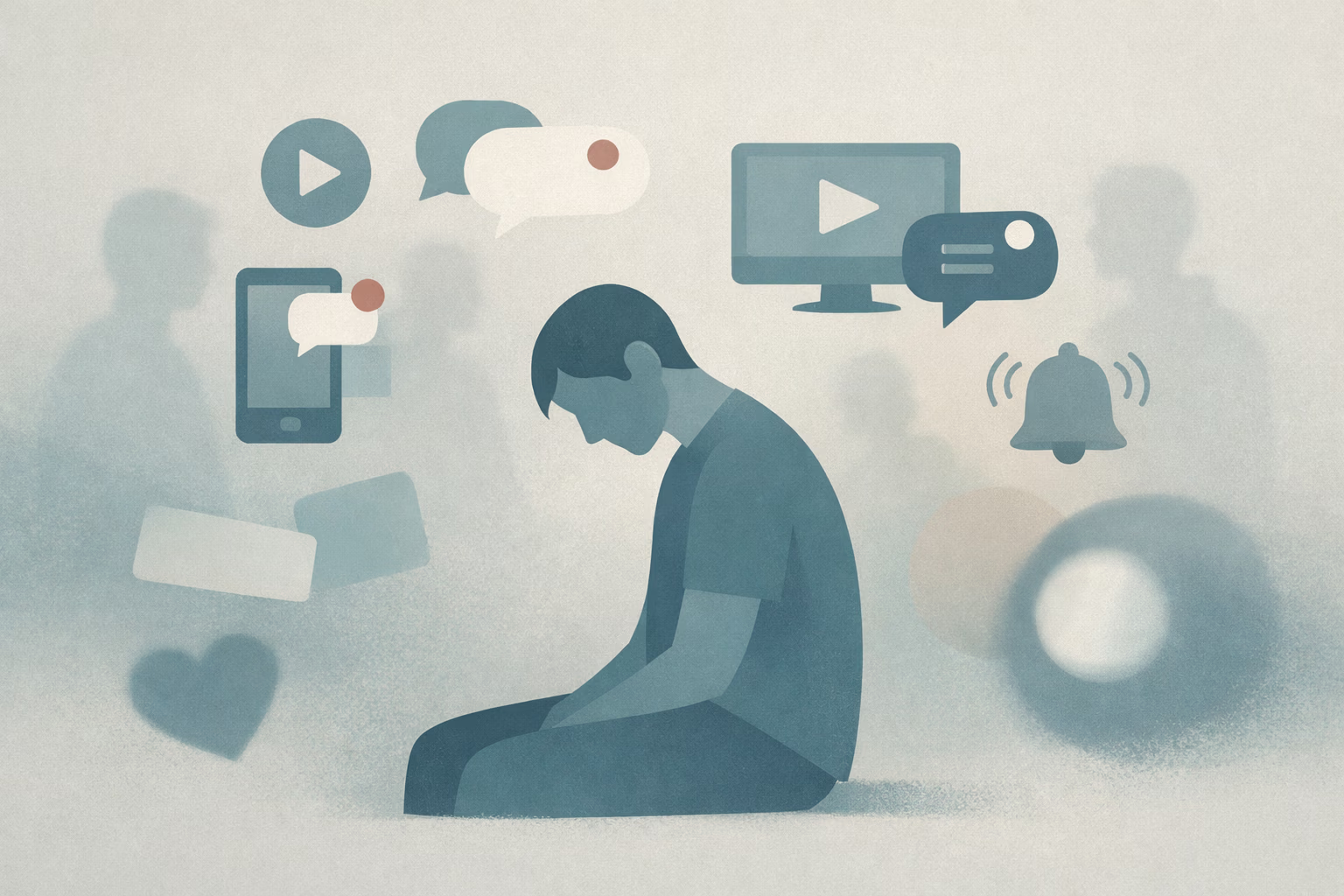
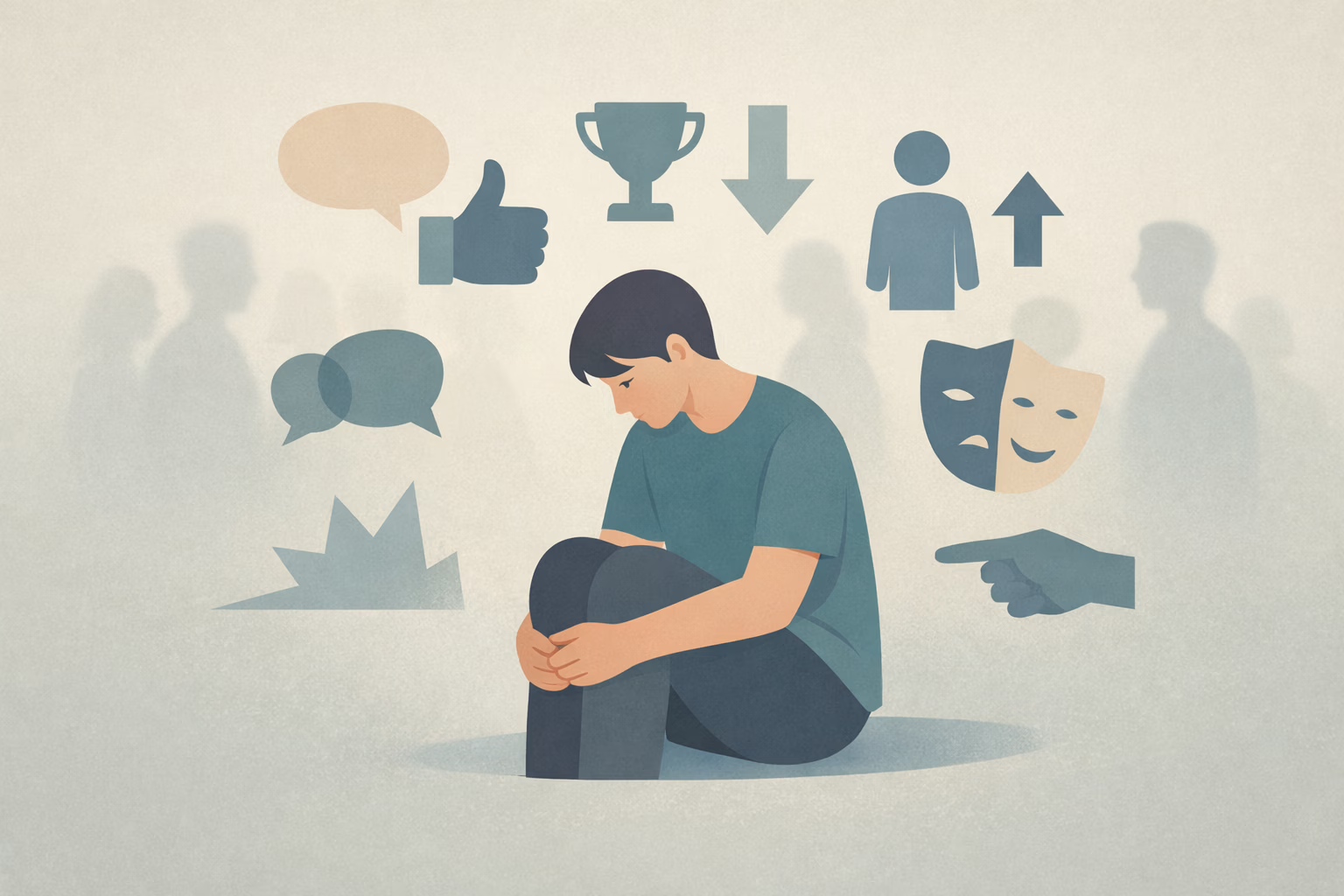
Understanding explains what is happening. Art allows you to feel it—without fixing, judging, or naming. Pause here. Let the images work quietly. Sometimes meaning settles before words do.
One Quiet Window, one insight, one reflection — every Sunday