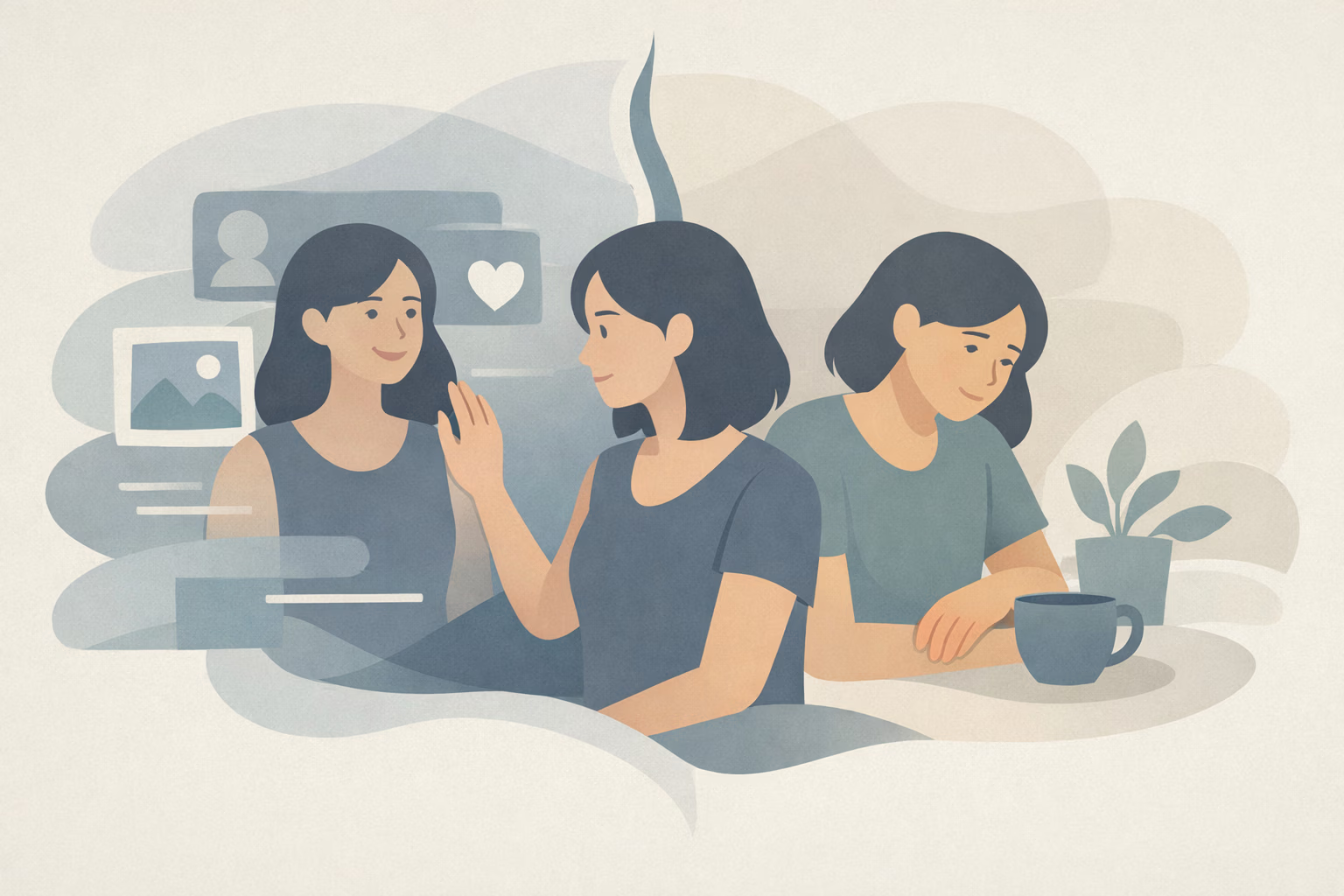
Curating an Online Self vs Living a Real Self

In short: Identity pressure is what happens when external expectations don’t just influence your choices—they start to organize your personality. You may notice yourself becoming more agreeable, more high-performing, more “together,” or more careful than you actually feel inside.
Identity pressure is what happens when external expectations don’t just influence your choices—they start to organize your personality. You may notice yourself becoming more agreeable, more high-performing, more “together,” or more careful than you actually feel inside. Not because anything is wrong with you, but because your system is responding to the conditions around you.
What if the version of you that feels “acceptable” is also the version that keeps you activated?
In the Meaning Density Model™ view, this isn’t a character flaw. It’s a coherence problem: when your actions are shaped by ongoing evaluation, your nervous system doesn’t get enough “done” signals to settle. The result can look like anxiety, overcontrol, or people-pleasing—but underneath, it’s often an organism trying to secure belonging, safety cues, and stable standing.
Identity pressure often shows up as tension: doing what’s expected, then feeling oddly disconnected afterward. You might get the compliment, the approval, or the “good job,” yet still feel a quiet guilt—like you’re renting your own life.
That discomfort isn’t a moral signal. It’s frequently a mismatch between the actions you’re taking and the internal cues that help your system recognize, this is me. When behavior is primarily driven by other people’s preferred outcomes, the body can’t easily complete the loop into closure.
Sometimes the hardest part isn’t making the right choice—it’s knowing whose choice you’re making.
This can create a subtle form of disconnection that isn’t dramatic or obvious. It can be functional on the surface, while internally you feel like you’re managing a role rather than inhabiting an identity. [Ref-1]
Humans are wired to learn from social feedback. Approval, praise, and inclusion function as powerful rewards—especially when the environment feels uncertain. Over time, the system starts predicting which version of you will be “safe” to present, and it nudges you toward that version.
This is not vanity. It’s anticipation: the nervous system reducing risk by aligning with signals of acceptance. The problem is that reward for compliance can be faster and more reliable than the slower satisfaction of living from internal orientation. When reward is immediate, it can override subtler signals of fit and coherence. [Ref-2]
In practical terms, your personality may start to tilt toward what gets reinforced:
From an evolutionary angle, humans didn’t develop identity in isolation. For most of our history, belonging and cooperation were not lifestyle preferences—they were survival infrastructure. Being readable, acceptable, and aligned with group norms increased access to protection and resources.
So the modern sensitivity to expectation cues isn’t overreaction. It’s an inherited design: your system is built to notice shifts in status, approval, and inclusion. That sensitivity can be adaptive—until the number of “groups” expands and the evaluation never ends.
What if your sensitivity isn’t fragility, but social intelligence under load?
When social conditions are stable, that intelligence supports connection. When conditions are volatile or high-stakes, it can turn into constant monitoring, self-editing, and identity strain. [Ref-3]
Meeting expectations often reduces immediate friction. It lowers the chance of conflict, criticism, rejection, or disappointment. It also reduces internal uncertainty in the short term: if someone else’s script is clear, you don’t have to generate your own.
This is a genuine regulatory benefit. Compliance can function like a fast-acting safety cue: “I’m okay right now.” The issue is that short-term relief can come at the cost of long-term closure. When the system repeatedly resolves tension by conforming, it doesn’t always get to complete the deeper loop of “this choice is mine.”
Over time, the body learns an implicit equation: alignment with expectation = reduced risk. That equation can quietly govern behavior long after the original stakes have changed. [Ref-4]
It’s common to assume that meeting expectations is the same as building a good life. But expectation-meeting can produce a particular kind of success: externally legible, internally noisy.
Self-Determination Theory research highlights that humans tend to stabilize when core needs like autonomy, competence, and relatedness are supported. When autonomy is consistently traded away—even for admirable goals—behavior may continue, but meaning can thin out. The system performs, yet it doesn’t fully settle. [Ref-5]
This is where people can feel confused: “I did everything right, why do I still feel off?” In Meaning Density terms, it’s not a motivation problem. It’s a coherence problem—actions stacking up without completing into identity.
Identity pressure tends to form a loop: the more you orient to expectations, the more your identity becomes organized around external reference points. Not because you lack a self, but because the environment keeps rewarding one pattern of self-presentation.
In narrative terms, your life story starts being written in second-person: “You should.” “They need.” “What will people think.” The self becomes something you manage, rather than something you inhabit.
This loop can be especially strong in high-evaluation settings—competitive workplaces, family systems with rigid roles, social media cultures, or communities where worth is constantly measured. The result is a thinning of personal authorship, not in thought, but in lived completion. [Ref-6]
Under identity pressure, the nervous system tends to pick strategies that keep social consequences muted and outcomes predictable. These strategies can look like traits, but they often function more like adaptive settings.
These patterns are often costly, but they are not random. They are coherent responses to environments where belonging feels conditional. Identity disruption and strain commonly increase when the self is repeatedly edited to fit demands. [Ref-7]
When you are continuously adapting to others’ expectations, your system can remain in a semi-activated state. Even if nothing terrible is happening, there’s a background requirement to monitor, adjust, and maintain the role.
This can create internal conflict that isn’t about “denying feelings.” It’s structural: two different guidance systems competing—external obligation signals versus internal orientation signals. When obligation repeatedly wins, the internal system doesn’t get the closure needed to stand down.
Over time, this may show up as:
In narrative identity research, prolonged incoherence between lived experience and self-story is associated with distress trajectories—again, not as defect, but as disrupted integration. [Ref-8]
External validation doesn’t just feel good—it offers immediate certainty. It tells your system, “This version of you is acceptable,” which can temporarily reduce ambiguity and social scanning. That relief is real, and the brain learns from it.
But a life built on quick certainty often relies on repeat dosing. Each new context demands a new performance, and each performance creates another open loop: “Am I still okay?” Without a stable internal reference point, identity becomes reactive—assembled moment by moment from feedback.
Self-defining memories—key experiences that help form identity—tend to anchor a person’s story when they feel complete and owned. When major life moments are lived primarily for approval, they can be memorable without being settling, like highlights without a home. [Ref-9]
There’s a crucial distinction between understanding yourself and being organized from yourself. Insight can be accurate and still leave the body unchanged. Integration is not a thought; it’s a settling that comes when choices complete into identity—when your system can register, this was mine, and stand down.
What often restores autonomy isn’t a dramatic rebellion. It’s a gradual shift in where decisions are sourced. Values can function as an internal signal system—less like rules, more like orientation. When life is guided by internal orientation, coherence increases because actions start to point to the same underlying story. [Ref-10]
Autonomy isn’t doing whatever you want. It’s living in a way your system recognizes as self-authored.
As authorship returns, the need for constant external checking often reduces—not through effort, but because fewer loops are left unfinished.
Identity doesn’t form in isolation, and neither does relief. Supportive relationships—people who reflect you back without constant scoring—can provide the safety cues that make self-authored behavior less risky.
This doesn’t mean you need universal approval. It means that having even a few stable relational contexts can reduce nervous system load. When you are not bracing for evaluation, your system has more capacity to register internal signals and complete experiences into identity.
Research linking narrative identity patterns with mental health trajectories suggests that being able to build a coherent self-story—often supported by affirming contexts—relates to greater stability over time. [Ref-11]
As identity pressure lessens, people often report a different quality of clarity—not a constant confidence high, but a quieter signal return. Decisions may become less exhausting because they require less social forecasting.
This shift is sometimes misunderstood as “finding yourself” through ideas alone. More often, it’s the body recognizing completion: fewer performances to maintain, fewer unanswered social questions, fewer roles requiring continuous proof.
In narrative identity terms, coherence grows when lived experiences can be organized into a stable story of who you are and what matters—one that feels consistent across contexts. That coherence is associated with improved capacity and well-being markers in research across mental health domains. [Ref-12]
Expectation-driven living consumes energy in ways that are easy to underestimate: tracking others’ reactions, adjusting in real time, anticipating criticism, holding multiple versions of yourself for different contexts. When that load reduces, the reclaimed energy often doesn’t feel like “extra productivity.” It feels like more room to be a person.
Meaning tends to thicken when action, values, and identity align—when your life begins to generate internal closure rather than perpetual evaluation. In that state, agency becomes less performative and more grounded: you can move without needing constant permission signals.
Identity-related strain is increasingly recognized as a factor in distress patterns, suggesting that a stable sense of self is not a luxury—it's a protective organizing force. [Ref-13]
Identity pressure is often a signal that your environment has been asking you to fragment: be one person here, another person there, and a third person in your head—evaluating it all. That fragmentation isn’t proof you’re inauthentic. It’s evidence that the conditions have been demanding constant adaptation.
When you start viewing expectation as a social force rather than a personal verdict, shame tends to soften. The question becomes less “What’s wrong with me?” and more “What story have I been required to live, and what story actually fits?” Narrative identity research emphasizes how the stories we can coherently inhabit shape health and agency over time. [Ref-14]
And sometimes, simply naming the pressure restores a piece of authorship: not a quick fix, but a new orientation where your life can gradually become more internally sourced and complete.
When expectations shape your personality, it doesn’t mean you were weak or easily influenced. It means your system learned what kept you included, safe, and steady in the environments you had. Those adaptations deserve respect.
Reclaiming identity isn’t about pushing harder or proving independence. It’s about letting your life become coherent again—so that what you do can settle into who you are, and who you are can guide what you do.
There’s dignity in that return: less performance, more authorship; less bracing, more stability; less borrowed identity, more lived direction. [Ref-15]
From theory to practice — meaning forms when insight meets action.
Identity pressure shows up as tension: doing what's expected, then feeling oddly disconnected afterward. You get the compliment, the approval, the good job, yet still feel a quiet guilt — like you're renting your own life. That discomfort isn't a moral signal; it's a mismatch between actions you're taking and internal cues that help your system recognize this is me. When behaviour is primarily driven by other people's preferred outcomes, the body can't easily complete the loop into closure. You may be functional on the surface while internally you feel like you're managing a role rather than inhabiting an identity. Sometimes the hardest part isn't making the right choice — it's knowing whose choice you're making.
Humans are wired to learn from social feedback. Approval, praise, and inclusion function as powerful rewards, especially when the environment feels uncertain. Over time, the system predicts which version of you will be safe to present, and nudges you toward that version. From the Status & Control evolutionary root, this becomes a Power Loop: the more you orient to expectations, the more identity becomes organized around external reference points. Personality tilts toward what gets reinforced — being easy to work with instead of clear, impressive instead of aligned, agreeable instead of real-time responsive. This isn't vanity; it's the nervous system reducing risk by aligning with signals of acceptance.
Humans didn't develop identity in isolation. For most of our history, belonging and cooperation weren't lifestyle preferences — they were survival infrastructure. Being readable, acceptable, and aligned with group norms increased access to protection and resources. So modern sensitivity to expectation cues isn't overreaction; it's an inherited design. The Attachment & Belonging System is built to notice shifts in status, approval, and inclusion. That sensitivity is adaptive when social conditions are stable. When conditions are volatile or evaluations never end (workplaces, social media, family roles), it turns into constant monitoring, self-editing, and identity strain. Your sensitivity isn't fragility — it's social intelligence under load.
Insight isn't enough — integration is what matters. It's a settling that comes when choices complete into identity, when your system can register this was mine and stand down. What restores autonomy isn't dramatic rebellion; it's a gradual shift in where decisions are sourced. Values function as an internal signal system — less like rules, more like orientation. As authorship returns, the need for constant external checking reduces, not through effort, but because fewer loops are left unfinished. Autonomy isn't doing whatever you want — it's living in a way your system recognizes as self-authored. Meaning Density grows when energy stops going to impression management and becomes available for meaning.
From Science to Art.
Understanding explains what is happening. Art allows you to feel it—without fixing, judging, or naming. Pause here. Let the images work quietly. Sometimes meaning settles before words do.
One Quiet Window, one insight, one reflection — every Sunday