
Online Authenticity Fatigue: When Being “Real” Becomes Exhausting
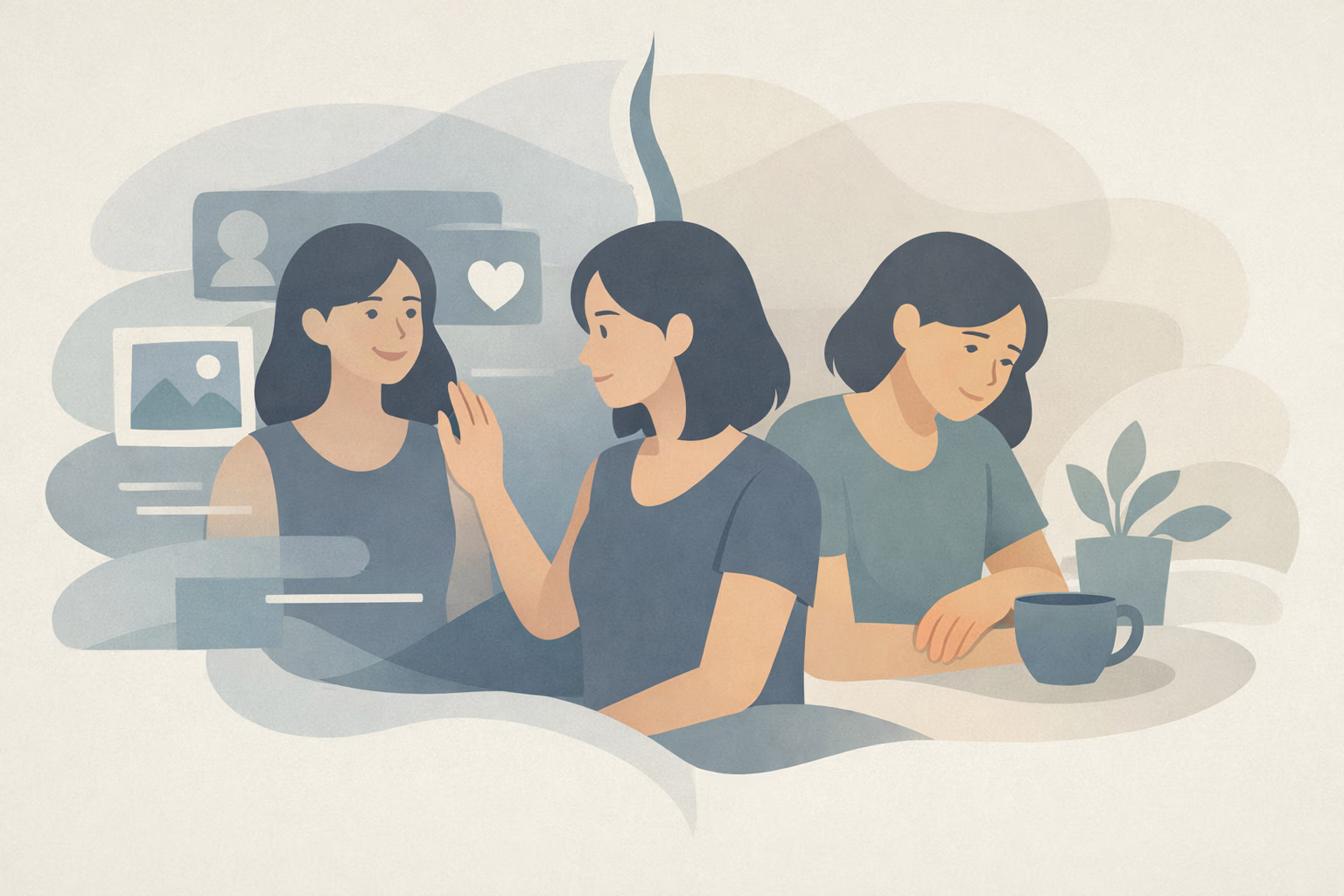
In short: Many people aren’t struggling because they “don’t know who they are.” They’re struggling because they’re carrying two parallel versions of themselves: one that reads well on a screen, and one that lives in a body, a schedule, a history, and a set of limits. What happens when the self you maintain online starts drifting away from the self you actually live?
Many people aren’t struggling because they “don’t know who they are.” They’re struggling because they’re carrying two parallel versions of themselves: one that reads well on a screen, and one that lives in a body, a schedule, a history, and a set of limits.
What happens when the self you maintain online starts drifting away from the self you actually live?
This tension is not a personal defect. It’s often a predictable outcome of modern environments that reward visibility, polish, and certainty—while real life remains complex, unfinished, and hard to compress into a clean narrative.
In one context, you’re a person among people: responsive, imperfect, changing, influenced by sleep, stress, relationships, and time. In another context, you’re a profile: a selective record that can be edited, refined, and repeated.
When those contexts pull in different directions, it can feel like living as two versions of you: a polished, presentable self for display, and a quieter, more layered self that doesn’t always translate into posts, captions, or metrics. That split isn’t automatically dishonest; it’s often an attempt to stay legible and safe in a high-visibility environment. [Ref-1]
You can be sincere and still feel divided—because the container demands a simpler version than real life can provide.
Curating a public-facing identity requires ongoing coordination: what you share, what you don’t, how consistent you appear, how you’ll be interpreted, and whether your future self can “hold” the storyline you posted today. That coordination is work, even if it looks effortless from the outside.
Over time, the brain has to keep track of multiple representations: the lived day, the posted version, and the anticipated reaction. This increases cognitive load and can create a persistent sense of internal friction—less like an emotional confession, and more like the nervous system running too many tabs at once. Digital stress research has linked constant connectivity and evaluation pressure to strain in well-being and health. [Ref-2]
Humans evolved in groups where reputation, belonging, and role clarity mattered. Being understood correctly could mean access to protection, resources, and relational stability. So the nervous system treats social perception as consequential, not superficial.
Online spaces amplify that ancient circuitry. Posts function like signals: “This is who I am, where I stand, what I value, what I’m like to be around.” When feedback arrives quickly and publicly, the signaling system can become hyper-active, scanning for cues that you’re accepted, admired, or at least not excluded. Social media has been widely discussed as shaping identity by making self-presentation more continuous and externally mirrored. [Ref-3]
When perception feels high-stakes, who wouldn’t start managing the presentation?
Curated presentation can create short-term stability. It offers a sense of control over what is seen, reduces unpredictable interpretations, and can generate a quick “I’m okay” signal through approval. In a fast social environment, that can feel like relief.
But this relief is often state-based—an immediate downshift after posting, checking, or receiving reassurance—rather than the deeper settling that comes from completion. Research on false self-presentation suggests that when people feel pressured to present an inauthentic version of themselves, it can be associated with mental health strain and platform behaviors like deleting content. [Ref-4]
In other words: the system learns that performance can reduce immediate uncertainty, so it repeats it—especially under stress.
A common hope is: “If I present well enough, I’ll secure belonging.” That hope makes sense in a world where attention is scarce and judgment is fast. But presentation-based belonging is fragile, because it depends on ongoing maintenance.
When the bond is with the image, not the whole person, the nervous system doesn’t fully stand down. There’s no clear “I’m safe now” completion point—only the next post, the next reaction, the next recalibration. Research connecting social comparison and false self-presentation to mental health highlights how these dynamics can intensify strain rather than resolve it. [Ref-5]
Being liked can feel good. Being known is what tends to feel settling.
Over time, identity curation can become a power loop: not power as arrogance, but power as control over uncertainty. If visibility feels consequential, then controlling perception can start to feel like the main way to stay regulated.
The loop is self-reinforcing: you curate to reduce risk, the environment rewards clarity and polish, and the nervous system learns that constant management prevents social “falls.” Yet this often comes with a cost—because the inner self (the one formed through lived experience) isn’t getting closure; it’s getting edited.
Studies examining similarity between online and offline selves suggest that greater alignment is associated with better well-being, implying that divergence can carry a psychological and regulatory burden. [Ref-6]
When online and offline versions drift apart, certain patterns can show up. Not because something is wrong with you, but because the system is trying to manage an ongoing mismatch between display and lived reality.
Research on online–offline identity gaps describes how divergence can relate to distress and social outcomes across contexts. [Ref-7]
The deepest cost of prolonged splitting isn’t simply stress. It’s the slow erosion of internal continuity—the feeling that your choices, your story, and your inner signals belong to the same person across situations.
When your public self becomes the dominant reference point, the body’s quieter data can start to feel irrelevant: fatigue, ambivalence, grief, uncertainty, changing values. Not because you’re disconnected from yourself in some abstract way, but because those signals don’t easily convert into shareable content.
Research examining online self-presentation and self-identity suggests that sustained curation can shape self-concept and stability over time. [Ref-8]
Self-trust tends to grow when your life has a consistent “return path” to you.
External validation is powerful because it provides fast, legible feedback. Likes, comments, views, and follower growth can act as social proof that the presented self “works.” The nervous system registers that as reduced risk.
But the more the environment rewards the curated version, the more costly it can feel to express the messy, unfinished, or changing parts of real life. The gap widens not because you’re choosing inauthenticity, but because the reinforcement schedule is stronger for what’s polished than for what’s human.
Discussions of digital identity often note that maintaining different selves across contexts can create tension and instability, especially when the online self becomes the primary mirror. [Ref-9]
There’s a difference between watching yourself and living yourself. Self-surveillance is the constant internal camera: “How am I coming across? Is this aligned? Will this make sense to others?” Values-based orientation is quieter: “What matters to me, even when no one sees it?”
This is not about gaining more insight or crafting a better narrative. Understanding the problem doesn’t complete the loop. Coherence returns when the system no longer has to keep competing versions active—when expression and lived experience are close enough that the body can stop bracing for contradiction.
Work on social media and identity often highlights how self-esteem and identity strain increase under constant comparison and monitoring, and ease when self-definition is less externally managed. [Ref-10]
What would “being yourself” mean if it weren’t a performance, but a reduction in internal split?
Identity becomes more stable in environments where you don’t have to be perfectly consistent to remain connected. Relationships that can hold normal shifts—uncertainty, contradiction, growth—give the nervous system a rare signal: you can be real and still belong.
This isn’t about confessing everything or becoming radically transparent. It’s about having at least a few relational spaces where you’re not primarily evaluated as an image. When that exists, the body receives more safety cues, and the drive to manage perception can soften.
Commentary on virtual worlds and social media has noted how distorted comparison environments can shape self-esteem, while supportive connections can buffer the impact by re-centering worth outside metrics. [Ref-11]
When online and offline selves become more congruent, people often describe a specific kind of relief: less need to monitor, less background tension, fewer “maintenance thoughts,” and more ability to feel settled after social interaction.
Importantly, this isn’t an emotional high. It’s a capacity shift—more room for ordinary life to register as complete. The nervous system gets clearer “done” signals: you said what you meant, you showed up as you are, and you don’t have to keep checking whether you contradicted yourself.
Discussions of how online persona affects real-life identity often emphasize that alignment tends to reduce the strain of sustaining a separate public self. [Ref-12]
Congruence is not a vibe. It’s what happens when you stop paying double rent on identity.
As coherence returns, self-expression can shift from impression control to meaning communication. The question becomes less “Will this land?” and more “Is this true to what I’m living?” That doesn’t guarantee approval—but it often reduces the internal cost of being seen.
In this orientation, the online self becomes a partial translation of a real life, not a replacement for it. Identity is formed through completion—through lived choices that settle into who you are—rather than through the endless editing of how you appear.
Writing about actual versus ideal selves often notes that platforms can pull people toward idealized presentation, but stability tends to grow when expression reflects lived reality instead of a perfected image. [Ref-13]
If you feel pulled between an online self and a real self, that pull can be understood as a coherence signal: the system noticing that your expression and your lived experience are no longer in the same place.
In modern digital life, this is increasingly common. Large-scale research has linked certain patterns of digital engagement with differences in well-being, suggesting that context and usage style matter—not character. [Ref-14]
When the goal shifts from being impressive to being integrated, agency tends to return—not as motivation, but as a calmer sense that your life belongs to you.
Identity stabilizes when it doesn’t require constant defense. Not because you found the perfect version of yourself, but because fewer parts are being held apart.
You’re allowed to be complex, unfinished, and still real. And when what you present no longer contradicts what you live, the nervous system often recognizes that as completion—a quiet permission to stand down. Research on ideal versus real self dynamics on social media echoes how these gaps can shape self-experience over time. [Ref-15]
From theory to practice — meaning forms when insight meets action.
Two selves isn't automatically fake — it's often a sign of split context. In one context you're a person among people: responsive, imperfect, changing. In another, you're a profile: a selective record that can be edited, refined, and repeated. When those contexts pull in different directions, you carry a polished self for display and a quieter, more layered self that doesn't translate into posts or metrics. That's not dishonesty; it's an attempt to stay legible and safe in a high-visibility environment. You can be sincere and still feel divided — because the container demands a simpler version than real life can provide.
Curation is real work, even when it looks effortless. The brain has to track multiple representations: the lived day, the posted version, and the anticipated reaction. That's more monitoring, less resting; more editing, fewer Done Signals; more anticipating, less settling. Over time, this produces background friction — less like an emotional confession and more like the nervous system running too many tabs at once. Status & Control circuits stay active because reputation feels consequential, not superficial. The fatigue isn't proof of weakness; it's the cost of maintaining two ledgers of identity at the same pace life is happening.
Because curated belonging is fragile — it depends on ongoing maintenance. When the bond is with the image rather than the whole person, the nervous system doesn't fully stand down. There's no clear 'I'm safe now' completion point, only the next post, the next reaction, the next recalibration. Validation can feel like relief because the system registers reduced risk, but it's state-based, not closure. The more the environment rewards the polished version, the more costly it can feel to express the messy or unfinished parts of real life. Being liked can feel good; being known is what tends to feel settling.
Coherence doesn't return through more insight — understanding the split doesn't complete the loop. It returns when the system no longer has to keep competing versions active, so expression and lived experience are close enough that the body can stop bracing for contradiction. Relationships that hold normal shifts — uncertainty, contradiction, growth — give a rare cue: you can be real and still belong. The shift is from self-surveillance ('How am I coming across?') to values-based orientation ('What matters to me, even when no one sees it?'). Congruence isn't a vibe; it's what happens when you stop paying double rent on identity.
From Science to Art.
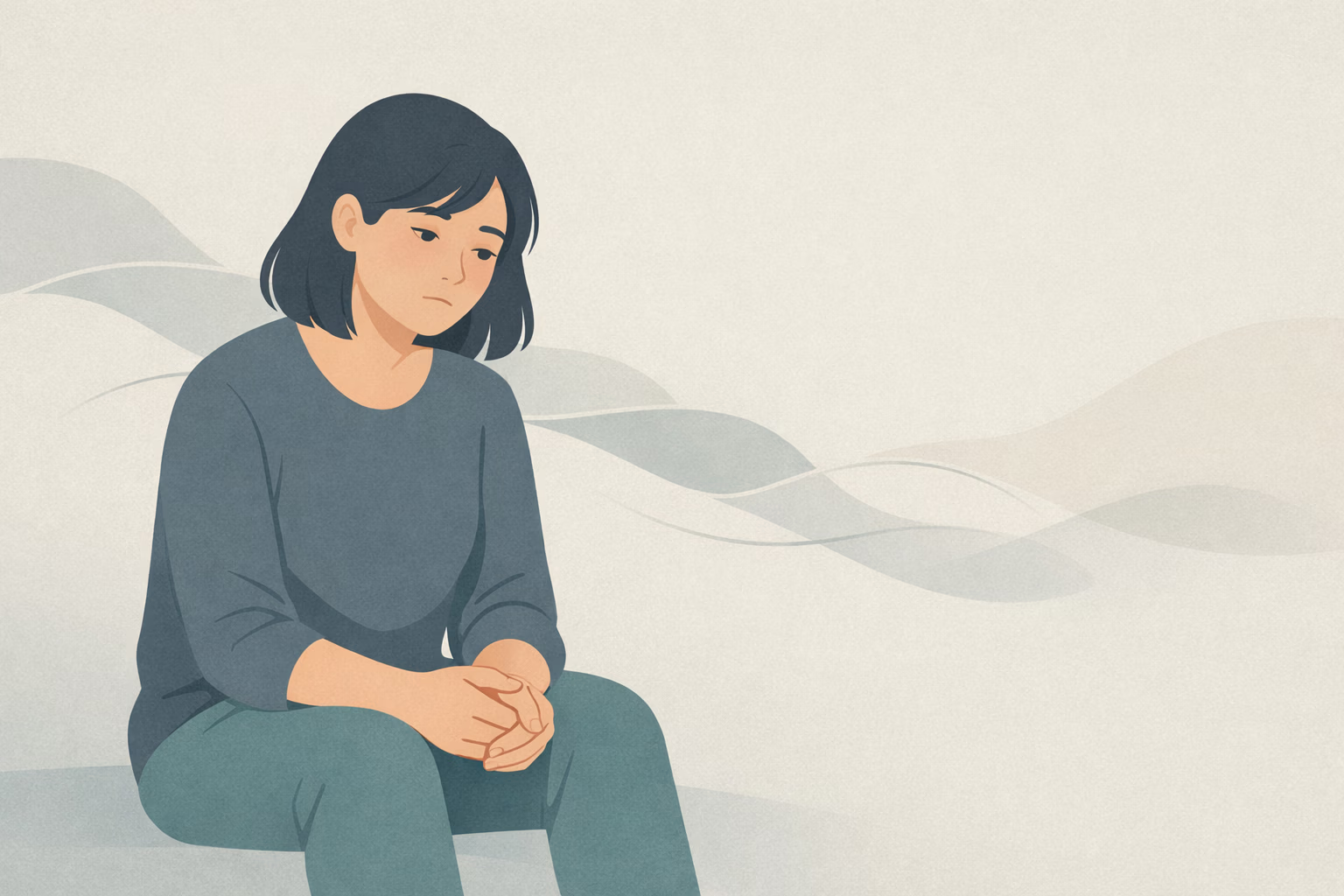
Understanding explains what is happening. Art allows you to feel it—without fixing, judging, or naming. Pause here. Let the images work quietly. Sometimes meaning settles before words do.
One Quiet Window, one insight, one reflection — every Sunday