Identity Pressure: When Expectations Shape Your Personality
In short: In a noisy world, brands can feel like clarity. A logo, a “type” of person, a recognizable style — suddenly you know what you’re communicating, and other people seem to know where to place you.
In a noisy world, brands can feel like clarity. A logo, a “type” of person, a recognizable style — suddenly you know what you’re communicating, and other people seem to know where to place you.
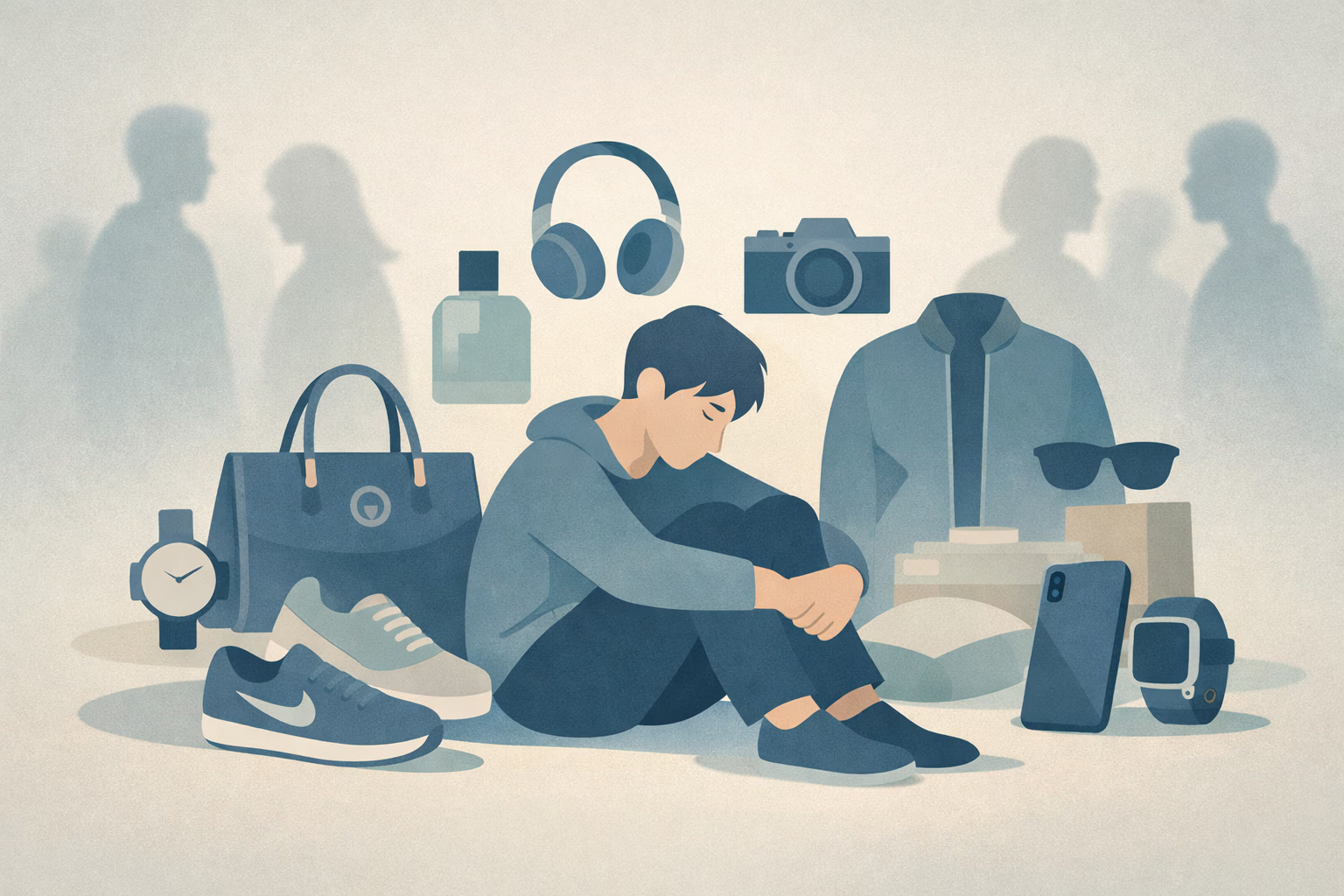
When life is fragmented, that quick coherence can be genuinely regulating. It can reduce social ambiguity, soften uncertainty, and give the nervous system a feeling of orientation. The problem isn’t buying things. The strain shows up when purchases start doing the job of identity — when the self feels stable mainly through what’s visible, approved, and current.
What if “brand you” isn’t vanity — but a nervous system looking for a durable done-signal?
Brand identity often begins as relief: you put something on, carry something, post something, and your presentation clicks into place. It can feel like stepping into a more defined version of yourself — clearer, more legible, more recognized. Researchers describe how brands can function as tools for self-expression and desired-self signaling. [Ref-1]
But that clarity can be surprisingly fragile. When the trend shifts, the group changes, or the item stops drawing the same response, the nervous system doesn’t just “lose a look.” It loses a stabilizer. What follows is often not dramatic sadness — more like a thin, restless emptiness, a sense of being unfinished, or a low-grade confusion about who you are when nothing is being signaled.
“It’s not that the thing stopped working. It’s that I stopped feeling held together by it.”
Brands offer ready-made narratives: adventurous, minimalist, elite, grounded, disruptive, wholesome, edgy. They aren’t just products; they’re compact identity scripts. When someone adopts a brand’s “personality,” it can create fast alignment between self-image and social image — a shortcut to coherence that would otherwise take time, repetition, and lived experience to form. [Ref-2]
This speed matters. Internal identity formation is slow because it requires completion: doing things, being in relationships, making tradeoffs, and letting experiences settle into “this is who I am.” Brand narratives can mimic that settling without requiring the same sequence. The body often experiences it as a quick stand-in for belonging and definition — especially under high cognitive load.
Humans evolved to scan for rank, safety, and affiliation cues. In earlier environments, visible markers often communicated practical information: who could share resources, who had influence, who belonged, who was trustworthy. That doesn’t make status signaling shallow — it makes it ancient.
Digital life amplifies this system. When identity is routinely performed in public-facing spaces, “what I have” and “what I align with” can become compressed into quick symbols. Research on consumer self-concept in a digital context describes how technology reshapes how identity is constructed and displayed. [Ref-3]
Self-exploration is not just mental. It’s metabolically expensive: it involves ambiguity, mixed feedback, and long stretches without clear closure. A brand identity can offer the opposite — immediate shape.
In consumer behavior frameworks, identity-linked consumption is often described as a way people communicate roles and group membership. [Ref-4] The nervous system tends to prefer signals that resolve social uncertainty quickly. A consistent brand style can function like a portable context: it reduces the number of open questions the environment is asking you to answer.
When the world asks “Who are you?” a brand can answer in one second.
Borrowed identity can feel like identity, especially when it brings a hit of social clarity. But dependence shows up when the self feels less available without the symbol. This is one reason symbolic self-completion theory is often discussed in relation to consumption: when a sense of self is incomplete, symbols can temporarily “complete” the picture in public view. [Ref-5]
That completion, however, is often external and conditional. If the symbol needs to be renewed, upgraded, or repeatedly displayed to keep working, the nervous system doesn’t receive a durable done-signal. Instead, it learns a loop: coherence arrives through acquisition and recognition — and fades when recognition does.
In the power loop, the system tries to stabilize status and selfhood through controllable externals: what can be bought, curated, displayed, and compared. It’s not inherently about arrogance. It’s often about predictability.
Symbolic self-completion accounts describe how people may reach for symbols when a valued identity feels threatened or unfinished. [Ref-6] The symbol becomes a form of external scaffolding — a way to hold shape when internal coherence hasn’t had the chance to fully consolidate.
Over time, the “source” of self-definition can drift outward. The nervous system begins to treat external validation as a primary safety cue, while internal signals (preference, value, satisfaction) are treated as secondary, unreliable, or too slow to matter.
When purchases become personality, it often looks less like indulgence and more like a patterned attempt to stay oriented. In research contexts, symbolic self-completion dynamics are also discussed in relation to perceived threats to competence or identity stability. [Ref-7]
Some common patterns include:
Notice how none of these require a story about “fear” or “low self-esteem” to make sense. They can be understood structurally: a system seeking closure through symbols because closure through lived completion is harder to access in high-pressure conditions.
When identity is stabilized through external signals, the nervous system stays attentive to the social field: what’s in, what’s admired, what’s losing value. The result is often chronic comparison — not as a personal flaw, but as a predictable outcome of using public markers as your primary orientation tool.
Symbolic self-completion research lines often emphasize that when a self-definition feels incomplete, people may lean harder on symbols to compensate. [Ref-8] That compensatory strategy can unintentionally reduce self-trust over time: your internal “yes/no” signals get quieter because the environment’s feedback is louder, faster, and more measurable.
“I can’t tell if I like it. I can tell if it lands.”
Even when brand affiliation brings real social rewards, the effect often decays. Not because you’re ungrateful, but because the nervous system habituates. What was once a strong signal becomes background. Meanwhile, social groups shift, novelty wears off, and prominence thresholds rise.
Research on identity signaling and brand prominence describes how visible markers can communicate group alignment — and how that signaling changes depending on audience and context. [Ref-9] If your coherence depends on being read correctly, then “being read” has to keep happening. When it doesn’t, the loop naturally returns to the most available lever: another purchase, another refresh, another symbol that can produce immediate legibility.
There’s a difference between being recognized and being realized. Recognition is a social event; realization is a settling process. Products can signal who you are to others, but signals don’t automatically become integrated selfhood.
Identity tends to stabilize when experiences reach closure: when choices have been lived long enough to become “mine,” when values have been expressed in real constraints, when contributions have consequences you can stand inside. By contrast, display can keep the system in a state of readiness — always preparing the next signal.
In identity signaling overviews, products are often described as communicative tools. [Ref-10] Tools can be useful. The strain begins when the tool is asked to do the job of a nervous system that wants durable completion.
Brand-based belonging is often clean and immediate: shared tastes, shared aesthetics, shared shorthand. But it can remain conditional — maintained through correct markers and ongoing relevance.
Another kind of belonging forms around shared values, mutual contribution, and lived reliability. It tends to be slower, but it generates different body signals: less scanning, less performance pressure, more room for ordinary presence. Status signaling discussions note how social display influences behavior; the counterweight is contexts where value is recognized through participation rather than prominence. [Ref-11]
When you’re needed and known, you don’t have to be as loudly “read.”
When coherence is returning, it often isn’t dramatic. It can feel like decreased urgency around presentation and fewer identity “emergencies” that require a purchase to resolve. Comparison may still appear, but it doesn’t recruit the whole system.
Writings on logos, labels, and status signaling often point to the social role of visible markers across contexts. [Ref-12] As internal definition strengthens, those markers can become optional rather than compulsory. The person may still enjoy brands — but enjoyment is different from dependence.
Brand identity often tries to solve a real human problem: the need to feel coherent, placed, and meaningful. The long-term shift is not “rejecting brands.” It’s relocating the center of identity from what’s shown to what’s lived.
Research on brand identity and consumer identification discusses how congruence between lifestyle and brand can shape identification. [Ref-13] The deeper stabilization tends to come when lifestyle itself carries the weight — when values are enacted in ways that leave traces in relationships, work, care, craft, learning, and community. Those traces create completion the nervous system can register.
When identity is directional, it doesn’t require constant proof. It becomes less about announcing who you are, and more about moving through the world in ways that repeatedly confirm it.
Brand attachment often points to something intelligent: a search for belonging, status safety, clarity, and a self that feels recognizable. In a fragmented environment, borrowing a ready-made identity can be a reasonable way to reduce uncertainty.
Over time, many people notice the same thing: the purchase changes state, but it doesn’t always create lasting closure. That doesn’t mean you did it wrong. It means the system is still looking for a more durable form of coherence — one that can’t be taken away by trend cycles, algorithms, or shifting approval. Brand perceptions across the self-concept life cycle are often discussed as changing with development and context, not as fixed traits. [Ref-14]
There’s agency in seeing the pattern as a regulation strategy rather than a character verdict. Not to fight it harder — but to understand what kind of completion your system is actually asking for.
Brands can be expressive, playful, and meaningful. The problem begins only when they become the primary container for identity.
When self-concept and image congruity are discussed, the underlying theme is simple: people want alignment. [Ref-15] The most settling alignment tends to come from lived congruence — the steady accumulation of choices that become unmistakably yours.
Identity feels fulfilling when it’s expressed through how you relate, what you uphold, and what you complete — not only through what you display.
From theory to practice — meaning forms when insight meets action.
Because they offer fast coherence in a fragmented environment. A logo, a style, a recognizable type — suddenly self-image and social image lock together without the slow work of lived experience. Internal identity formation is metabolically expensive: it requires ambiguity, mixed feedback, and long stretches without clear closure. Brand narratives mimic that settling without requiring the same sequence. Under cognitive load, the nervous system experiences this as relief — a quick stand-in for belonging and definition. The clarity is real, but it's borrowed, which is why it can fade when the symbol stops being read correctly.
It's rooted in something ancient. Humans evolved to scan for rank, safety, and affiliation cues, and visible markers once carried practical information about who could share resources and who belonged. Status signaling isn't shallow — it's a survival system running in a digital environment that compresses identity into quick symbols. The strain shows up only when the Power Loop takes over: when worth gets outsourced to controllable externals, and internal signals like preference and value get drowned out by the louder, faster feedback of the social field.
Because the nervous system habituates, and brand-based coherence is conditional on being read correctly. What was once a strong signal becomes background. Trends shift, novelty wears off, prominence thresholds rise. Symbolic self-completion can stabilize identity in public view, but the completion is external — if the symbol needs to be renewed, upgraded, or repeatedly displayed to keep working, no durable Done Signal arrives. The system learns a loop: coherence comes through acquisition and recognition, then thins. The reach for the next purchase isn't greed; it's a body still searching for closure that display can't deliver.
By relocating the center of identity from what's shown to what's lived. Recognition is a social event; realization is a settling process. Identity tends to stabilize when experiences reach closure — when choices have been lived long enough to become "mine," when values have been expressed in real constraints, when contributions leave traces in relationships, work, and craft. Those traces create completion the nervous system can register. Brands can still be enjoyable; they just stop being compulsory. When you're needed and known, you don't have to be as loudly read.
From Science to Art.
Understanding explains what is happening. Art allows you to feel it—without fixing, judging, or naming. Pause here. Let the images work quietly. Sometimes meaning settles before words do.
One Quiet Window, one insight, one reflection — every Sunday