
Internal Alignment: When Your Values and Actions Finally Match

In short: Values alignment isn’t a personality trait or a moral achievement. It’s a form of coherence: when your daily decisions, relationships, and rhythms repeatedly confirm what you stand for, your system can settle.
Values alignment isn’t a personality trait or a moral achievement. It’s a form of coherence: when your daily decisions, relationships, and rhythms repeatedly confirm what you stand for, your system can settle.
When your life runs in the opposite direction—through pressure, speed, or constant adaptation—you can still function. But many people notice a specific kind of strain: a low-grade tension, a foggy guilt, or a quiet emptiness that doesn’t respond to more effort.
What if the discomfort isn’t a flaw in you, but a signal that your meaning system hasn’t gotten closure?
When actions repeatedly contradict what matters to you, the discomfort often shows up as friction, not insight. It can feel like irritability, restlessness, or a persistent sense of “I’m behind,” even when nothing is obviously wrong. That’s not your character failing—it’s your nervous system registering mismatch.
Humans don’t only regulate for safety; we also regulate for continuity. Values act like internal coordinates. When your day keeps confirming them, there’s a subtle “done signal.” When your day keeps violating them, the signal doesn’t arrive, and activation stays online. [Ref-1]
It’s hard to feel at ease in a life you have to constantly explain away to yourself.
Misalignment is often described as “cognitive dissonance,” but it’s not only an abstract contradiction. It’s an ongoing load: your system holds two tracks at once—what you say matters and what your behavior repeatedly confirms. Over time, that split can drain capacity, making everyday choices feel heavier than they should. [Ref-2]
This is one reason people can become both highly functional and strangely ungrounded. Not because they “lack self-awareness,” but because the organism is managing an unresolved loop: the integrity check never completes. Understanding the mismatch can be clarifying, but clarity alone isn’t closure. Closure arrives when life repeatedly lands in a pattern your body recognizes as consistent.
When you’re tired of “figuring yourself out,” could your system be tired of carrying an incomplete story?
Across human history, being predictable to yourself and legible to others mattered. Not in a performative way, but in a coordination way: groups rely on stable signals—who keeps promises, who protects the vulnerable, who shares resources, who tells the truth. A coherent narrative wasn’t a luxury; it supported belonging and cooperation. [Ref-3]
Values are part of that narrative. They help organize tradeoffs: what you’ll sacrifice and what you won’t. When behavior and values repeatedly match, identity becomes less effortful. When they diverge for long stretches, people often compensate by overexplaining, overcontrolling, or disconnecting from inner signals—adaptive moves when the environment is demanding, but costly when they become a lifestyle.
In the short term, stepping away from values can reduce friction. Conforming to expectations, choosing the easier option, or staying in familiar roles may quiet social tension, protect resources, or prevent immediate conflict. That reduction in conflict can read as “I feel better,” even when the deeper mismatch remains. [Ref-4]
It’s not that people don’t care. It’s that the body prioritizes what lowers immediate load. When a system is already taxed, it often selects options that minimize near-term consequences. The relief is real—just incomplete.
Modern life offers many ways to reduce discomfort quickly: scrolling, snacking, overworking, overplanning, pleasing, numbing, “just getting through.” These moves often stabilize the moment. Yet values congruence is strongly tied to longer-term well-being, because congruence produces coherence—an internal sense that life is adding up. [Ref-5]
When compromise becomes chronic, meaning doesn’t always collapse dramatically. More often, it thins. People describe it as going through motions, losing interest in things they used to care about, or feeling oddly absent even while performing well.
In other words: relief changes state. Coherence changes trajectory.
Once misalignment is established, it can perpetuate itself. If inner signals are uncomfortable, it’s natural to lean harder on external markers: praise, metrics, urgency, visibility, achievement. These provide quick confirmation—temporary structure. But they don’t necessarily complete the deeper loop of “this reflects who I am.” [Ref-6]
Over time, a person can become skilled at managing impressions while feeling less able to locate themselves. Not because they’re in denial, but because the environment rewards speed and compliance more than completion and integration.
When the outside becomes the main source of “okay,” the inside stops getting the chance to settle.
When values and actions drift apart, the system often recruits predictable strategies to keep functioning. These strategies can look like “self-sabotage” from the outside, but they often reduce immediate load or muted consequence inside the moment. [Ref-7]
These aren’t who someone is. They’re how a system adapts when it can’t reliably complete the loops that create stable meaning.
Resilience isn’t just grit; it’s recovery capacity. When your daily life regularly contradicts your priorities, recovery is harder because there’s less internal permission to stand down. The system stays on alert, scanning for what’s missing or unresolved. [Ref-8]
Over time, this can look like burnout vulnerability: effort no longer translates into satisfaction, rest doesn’t restore the same way, and small tasks begin to feel disproportionately difficult. Fulfillment tends to decline not because life is objectively worse, but because the organism isn’t receiving coherence signals that say, “This counts. This belongs to me.”
Misalignment rarely persists because someone “doesn’t want meaning.” It persists because systems are sticky. Habits reduce decision load. Environments cue familiar behaviors. Social feedback trains what gets repeated. When a pattern is reinforced—even subtly—it becomes the default path of least resistance. [Ref-9]
Fragmentation amplifies this. If your day is constantly interrupted, evaluated, and accelerated, there’s little room for completion. Without completion, you don’t get the physiological settling that helps identity feel stable. So the system keeps cycling: more reacting, more coping, more compensating—less arriving.
When was the last time your day ended with a felt sense of “that was true to me”?
People often assume values alignment is mainly about insight—naming values, understanding motives, making better plans. Those can be helpful as orientation, but orientation is not the same as integration.
Integration is more like a settling that follows completion: when choices consistently express what you value, and the nervous system stops bracing for contradiction. Practices like journaling, intention-setting, or periodic “value audits” are sometimes used as a bridge—not because writing fixes life, but because it can make patterns visible and reduce the fragmentation that keeps loops open. [Ref-10]
In this frame, reflection isn’t a self-improvement project. It’s a way to let the meaning system find the thread again—so future completions are possible.
Values are personal, but they aren’t formed or maintained in isolation. Humans stabilize through shared reality: being seen accurately, having commitments recognized, and receiving known signals of support. When your environment mirrors what matters to you, alignment becomes less effortful because fewer parts of you have to be hidden or overridden. [Ref-11]
This is why accountability, mentoring, or peer alignment can matter—not as pressure, but as structure. Consistency is easier when the social field reduces friction and increases follow-through cues. In that context, values are no longer just ideals; they become lived patterns that others can anticipate and rely on.
Sometimes the most regulating question isn’t “What should I do?” but “Who is this life being built for?”
When values and actions begin to match more often, people frequently report not a constant high, but a quieter kind of clarity. Decisions take fewer internal negotiations. Boundaries feel less dramatic. You may notice more signal return—hunger, fatigue, interest, boredom—because the system isn’t spending as much energy managing contradiction. [Ref-12]
Confidence also shifts. It’s less about certainty and more about sturdiness: choices feel defensible without elaborate justification. Not because life becomes simple, but because it becomes more coherent.
Alignment doesn’t eliminate stress. It changes what stress is in service of. When actions repeatedly confirm values, the nervous system receives closure: effort leads somewhere that matches identity. That closure frees energy that used to be spent on internal conflict, self-monitoring, or compensatory coping. [Ref-13]
Over time, direction becomes more available. You may still face uncertainty, but you’re less likely to be yanked around by every cue. Not through force, but through coherence: the life you’re living keeps teaching your system who you are.
If you’re noticing strain, numbness, urgency, or a vague sense of “off,” it doesn’t have to mean you’re broken or unmotivated. It may simply mean your meaning system hasn’t been getting enough completion—enough moments where your choices resolve into a lived “this is what I stand for.”
In that light, values alignment is less a self-improvement task and more a reorientation toward coherence. When priorities are clarified and life begins to reflect them, the body often interprets that as safety and continuity—signals that allow stand-down and restore capacity. [Ref-14]
Living what truly matters isn’t about never compromising. It’s about reducing the distance between your principles and your patterns until your life becomes easier to inhabit. When actions and values repeatedly meet, meaning stops being a concept and starts becoming a stable background condition—something your nervous system can rest inside. [Ref-15]
That kind of alignment doesn’t announce itself as perfection. It shows up as a quieter integrity: less fragmentation, more continuity, and the steady sense that your days belong to you.
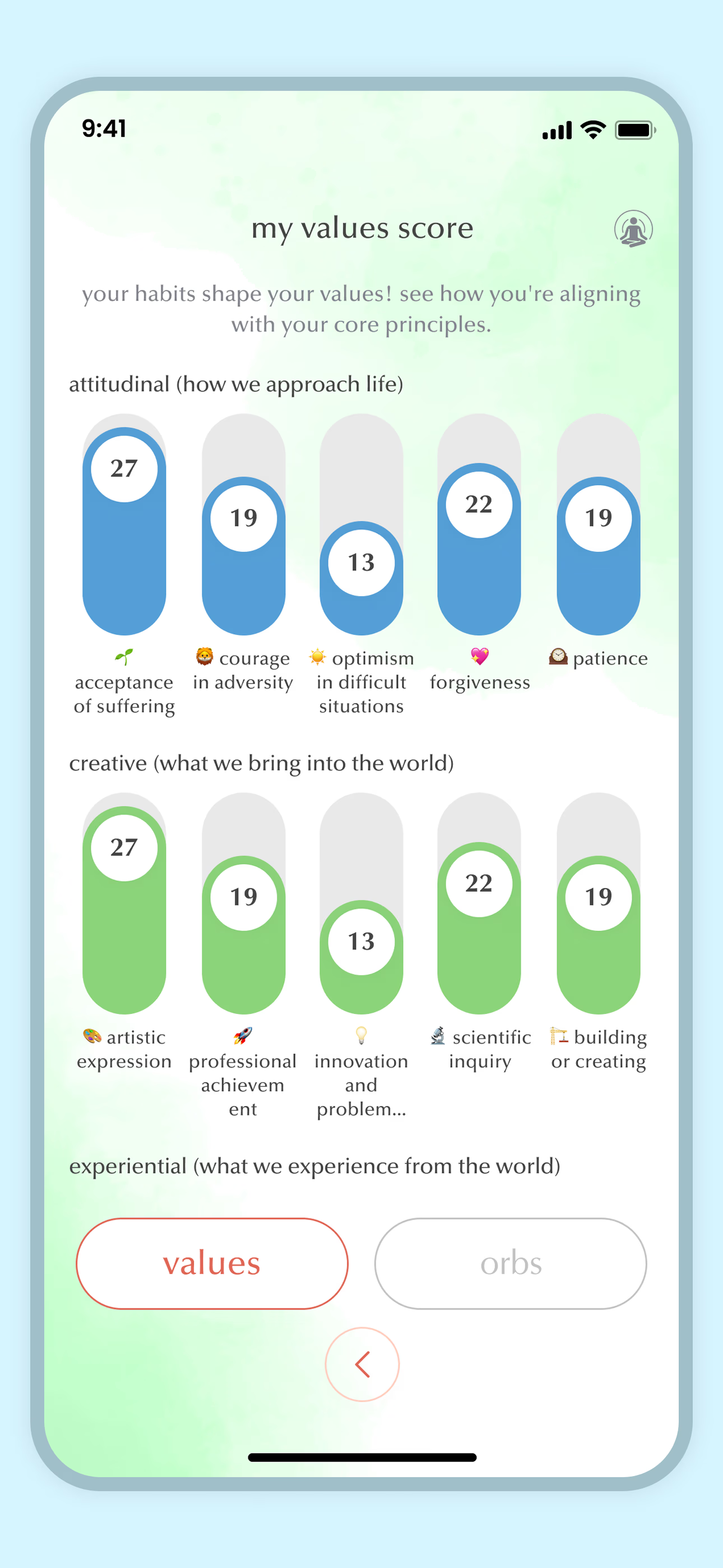
From theory to practice — meaning forms when insight meets action.
Because humans don't only regulate for safety — we regulate for continuity. Values act like internal coordinates. When daily action keeps confirming them, the body gets a subtle Done Signal. When it keeps violating them, the signal doesn't arrive and activation stays online. The discomfort shows up as friction, not insight: irritability, restlessness, foggy guilt, a persistent sense of being behind even when nothing is obviously wrong. That's not character failing. It's the nervous system registering mismatch. The Identity & Meaning System tracks integrity, and it can't stand down while integrity is unresolved. Tension is information, not verdict.
Yes — it's an ongoing physiological load, not just a mental contradiction. Your system holds two tracks at once: what you say matters and what your behavior repeatedly confirms. Over time, that split drains capacity, making everyday choices heavier than they should be. People can become highly functional and strangely ungrounded simultaneously — not from lack of self-awareness, but because the organism is managing an unresolved loop where the integrity check never completes. Understanding the mismatch can clarify, but clarity alone isn't closure. Closure arrives when life repeatedly lands in a pattern your body recognizes as consistent with what it cares about.
Because the body prioritizes what lowers immediate load. Conforming to expectations, choosing the easier option, staying in familiar roles — all reduce near-term friction. That reduction reads as I feel better even when the deeper mismatch remains. It's not that people don't care; it's that a taxed system selects options that minimize immediate consequences. The relief is real but incomplete. Less conflict today means more internal fragmentation tomorrow. Less risk now means less agency later. The Avoidance Loop here isn't cowardice — it's the system trading coherence for immediate comfort. Quick relief changes state; only completion changes trajectory.
Quieter, not euphoric. Decisions take fewer internal negotiations. Boundaries feel less dramatic. You notice more signal return — hunger, fatigue, interest, boredom — because the system isn't spending energy managing contradiction. Confidence shifts from certainty to sturdiness: choices feel defensible without elaborate justification. Less second-guessing after decisions. More stable motivation that doesn't depend on adrenaline. Greater tolerance for discomfort because it has a why that lands. Meaning Density grows when actions and values repeatedly meet, until meaning stops being a concept and becomes a stable background condition the nervous system can rest inside.
From Science to Art.
Understanding explains what is happening. Art allows you to feel it—without fixing, judging, or naming. Pause here. Let the images work quietly. Sometimes meaning settles before words do.
One Quiet Window, one insight, one reflection — every Sunday