Purpose Alignment: When Your Actions Finally Match Your Values
In short: Many people can name what matters to them—values, callings, priorities—and still feel oddly untethered. Purpose may be clear on paper but hard to live inside. That gap is not a character flaw.
Many people can name what matters to them—values, callings, priorities—and still feel oddly untethered. Purpose may be clear on paper but hard to live inside. That gap is not a character flaw. It often reflects how modern life keeps experiences unfinished: too many inputs, too little completion, and not enough “done” signals for the nervous system to stand down.
What if purpose isn’t something you find, but something that settles into you after enough life has actually completed it?
Meaning integration is less like insight and more like consolidation. It’s when actions, choices, and consequences have repeated enough—under real conditions—that your identity stops negotiating. Purpose becomes a reliable reference point, not a performance you have to remember.
Humans don’t only seek goals; we seek coherence. We want our lives to make sense in a way the body can trust. When purpose is integrated, it doesn’t require constant self-talk or vigilance. It shows up as a steady “of course” feeling: a quiet recognition that certain choices fit.
This isn’t mystical. It’s the narrative system doing what it evolved to do: organizing experiences into an identity that can guide behavior across time. When the story is coherent, the nervous system spends less energy scanning for contradictions. When the story is fragmented, the system stays on alert, as if it might need to renegotiate who you are at any moment. [Ref-1]
Identity doesn’t form primarily from what we declare. It forms from what repeats with consequence: what we choose, what it costs, what it protects, what it builds, and what keeps happening even when no one is watching. Over time, the mind links these sequences into a stable narrative: “This is the kind of person I am.”
That’s why purpose can’t be integrated by understanding alone. Understanding can orient you, but integration requires enough completed cycles—decision, action, consequence, recovery, return—that the body recognizes the pattern as safe and self-consistent. Coherent narratives are associated with greater well-being and a stronger sense of meaning, likely because they reduce internal contradiction and increase continuity over time. [Ref-2]
“When something matters to you in a lived way, it stops needing to be proved.”
The human narrative system is constantly assembling: past events, current demands, social feedback, and future plans. Its job is not to be perfect—it’s to keep the self continuous. This continuity is a form of regulation. When your story has too many loose ends, the system keeps allocating attention to unresolved questions: Who am I in this? What does this mean about me? What happens next?
Coherence isn’t forced positivity. It’s structure: sequences that connect, explanations that hold, and an identity that can carry complexity without splitting into competing versions of self. Narrative coherence has measurable links to identity and well-being, suggesting that continuity itself is stabilizing. [Ref-3]
Before integration, decisions can feel like repeated negotiations. Even small choices—what to say yes to, how to spend an evening, whether to rest—carry an invisible tax. Not because you’re indecisive, but because your identity has not fully consolidated around what matters. The nervous system keeps the choice “open,” sensing multiple possible selves.
As meaning-making across self-relevant experiences becomes more complete, identity commitment tends to strengthen. That commitment reduces internal conflict because fewer decisions need to be re-litigated from scratch. The experience is less “I should” and more “this fits.” [Ref-4]
What if decision fatigue is sometimes a sign of unfinished identity work—not weak willpower?
It’s tempting to imagine integration as a final arrival: one day you “figure it out” and everything stays aligned. In real life, identity is an evolving story. New roles, losses, relationships, and environments add material, and the narrative system updates. Integration is not the end of change; it’s the ability to change without losing continuity. [Ref-5]
So the question is rarely “Do I have purpose?” More often it’s: “Is my purpose currently supported by the conditions I’m living in?” When conditions fragment attention and compress time, even a deeply held purpose can become difficult to embody—not because it’s false, but because it’s under-resourced.
Stalled integration often looks like a “meaning loop”: you think about purpose, read about it, plan around it, maybe even talk about it—yet it doesn’t settle. The loop stays open because it hasn’t moved through enough real completion. The body hasn’t received the signal that the value is truly lived and survivable.
In this state, the mind may generate more abstraction: new frameworks, new labels, new promises. But conceptual clarity can coexist with physiological uncertainty. Research on self-concordance and identity suggests that stronger identity development is linked with more value-aligned goal pursuit over time, implying that integration depends on identity consolidation—not just preference. [Ref-6]
When purpose becomes part of identity, it tends to change the texture of daily life. The shift isn’t constant inspiration. It’s reduced internal arguing. Choices start to feel more self-evident because they’re being referenced against a stable “who I am,” rather than a fluctuating mood or external evaluation.
Self-concordant striving—pursuing goals for reasons that match authentic values—has been associated with both well-being and sustained engagement. This doesn’t mean life becomes easy; it means the effort feels less like self-coercion and more like self-expression. [Ref-7]
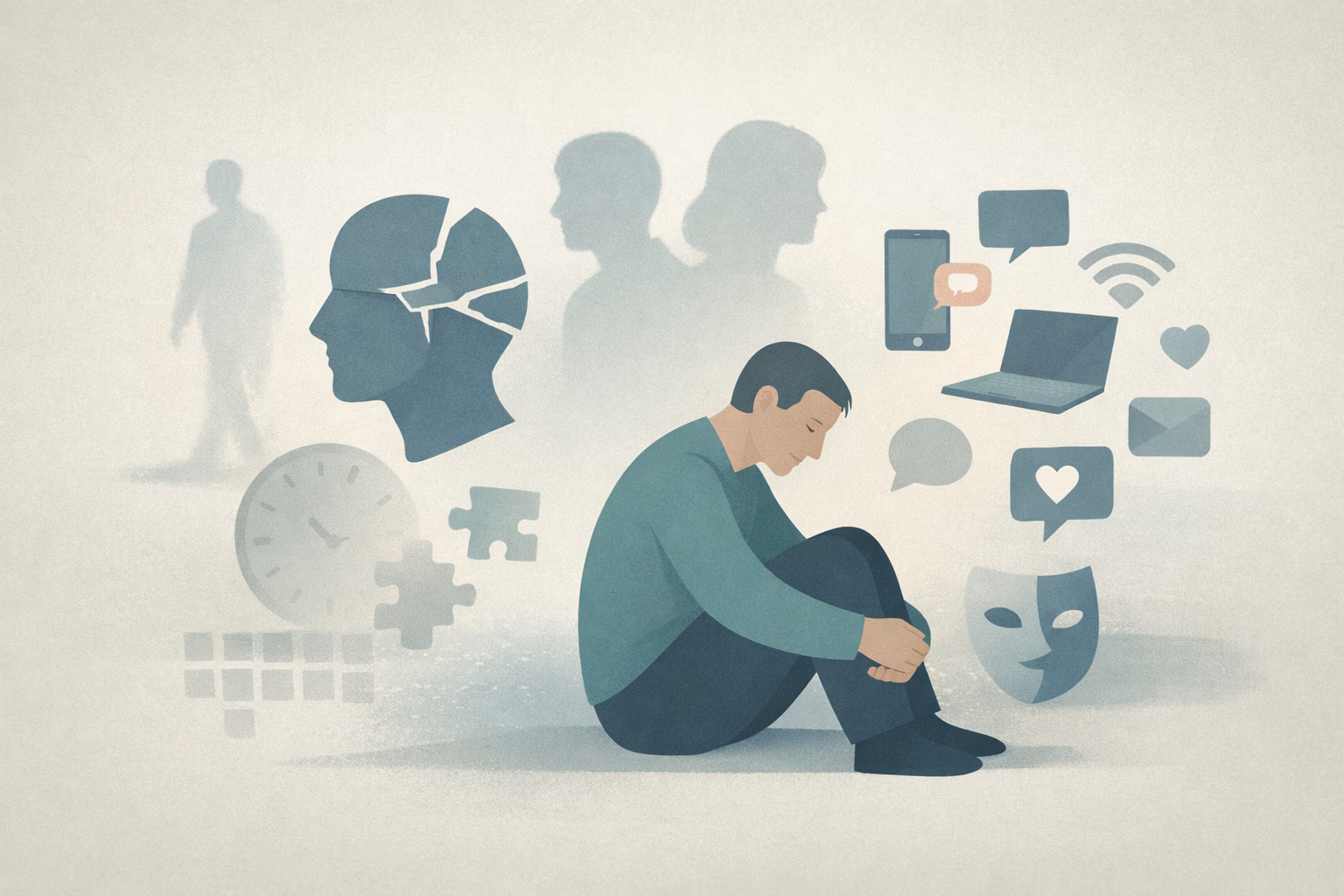
When meaning is not integrated, identity can become porous. Not in a moral sense—in a structural sense. Without a consolidated internal reference point, the nervous system looks outward for cues: metrics, reactions, trends, urgency. External direction feels temporarily relieving because it reduces uncertainty, even if it doesn’t fit long-term values.
In this fragmented state, patterns like overcontrol, avoidance, or craving often function as short-term regulators. They simplify the moment by narrowing the field: one task, one scroll, one rule, one escape. But simplification is not closure. Without closure, identity remains vulnerable to the next strong cue or reward signal.
Work on self-concordant goals emphasizes that goals aligned with core values and authentic interests tend to be more sustaining; when alignment is missing, persistence often depends on external pressure, which is inherently unstable. [Ref-8]
Integration has a compounding quality. When an action expresses a value and reaches completion—followed by real consequence and recovery—it becomes evidence. Evidence is powerful because it doesn’t require persuasion. It becomes part of the lived record: “I do this. I can be this. This is mine.”
Over time, the narrative system uses that record to predict behavior, and behavior becomes easier to repeat. This is one reason identity-congruent action can feel more effortless: the brain interprets it as meaningful, even when it’s challenging, because it matches “who I am.” [Ref-9]
“Consistency isn’t a personality trait. Sometimes it’s just what happens when the inner story stops being contested.”
There’s a common belief that staying aligned requires constant checking: Am I on track? Am I doing it right? Am I falling behind? But chronic self-monitoring is itself a load. It keeps the system in evaluation mode, which can prevent the settled feeling that integration needs.
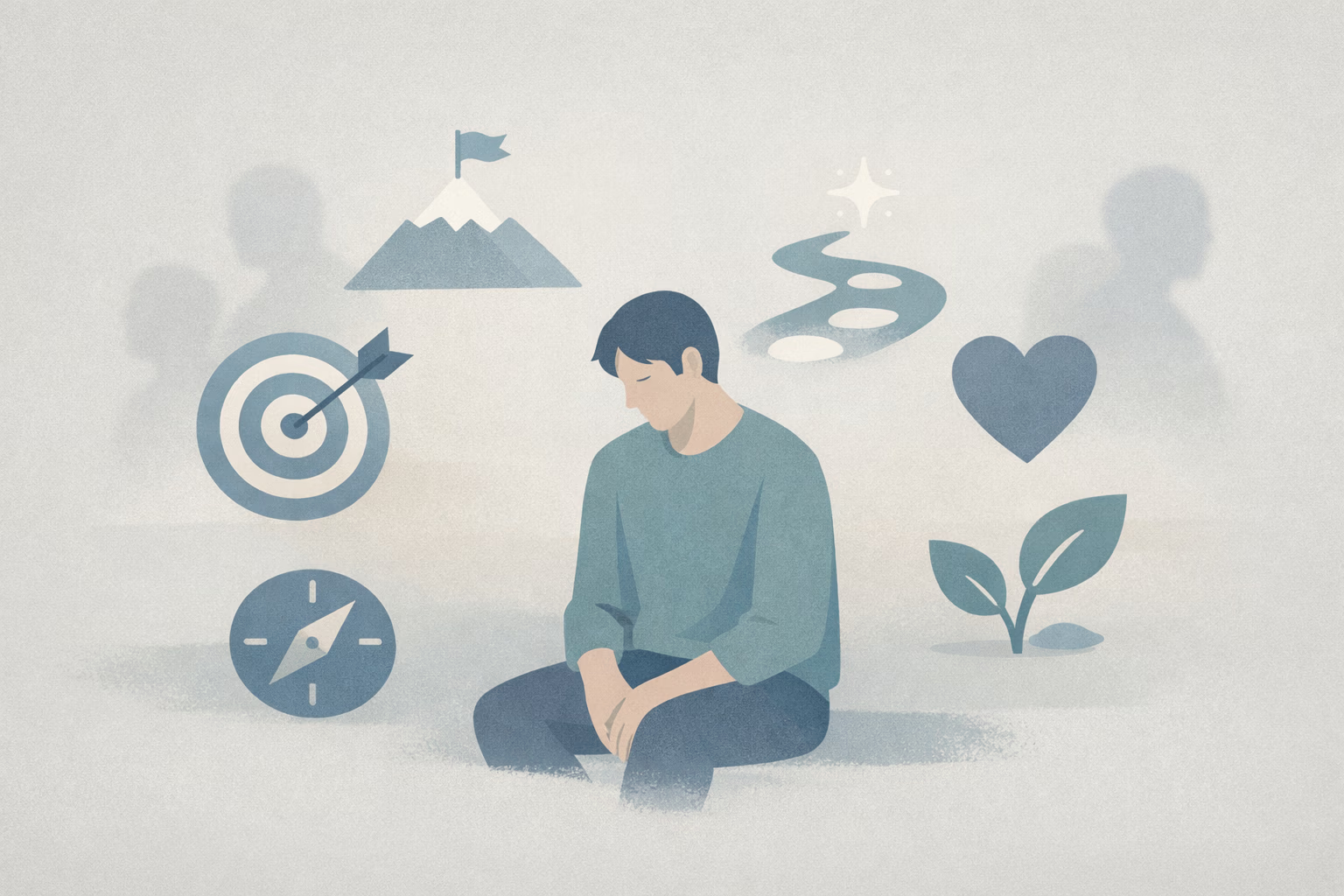
When purpose is embodied, it can guide perception and choice more automatically, like a compass rather than a checklist. That doesn’t remove complexity, but it reduces the need for relentless internal surveillance. Identity-based motivation models describe how identity can shape what feels relevant, what feels worth doing, and what feels like “me,” making certain behaviors more natural. [Ref-10]
What if the goal isn’t to watch yourself harder—but to live in a way that needs less watching?
Relationships are sensitive to coherence. When someone’s identity signals are consistent, others feel it: fewer abrupt switches, fewer unexplained withdrawals, fewer promises that evaporate under stress. This isn’t about being predictable in a rigid way. It’s about being legible—your values show up in how you handle pressure.
Integrated purpose can also reduce performative relating. When you’re not constantly negotiating your identity, you’re less likely to use relationships as an arena for proof. Identity-based motivation research emphasizes that what feels identity-congruent shapes action and interpretation, including in social contexts—affecting trust, follow-through, and felt authenticity. [Ref-11]
People often expect integration to feel like intensity—more passion, more certainty, more drive. In practice, it often feels like a drop in noise. A quieter baseline. More capacity to return to center after disruption, because fewer internal systems are competing for control.
This can look like calm confidence, not as bravado, but as reduced internal contradiction. The self-story can carry stress without immediately fragmenting into urgency, collapse, or overcorrection. Many descriptions of values-identity alignment emphasize this sense of internal alignment and wholeness as a stabilizing experience. [Ref-12]
As meaning integrates, direction becomes less of a search and more of an emergence. Not because life gets simpler, but because the internal reference point is clearer. The narrative system doesn’t have to generate a new self each day. It can extend a coherent line forward.
In this state, you may still face choices—but fewer of them feel like identity crises. Purpose acts as an organizing principle, shaping what you notice, what you tolerate, and what you consider “worth it.” Narrative coherence supports this continuity, helping identity guide life direction without constant deliberation. [Ref-13]
Meaning integration isn’t primarily about becoming better. It’s about becoming more whole—less split between what you value and what your life repeatedly communicates. When values are lived with enough completion, they stop needing to be announced. They start functioning as identity.
From this angle, struggles with purpose often point to conditions: too much fragmentation, too much evaluation, too little closure. Agency returns when the inner story becomes more coherent—not through pressure, but through lived continuity that the nervous system can register as real. [Ref-14]
There is a particular kind of relief when direction no longer has to be chased. Not because questions disappear, but because your life is generating answers in the form of completed patterns. When meaning becomes identity, purpose stops being something you manage—and becomes something you inhabit.
From theory to practice — meaning forms when insight meets action.
Because clarity and integration are different processes. You can name your values precisely and still feel untethered, because the narrative system needs more than understanding — it needs completed cycles. Decision, action, consequence, recovery, return. When modern life keeps experiences unfinished, purpose stays conceptual: a thing you remember rather than something you inhabit. The Meaning Loop can't close on language alone. The body has to register, repeatedly, that the value is lived and survivable. Until that happens, the gap between what you believe and how you live remains — not as a character flaw, but as unfinished consolidation.
Often it feels like a drop in noise rather than a surge of intensity. Decisions get quieter — not necessarily faster — because they're being referenced against a stable 'who I am' instead of a fluctuating mood. Fewer restarts after a slip. Less reliance on motivation, because meaning is doing the orienting. Less background shame, because the self-story stops contradicting itself. Self-concordant action feels less like coercion and more like expression. The Done Signal arrives more often: completed loops, smaller arguments, more 'enoughness' after ordinary tasks. Purpose stops being something you manage and becomes something you inhabit.
Because every unconsolidated value turns small choices into open negotiations. What to say yes to, how to spend an evening, whether to rest — each one quietly costs more when identity hasn't settled around what matters. The nervous system keeps the choice 'open,' sensing multiple possible selves competing for direction. That's not weak willpower; it's the cost of low Meaning Density. As identity commitment strengthens through lived completion, fewer decisions need to be re-litigated from scratch. The experience shifts from 'I should' to 'this fits.' Decision fatigue often eases not through better systems, but through a more consolidated self.
No, and chronic self-monitoring is itself a form of load. It keeps the system in evaluation mode — scanning, checking, doubting — which prevents the settled feeling integration actually needs. When purpose is embodied, it works more like a compass than a checklist: it shapes what you notice, what you tolerate, what feels worth doing, without constant deliberation. That doesn't remove complexity. It reduces the need for relentless internal surveillance. Identity becomes legible to others too — fewer abrupt switches, fewer promises that evaporate under stress. The goal isn't to watch yourself harder; it's to live in a way that needs less watching.
From Science to Art.
Understanding explains what is happening. Art allows you to feel it—without fixing, judging, or naming. Pause here. Let the images work quietly. Sometimes meaning settles before words do.
One Quiet Window, one insight, one reflection — every Sunday