Fear of Aging: The Psychological Root of Avoidance
In short: Sudden doubt, disorientation, and the sense that the “you” who used to make sense no longer fits. But in many cases, it’s less a character flaw than a predictable nervous-system and meaning-system response to a life that has changed faster than the inner story can complete.
Midlife identity collapse is often described like a personal crisis: sudden doubt, disorientation, and the sense that the “you” who used to make sense no longer fits. But in many cases, it’s less a character flaw than a predictable nervous-system and meaning-system response to a life that has changed faster than the inner story can complete.
What if the problem isn’t that you’re behind—what if your system can’t find a clean “done” signal anymore?
In the digital era, comparison never closes. Milestones are constantly displayed, edited, ranked, and refreshed. That keeps identity under evaluation rather than under settlement—so even good choices can start to feel provisional, and even real accomplishments can feel oddly unowned.
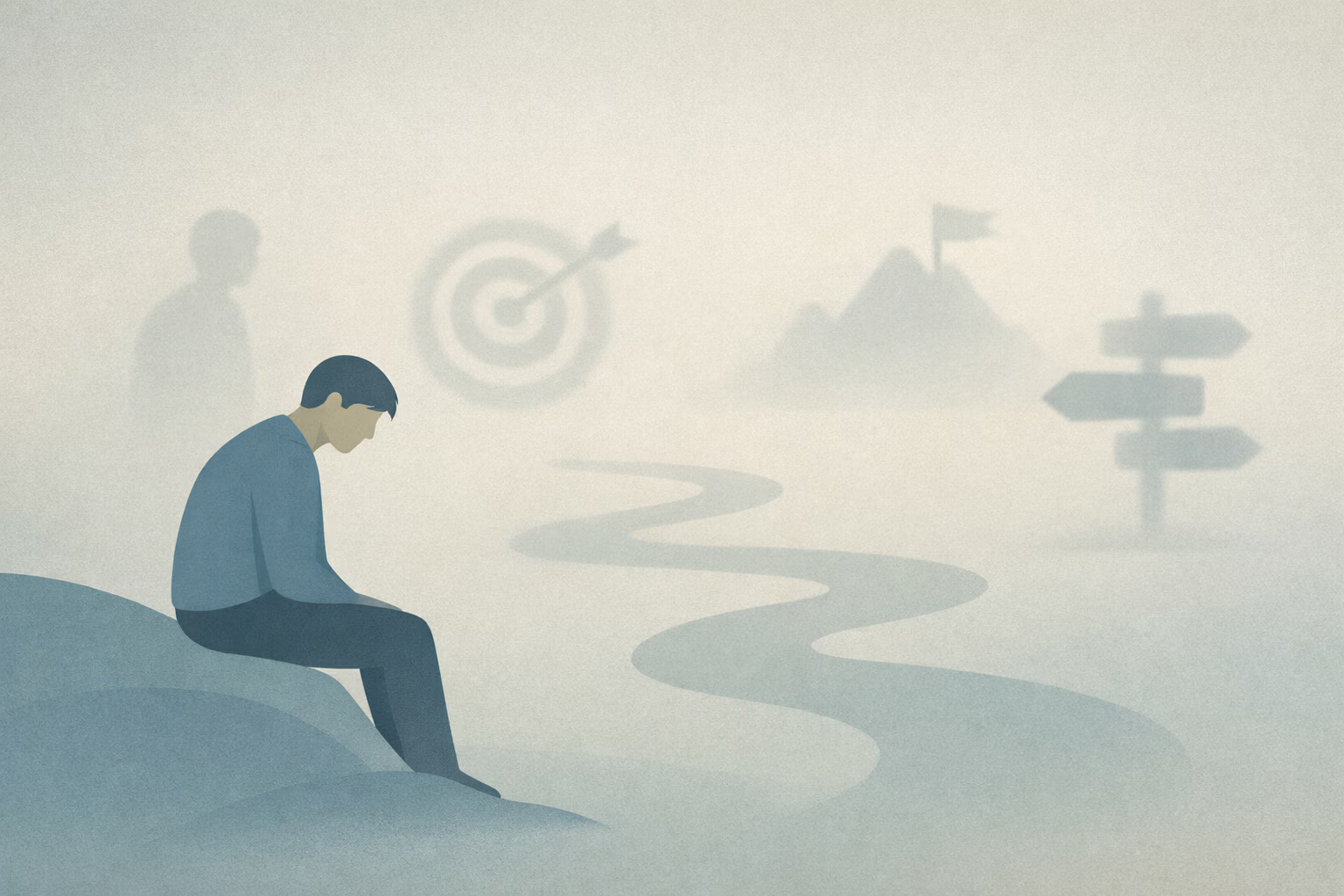
Identity is not just a set of traits or preferences. It’s an orientation system: a lived sense of “this is who I am, this is what matters, and this is where my life is going.” When that orientation weakens, the world can feel strangely loud and unclear—too many options, too many interpretations, too little certainty about what counts.
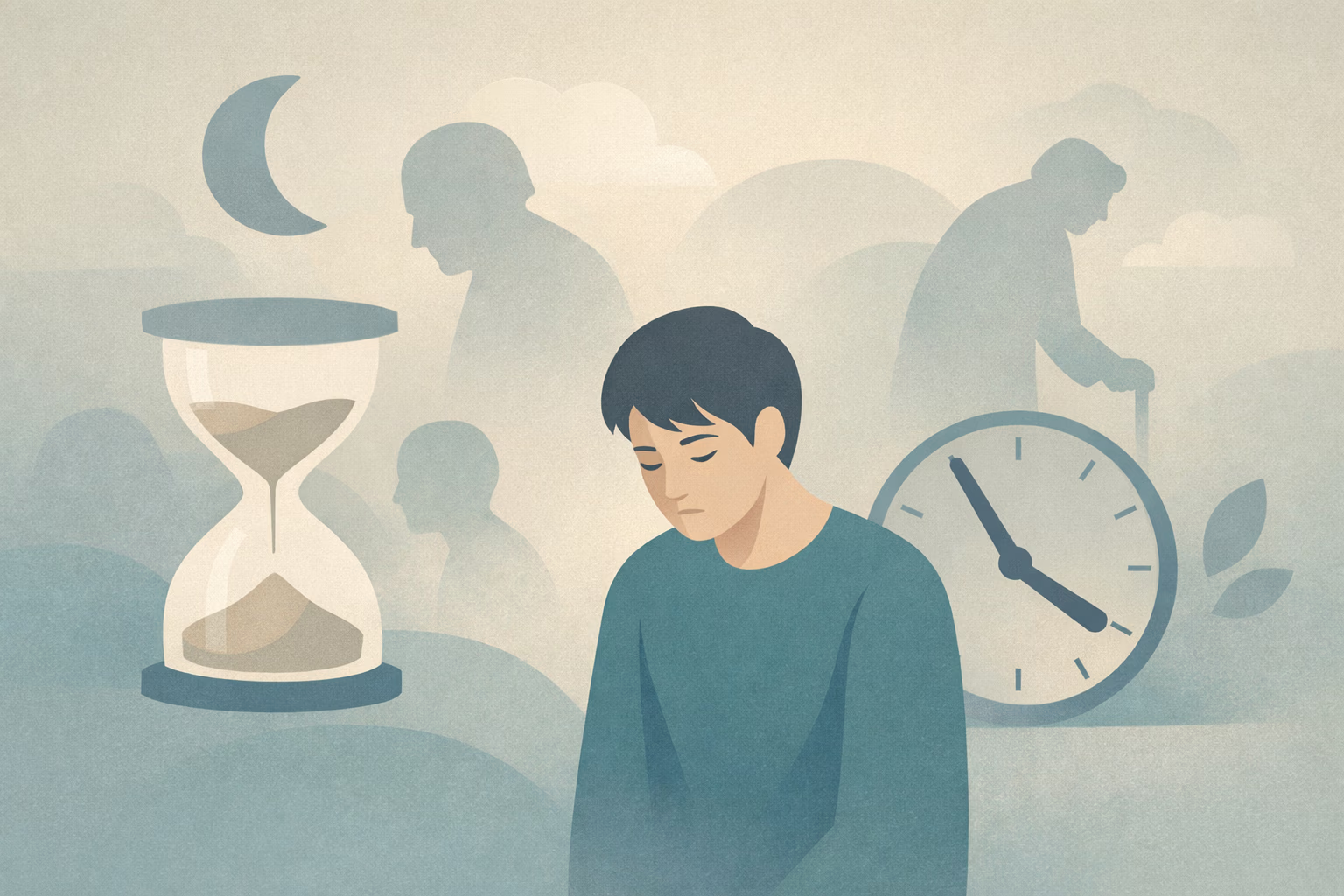
Midlife adds a specific kind of pressure: earlier roles and timelines (student, early-career, new parent, builder, achiever) may no longer supply coherence. The nervous system reads that loss of coherence as increased load—more scanning, more second-guessing, more urgency to resolve the uncertainty. Disorientation is not proof that you’re broken; it’s a signal that an old organizing story is no longer completing cleanly. [Ref-1]
Online environments don’t just show information; they shape attention and memory. When the mind repeatedly “checks” the external world for cues about status, direction, and sufficiency, it can outsource internal orientation to the feed—creating a loop where the next scroll becomes the next attempt at clarity. That can temporarily reduce uncertainty, but it also keeps the identity system dependent on external updates rather than internal completion. [Ref-2]
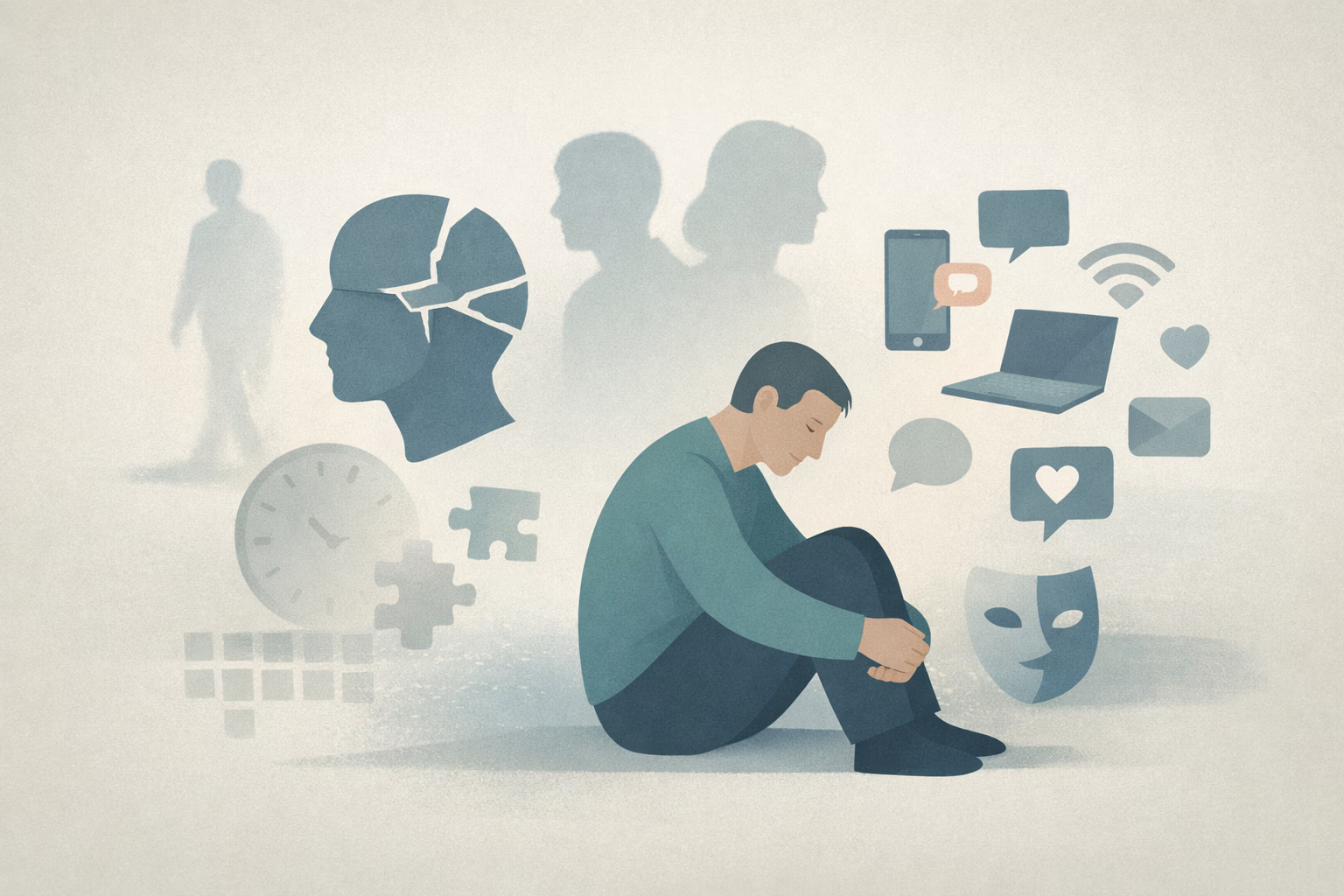
In midlife, that loop can hit especially hard because the comparisons often involve life structure: partnership, family, career prestige, health, finances, creativity, youthfulness. The algorithm amplifies what generates engagement—often the most polished, dramatic, or status-signaling slices of other people’s lives—so the nervous system receives a steady stream of “you may be missing something” cues.
Over time, this can produce fragmentation: many partial conclusions (“I should have…,” “I’m late,” “I picked wrong,” “I need to catch up”) without a stable, embodied sense of what your life is actually becoming.
Humans evolved to track goals, roles, and belonging through narrative: we build continuity by linking past choices to present commitments to future direction. Social comparison also has a place in that system—it can help us calibrate, learn norms, and coordinate with a group.
The problem isn’t that comparison exists. The problem is that modern comparison is continuous, global, and often decontextualized. Your nervous system can be exposed to thousands of “peers” in a day—without the stabilizing context of shared reality, shared contribution, and shared consequence. Under chronic stress load, the mind often narrows toward perfectionistic metrics and self-worth monitoring, because those are quick, countable proxies for safety and belonging. [Ref-3]
So when midlife naturally asks for story revision, the digital environment can flood the revision process with noise—making it harder for the system to land anywhere long enough to integrate.
When identity feels unstable, the system looks for immediate ways to reduce internal friction. Disengaging from certain conversations, delaying decisions, staying busy, over-researching, or leaning harder into an old role can all create a temporary sense of safety because they reduce exposure to uncertainty.
This isn’t “self-sabotage.” It’s a short-term regulatory move: if closure isn’t available, the system often chooses the next-best thing—lowering the felt intensity by narrowing life, postponing contact with consequences, or outsourcing direction to familiar metrics. In midlife transitions, this can also show up as clinging to a former identity label (the achiever, the caretaker, the reliable one) because it’s a known container, even if it no longer fits. [Ref-4]
When the inner map wobbles, the nervous system prefers any map over no map.
It can seem reasonable to use visible milestones as guidance: compare, evaluate, correct course. But external metrics rarely reflect the invisible parts of life that create real coherence—values, tradeoffs, caregiving, recovery from stress, health constraints, economic conditions, cultural differences, or sheer timing.
In midlife, many people naturally report increased acceptance and less regret as they move toward a wider perspective of what life is for. That shift is not laziness; it can be an emergent form of coherence. Yet algorithmic culture often frames acceptance as “settling,” keeping the nervous system in a chronic state of appraisal instead of allowing identity to consolidate. [Ref-5]
What if your discomfort isn’t proof you chose wrong—what if it’s proof you’re being evaluated too often?
Digital comparison often functions like a two-part loop: stimulation (new images, new outcomes, new proof of someone else’s progress) followed by a brief state shift (numbness, urgency, resolve, or self-critique). The shift can feel like movement, but it doesn’t necessarily produce completion. It rarely ends with “done.”
Because the feed refreshes, the system stays in partial processing—collecting signals without arriving at a settled identity conclusion. This can resemble “searching for yourself” while actually keeping the self in suspension. Many people interpret that suspension as personal confusion, when it may be a structural mismatch: a narrative organism placed in a non-narrative environment that never closes. [Ref-6]
In that context, avoidance isn’t primarily about fear. It’s about load management: when too many identity questions are opened at once, the system reduces exposure by retreating into quick loops that promise certainty but deliver more open tabs.
When identity coherence is under strain, patterns often emerge that make sense as regulation. They aren’t “who you are.” They’re what happens when the system can’t reach completion and keeps searching for stabilizing cues.
Public discourse increasingly frames platforms themselves as shaping midlife insecurity—because the environment can repeatedly trigger timeline comparison and status appraisal. [Ref-7]
Autonomy isn’t simply making choices; it’s experiencing your choices as yours—anchored in a stable sense of what matters. Prolonged comparison can thin that felt ownership. You may still function well, but with a background sense that your life is being graded by an invisible committee.
Over time, the identity system may stop investing in new commitments, because new commitments require a period of awkwardness before they become integrated. If the environment keeps interrupting that period with “someone else did it better,” the nervous system learns that investing is costly and uncertain—so it stays in evaluation mode instead of consolidation. [Ref-8]
This is how meaning can feel like it’s collapsing: not because values are gone, but because the conditions for meaning to settle—continuity, consequence, closure—keep getting disrupted.
Identity drift happens when the self is repeatedly pulled toward what gets immediate feedback rather than what produces long-run coherence. Algorithmic validation (likes, views, comments) can become a stand-in for “this matters,” even when it doesn’t match your deeper orientation.
At the same time, rumination can become a parallel loop: the mind replays comparisons and alternate timelines, not necessarily to punish you, but because the system is trying to complete an unresolved question. Without real-world closure, rumination can act like a persistent loading screen.
Many people describe a sense of living in a “fake world” online—not because their experiences aren’t real, but because the social signals are divorced from shared context and sustained consequence. That dislocation can amplify the feeling that your life is both visible and unconfirmed at the same time. [Ref-9]
Reflection is often offered as the solution to identity confusion, but reflection alone can become another loop—more analysis, more tracking, more “figuring it out.” Insight is not the same as integration. Integration shows up when the body stops bracing around the question and the identity story can hold steady without constant checking.
Still, certain forms of self-inquiry can act as a bridge toward coherence because they reduce noise and clarify what is actually being asked. Value clarification and journaling can help differentiate borrowed metrics (“what looks impressive”) from lived metrics (“what feels structurally true in my life”). In research on social comparison, rumination is a key pathway by which upward comparison intensifies anxiety; reducing that spiral can change the load on the system. [Ref-10]
In other words: the goal isn’t to think harder. It’s for your meaning system to have enough continuity and closure that the question doesn’t keep reopening in the same painful way.
Humans don’t build identity in isolation. We calibrate ourselves through relationship: being seen consistently, receiving reality-based feedback, and having our contributions reflected back in ways that feel grounded. When the digital world provides high-volume signals without stable context, trusted relationships can restore context.
Peer support, mentoring, or coaching can help not by “fixing” you, but by providing a coherent mirror—someone who can hold the thread of your story while you’re revising it. This matters because social-comparison rumination is strongly tied to distress and burnout; reducing that loop often requires a different kind of social input than the feed provides. [Ref-11]
Some clarity arrives not as a breakthrough, but as a steady return to what’s real.
When identity begins to reconstruct, many people expect fireworks—confidence, certainty, a big emotional moment. More often, coherence returns as a quieter signal: less internal arguing, fewer urgency spikes after comparison, and a stronger sense of “this is mine” around choices.
Well-being tends to improve when social comparison loses its authority as the main reference point. This isn’t about never noticing others; it’s about not being reorganized by them. Research links social comparison on networking sites with shifts in self-esteem and well-being, suggesting that the comparison environment can meaningfully shape how stable you feel inside your own life. [Ref-12]
As the comparison-and-avoidance loop loosens, energy often shifts from managing impressions to making meaning. Not as inspiration, but as orientation: the system starts investing in what can actually complete—relationships, responsibilities, craft, health, contribution, play, learning—whatever fits your values and context.
In this phase, “identity” becomes less about a label and more about a pattern you can live. The nervous system receives more consistent safety cues because actions and values are no longer constantly interrupted by external ranking. Meta-analytic work links social media use with social comparison, suggesting that when comparison pressure is high, it can keep people in a reactive posture; when it’s lower, more self-authored direction becomes possible. [Ref-13]
Not “Who should I be?” but: “What kind of life can I stand inside?”
Midlife identity collapse is often treated as embarrassment—a sign you failed to plan correctly. Another view is more humane: it can be a moment when borrowed timelines stop working, and the system refuses to keep pretending they do.
Digital life can intensify the disruption by keeping identity under perpetual observation, but identity development in the digital age is not doomed. It’s shaped by conditions: what you’re exposed to, what gets repeated, what gets closure, and what gets to become embodied as “me.” [Ref-14]
If you’re in this terrain, it can help to hold one steady idea: you’re not looking for a perfect answer. You’re looking for a life that can settle—one that your nervous system can recognize as coherent enough to stop re-checking.
Identity strain isn’t reserved for one age group. Even younger generations report “midlife crisis” feelings in a culture that accelerates comparison and destabilizes timelines. [Ref-15] That doesn’t make the experience less serious; it makes it more understandable.
When an old story collapses, it may be because your system is ready for a truer one—one built from lived values, completed choices, and a pace that allows your life to feel like it belongs to you. Not optimized. Not performed. Coherent.
From theory to practice — meaning forms when insight meets action.
It's usually a structural response, not a character flaw. Identity is an orientation system — a lived sense of 'this is who I am, this is what matters, this is where my life is going.' Earlier roles like student, builder, or new parent supplied coherence; in midlife, those organizing stories often stop completing cleanly. The nervous system reads that loss of coherence as increased load and starts scanning, second-guessing, and rushing to resolve the uncertainty. Disorientation isn't proof you're broken. It's a signal that an old narrative loop has run out, and the system is asking for a truer one to take its place.
Online environments shape attention and memory by keeping identity under perpetual evaluation. Comparisons in midlife often involve life structure — partnership, family, career prestige, finances, health, youthfulness — and the algorithm amplifies the most polished, status-signaling slices. Your nervous system receives a steady stream of 'you may be missing something' cues without the stabilizing context of shared reality or shared consequence. That keeps the identity system dependent on external updates rather than internal completion, producing fragmentation: many partial conclusions like 'I should have' or 'I'm late,' without a stable, embodied sense of what your life is actually becoming.
Because the nervous system prefers any map over no map. When identity feels unstable, holding onto a former label — the achiever, the caretaker, the reliable one — provides immediate regulatory relief by reducing exposure to uncertainty. It's not self-sabotage. It's a short-term move: if closure isn't available, the system narrows life, postpones contact with consequences, or outsources direction to familiar metrics. The cost is that the role no longer fits, so the relief is partial and the underlying question keeps reopening. Real settlement comes from a story your system can recognize as coherent enough to stop re-checking, not from clinging tighter to one that's already collapsed.
Quieter than people expect. Most imagine confidence and certainty arriving as a breakthrough; in practice, coherence shows up as less internal arguing, fewer urgency spikes after comparison, and a stronger sense of 'this is mine' around choices. Decisions feel less like a referendum on your worth. Days have more clean endings and less mental carryover. Values become easier to name without needing to defend them. Energy returns in small, usable amounts rather than dramatic surges. The shift isn't from confused to certain — it's from constantly re-evaluated to settled enough to live inside, where the Meaning Loop can run without being interrupted by external ranking.
From Science to Art.
Understanding explains what is happening. Art allows you to feel it—without fixing, judging, or naming. Pause here. Let the images work quietly. Sometimes meaning settles before words do.
One Quiet Window, one insight, one reflection — every Sunday