The Hidden Cost of Mental Fatigue: When Your Brain Never Gets Quiet

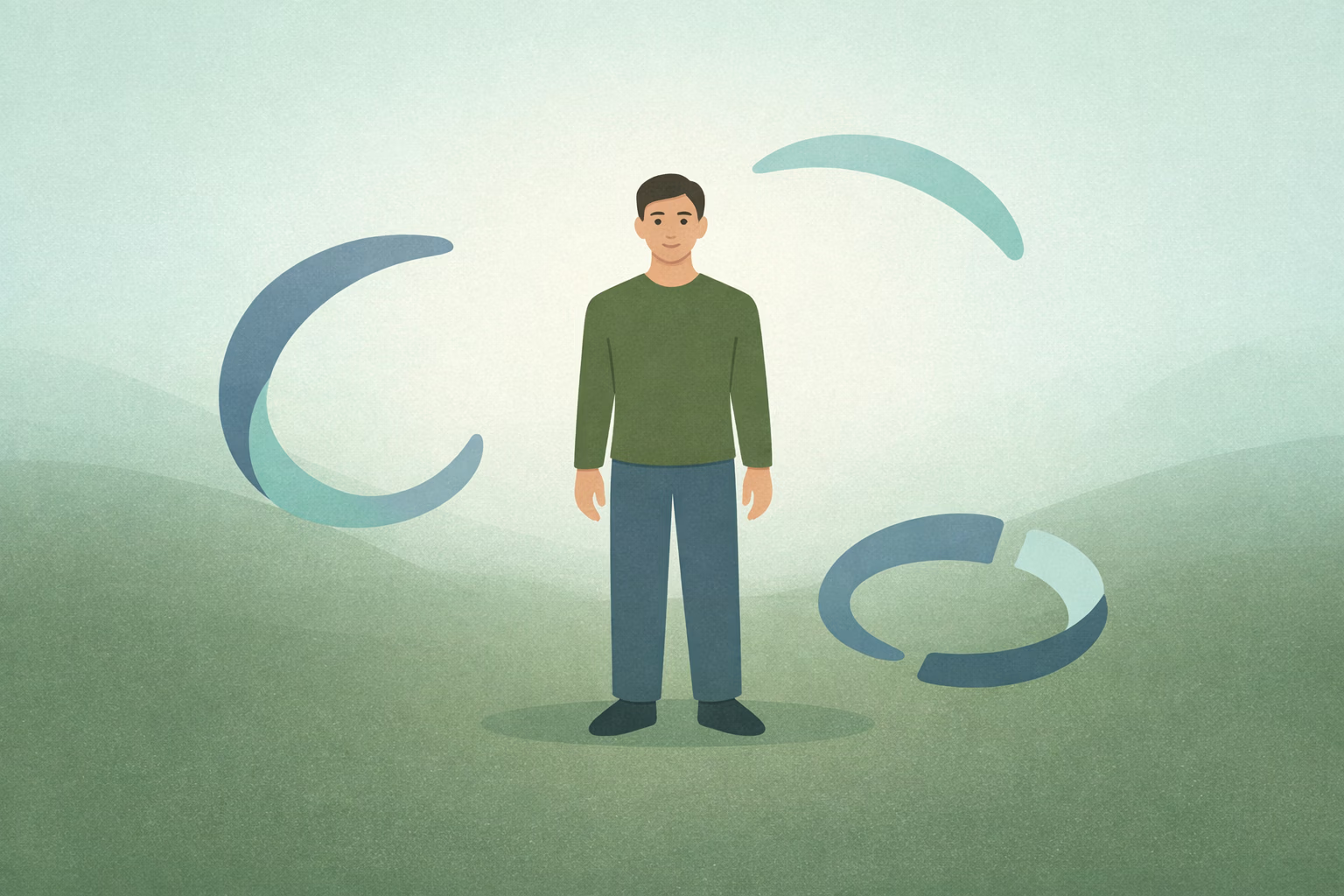
In short: Many people describe the same strange tension: you’re technically “doing something,” but your attention feels partially elsewhere—split between tabs, thoughts, messages, and the sense that something might happen any second. What if “not being present” isn’t a character flaw, but a nervous system adapting to constant interruption?
Many people describe the same strange tension: you’re technically “doing something,” but your attention feels partially elsewhere—split between tabs, thoughts, messages, and the sense that something might happen any second.
What if “not being present” isn’t a character flaw, but a nervous system adapting to constant interruption?
In modern digital life, attention is repeatedly recruited and released before it can settle. Over time, the system learns a new baseline: stay ready to switch. That readiness can look like restlessness, checking, urgency, or blankness—not because you’re broken, but because your brain is working with the conditions it’s been given.
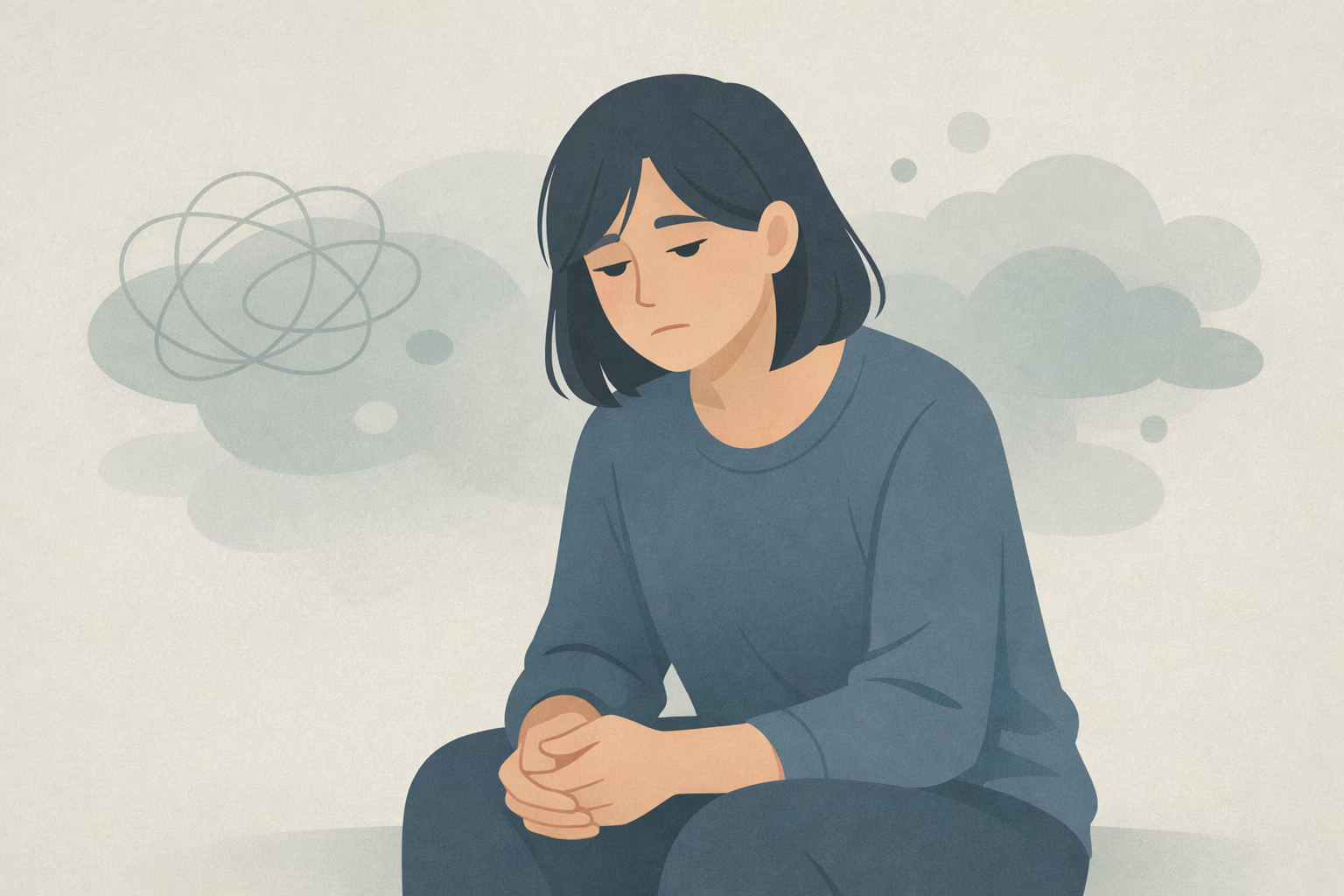
The attention crisis usually isn’t experienced as “I can’t focus.” It’s experienced as a low-grade mental dispersion: you begin something, and within moments there’s a pull toward something else—another input, another thought, another micro-decision.
This can come with a specific kind of friction: you’re trying to be “here,” but your system keeps preparing for “next.” Even pleasant activities can feel thin, like they don’t fully land. Many people also notice a quiet frustration—because presence looks like it should be a choice. [Ref-1]
It’s not that you don’t care. It’s that your attention keeps getting recruited before it can arrive.
Attention isn’t an infinite resource; it’s an allocation system. Each time your environment offers novelty—notifications, short-form video, rapid feeds, auto-play—your attention is asked to reassign itself. Even when you don’t click, the cue itself can create a “partial orienting,” a small internal turn toward what might be there.
When this happens repeatedly, your day becomes a series of interrupted allocations rather than completed engagements. The result isn’t just distraction; it’s a pattern of incompletion. Experiences start, then stop, then restart—without the kind of ending that tells the nervous system, “that loop is done.” [Ref-2]
Humans evolved to track meaningful change—signals that mattered for safety, belonging, and survival. That orienting response is intelligent. The challenge is that modern environments can produce far more “meaning-like” signals than a nervous system can metabolize.
Executive functions (like working memory, inhibition, and task maintenance) are effortful, energy-sensitive systems. When they’re asked to arbitrate hundreds of micro-choices—open this, ignore that, respond now, save for later—fatigue isn’t a failure; it’s a predictable load response. Under sustained novelty pressure, the system may shift toward faster scanning and shorter holding times because that’s what the environment rewards. [Ref-3]
In a high-input environment, “staying present” can become a full-time job.
Rapid switching can create a convincing sense of engagement: you’re replying, checking, reading, reacting. But physiologically, the system may remain in a mobilized, “ready” state—because each interruption reopens the question of what matters most right now.
Notifications are especially powerful because they arrive as external commands on your attention. Research suggests that notifications and their interruptions can tax cognitive control and degrade performance, even when the task feels manageable in the moment. [Ref-4]
The hidden cost isn’t just lost time. It’s the loss of closure—the nervous system’s stand-down signal that something has fully resolved.
A person can be highly engaged—scrolling, watching, clicking—without being cognitively present in a deeper way. Presence has a “landing” quality: attention holds long enough for perception to organize, for context to form, for the moment to feel real.
Many digital experiences are designed for continuous partial engagement: quick hits, fast switching, shallow resolution. That doesn’t make them evil; it makes them structurally different from activities that naturally complete (a conversation that ends, a meal that finishes, a walk that returns you home).
Even general educational summaries of notification effects emphasize that frequent pings can keep the mind in a checking posture rather than a settling posture. [Ref-5]
One reason attention keeps drifting isn’t a lack of discipline—it’s a common loop in high-reward environments. The sequence often goes: anticipation (something could be there), stimulation (a quick hit of novelty), then dissatisfaction (it didn’t complete anything, so the system stays slightly unfinished).
Task interruptions caused by communication notifications have been linked to increased strain and reduced performance, which fits the lived experience: you’re not just distracted, you’re taxed. [Ref-6]
When the loop repeats, the nervous system learns an unfortunate lesson: short bursts feel like relief, but they don’t produce the “done” signal that restores baseline. So the urge returns—not because you’re weak, but because the cycle never closes.
The attention crisis often shows up as behaviors people judge harshly, even though they’re largely predictable responses to constant cueing and incomplete loops.
Interestingly, research has found that restricting mobile internet access can improve sustained attention—suggesting that the environment meaningfully shapes attention stability. [Ref-7]
These patterns aren’t identities. They’re what attention does when it’s repeatedly trained to expect interruption.
When attention can’t hold, a few downstream capacities can thin out—not as a moral problem, but as a structural one. Deep thinking requires continuity; regulation requires the nervous system to receive completion cues; meaning-making requires experiences to consolidate into memory and identity.
If experiences are constantly cut into fragments, the mind has less opportunity to form coherent narratives. Not dramatic narratives—just the quiet feeling that your day “added up” to something. In developmental and health research discussions, heavy technology exposure is often associated with changes in attention and self-regulatory capacities over time, especially in younger users. [Ref-8]
Without enough endings, life can start to feel like one long middle.
Reward learning is efficient: the brain strengthens what gets reinforced. When novelty reliably offers micro-reward (information, social cues, entertainment), attention begins to orient toward the next potential hit, sometimes even before the current moment is fully processed.
Over time, sustained awareness can feel strangely unrewarding—not because it is, but because the reward system has been calibrated to faster cycles. This is one way “presence” gets displaced by scanning. Research on screen time and executive functions (including in children) frequently discusses associations between higher screen exposure and attentional or behavioral outcomes, underscoring that these are learnable patterns, not fixed traits. [Ref-9]
In a novelty-trained system, boredom isn’t emptiness—it’s a signal that the reward rhythm has shifted.
It can be tempting to frame attention as something you must force back into place. But attention often returns more reliably when the environment stops interrupting its natural completion cycles.
Some people notice a difference between two states: mindless scrolling that disperses them, and bounded engagement that finishes cleanly. Research on mindless scrolling and well-being points to how passive, unstructured use can correlate with poorer outcomes, while the broader pattern depends on context and how the interaction is shaped. [Ref-10]
In Meaning Density terms, presence grows where there is coherence: fewer open loops, fewer split incentives, more experiences that end in a way your nervous system can register. That “registration” isn’t just insight. It’s a settling—an internal permission to stand down because something actually completed.
Attention is not only an individual skill; it’s also relational. In safe connection, nervous systems borrow stability from one another through rhythm, eye contact, pacing, and predictable feedback. When you’re with someone who is truly with you, attention often becomes easier—not because you’re trying harder, but because the environment is giving clear, coherent cues.
Modern tech can reduce these cues: half-conversations, divided eye contact, constant partial availability. Research reviews on digital technology and cognition discuss how pervasive tech contexts can shape attentional habits and social cognition, including the quality of sustained engagement. [Ref-11]
Sometimes the mind can’t stay in the moment because the moment keeps getting interrupted.
When attention stabilizes, the change is often subtle but unmistakable. The moment feels thicker. You track what you’re doing without constant self-correction. You don’t have to repeatedly “come back” because you didn’t leave as often.
Many people describe a quiet return of sequence: one thought leads to the next; a task has a beginning and an end; rest feels more like rest because it isn’t filled with micro-alertness. Discussions of social media’s impact on attention often highlight how frequent switching can shrink the felt span of focus, making even brief stability feel unfamiliar at first. [Ref-12]
This is not a dramatic breakthrough. It’s a capacity returning after load reduces and completion becomes possible.
Willpower narratives tend to intensify shame: if you can’t focus, you assume you’re not trying. But focus is better understood as a trainable, state-dependent function—supported by sleep, stress load, environmental cueing, and the number of open loops you’re carrying.
High screen time is frequently discussed alongside working memory and executive function concerns in public science communication, not as destiny, but as a reminder that cognition is plastic and context-sensitive. [Ref-13]
When focus is treated as physiology rather than virtue, the story changes. The question becomes less “What’s wrong with me?” and more “What conditions keep pulling my attention open?” That question is inherently more humane—and more accurate.
If your attention keeps slipping, it may be responding exactly as a responsive system would: orienting to cues, preparing for interruption, seeking quick relief from unfinished tension.
Studies of smartphone notifications during full-attention tasks support a simple truth many people already feel: the interruptions matter, and they accumulate. [Ref-14]
When you hold your experience in this frame—adaptation rather than defect—agency becomes possible again. Not as a demand to “do better,” but as a renewed sense that your attention is shaped by coherence, completion, and the kinds of moments your life makes available.
The modern world asks your mind to be everywhere at once. If presence has become difficult, that difficulty deserves respect. It’s a signal of load, velocity, and too few endings—not proof that you’re failing.
As conditions become more coherent, attention often reappears in ordinary ways: finishing a thought, staying with a page, hearing someone fully, noticing that the day feels more like it belongs to you. Focus isn’t a personality type. It’s a capacity that strengthens when life provides fewer fractures and more completion.
And when attention does return, meaning often returns with it—not as a motivational slogan, but as the quiet stability of a life that can finally register as lived.
From theory to practice — meaning forms when insight meets action.
Because the issue usually isn't 'I can't focus.' It's a low-grade mental dispersion: you begin something and within moments there's a pull toward something else — another input, thought, micro-decision. You're trying to be 'here,' but the system keeps preparing for 'next.' Even pleasant activities feel thin, like they don't fully land. Attention isn't infinite; it's an allocation system. Each time the environment offers novelty — notifications, short-form video, auto-play — your attention is asked to reassign itself. Even when you don't click, the cue creates partial orienting. The day becomes a series of interrupted allocations rather than completed engagements. It's not that you don't care. Your attention keeps getting recruited before it can arrive.
No, and confusing the two costs more than people realize. A person can be highly engaged — scrolling, watching, clicking — without being cognitively present in a deeper way. Presence has a 'landing' quality: attention holds long enough for perception to organize, for context to form, for the moment to feel real. Many digital experiences are designed for continuous partial engagement: quick hits, fast switching, shallow resolution. The hidden cost isn't only lost time. It's the loss of closure — the Done Signal that something has fully resolved. Rapid switching can create a convincing sense of activity while the body remains in a mobilized 'ready' state, because each interruption reopens the question of what matters most right now.
Because the loop is engineered for it. The sequence runs anticipation (something could be there), stimulation (a quick hit of novelty), then dissatisfaction (it didn't complete anything, so the system stays slightly unfinished). Reward learning is efficient: the brain strengthens what gets reinforced. When novelty reliably offers micro-reward — information, social cues, entertainment — attention orients toward the next potential hit, sometimes before the current moment is fully processed. Sustained awareness can start feeling unrewarding because the reward system has been calibrated to faster cycles. Boredom isn't emptiness in a novelty-trained system. It's a signal that the reward rhythm has shifted. The Pleasure Loop never fully closes, so the urge keeps returning.
Treating focus as willpower tends to intensify shame: if you can't focus, you assume you're not trying. But focus is a trainable, state-dependent function — supported by sleep, stress load, environmental cueing, and the number of open loops you're carrying. When attention is treated as physiology rather than virtue, the question changes from 'What's wrong with me?' to 'What conditions keep pulling my attention open?' Attention often returns more reliably when the environment stops interrupting natural completion cycles. As coherence increases — fewer split incentives, more experiences that end in registrable ways — the moment thickens. You don't have to repeatedly come back because you didn't leave as often. Presence is a capacity returning, not a personality type.
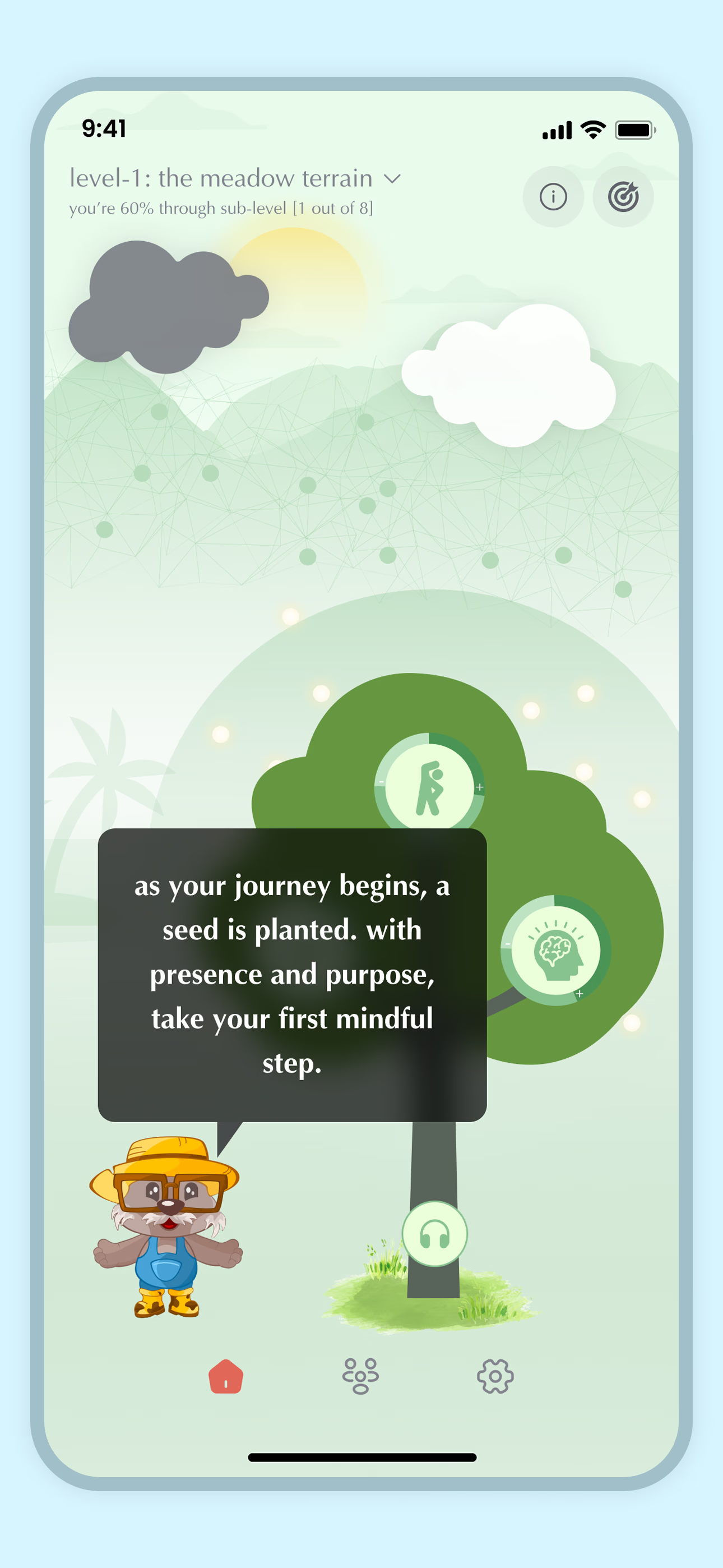
From Science to Art.
Understanding explains what is happening. Art allows you to feel it—without fixing, judging, or naming. Pause here. Let the images work quietly. Sometimes meaning settles before words do.
One Quiet Window, one insight, one reflection — every Sunday