Emotional Exhaustion: When Your Tank Is Empty but Life Keeps Going

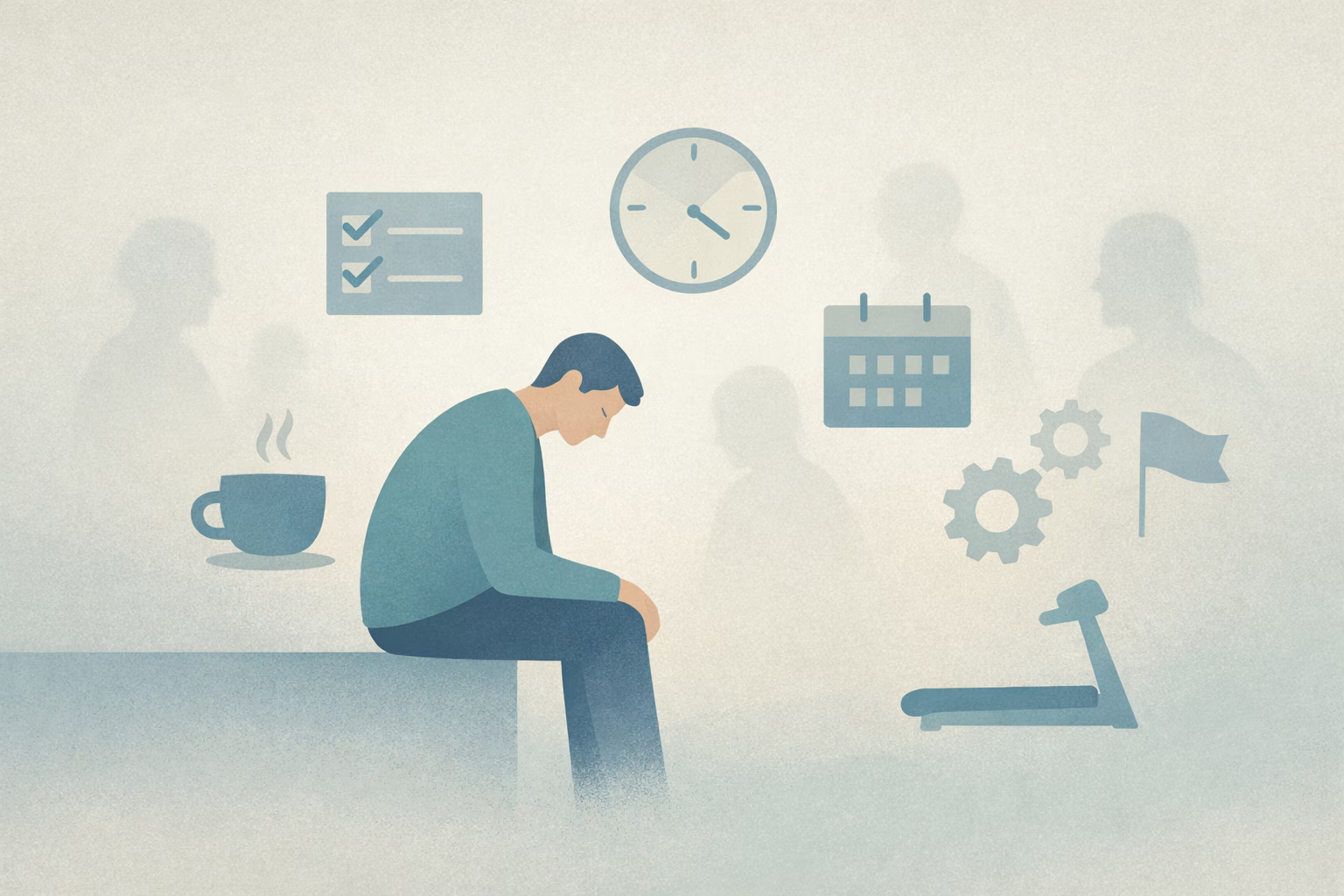
In short: Sometimes the heaviness doesn’t come with a clear story. You might be sleeping “enough,” keeping up with responsibilities, and still feel drained—like life is made of wet sand. Not dramatic, not catastrophic.
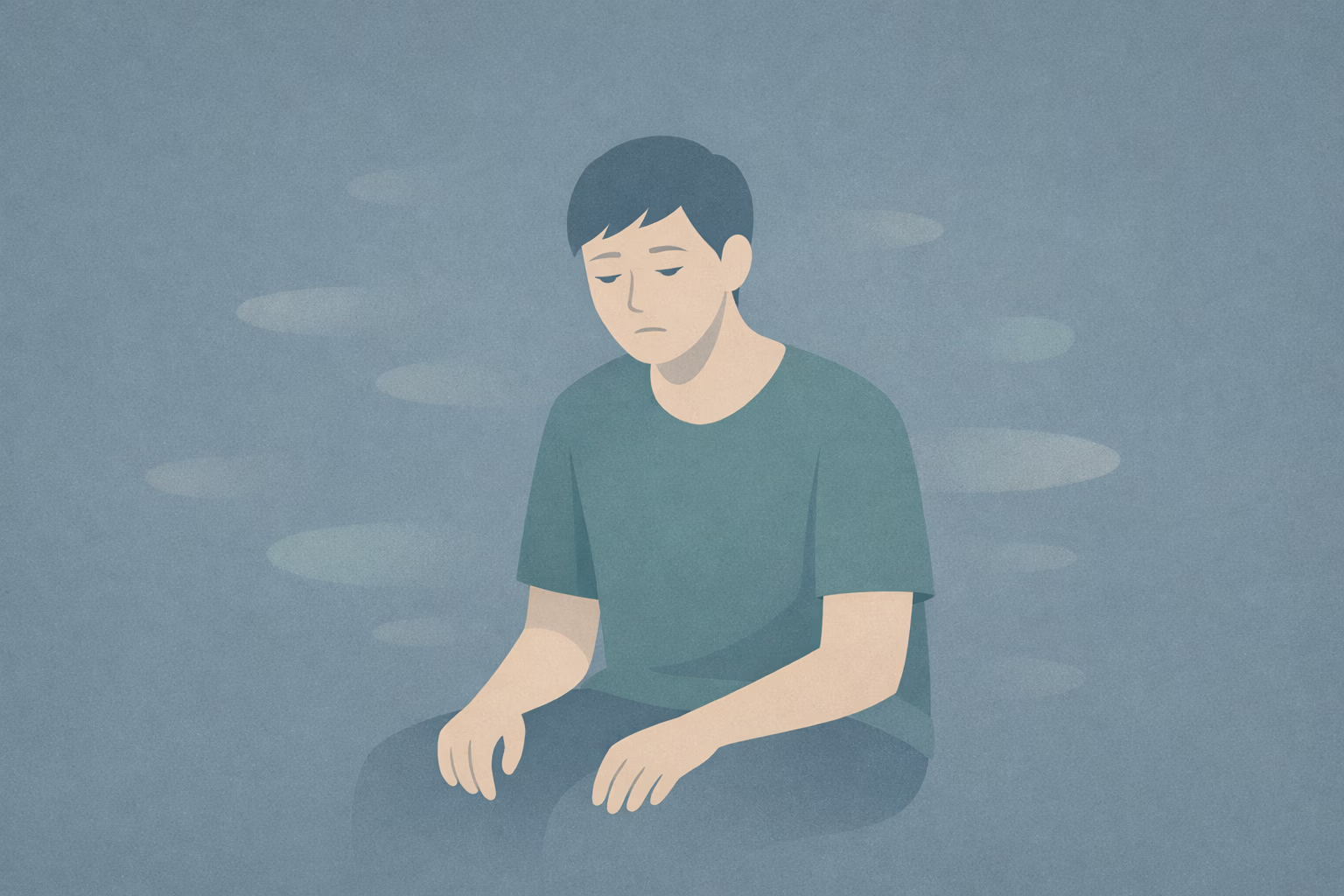
Sometimes the heaviness doesn’t come with a clear story. You might be sleeping “enough,” keeping up with responsibilities, and still feel drained—like life is made of wet sand. Not dramatic, not catastrophic. Just dense.
In the Meaning Density Model™, this isn’t treated as a personal flaw or a mysterious moral failing. It’s often what happens when the nervous system is carrying too many incomplete loops—too much input, not enough closure—and the mind can’t locate a coherent “why” that lets effort settle into something finished.
What if the heaviness isn’t random—what if it’s a signal that meaning isn’t landing anywhere?
Existential fatigue often shows up as persistent tiredness that doesn’t match the calendar. The day may be objectively manageable, yet your system meets it with drag. The effort-to-reward ratio feels off, and even small tasks can feel oddly weighty.
Common descriptions include low initiative, muted interest, a sense of being stuck, and a background question of “What’s the point?”—not necessarily as a thought you endorse, but as a lack of internal lift. It can resemble depression in tone while still feeling distinct: less about a single sadness and more about a diffuse loss of traction. [Ref-1]
Human energy isn’t only metabolic. It’s also directional. When activity connects to values and a stable sense of self, the brain can tag effort as coherent—worth doing—and the nervous system is more likely to stand down afterward. When that connection weakens, effort can start to feel like pure expenditure.
In existential fatigue, it’s not that a person “doesn’t want anything.” It’s that value-alignment signals aren’t completing into identity. The reward system can still respond to quick stimulation, but deeper satisfaction requires closure: a sense that something was carried through and integrated into who you are.
Research discussing the “existential vacuum” describes links between perceived meaninglessness and mental health strain, including pessimism and reduced vitality. [Ref-2]
From an evolutionary angle, humans don’t just survive by reacting—we survive by orienting. We carry narratives: what matters, who we are, what we’re moving toward, what counts as “done.” That narrative coherence isn’t a luxury; it’s a coordination system for attention, effort, and social belonging.
Historically, meaning was reinforced through visible contribution, seasonal rhythms, and shared roles. Work ended. Meals ended. Stories ended. The nervous system received frequent completion signals—natural endpoints that allowed recovery and future engagement.
When narrative coherence is thin, a person can still function, but it can feel like pushing a cart with a misaligned wheel: constant friction, little sense of arrival. Some research on burnout frames it partly as an existential disruption—effort without felt meaning. [Ref-3]
When life feels heavy for “no reason,” the system often tries to reduce load. Withdrawal—less social contact, fewer decisions, fewer commitments—can lower immediate cognitive demand. It can be a reasonable short-term regulation response to a world that isn’t offering closure.
This isn’t best explained as simple fear or “avoidance of feelings.” More often, it’s structural: engagement has stopped paying back. If action no longer produces completion or identity coherence, the nervous system treats action as costly and begins conserving.
Sometimes the body isn’t resisting life. It’s resisting a life that never resolves.
Writings on the existential vacuum describe how people can drift toward distraction or disengagement when meaning feels unavailable. [Ref-4]
Existential fatigue can be confusing because it doesn’t always track with external stress. You might look at your life and see stability—yet internally feel flat, heavy, or chronically behind.
In a coherence-based frame, that mismatch makes sense. The nervous system doesn’t only respond to threats; it responds to unresolvedness. If there are few experiences that complete into a “finished” signal—finished conversations, finished choices, finished seasons of effort—your system can stay in a low-grade state of activation.
What feels like “random tiredness” can be a meaning deficiency signal: not a character verdict, but an indicator that the effort you’re spending isn’t consolidating into a lived reason. Burnout literature often emphasizes this loss of meaning as a core ingredient in depletion. [Ref-5]
Existential fatigue tends to organize itself into a loop. Reduced meaning lowers engagement. Reduced engagement reduces opportunities for completion and identity reinforcement. Then the lack of completion makes the next day feel even heavier.
This is an “avoidance loop,” not as a personality trait, but as a regulatory pattern. The system chooses what is least costly in the short term: fewer exposures, fewer stakes, fewer endings. And yet meaning is often constructed through completed commitments—through sequences that have a beginning, middle, and end.
Reflections on the existential vacuum describe how modern life can quietly pull people into a drift state—busy or distracted, yet not anchored. [Ref-6]
Because existential fatigue is subtle, it often hides inside ordinary habits. The person may still be “doing things,” but fewer of those things deliver a completed signal. The result is motion without settlement.
Some existential frameworks describe boredom and meaninglessness as conditions where the mind keeps searching for significance but can’t find a stable endpoint to attach to. [Ref-7]
When existential fatigue lasts, it can quietly shrink your life. Not through one dramatic collapse, but through reduced range. Fewer initiations. Less curiosity. More “getting through” and less “arriving.”
Over time, the nervous system can learn that effort doesn’t resolve. That learning decreases resilience: it becomes harder to mobilize for challenges, even good ones, because the body predicts cost without closure. Writings on existential meaninglessness often note how sustained emptiness can erode vitality and engagement. [Ref-8]
Why does even rest stop working?
Because rest changes state, but closure changes structure. If nothing is completing, downtime can become another open loop: time passes, but the system doesn’t receive a “finished” signal that allows true stand-down.
Existential fatigue persists when the environment keeps producing partial starts and few clean endings. A little work, a little scrolling, a little worry, a little entertainment—then sleep. The next day repeats. The system stays saturated with fragments.
In this condition, avoidance isn’t a conscious decision to not live. It’s the predictable outcome of muted consequence and bypassed completion: if choices don’t consolidate into identity (“this is who I am”), they don’t generate stable motivation. So the nervous system defaults to what is easiest to initiate and easiest to exit—even if it doesn’t satisfy.
Some discussions of meaninglessness describe this pattern as a self-reinforcing cycle: disengagement deepens the sense of emptiness, and emptiness makes engagement feel pointless. [Ref-9]
It can help to distinguish stimulation from integration. Stimulation changes how you feel for a while. Integration is different: it’s what happens when an experience completes and settles into identity—when your system registers, at a physiological level, “that counted.”
Values-based engagement is often described as a pathway out of meaninglessness—not as self-improvement, but as re-anchoring. In this frame, “values” are not motivational slogans. They are orientation signals that help the nervous system decide what effort is for, so effort can close rather than remain suspended. [Ref-10]
When pacing and “small enough to finish” commitments are mentioned in meaning-oriented literature, the key point isn’t productivity. It’s closure density: more experiences that reach an endpoint, more opportunities for the system to stand down.
Meaning is rarely built in isolation. Humans stabilize through social reality: being seen, having roles, sharing effort, and receiving feedback that something mattered. Not praise as fuel, but recognition as closure—evidence that a chapter actually happened.
Supportive relationships can function like scaffolding for coherence. They help reduce cognitive load, clarify priorities, and provide natural endpoints (a conversation that resolves, a plan that completes, a shared ritual that closes the week). In this sense, mentorship, community, or simply a steady witness can soften identity drift.
Reflections on the existential vacuum emphasize how modern life can leave people privately unmoored—and how connection to shared meaning can counter that drift. [Ref-11]
When meaning loops begin to reactivate, the change isn’t always dramatic happiness. It’s often a quieter shift: you recover the ability to feel a “yes” or “no” again. Decisions become less draining because they have somewhere to land. The future feels more dimensional.
Physiologically, you may notice more signal return—appetite, interest, focus, and tiredness that matches exertion. You can be fatigued after a full day and also sense that the day is complete. That “done” signal matters.
It’s also important to hold a dignified distinction: existential fatigue can overlap with clinical depression, which is a medical condition with recognized symptoms and risks. If heaviness is persistent, impairing, or paired with hopelessness, support and evaluation can be appropriate and life-protecting. [Ref-12]
As coherence returns, agency tends to feel less like forcing and more like alignment. Not constant certainty—just a steadier internal map. Choices create less residue, because they connect to a recognizable self.
Purpose here doesn’t mean a single grand mission. It can be a set of lived priorities that repeatedly close into identity: “this is what I stand for,” “this is how I relate,” “this is what I’m building.” When those patterns complete, the nervous system spends less time bracing and more time participating.
Medical sources note that persistent low energy and loss of interest can also be signs of depressive disorders, which deserve careful attention rather than self-judgment. Seeing the difference isn’t about labeling yourself—it’s about restoring the conditions for safety and support. [Ref-13]
Existential fatigue is often the body’s way of saying: the current pattern is consuming energy without returning coherence. That message can sound like “I can’t,” but underneath it is frequently “this isn’t landing anywhere.”
When the culture treats meaning as optional and keeps life in perpetual evaluation, it makes sense that some nervous systems go quiet. The point of a non-pathologizing view is not to minimize the pain—it’s to remove shame from the equation and make room for a clearer read on what the signal is asking for.
And because fatigue and depression can look similar, it can be grounding to remember that depression is a recognized health condition, not a personal failure—support is a form of care, not an overreaction. [Ref-14]
You don’t have to prove you “want life enough” to deserve relief. If life feels heavy for no reason, it may be because your system is carrying too many open loops and too little completion—too much demand without a lived sense of meaning.
When experiences begin to complete again—when effort connects to values and settles into identity—vitality often returns as a side effect. Not because you pushed harder, but because your nervous system finally receives the signal it’s been missing: this matters, and it’s done. [Ref-15]
From theory to practice — meaning forms when insight meets action.
Because the heaviness isn't tracking external events — it's tracking incompletion. The article frames existential fatigue as what happens when the nervous system carries too many open loops with not enough closure, and the mind can't locate a coherent 'why' that lets effort settle. This isn't a personal flaw or a mysterious moral failing. The day may be objectively manageable, yet your system meets it with drag because effort hasn't been consolidating into something finished. What looks like 'random tiredness' is often a meaning-deficiency signal.
They can overlap and resemble each other, but the article holds a careful distinction. Existential fatigue often resembles depression in tone — flatness, low motivation, a background 'what's the point' — while feeling distinct: less about a single sadness, more about diffuse loss of traction. Importantly, persistent low energy and loss of interest can also be signs of depressive disorders, which deserve attention rather than self-judgment. If heaviness is impairing or paired with hopelessness, support is appropriate care, not overreaction. Recognizing the difference isn't labeling — it's restoring conditions for safety.
Because rest changes state, but closure changes structure. When life feels heavy 'for no reason,' the system tries to reduce load — withdrawal lowers immediate cognitive demand. It's not best explained as fear of feelings; it's structural: engagement has stopped paying back. If action no longer produces completion or identity coherence, the nervous system treats action as costly and conserves. The body isn't resisting life; it's resisting a life that never resolves. Even downtime can become another open loop — time passes without a Done Signal that allows true stand-down.
Not dramatic happiness — quieter than that. The first signs are signal return: appetite, interest, focus, and tiredness that matches exertion. You recover the ability to feel a 'yes' or 'no' again. Decisions become less draining because they have somewhere to land. The future feels more dimensional. Fatigue after a full day can coexist with a sense that the day is complete — and that 'done' signal matters. Vitality returns as a side effect, not because you pushed harder, but because the nervous system finally receives the message it was missing: this matters, and it's done.
From Science to Art.
Understanding explains what is happening. Art allows you to feel it—without fixing, judging, or naming. Pause here. Let the images work quietly. Sometimes meaning settles before words do.
One Quiet Window, one insight, one reflection — every Sunday