The Hedonic Treadmill: Why Satisfaction Never Lasts
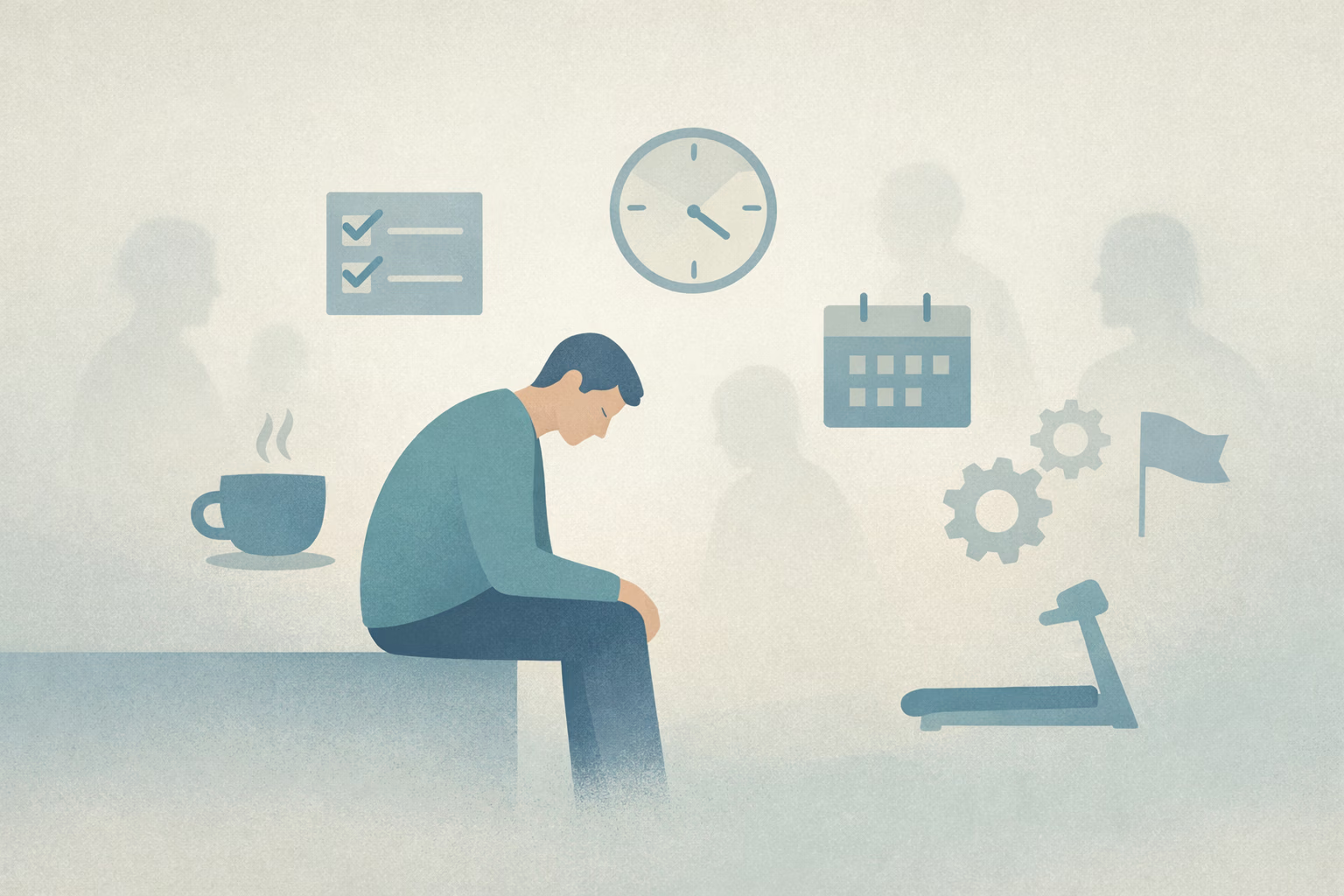
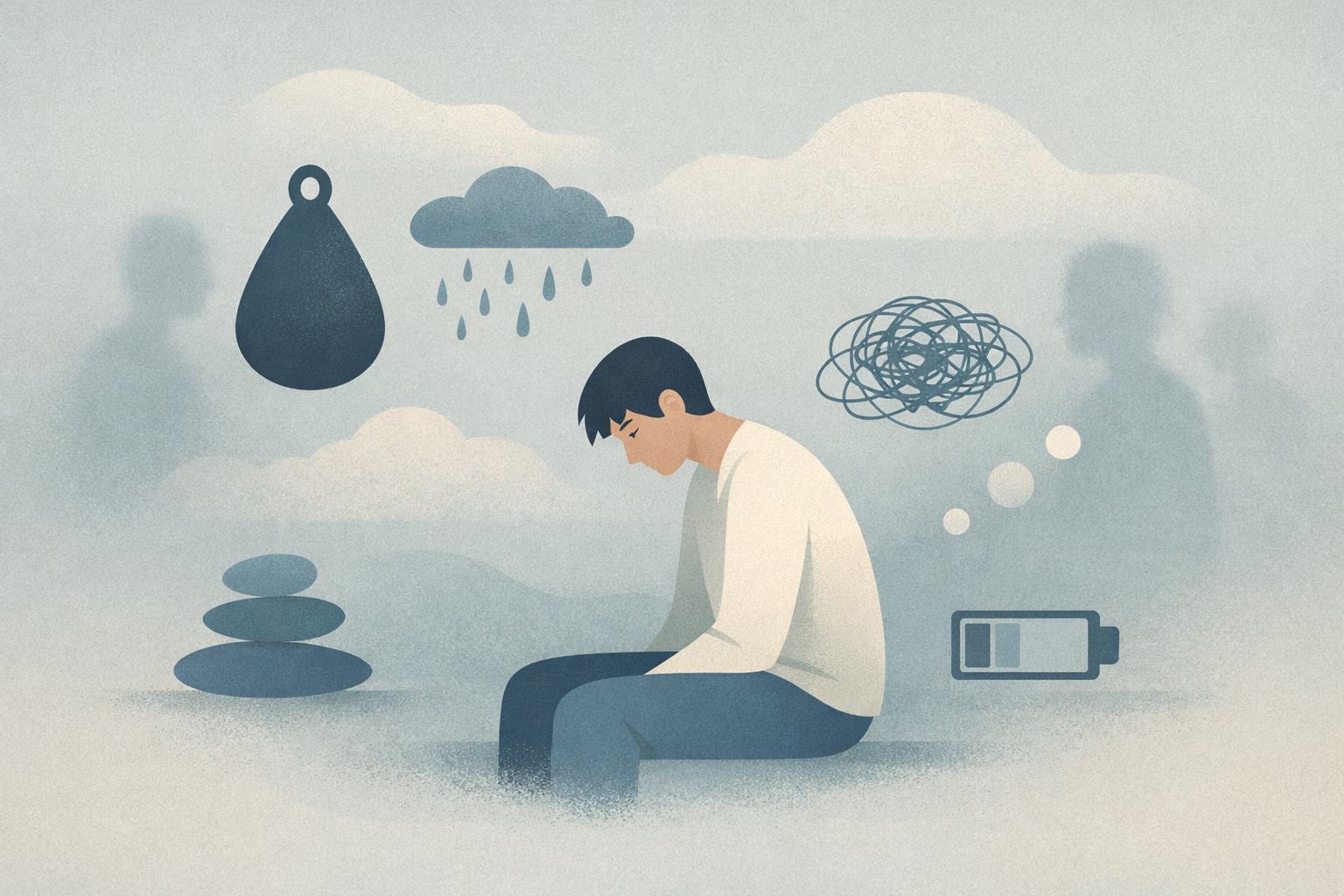
In short: Some lives run like well-built machines: the calendar is handled, the bills are paid, other people are reassured, and the basics are covered. And yet, inside that functional flow, there can be a quiet absence—less interest, less color, less sense of “this is mine.” What if emptiness isn’t a personality flaw, but a nervous system signal that your meaning loops aren’t getting closure?
Some lives run like well-built machines: the calendar is handled, the bills are paid, other people are reassured, and the basics are covered. And yet, inside that functional flow, there can be a quiet absence—less interest, less color, less sense of “this is mine.”
What if emptiness isn’t a personality flaw, but a nervous system signal that your meaning loops aren’t getting closure?
A meaning deficit often shows up when a life is externally coherent (tasks, roles, routines) but internally fragmented (values, identity, personal “done” signals). In that state, many people aren’t “unmotivated.” They’re carrying sustained load with too few experiences that complete into felt orientation.
A meaning deficit can feel like boredom, detachment, or a low-grade sense of being elsewhere—even while you’re doing everything you planned to do. The puzzling part is that success still arrives, but it doesn’t settle.
From a biology perspective, satisfaction isn’t just “getting what you want.” It’s also the body recognizing completion: a cycle that starts, unfolds, and reaches a stand-down point. When that stand-down doesn’t arrive, the system stays subtly mobilized, scanning for the next requirement.
So the emptiness isn’t proof that you’re ungrateful. It can be the body’s way of saying: “We’re moving, but we’re not arriving.” [Ref-1]
Human engagement is not powered by tasks alone. It’s stabilized when actions connect to identity—when the nervous system can link effort to a coherent “this matters, and it’s part of who I am.” Without that linkage, rewards can become smaller and shorter-lived.
When meaning loops go inactive, many people notice a blunting effect: achievements feel neutral, routines feel heavy, and the pull toward “quick relief” gets stronger. That’s not because someone lacks depth; it’s because the system starts prioritizing fast state-shifts over slow coherence.
In other words, a life can be highly functional and still undernourished in the signals that make effort feel worth continuing. [Ref-2]
Unlike many animals, humans rely heavily on narrative and identity to create stability. Not as a motivational poster, but as an organizing structure: a way the brain decides what counts, what belongs, what is “finished,” and what is still unresolved.
When that organizing structure is thin—when days are full but the story doesn’t integrate—reward systems tend to drift toward whatever provides immediate contrast: stimulation, novelty, short-term pleasure, or urgency. These aren’t “bad habits.” They are efficient ways a loaded nervous system changes state when deeper completion is missing.
That’s why emptiness can show up even in objectively good circumstances. The system isn’t asking for more achievements. It’s asking for coherence. [Ref-3]
In uncertain environments, the body naturally looks for controllable levers. Function—emails answered, workouts done, projects shipped—can provide a temporary sense of grip. It reduces ambiguity and quiets the alarm that comes from not knowing what’s next.
This is one reason people can become intensely competent while feeling internally distant. The functional layer becomes a regulatory layer: a way to manage load through structure, performance, and completion of tasks.
But tasks can only substitute for meaning for so long. Eventually, the system notices the difference between “I did what was required” and “my life is integrating.” [Ref-4]
Externally, things can look stable. Internally, the costs may show up as flatness, irritability, low desire, or a sense that connection takes more effort than it used to. Not because you’re broken—because the system is running on maintenance mode.
When meaning is suppressed or bypassed, the nervous system often narrows its focus: keep the machine going, minimize risk, avoid disruption. Over time, that narrowing can resemble numbness or disinterest. It’s less about “not feeling” and more about reduced capacity for signals to return once load stays high.
Many people describe it simply as: “I’m doing everything, but it’s not touching me.” [Ref-5]
Meaning deficit often becomes self-reinforcing. When the inner world feels vague or unrewarding, the system leans harder on what is measurable: checklists, outcomes, external standards, and immediate relief.
That shift makes sense structurally. Functional focus gives quick closure (a task is done). Purpose-driven engagement gives deeper closure (a piece of identity integrates). If a system has learned that deeper closure is unlikely or too costly, it will default to the faster kind.
Over time, short-term closure can crowd out the conditions that allow meaning to complete. The person isn’t choosing emptiness; they’re adapting to a loop that keeps them moving. [Ref-6]
Meaning deficit tends to look less like dramatic crisis and more like quiet drift. Many patterns are regulatory responses to sustained evaluation and thin completion—not personal shortcomings.
These are often signals that basic psychological needs—like autonomy, competence, and connection—aren’t translating into lived coherence, even if they look present on paper. [Ref-7]
When meaning loops stay inactive, identity can become more role-based: employee, parent, partner, achiever, caretaker. Roles aren’t the problem. The problem is when there’s no “inside” to the roles—no felt sense of authorship.
That shift affects resilience. Stress is easier to metabolize when the system has a stable “why” that is not performative. When meaning is thin, stressors feel heavier because there’s less internal context to distribute them.
It can also limit intimacy. Not because someone is avoiding vulnerability, but because a body in maintenance mode has reduced capacity for mutual attunement and for experiences to land as nourishing. [Ref-8]
A steady task orientation can be useful, but it has a side effect: it keeps attention on external prompts and immediate contingencies. That makes it harder for reflective processes to come online—the ones that help experiences organize into identity and meaning.
In practical terms, life becomes driven by extrinsic signals: deadlines, metrics, other people’s expectations, and visible outcomes. Intrinsic signals—interest, resonance, personal conviction—can get quieter, not because they disappeared, but because there’s no bandwidth for them to register.
This is a structural mismatch: the environment rewards output, while the nervous system needs integration. When extrinsic control dominates, internal motivation often thins, even in high performers. [Ref-9]
It’s common to think that if you could just figure out why you feel empty, you would feel different. But insight is not the same as integration. Understanding can happen quickly; completion is slower and more bodily.
Meaning tends to return when life offers repeated, believable cues that your days connect to your values and your identity—cues that are lived, not merely stated. Narrative coherence research points to the stabilizing role of having experiences that form a clear arc: something happened, it mattered, it changed how you orient. [Ref-10]
“My system didn’t need a better explanation. It needed life to start landing as mine again.”
This is less about chasing inspiration and more about allowing the conditions where the nervous system can stand down and register “this counts.”
Humans don’t build identity alone. We calibrate it through witnessing and being witnessed: a trusted person reflecting back what they see as consistent, true, and alive in us.
When values and purpose are spoken in safe relationships, they become more than private thoughts. They gain social reality—another form of closure. This is one reason narrative coherence is associated with well-being: coherent stories are easier to carry, share, and live from. [Ref-11]
This doesn’t require a big audience or dramatic disclosure. It’s about contact that reduces fragmentation and makes your inner world feel less like a separate, unconfirmed universe.
When meaning loops begin to reactivate, people often describe a shift that is subtle but unmistakable: not constant happiness, but a return of signal. Choices feel less forced. Effort feels less like self-pushing. Interest returns in small, steady ways.
This isn’t about being more emotional. It’s about increased capacity: the nervous system can take in experience and let it register, rather than immediately converting everything into management. Narrative coherence has been linked with emotional well-being partly because coherent experience reduces background noise—less internal contradiction, fewer dangling threads. [Ref-12]
How do you know it’s coherence and not just a mood bump?
Coherence tends to persist after the moment passes. It leaves a trace: a steadier sense of “I know what I’m doing and why,” even when life is imperfect.
When meaning is restored, agency becomes more available. Not as a surge of motivation, but as clearer direction with less internal drag. The system wastes less energy on proving, monitoring, or escaping.
This is why meaning is often associated with resilience and mental well-being: it helps experiences organize into a coherent identity, which makes stress more navigable and decisions more deliberate. [Ref-13]
Over time, the “functional but empty” pattern can soften into something more integrated: a life that still includes tasks and responsibilities, but also contains enough completion that the person feels present inside it.
Feeling functional but empty can be a dignified signal: your system is telling the truth about fragmentation. Not everything that is efficient is integrating. Not everything that looks stable is giving your nervous system the closure it needs to stand down.
From a self-determination lens, humans tend to thrive when life supports autonomy, competence, and connection—not as ideals, but as lived conditions that create internal legitimacy. When those conditions are thin or performative, emptiness can be the most honest feedback available. [Ref-14]
Meaning isn’t a prize you earn by trying harder. It’s what emerges when experiences complete into identity—when your days add up to a life that feels like it belongs to you.
A meaning deficit can coexist with capability, kindness, and success. It doesn’t mean you are ungrateful or broken. It often means your life has been organized around function for so long that the deeper “why” hasn’t had room to resolve and settle.
When coherence returns, people don’t necessarily become different people. They become more inhabitable to themselves—less split, less driven by pressure, more guided by what fits. And that shift can turn “empty” into something quieter and sturdier: clarity, direction, and a sense of living from the inside out. [Ref-15]
From theory to practice — meaning forms when insight meets action.
Because external coherence — calendar handled, bills paid, roles performed — isn't the same as internal coherence. A meaning deficit shows up when a life is functionally organized but the days don't integrate into a felt sense of 'this is mine.' Satisfaction isn't just getting what you want; it's the body recognizing completion. When the stand-down signal doesn't arrive, the system stays subtly mobilized, scanning for the next requirement. So the emptiness isn't proof you're ungrateful or broken. It's the nervous system saying 'we're moving but not arriving' — a signal that the Meaning Loop isn't closing, even though the achievement loop is.
Because human engagement isn't powered by tasks alone. It stabilizes when actions link to identity — when the system can connect effort to a coherent 'this matters and it's part of who I am.' Without that linkage, achievements register briefly and vanish. The body starts prioritizing fast state-shifts over slow coherence: scrolling, planning, snacking, urgency. These aren't bad habits; they're efficient ways a loaded nervous system changes state when deeper completion is missing. A life can be highly functional and still undernourished in the signals that make effort feel worth continuing. The system isn't asking for more wins. It's asking for closure that touches identity.
In uncertain environments, the body looks for controllable levers. Function — emails answered, projects shipped, workouts done — provides temporary grip. It reduces ambiguity and quiets the alarm of not knowing what's next. The functional layer becomes a regulatory layer, a way to manage load through structure and visible completion. This is how people become highly competent while feeling internally distant. Tasks substitute for meaning for a while, but eventually the system notices the difference between 'I did what was required' and 'my life is integrating.' Productivity calms the Threat & Safety System short-term; it doesn't activate the Identity & Meaning System.
Subtle but unmistakable. Not constant happiness — a return of signal. Choices feel less forced, effort feels less like self-pushing, interest returns in small steady ways. The system can take in experience and let it register, instead of immediately converting everything into management. Coherence persists after the moment passes; it leaves a trace of 'I know what I'm doing and why' even when life is imperfect. Meaning isn't earned by trying harder. It emerges when experiences complete into identity — when a trusted person reflects something back, when values are lived rather than stated, when days finally start adding up to a life that feels inhabitable from the inside.
From Science to Art.
Understanding explains what is happening. Art allows you to feel it—without fixing, judging, or naming. Pause here. Let the images work quietly. Sometimes meaning settles before words do.
One Quiet Window, one insight, one reflection — every Sunday