Self-Improvement Overload: When Growth Becomes Exhausting

In short: Tracking habits, refining routines, upgrading skills, tightening health metrics, reading the next book, running the next experiment. From the outside it often reads as responsible and ambitious.
Self-optimization can look like care: tracking habits, refining routines, upgrading skills, tightening health metrics, reading the next book, running the next experiment. From the outside it often reads as responsible and ambitious.
But there’s a specific kind of optimization that doesn’t land as steadiness. It lands as pressure—more measuring, more adjusting, more urgency—paired with a quiet sense of hollowness or “not yet.” In that pattern, improvement stops being growth and becomes a way to avoid unstructured moments where life feels less definable.
What if the drive to optimize isn’t a character trait—what if it’s your system trying to create closure?
Many people describe a strange pairing: intense effort to improve, alongside a sense that nothing really counts. You complete tasks, hit goals, get praise—yet the internal ledger doesn’t close. The body stays braced, as if the work is still pending.
In this light, self-optimization isn’t simply “wanting better.” It’s a form of constant self-revision that keeps identity slightly provisional: always in progress, always under review. When the internal system can’t register completion, it tends to increase monitoring, tightening standards and searching for the next lever to pull. [Ref-1]
This isn’t a personal defect. It’s what nervous systems do when closure is hard to reach: they stay active, scanning for the missing piece that would allow a stand-down.
Optimization culture offers a very specific kind of relief: it converts uncertainty into a checklist. Tracking and refining can quickly generate a sense of control—clear inputs, clear outputs, clear comparisons. For a stressed system, that structure can feel like safety.
It also supplies frequent “micro-rewards”: a streak, a number, a graph, a before-and-after. Even when the rewards are small, they are definite—and definiteness is soothing when the internal landscape feels vague. [Ref-2]
Over time, the system can start preferring what is measurable over what is meaningful, not because meaning is unimportant, but because meaning is harder to certify on demand.
Beyond survival and comfort, humans need narrative coherence: a sense that life makes sense, that choices fit together, that one’s presence is justified by something more than performance. This is not a lofty preference—it’s a stabilizer.
When coherence is low, the mind naturally tries to tighten the story. Optimization offers an easy storyline: “I am becoming my best self.” It organizes time, explains effort, and promises that the future will finally feel solid.
But coherence doesn’t fully form through explanation. It forms when experiences reach completion and settle into identity—when the system can register, this is real and done. If life keeps generating new benchmarks faster than it generates closure, the story stays unfinished. [Ref-3]
Constant improvement can create a portable sense of purpose: there is always something to refine. That can feel grounding in a world that offers fewer shared rites of passage and fewer clear “arrival” moments.
In many environments, output is treated as proof of value. So optimization becomes a way to generate proof—internally and socially. A routine becomes a moral alibi. A metric becomes a stand-in for self-trust.
When worth is measured through motion, stillness can start to feel like disappearance.
This is one reason the pull is strong: optimization offers instant orientation. It’s not that people love pressure. It’s that pressure can be easier to hold than emptiness. [Ref-4]
Self-optimization is often sold as a path to fulfillment: refine enough variables and you will finally feel satisfied. But satisfaction requires closure, and closure requires completion—not just activity.
If the underlying discomfort is existential uncertainty (the open-endedness of life, identity, mortality, choice), optimization can become a way to keep those questions perpetually postponed. The future is always where relief will happen. The present stays instrumental: something to improve, not something to inhabit.
In that cycle, the system learns a costly lesson: when unease appears, the answer is more upgrading. That can look like motivation, but it functions like avoidance of the unstructured parts of being human. [Ref-5]
There’s a particular loop that forms when optimization becomes the primary way of regulating: action creates short-term control, control briefly reduces discomfort, and the reduction is interpreted as “I should do more of this.” Soon, the absence of optimizing feels like danger, not rest.
This is a power loop because it promises mastery: if you can control the right variables, you can control how life feels. But life is not only a set of variables. It is also relationship, uncertainty, loss, seasonality, and change—realities that don’t resolve through better tracking.
When optimization fails to produce lasting settling, the system often responds by tightening further: more rules, more research, more self-surveillance. That escalation isn’t vanity; it’s an attempt to regain stability through controllability. [Ref-6]
Optimization becomes existential avoidance when it stops producing completion and starts producing compulsion—when the system cannot easily power down without a substitute structure.
Some common patterns include:
These patterns are increasingly common in achievement-oriented settings, where standards rise and “good enough” becomes socially thin. [Ref-7]
When life is organized around improvement, the present moment often becomes a means to an end. Meals become macros. Walks become steps. Conversations become networking. Even hobbies can turn into performance projects.
This doesn’t mean joy disappears because someone “can’t relax.” It disappears because the system is busy converting experience into evidence. Evidence is useful for evaluation, but it can thin out lived meaning—the felt sense that something matters because it is itself, not because it proves something.
Over time, the body may start to register fewer safety cues: less spontaneous play, less unmeasured connection, fewer moments that signal, nothing is being asked of you right now. That’s one reason achievement culture can correlate with distress: it reduces the conditions under which nervous systems naturally settle. [Ref-8]
When unstructured space arrives—an evening with no plan, a quiet weekend, a pause between goals—the system may not interpret it as neutral. It can interpret it as an absence of orientation: no scorecard, no next step, no obvious identity anchor.
In response, optimization tools become stabilizers. Metrics offer immediate direction. Routines offer containment. Control narratives (“If I just fix X, I’ll be okay”) offer a reason for the unease.
This is less about hidden fear and more about incomplete closure. If the system never gets a convincing “done,” it keeps generating “not yet.” Perfectionism can function similarly: not as high standards alone, but as a mechanism that prevents completion from registering. [Ref-9]
When did life start needing constant proof to feel real?
Unstructured time is often described as restorative, but not because it provides a new insight. Its value is more physiological: it reduces evaluation load. When nothing is being measured, the system has fewer reasons to stay on alert.
In that lower-load space, different signals can return—signals that don’t speak in metrics: quiet preference, natural fatigue, simple satisfaction, subtle interest, the sense of “this fits.” These signals aren’t dramatic. They’re foundational. They are what get drowned out when identity is managed like a project.
This isn’t about forcing stillness or chasing a special feeling. It’s about what becomes possible when constant optimization stops interrupting the completion of ordinary life. Over time, moments can start to land as finished rather than merely logged. [Ref-10]
Optimization pressure intensifies in environments where connection feels contingent: where belonging seems to require impressing, producing, or staying “on.” In those conditions, self-improvement becomes a social safety strategy.
Relationships grounded in acceptance do something different to the nervous system. They provide a form of closure: “You are here, and you still count.” Not as a compliment, but as a stable baseline that reduces the need for constant self-justification.
When connection is less dependent on output, identity can relax out of its defensive posture. The body doesn’t have to hold itself as a résumé. That softening can reduce the compulsion to keep proving worth through upgrades. [Ref-11]
As performance pressure decreases, many people notice a subtle shift: less urgency to tinker, fewer internal audits, and a more stable sense of self-respect that doesn’t require constant evidence. This isn’t a motivational breakthrough. It’s what happens when the system has enough safety and completion to stop scanning.
In that state, kindness toward the self can stop being a concept and become a baseline tone—especially the kind that includes common humanity and a less punitive inner voice. Not because someone “reframed” perfectly, but because the body is no longer bracing against perpetual insufficiency. [Ref-12]
When you don’t have to earn your place in your own life, improvement becomes optional again.
From there, growth can return to its original shape: not a desperate chase, but a natural extension of what matters.
Efficiency is about doing more with less. Meaning is about what your life is in service of. When optimization dominates, direction is often determined by what can be improved fastest, measured easiest, or praised most reliably.
As coherence returns, direction can start coming from essence: values that feel lived rather than announced; roles that feel inhabited rather than performed; commitments that produce a sense of completion over time. Meaning tends to be experienced as alignment and continuity—a sense that your days fit together. [Ref-13]
This doesn’t remove uncertainty from life. It changes your relationship to it. Uncertainty becomes a normal condition of being human, not a defect you must outwork.
It makes sense that a person would reach for improvement in a world that constantly evaluates. Self-optimization can be an intelligent adaptation to modern conditions: it offers structure, predictability, and a way to keep moving when the inside feels unfinished.
But worth doesn’t stabilize through measurement alone. It stabilizes when life contains enough experiences that fully land—enough moments of completion, connection, and value-consistent direction that identity can stop being negotiated every day.
Human systems tend to orient toward autonomy, competence, and relatedness—not as goals to achieve, but as conditions that make behavior feel self-authored and sustainable. [Ref-14] When those conditions are present, optimization can become a tool rather than a lifeline.
You don’t have to optimize your way into being real. Meaning isn’t a prize for perfect self-management; it’s what emerges when your life has enough coherence to feel lived, not merely improved.
When days contain completion, when relationships don’t require constant proof, when values show up in ordinary choices, the nervous system gets a quieter message: you can stand down. From there, change can still happen—but it no longer has to carry the burden of making existence feel justified. [Ref-15]
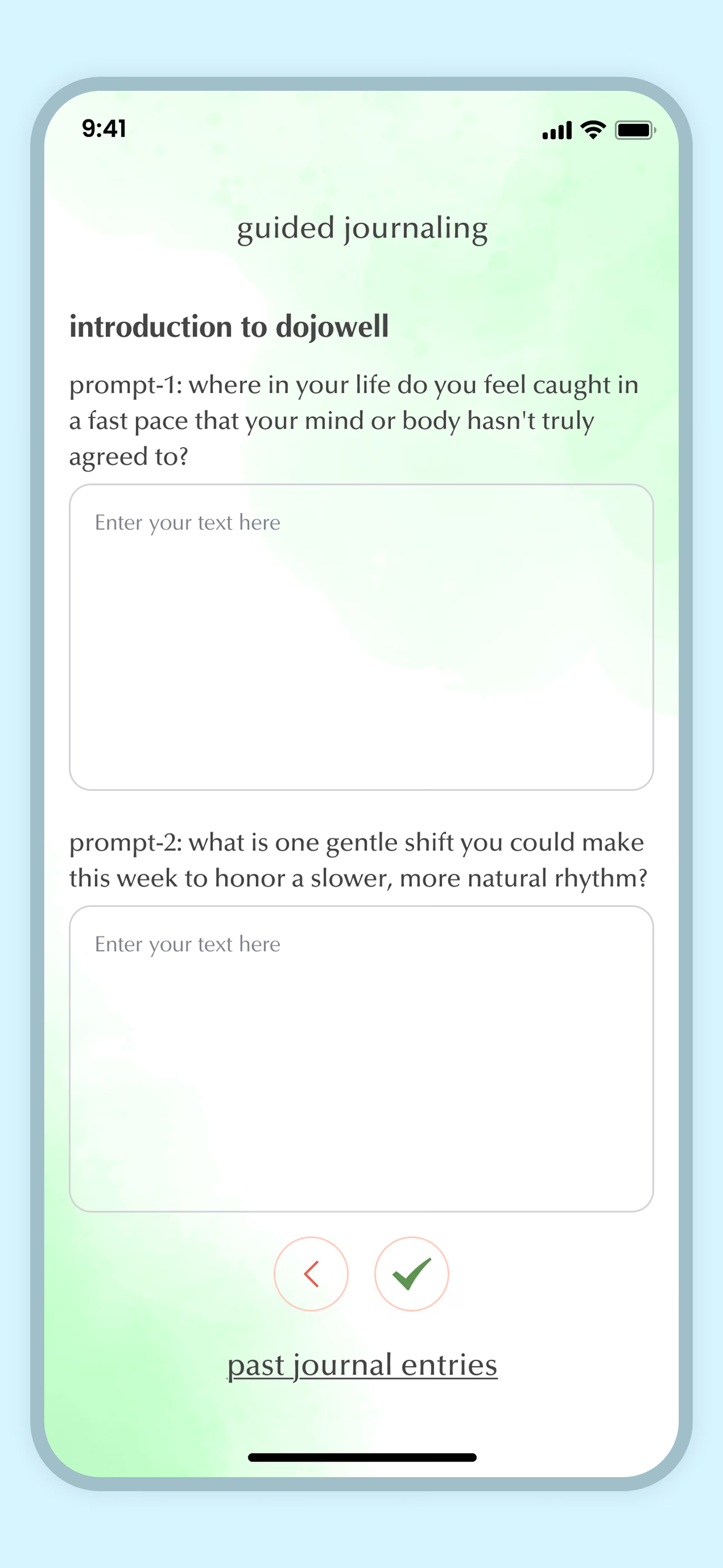
From theory to practice — meaning forms when insight meets action.
Because the internal ledger never closes. You complete tasks, hit goals, get praise — yet the body stays braced, as if the work is still pending. Self-optimization isn't simply 'wanting better'; it's a form of constant self-revision that keeps identity slightly provisional, always under review. When the system can't register completion, it tightens standards and searches for the next lever to pull. That's not a personal defect. It's what nervous systems do when closure is hard to reach: they stay active, scanning for the missing piece that would allow a stand-down. The emptiness isn't laziness — it's a missing Done Signal.
Because optimization converts uncertainty into a checklist. Tracking and refining quickly generate a sense of control — clear inputs, clear outputs, clear comparisons. For a stressed system, that structure feels like safety. It also supplies frequent micro-rewards: a streak, a number, a graph. Those rewards are small but definite, and definiteness is soothing when the internal landscape feels vague. When unstructured time arrives, the system may not interpret it as neutral — it can interpret it as an absence of orientation: no scorecard, no next step, no obvious identity anchor. So optimization tools become stabilizers, not because emptiness is dangerous, but because the body never got a convincing 'done.'
It often becomes one. There's a particular loop that forms when optimization becomes the primary regulator: action creates short-term control, control briefly reduces discomfort, and the reduction is interpreted as 'I should do more of this.' Soon, the absence of optimizing feels like danger, not rest. It's a Power Loop because it promises mastery — if you can control the right variables, you can control how life feels. But life isn't only variables. It's also relationship, uncertainty, loss, seasonality, change — realities that don't resolve through better tracking. When optimization fails to produce settling, the system tightens further: more rules, more research, more self-surveillance.
Direction sourced from essence rather than efficiency. Efficiency is about doing more with less. Meaning is about what your life is in service of. As coherence returns, direction comes from values that feel lived rather than announced, roles that feel inhabited rather than performed, commitments that produce a sense of completion over time. Worth stops being something to prove through measurement and starts being something registered through completed experiences. From there, growth can return to its original shape: not a desperate chase, but a natural extension of what matters. You don't have to optimize your way into being real.
From Science to Art.
Understanding explains what is happening. Art allows you to feel it—without fixing, judging, or naming. Pause here. Let the images work quietly. Sometimes meaning settles before words do.
One Quiet Window, one insight, one reflection — every Sunday