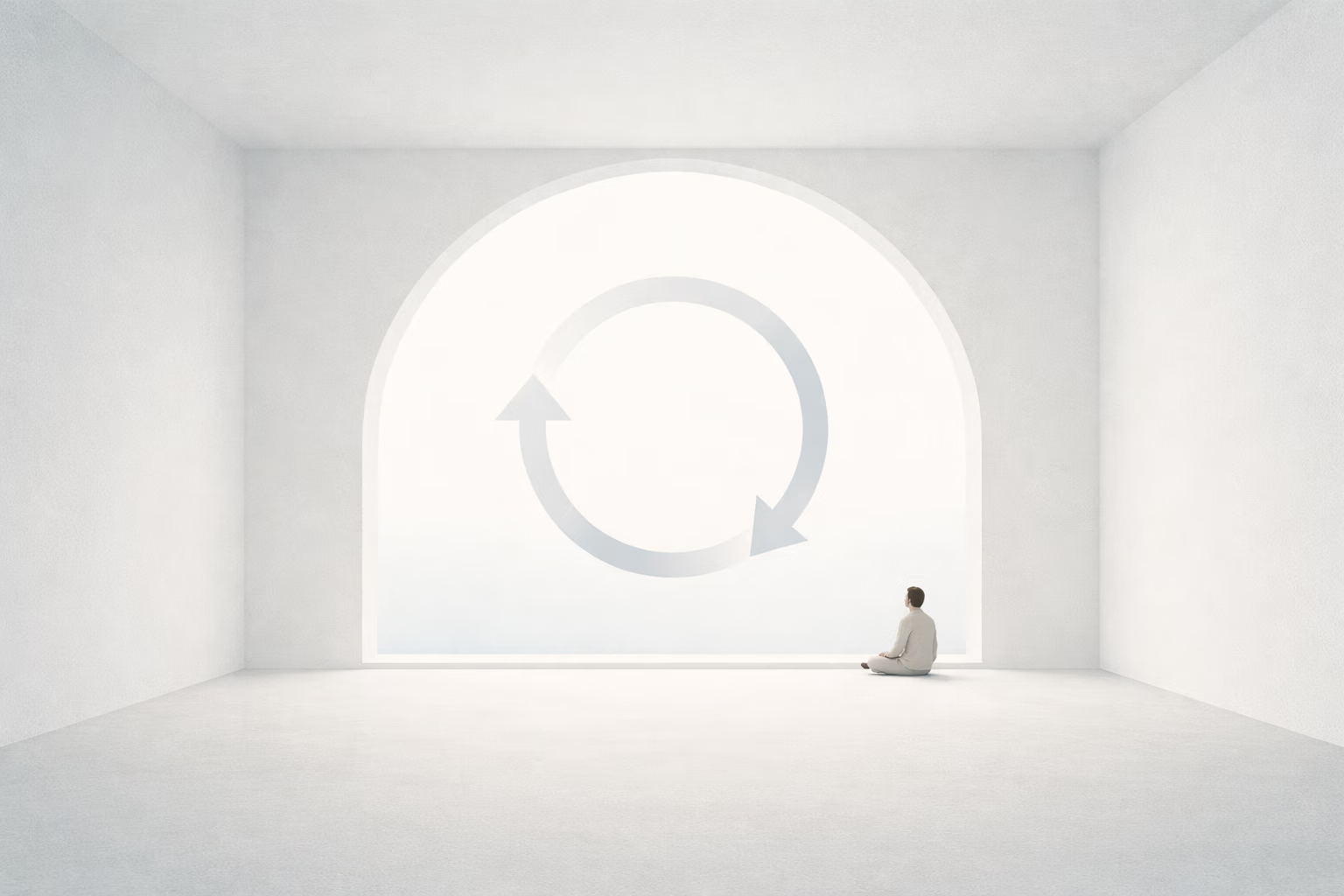
Overthinking Loops: When the Mind Won’t Quiet Down
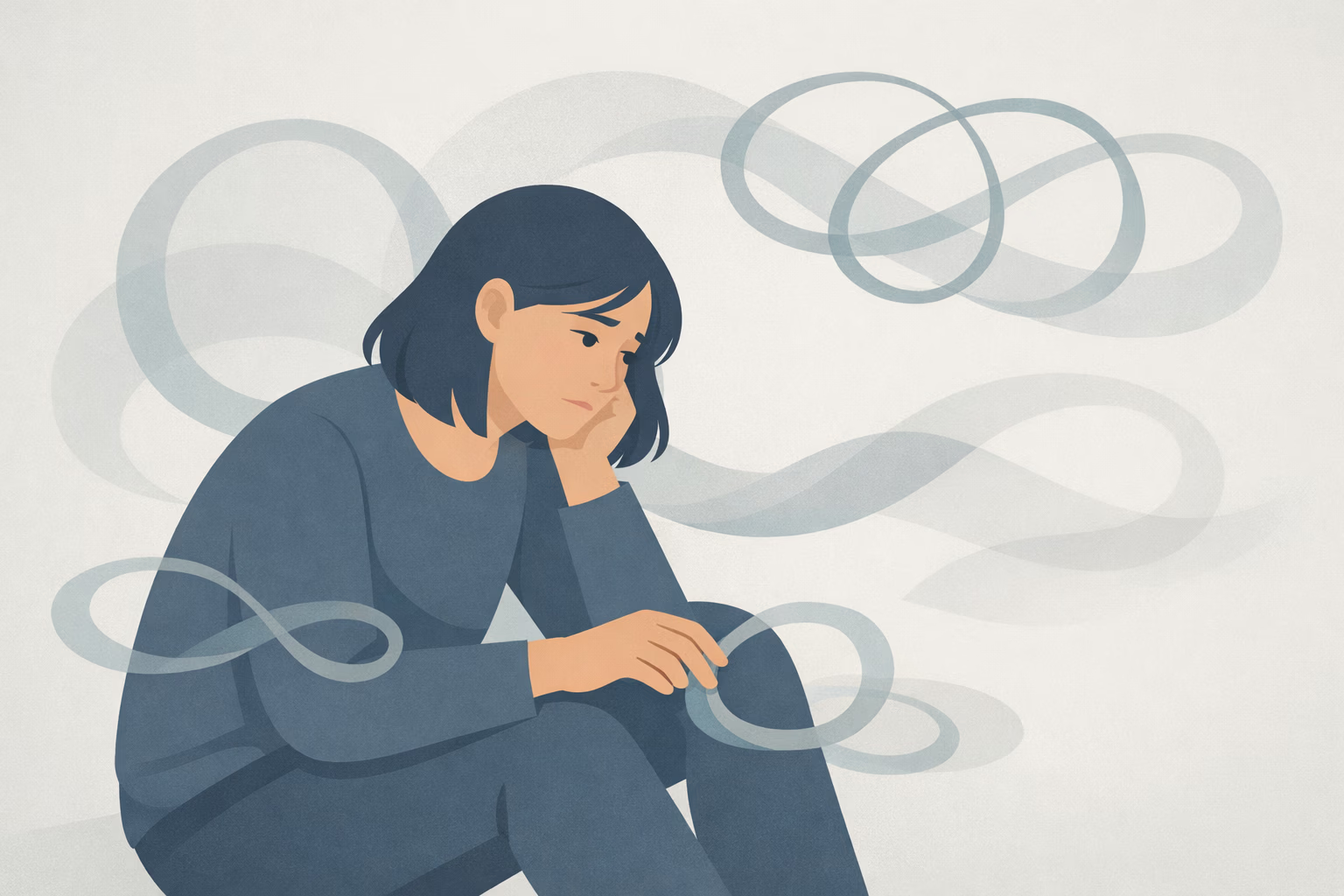
In short: There’s a particular kind of tired that comes from a mind that keeps sprinting: replaying conversations, scanning for what you missed, predicting outcomes, drafting contingency plans. It can look like “thinking,” but it often behaves more like a system stuck in motion.
There’s a particular kind of tired that comes from a mind that keeps sprinting: replaying conversations, scanning for what you missed, predicting outcomes, drafting contingency plans. It can look like “thinking,” but it often behaves more like a system stuck in motion.
What if your fast mind isn’t the problem—what if it’s your nervous system trying to find an exit?
Slowing down thought loops isn’t about becoming less intelligent or less prepared. It’s about restoring conditions where the mind can register completion—where signals can return to baseline, and clarity can reappear as a byproduct of reduced load and restored closure.
A constantly active mind is rarely neutral. It tends to carry urgency—an internal sense that something still needs solving, checking, or securing. Even in quiet moments, the system stays half-on, as if life is one notification away from falling apart.
This can be exhausting in a very specific way: not just “too many thoughts,” but too few moments where the mind feels finished. Without those physiological stand-down cues, attention keeps circling the same terrain, trying to complete something it can’t quite complete. [Ref-1]
When the mind can’t land, it keeps looping—not because you’re broken, but because it hasn’t received closure.
Under pressure, cognition often accelerates. Thought becomes quicker, tighter, and more repetitive—less like exploration, more like scanning. This is a predictable shift: when the nervous system reads “risk,” attention prioritizes detection over depth.
The cost is subtle but significant. Fast threat-speed thinking tends to reduce context, flatten nuance, and over-weight what feels unresolved. That’s one reason overthinking can feel both intense and unproductive: it’s running a protective mode that isn’t designed for accuracy, only for coverage. [Ref-2]
Why does it feel so hard to slow down?
Because speed can be the mind’s way of staying ahead of discomforting uncertainty—keeping the system moving so it doesn’t have to settle into ambiguity before there’s a clear end point.
Rapid looping makes sense in an evolutionary frame. Human attention evolved to detect changes in the environment—movement in the bushes, shifts in social signals, signs that something is off. Short bursts of heightened scanning helped bodies mobilize and then return to baseline when the situation resolved.
Modern stressors often don’t resolve cleanly. They linger as open tabs: complex work, social dynamics, financial ambiguity, health information, global events. The mind keeps scanning because the environment keeps presenting “maybe” instead of “done.” Racing thoughts are often the sound of a system built for short alarms living inside long, incomplete ones. [Ref-3]
In uncertain conditions, speed can resemble competence. The mind produces plans, explanations, and predictions quickly, which can create a temporary sense of control. This isn’t vanity; it’s regulation. The system uses mental motion to generate a feeling of preparedness.
Fast thinking can also serve as social protection: rehearsing what to say, preventing mistakes, staying “on.” In those contexts, slowing down may register as risky—not because you’re afraid of feelings, but because slower tempo can reveal how much is unresolved and how little external certainty is available.
When rumination shows up, it’s often the mind trying to complete a narrative—finding a clean conclusion that the situation itself isn’t providing. [Ref-4]
Many people were taught—explicitly or implicitly—that thinking harder and faster creates answers. Sometimes it does. But in looping states, more speed often produces more repetition: the same evidence, the same arguments, the same “what if,” just with higher internal volume.
Slowing isn’t a moral improvement. It’s a shift in processing conditions. When tempo decreases, the brain can integrate more signals at once—context, body cues, memory, values, real constraints. Clarity tends to emerge not from winning the argument in your head, but from the mind regaining its ability to discriminate what matters from what’s merely loud. [Ref-5]
An avoidance loop doesn’t require fear or suppression to be real. Structurally, it’s when motion replaces completion. The mind keeps moving because movement reduces contact with the missing “end” of something—an unanswered question, an unmade decision, an unclear boundary, a relationship ambiguity.
In this loop, overthinking is not a personality trait. It’s a regulatory strategy: keeping attention busy so the system doesn’t have to register the full weight of uncertainty or the limits of control. The loop persists because the environment keeps muting consequence and delaying closure—so the mind compensates with more tracking, more rehearsal, more analysis. [Ref-6]
Sometimes the mind doesn’t need a better thought. It needs a real ending.
Thought loops aren’t always dramatic. They often look like constant micro-processing—subtle, persistent, and hard to turn off. Many people don’t identify it as “racing thoughts” until they notice how rare it is to feel mentally quiet.
Common patterns include:
These are not character flaws. They’re signs of a system seeking stabilization in a world that rarely offers clean completion. [Ref-7]
When the mind stays in high tempo for long periods, capacity narrows. Attention becomes less flexible, more easily snagged by uncertainty and more easily depleted by decisions. Even pleasurable things can start to feel like effort because the system can’t fully stand down.
Over time, chronic cognitive acceleration can contribute to agitation, burnout-like fatigue, and a brittle kind of focus—where you can concentrate, but only by tightening. Clarity declines not because you lack insight, but because the mental environment is too loud for signals to settle into a coherent picture. Rumination is often linked with stress and anxiety precisely because it keeps the system activated without delivering closure. [Ref-8]
Why can the mind feel both busy and blank?
Because speed can increase output while reducing integration. You may generate many thoughts without the physiological “settling” that allows thoughts to become orientation.
There’s a paradox many people recognize: the more exhausted you are, the harder it can be to slow down. This isn’t stubbornness. Unresolved stress often sensitizes the system—keeping attention on alert for the next demand, the next mistake, the next social ripple.
In that state, slowing may register as exposure to unfinished material. Not “emotions” in a dramatic sense, but the raw reality of what isn’t concluded: the conversation that never got clarity, the workload that never ends, the standards that keep shifting, the relationship signals that don’t resolve. So cognition speeds up again, trying to re-establish control through iteration. Repetitive thought is frequently maintained by the absence of a true closing signal. [Ref-9]
Thought speed is not only a cognitive phenomenon; it’s tightly linked to physiological arousal. When the body is running “high,” the mind tends to mirror that state—quick, vigilant, future-oriented. When arousal decreases, thought can naturally become more spacious and less compelled.
This isn’t the same as insight or reframing. You can understand your patterns and still feel stuck in speed. What changes the loop is often a shift in state that allows the nervous system to register safety cues and reduce urgency. From that place, thinking becomes less like defending and more like perceiving. Research on breathing-based practices highlights how changes in breath can influence stress physiology and anxiety-related arousal, which can support cognitive steadiness. [Ref-10]
Clarity is often a property of a calmer system, not a smarter argument.
Human nervous systems don’t regulate in isolation. Pace is contagious: in conversation, in conflict, in workplaces, in families. A steady presence—someone who isn’t rushing you, evaluating you, or escalating—can act as an external “metronome,” giving your system evidence that it can downshift.
This is one reason certain interactions instantly calm the mind while others accelerate it. It’s not just what is said; it’s the timing, tone, predictability, and sense of being met. When social environments create constant evaluation or ongoing micro-demands, cognition often stays sped up to keep up. When environments offer steadiness, the mind doesn’t have to sprint to stay safe. [Ref-11]
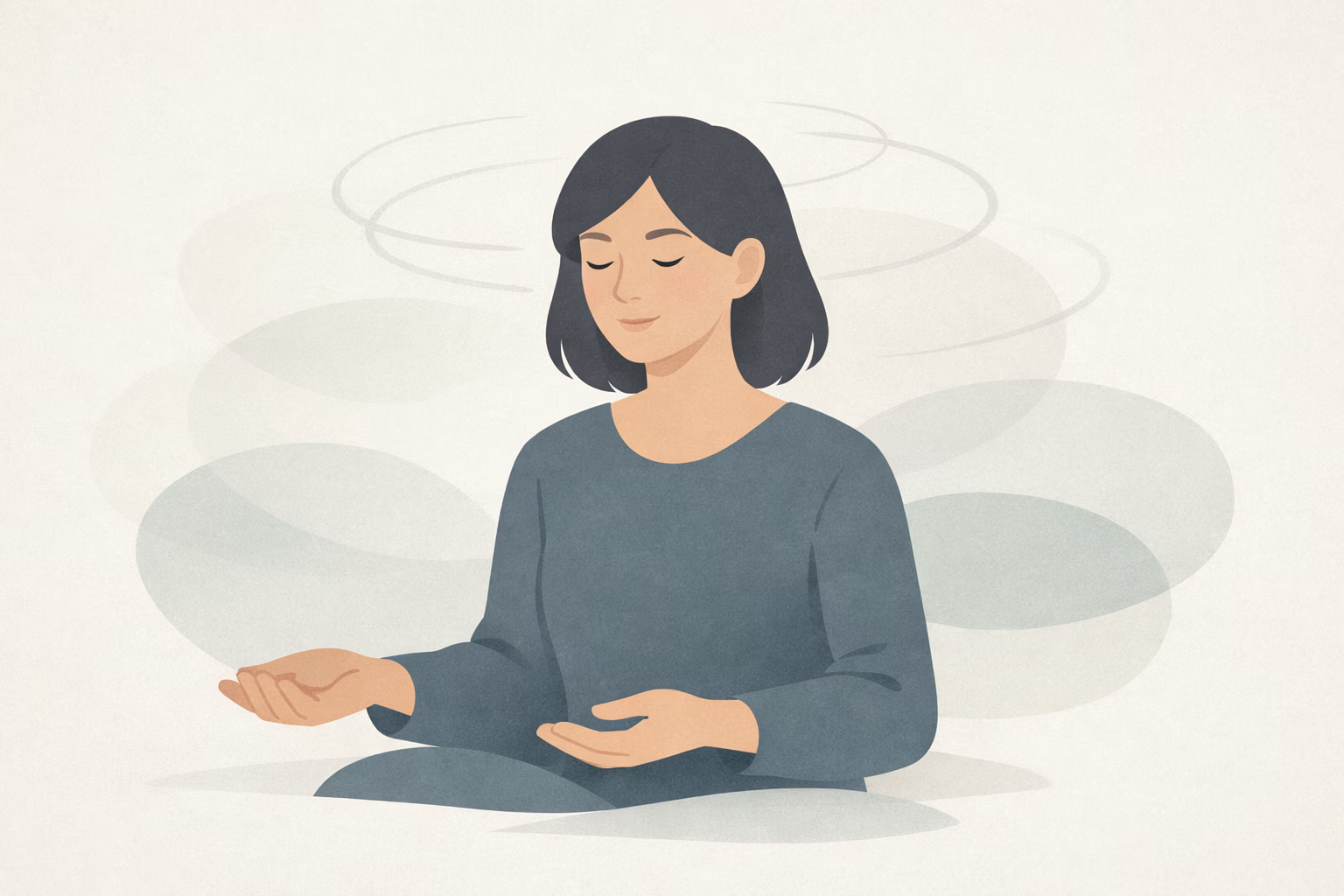
When thought loops slow, people often notice changes that are less dramatic than they expected—and more relieving. The mind doesn’t necessarily go silent. It becomes less sticky. Ideas come and go without demanding immediate resolution.
Mental spaciousness is recognizable by the return of choice: the ability to hold a question without being dragged by it, to notice multiple options, to sense priorities again. This is not simply “feeling better.” It’s an increase in capacity—the system can receive signals, sort them, and allow some of them to complete. Physiological pathways that link breath, vagal tone, and brain-body communication are often discussed as part of why calmer states support clearer perception. [Ref-12]
When the mind is moving fast, it tends to organize life around threat: what could go wrong, what needs fixing, what might be judged. This isn’t pessimism; it’s the attention system doing its job under load. But it has a side effect: identity can start to shrink to “the one who manages risk.”
As tempo slows, another organizing principle can return—meaning. Meaning isn’t a motivational slogan. It’s what becomes visible when life has enough coherence to register: values, relationships, commitments, the kind of person you’re being in ordinary moments. With reduced arousal, attention can reorient from constant scanning to steadier directionality, and the body can support that shift by moving out of perpetual alarm. [Ref-13]
When speed drops, you don’t just think differently—you remember what you’re living for.
In a culture that rewards responsiveness and constant updating, slowing down can be misunderstood as falling behind. But from a nervous-system and meaning perspective, slowing is often what makes accurate perception possible. It allows the mind to register completion, the body to stand down, and attention to return to what is actually here.
Clarity isn’t something you force out of a tight system. It tends to arrive when the conditions for coherence return—when fewer loops stay open, when load reduces, and when your inner life can finally deliver a clean “done.” Research exploring mindfulness breathing meditation has described links between stress reduction and cognitive performance, which aligns with the broader idea that steadier states support clearer thinking. [Ref-14]
When thought loops speed up, it usually means something in the system is still unresolved—something is still being tracked, checked, or guarded. That doesn’t make you deficient; it makes you responsive to conditions.
Clarity is less like a breakthrough and more like a settling: the moment the mind no longer needs to repeat itself to feel safe. Not because you won a battle with your thoughts, but because the system finally received enough closure to stand down. [Ref-15]
From theory to practice — meaning forms when insight meets action.
Because under pressure, cognition accelerates — thought becomes quicker, tighter, more repetitive. Less like exploration, more like scanning. When the nervous system reads 'risk,' attention prioritizes detection over depth, which reduces context, flattens nuance, and over-weights what feels unresolved. That's why overthinking can feel both intense and unproductive: it's running a protective mode designed for coverage, not accuracy. Speed is often the mind's way of staying ahead of uncertainty — keeping the system moving so it doesn't have to settle into ambiguity before there's a clear endpoint. Sometimes the mind doesn't need a better thought; it needs a real ending.
Structurally, often yes. An Avoidance Loop doesn't require fear or suppression to be real — it's when motion replaces completion. The mind keeps moving because movement reduces contact with the missing 'end' of something: an unanswered question, an unmade decision, an unclear boundary. Overthinking isn't a personality trait; it's a regulatory strategy that keeps attention busy so the system doesn't have to register the full weight of uncertainty. The loop persists because the environment keeps muting consequence and delaying closure, so the mind compensates with more tracking, rehearsal, analysis. Repetitive thought is frequently maintained by the absence of a true closing signal.
In looping states, more speed often produces more repetition — the same evidence, the same arguments, the same 'what if,' just at higher internal volume. Slowing isn't a moral improvement; it's a shift in processing conditions. When tempo decreases, the brain integrates more signals at once: context, body cues, memory, values, real constraints. Clarity emerges not from winning the argument in your head, but from the mind regaining its ability to discriminate what matters from what's merely loud. Fast loops prioritize coverage ('did I miss anything?'); slower cognition restores sorting ('what's relevant now?'). Clarity is often a property of a calmer system, not a smarter argument.
There's a paradox: the more depleted you are, the harder it is to slow down. Unresolved stress sensitizes the system, keeping attention on alert for the next demand. In that state, slowing registers as exposure to unfinished material — not 'emotions,' but the raw reality of what hasn't concluded. So cognition speeds up again, trying to re-establish control through iteration. Thought speed is tightly linked to physiological arousal; when the body runs high, the mind mirrors it. Co-regulation helps because pace is contagious — a steady presence acts as an external metronome, giving your system evidence it can downshift. When speed drops, you remember what you're living for.
From Science to Art.
Understanding explains what is happening. Art allows you to feel it—without fixing, judging, or naming. Pause here. Let the images work quietly. Sometimes meaning settles before words do.
One Quiet Window, one insight, one reflection — every Sunday