Digital Detox Resistance: Why Your Brain Fights Abstaining
In short: Some stress doesn’t arrive as a reaction to what’s happening. It arrives ahead of time—like your system is already lifting its shoulders, tightening its jaw, and scanning for what might go wrong.
Some stress doesn’t arrive as a reaction to what’s happening. It arrives ahead of time—like your system is already lifting its shoulders, tightening its jaw, and scanning for what might go wrong.
This is often less about personality and more about biology doing what it was built to do: predict, prepare, and reduce uncertainty. When the world is fast, ambiguous, and evaluative, the nervous system can start treating “later” as if it’s “now.”
What if your tension isn’t proof that something is wrong—what if it’s a readiness signal that never gets a clean “done”?
Stress preloading can look like starting the day already tense: a tight chest before checking your phone, a clenched stomach before opening email, a pressure behind the eyes before any conversation has even begun.
The confusing part is the timing. There may be no immediate threat in the room—no urgent demand, no conflict, no deadline right this second—yet the body acts as if it needs to be ready. This early activation is a real physiological state, not a failure of attitude or gratitude. [Ref-1]
In many people, the trigger is not the event itself but the uncertainty around it: “What will they say?” “What did I miss?” “What if I’m behind?” The prediction engine starts running before the day has a chance to provide clear signals.
Nervous systems are built to anticipate. They use prior patterns—what tended to happen, what felt costly, what created fallout—to generate forecasts. When forecasts carry enough “danger weight,” the body mobilizes in advance: more tension, more monitoring, more urgency. [Ref-2]
This can happen even when you consciously know you’re safe. Stress preloading doesn’t require a scary thought or a dramatic memory. It can be more mechanical than that: the system has learned that uncertainty often precedes effort, evaluation, or social consequence, so it primes itself early.
Importantly, this is not “overthinking” as a character flaw. It is a prediction-based regulation strategy: if you activate early, maybe you won’t be caught off-guard later.
From an evolutionary perspective, anticipating threat was protective. If something in the environment signaled possible danger, early mobilization increased readiness—more scanning, faster response, better odds of avoiding harm. [Ref-3]
In modern life, many “threats” are abstract: performance reviews, unread messages, social tone, finances, health headlines, uncertainty about the future. The cues are subtle and continuous. The body can still treat them as if they require immediate mobilization—because the survival system doesn’t primarily care whether a threat is physical or social. It cares whether it might cost you.
When the future feels heavy, the body often tries to carry it early.
Preloading often comes with a quiet logic: if you brace, you won’t be surprised. If you worry, you’ll be prepared. If you tense, you’ll stay sharp.
Biologically, anticipatory activation can create a brief sense of readiness—an internal “I’m on it” signal—especially under uncertainty. That readiness can feel like control, even when it’s expensive. [Ref-4]
The nervous system is not trying to punish you. It’s trying to reduce the chance of being unready in a world that rarely offers clean closure.
The problem with stress preloading isn’t that it’s irrational. The problem is that it front-loads the bill. Mobilization uses fuel: muscle tension, stress hormones, narrowed attention, and a constant “monitoring” posture.
Research on anticipatory threat responses shows that the body can mount a measurable stress response even before anything occurs—especially when outcomes feel uncertain. [Ref-5]
So you may arrive at the actual moment already partly depleted. The day then feels harder not because you’re incapable, but because you began it with a nervous system that was already “up on the gas.”
Stress preloading often functions like an avoidance loop—not avoidance as cowardice, but as a structural detour. Anticipation replaces presence. The system stays busy predicting, rehearsing, and scanning, which can temporarily bypass the discomfort of not knowing.
In threat imminence models, defensive responses shift as a threat feels closer; when the brain treats “maybe later” as “approaching now,” it can keep the body in a prolonged preparatory state. [Ref-6]
The loop is self-reinforcing: preloading creates internal pressure, and pressure becomes a signal that something must be wrong—so the system preloads more.
What if the “can’t relax” feeling is your system waiting for a clear stand-down signal?
Preloading can be loud or quiet. Sometimes it’s obvious panic; more often it’s a steady hum of readiness that becomes so familiar it reads as “normal.”
Tension before routine tasks (sending a simple message, starting laundry, making a call)
Micro-startle responses to notifications or footsteps
Constant “mental staging,” as if every interaction needs a script
Difficulty transitioning into rest, even when time is available
A sense of being behind before the day has actually asked anything of you
Many of these overlap with what people call anticipatory anxiety—stress that forms ahead of an event, sometimes without a clear reason in the present moment. [Ref-7]
When the body repeatedly mobilizes early, it can start to feel like you’re always “about to” do something: about to get in trouble, about to fall behind, about to be evaluated. That constant readiness can wear down resilience, even if nothing catastrophic happens. [Ref-8]
Over time, chronic preloading often shows up as:
Background fatigue that sleep doesn’t fully fix
Shortened patience and reduced tolerance for complexity
More frequent bodily discomfort (tight shoulders, headaches, jaw tension, stomach churn)
A narrowed sense of choice, because everything feels urgent
This is not a personal weakness. It’s what prolonged load can do to any human system that rarely gets completion and stand-down.
When anticipation happens often, the brain learns that anticipation is necessary. The internal alarm becomes the familiar backdrop, and “calm” can start to feel suspicious—like something is being missed.
Repeated vigilance strengthens the habit of scanning and threat-projection, which can make stress feel present even on neutral days. Consumer health summaries of hypervigilance describe this pattern: heightened alertness, sensitivity to cues, and difficulty settling. [Ref-9]
In a sense, the predicted future becomes the current climate. Not because you’re choosing it, but because the nervous system treats prediction as part of survival.
It helps to distinguish between understanding and settling. You can intellectually know “I’m fine,” and still feel braced. That’s because the body doesn’t stand down through logic alone; it responds to safety cues that are concrete enough to update the prediction system. [Ref-10]
When safety cues register, the nervous system can shift from preloading toward a more present-based orientation: “Nothing is required right now.” This isn’t about forcing calm or performing positivity. It’s about the system receiving enough evidence to reduce mobilization.
Relief changes state. Completion creates a lasting “we’re done here.”
Meaning, in this context, is not a mantra. It’s what forms when the day contains real endpoints—moments that land, resolve, and become part of lived identity rather than a never-finished rehearsal.
Humans regulate in connection. When reality is checked with another person—through ordinary conversation, dependable presence, or being understood—the nervous system often updates faster than it does in isolation.
This is not about being “reassured” into denial. It’s about shared orientation: the sense that you are not alone in interpreting signals, and that the stakes are not all on you to predict perfectly. Resources discussing hypervigilance in trauma contexts often note that persistent scanning can soften when safety is experienced consistently, especially in relationships and supportive environments. [Ref-11]
In practical terms, shared reality reduces the pressure to preload, because the burden of prediction is no longer carried by a single nervous system.
When preloading eases, it doesn’t mean you never anticipate again. It means anticipation becomes proportional. The system can prepare when preparation is needed—and stand down when it isn’t.
People often describe this shift as a return of flexibility: the ability to wait for more information, to move through transitions with less friction, and to rest without “paying for it” later with a spike of urgency. Descriptions of hypervigilance frequently contrast chronic alertness with a more regulated baseline where attention can widen and settle. [Ref-12]
The key marker is not constant calm. It’s capacity: signals come in, signals resolve, and the body can return closer to baseline without needing to keep the future running in the foreground.
Preloaded tension takes up space. It occupies attention, tightens time, and narrows identity to “the one who must stay ahead.” When that load reduces, another orientation becomes available: moving from what you’re bracing against to what you’re here for.
This is where agency often reappears—not as willpower, but as a clearer internal map. Values become easier to feel as real, because the nervous system isn’t spending most of its bandwidth on monitoring. In stress physiology terms, chronic anticipatory activation contributes to allostatic load—wear and tear from repeated adjustment demands. [Ref-13]
As closure returns—small ends, clear completions, fewer open loops—meaning can densify. Life starts to cohere not because you thought the right thoughts, but because your system has fewer unfinished mobilizations pulling it forward.
Stress preloading is often a learned form of vigilance: a nervous system strategy for living in conditions that are fast, ambiguous, and high-stakes. Naming it can reduce shame, because it clarifies that the pattern is adaptive under load—even when it’s costly.
When you view preloading as a load-and-closure issue, the story changes. The question becomes less “Why can’t I relax?” and more “What keeps my system from receiving a reliable ‘done’?” Over time, reduced chronic load matters for health and functioning, not as a moral project but as a biological reality. [Ref-14]
Agency, here, is not forcing yourself into calm. It’s the gradual return of orientation—when your body isn’t spending tomorrow’s energy today.
If your body braces early, it’s not because you’re failing at life. It’s because your system has learned that “later” is rarely neutral—and it has been trying to protect you in advance.
And still: a human nervous system is allowed to have mornings that don’t start with readiness. It is allowed to wait for the moment to actually arrive. In the language of stress science, lower allostatic load is what lets systems recover their range. [Ref-15]
Sometimes the most meaningful shift is simple: life happens, and stress no longer has to get there first.
From theory to practice — meaning forms when insight meets action.
Because your nervous system is doing what it was built to do: predict, prepare, and reduce uncertainty. Stress preloading isn't a reaction to a present event — it's anticipatory mobilization based on patterns. The brain uses prior experiences to generate forecasts, and when those forecasts carry enough 'danger weight,' the body activates in advance. This happens even when you consciously know you're safe. The trigger isn't usually a scary thought; it's mechanical. The system has learned that uncertainty often precedes effort, evaluation, or social consequence, so it primes early. When the future feels heavy, the body tries to carry it ahead of time.
Because anticipatory activation creates a brief sense of readiness — an internal 'I'm on it' signal that registers as control under uncertainty. The logic is simple: if you brace, you won't be surprised; if you worry, you'll be prepared. The nervous system isn't trying to punish you. It's trying to reduce the chance of being unready in a world that rarely offers clean closure. The cost is that mobilization front-loads the bill — stress hormones, muscle tension, narrowed attention, constant monitoring — so you arrive at the actual moment partly depleted. The day feels harder not because you're incapable, but because you began with the gas already up.
It functions like an Avoidance Loop, though not avoidance as cowardice. Anticipation replaces presence: the system stays busy predicting, rehearsing, and scanning, which temporarily bypasses the discomfort of not knowing. Preloading creates internal pressure, and pressure becomes a signal that something must be wrong, so the system preloads more. Repeated vigilance also strengthens the habit of scanning — calm starts to feel suspicious, like something's being missed. Over time, the predicted future becomes the current climate. Not because you chose it, but because the nervous system treats prediction itself as part of survival when closure isn't reliably available.
Anticipation becomes proportional rather than constant. The system can prepare when preparation is needed and stand down when it isn't. People describe a return of flexibility — waiting for more information, moving through transitions with less friction, resting without paying for it later with an urgency spike. The marker isn't constant calm; it's capacity. Signals come in, signals resolve, and the body returns closer to baseline without needing to keep the future running in the foreground. Agency reappears not as willpower but as a clearer internal map: values feel real because the nervous system isn't spending most of its bandwidth on monitoring tomorrow.
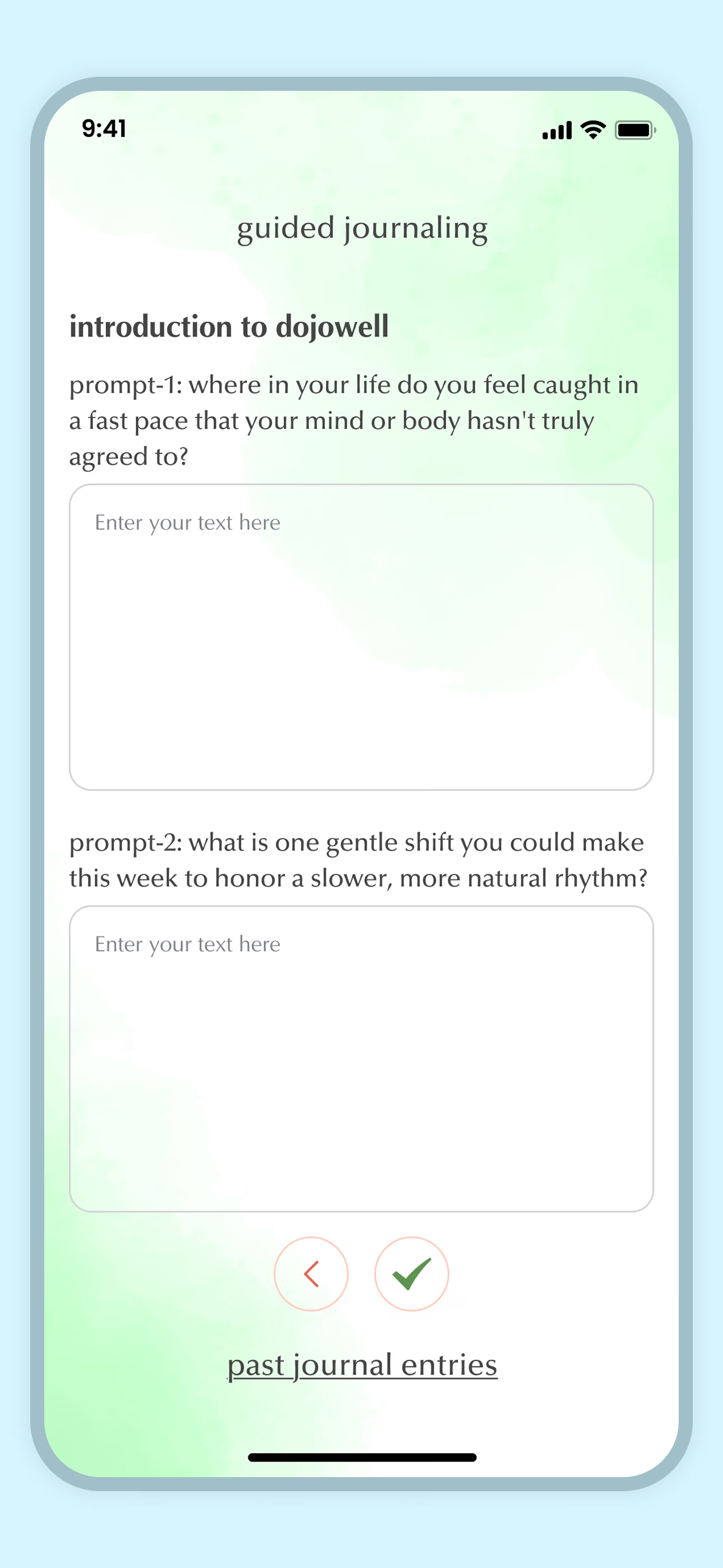
From Science to Art.
Understanding explains what is happening. Art allows you to feel it—without fixing, judging, or naming. Pause here. Let the images work quietly. Sometimes meaning settles before words do.
One Quiet Window, one insight, one reflection — every Sunday