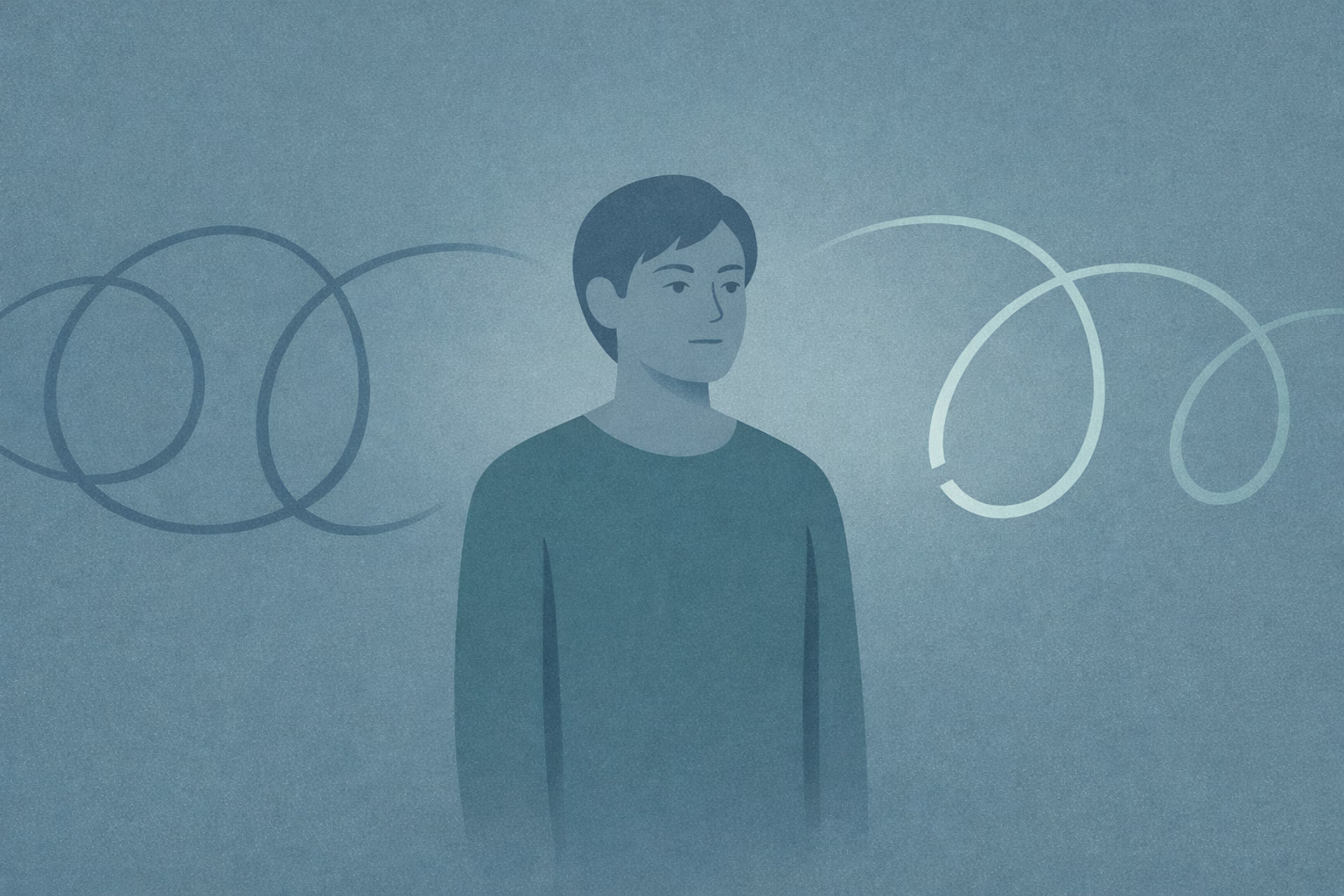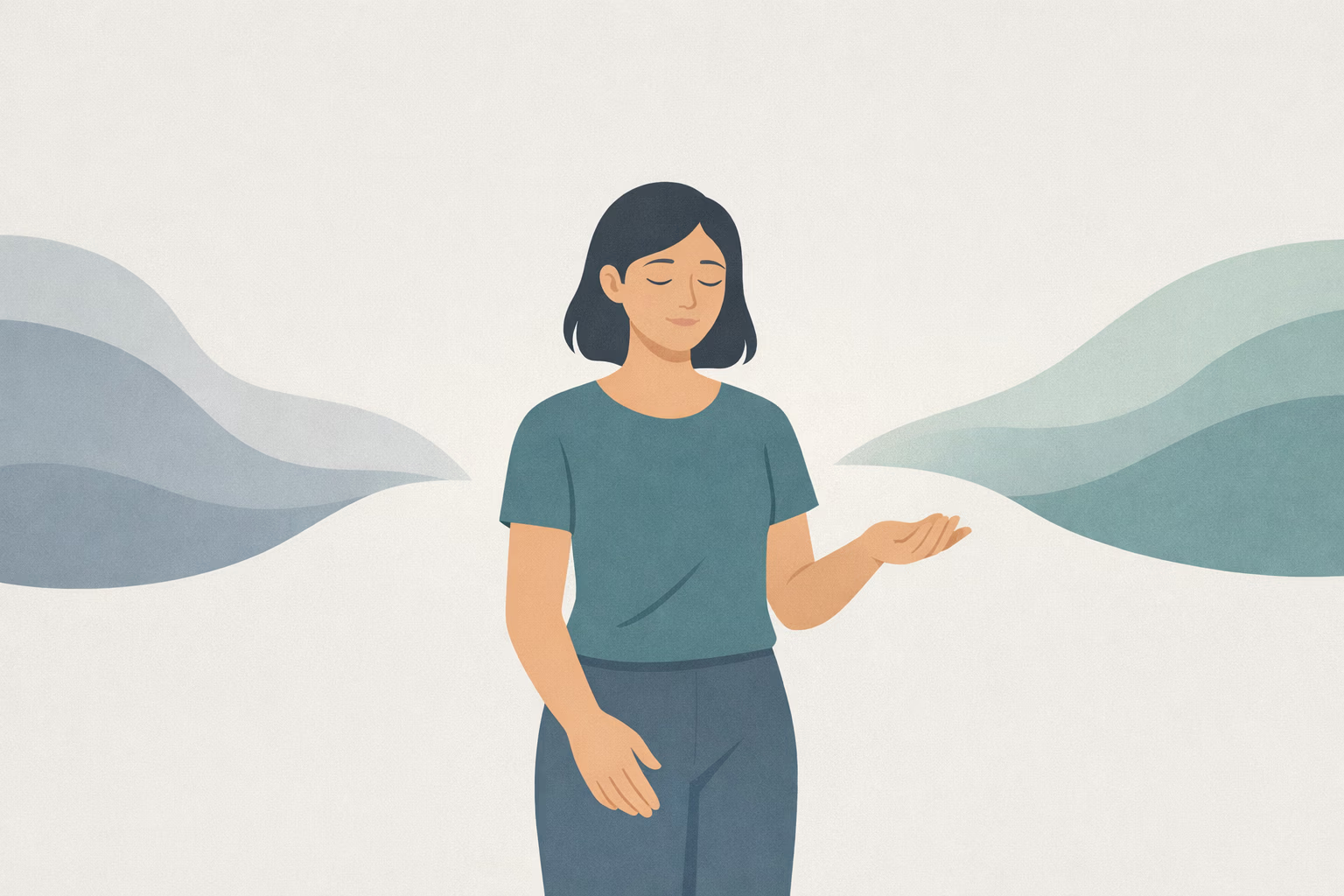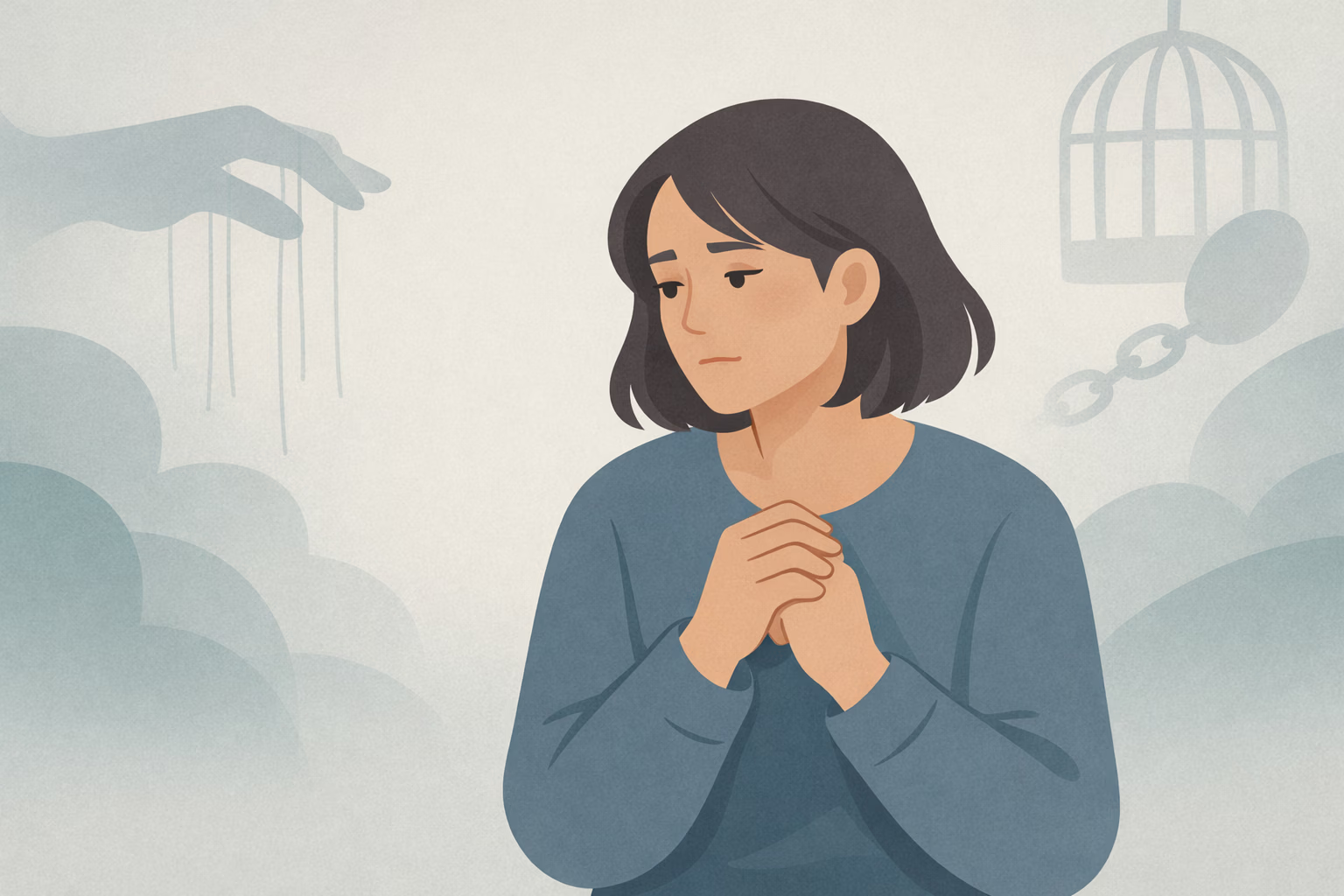
The Paradox of Control: When Holding On Makes Life Harder

In short: Control often gets framed as a personality trait: organized, driven, “on top of things.” But for many people, control is a regulation strategy—an attempt to create enough predictability for the nervous system to stand down. In a high-velocity world, that strategy can start to feel like the only way to function.
Control often gets framed as a personality trait: organized, driven, “on top of things.” But for many people, control is a regulation strategy—an attempt to create enough predictability for the nervous system to stand down.
In a high-velocity world, that strategy can start to feel like the only way to function. Yet the more life is managed, the more life can begin to shrink. Not because you’re doing it wrong, but because control can provide state relief without providing true completion.
What if the need for control isn’t a flaw—but a sign your system hasn’t been allowed to feel “done”?
When control becomes the main way to feel safe, relaxation starts to depend on conditions: the plan must hold, the environment must cooperate, other people must behave predictably. That kind of dependence creates vigilance as a baseline.
Vigilance is expensive. It asks the body to keep scanning and updating—mentally rehearsing, double-checking, pre-solving. Even when nothing is “wrong,” the system stays positioned for impact, as if the next variable could tip everything over. Over time, ease can feel earned rather than available. [Ref-1]
Many people recognize this as a particular fatigue: not just tiredness, but the strain of needing to be the one who prevents things from going sideways.
Control behaviors can dampen threat signals quickly. When you organize, correct, research, monitor, or tighten a routine, uncertainty narrows. The immediate result is often a drop in internal noise: less agitation, fewer spikes of urgency, more sense of “I’ve handled it.” [Ref-2]
But dampening isn’t the same as completion. The underlying activation can remain, because the body hasn’t received the deeper cue it needs: that the loop has ended and the situation has truly resolved. So the system learns a rule: calm comes from managing, not from being safe.
Sometimes control doesn’t remove danger. It removes the feeling of danger—just long enough to keep going.
From an evolutionary standpoint, uncertainty has always carried cost. In harsher environments, not knowing could mean exposure—lack of shelter, lack of food, lack of protection. Humans developed powerful safety systems to reduce unpredictability: detect patterns, anticipate outcomes, coordinate group behavior, and avoid unnecessary risk.
In that context, control wasn’t about perfection. It was about survival efficiency: lowering the probability of surprise. Modern life still activates these same circuits, even when the “threat” is social evaluation, financial volatility, or a stream of ambiguous information. The body doesn’t require a predator to run a safety program. [Ref-3]
When uncertainty rises, the nervous system naturally looks for stabilizers. Control provides a fast stabilizer because it increases predictability: a plan, a rule, a checklist, a fixed standard. It creates a temporary sense of “I know what happens next,” which is a powerful safety cue for a loaded system. [Ref-4]
This is why control can be compelling even when it costs you. The body is responding to a real need: reduced unpredictability. The issue isn’t that control is “bad.” The issue is when control becomes the only pathway to calm, and the threshold for “safe enough” keeps moving.
What happens when the only way to relax is to keep tightening the grip?
Control can create a sense of safety, but it often does so by limiting aliveness. Spontaneity becomes risky. Rest feels conditional. Relationships start to carry invisible contracts: “If things go this way, I can be okay.”
Over time, the trade-off can show up as a loss of inner ease. Not dramatic distress—more like a quiet narrowing. When the system relies on management for calm, it has fewer opportunities to learn that life can be uncertain and still survivable, still meaningful. [Ref-5]
A “power loop” forms when control reduces discomfort quickly, so the system repeats it—again and again—whenever uncertainty appears. The relief teaches the body that letting go is unsafe, not because letting go is objectively dangerous, but because letting go removes the immediate stabilizer.
In this loop, surrender is misread as exposure. Not as a conscious belief, but as a physiological prediction: “If I don’t manage this, something will happen—and I won’t be able to handle it.” The nervous system isn’t being stubborn. It’s protecting continuity. [Ref-6]
And because the relief is real, the loop can feel rational. The cost shows up later, as rigidity, tension, and a life that requires constant supervision.
Control-seeking has many “faces.” Often it looks like competence. Sometimes it looks like intensity. Underneath, it is frequently a sign that the system is carrying too much uncertainty to metabolize, so it tries to reduce variables externally.
These patterns are not identities. They are regulatory responses—ways a body tries to close open loops and prevent unwanted outcomes when it doesn’t have enough capacity to stay flexible. [Ref-7]
Persistent control-seeking can quietly narrow experience. Not because you’re choosing smallness, but because unpredictability becomes expensive. When everything must be managed, fewer situations feel “worth it.” Fewer relationships feel easy. Fewer options feel tolerable.
As life narrows, meaning can thin out too. Meaning isn’t just having goals or positive thoughts; it tends to emerge when experiences complete—when what you live through can settle into identity as something integrated, not something still requiring management. When your days are dominated by prevention and monitoring, fewer moments reach that “done” signal. [Ref-8]
Control can keep things from falling apart, but it can also keep things from fully arriving.
Uncertainty tolerance isn’t a moral achievement; it’s a learned stability. The nervous system learns safety through lived evidence—through experiences that start, unfold, and complete without catastrophe. When uncertainty is consistently bypassed via control, that evidence doesn’t accumulate.
This creates a structural problem: the world continues to be uncertain, but the system has fewer completed experiences of “I didn’t manage everything, and I was still okay.” Without those completions, control remains the main route to relief, and uncertainty keeps its charge. [Ref-9]
In this way, avoidance of uncertainty doesn’t come from “fear” as a character trait. It comes from missing closure: the loop never finishes, so the system stays convinced it must keep controlling.
There’s an important distinction between controlling the environment and experiencing internal safety. Control tries to make the outside predictable enough for the inside to calm down. Internal safety is the sense that your system can return to baseline even when conditions are imperfect.
This is not a mindset shift and not a motivational trick. It’s a change in what your body expects: whether uncertainty always means danger, or whether uncertainty can exist alongside stability. When internal safety increases, the urgency to manage every variable often decreases—not because you stop caring, but because caring no longer requires constant tightening. [Ref-10]
What if “letting go” isn’t abandoning responsibility—just releasing the need to guarantee outcomes?
Control patterns often intensify in relationships because relationships are inherently uncertain: other people have autonomy, moods, histories, and limits. When your system is overloaded, that autonomy can register as risk.
Over time, control can replace shared agency. Instead of two people co-navigating reality, one person becomes the stabilizer—tracking details, preventing conflict, managing impressions, or holding the emotional temperature of the room. This can reduce immediate unpredictability, but it can also erode trust and reciprocity.
Trust here doesn’t mean blind optimism. It means allowing space for others to participate in the closure of shared experiences—so the burden of regulation isn’t carried by one nervous system alone. Intolerance of uncertainty often shows up most clearly in this relational terrain. [Ref-11]
When the need for control softens, it often doesn’t look like dramatic transformation. It looks like capacity returning. The body spends less time bracing and more time recovering. The mind spends less time pre-solving and more time noticing what is actually happening.
Uncertainty may still be present, but it carries less physiological charge. Not because uncertainty disappears, but because the system has more evidence that it can move through incomplete information and still find its way back to steadiness. In research, intolerance of uncertainty is closely linked with anxiety and coping strain—suggesting that when uncertainty stops dominating the system, load decreases and flexibility increases. [Ref-12]
Control is often a substitute for orientation. When life feels incoherent—too many inputs, too few completions—control offers structure. But structure isn’t the same as direction.
As control loosens, something quieter can re-emerge: values-based direction. Not as a concept, but as a lived sense of “this matters to me” that doesn’t require perfect conditions to be real. Meaning tends to grow when experiences can complete and settle into identity—when you can live, finish, and integrate chapters rather than endlessly managing them.
In studies of uncertainty tolerance across health contexts, higher intolerance of uncertainty is associated with broader mental health strain, underscoring how central uncertainty processing is to wellbeing. When uncertainty becomes more tolerable, the system can allocate energy to connection, purpose, and participation—not just prevention. [Ref-13]
The false promise of control is the contract it implies: “If I manage everything, I can finally be safe.” The world rarely signs that contract. Variables remain. People remain human. Bodies remain changeable. Time remains imperfect.
Letting go, in this frame, isn’t passivity. It’s a different relationship with agency: less about guaranteeing outcomes, more about trusting your capacity to meet life as it arrives. That trust is not naive; it is stabilizing. It reduces the need to live in constant preemption and returns energy to what actually matters. [Ref-14]
Control is often a sign of devotion: you care, you want things to go well, you’re trying to protect what matters. There’s dignity in that.
And sometimes, the next layer of dignity is allowing life to be alive—variable, seasonal, unfinished at times—without making your nervous system pay for every unknown. Meaning tends to expand not when the grip tightens, but when experiences can complete and settle, leaving behind a quieter sense of direction. [Ref-15]
From theory to practice — meaning forms when insight meets action.
Because it asks the body to keep scanning and updating — mentally rehearsing, double-checking, pre-solving. Even when nothing is wrong, the system stays positioned for impact, as if the next variable could tip everything over. Vigilance is expensive. When control becomes the main way to feel safe, ease becomes conditional: the plan must hold, the environment must cooperate, other people must behave predictably. Over time, that creates a particular fatigue — not just tiredness, but the strain of needing to be the one who prevents things from going sideways. Relaxation gets earned rather than allowed. The exhaustion isn't a personality issue; it's the cost of management as a regulation strategy.
Because dampening isn't the same as completion. When you organize, correct, research, or tighten a routine, uncertainty narrows and internal noise drops — less agitation, more sense of I've handled it. But the underlying activation can remain because the body hasn't received the deeper cue it needs: that the loop has ended and the situation has truly resolved. The system learns a rule: calm comes from managing, not from being safe. Sometimes control doesn't remove danger; it removes the feeling of danger, just long enough to keep going. The next variable reactivates the whole pattern, because no Done Signal ever landed.
Through repeated reinforcement. Control reduces discomfort quickly, so the system repeats it whenever uncertainty appears. The relief teaches the body that letting go is unsafe — not because letting go is objectively dangerous, but because it removes the immediate stabilizer. Surrender gets misread as exposure. Not as conscious belief, but as physiological prediction: if I don't manage this, something will happen I can't handle. The Power Loop here is protective, not manipulative. The cost shows up later as rigidity, tension, and a life that requires constant supervision. Trying harder isn't a virtue or a vice. It's a regulatory attempt that calcifies because relief is real and recurring.
Releasing the false contract — the implied if I manage everything, I can finally be safe. The world rarely signs that contract. Variables remain, people remain human, time remains imperfect. Letting go isn't passivity; it's a different relationship with agency: less about guaranteeing outcomes, more about trusting your capacity to meet life as it arrives. Internal safety is the sense that your system can return to baseline even when conditions are imperfect. As that grows, urgency to manage every variable decreases — not because you stop caring, but because caring no longer requires constant tightening. Direction can come from meaning rather than from prevention.
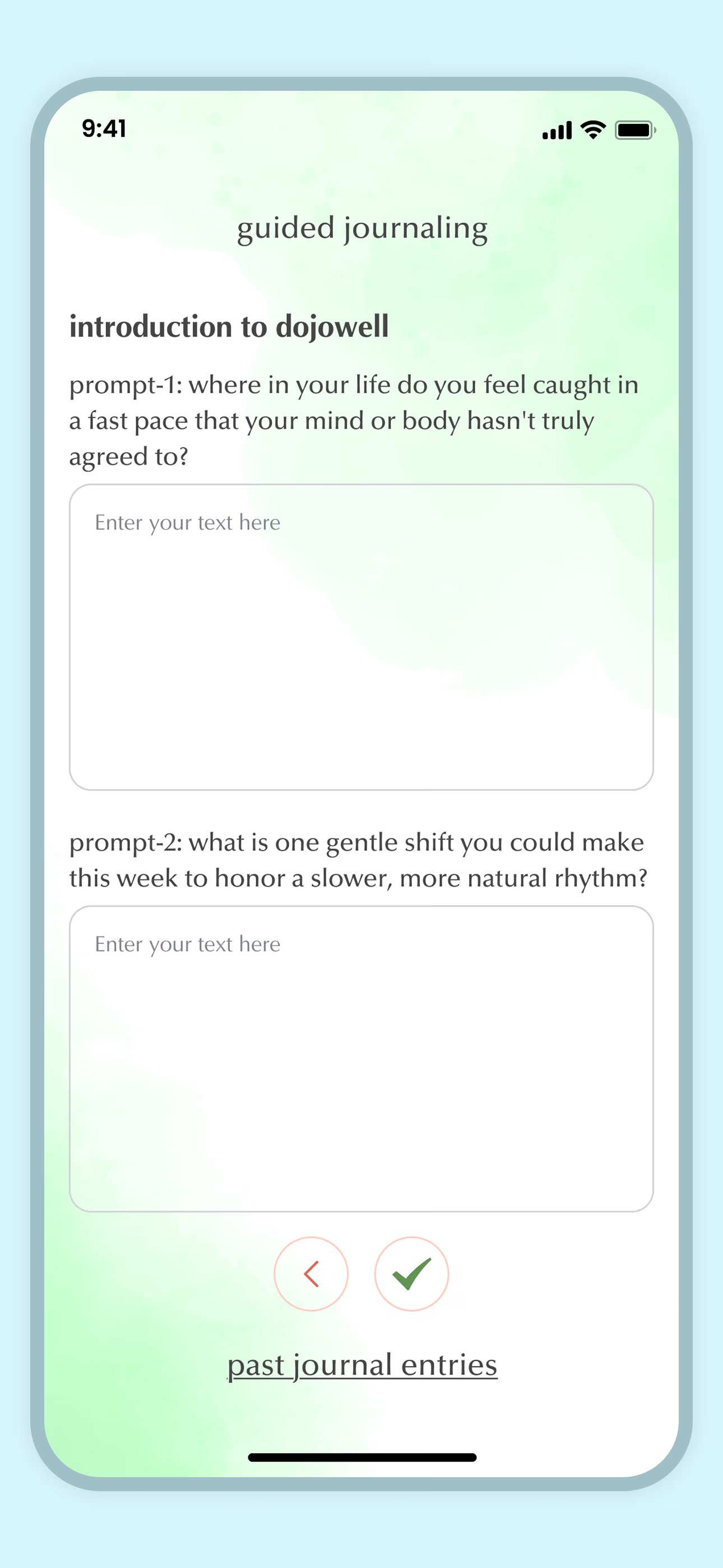
From Science to Art.
Understanding explains what is happening. Art allows you to feel it—without fixing, judging, or naming. Pause here. Let the images work quietly. Sometimes meaning settles before words do.
One Quiet Window, one insight, one reflection — every Sunday