


Emotional Reflexes: Why You React Before You Think
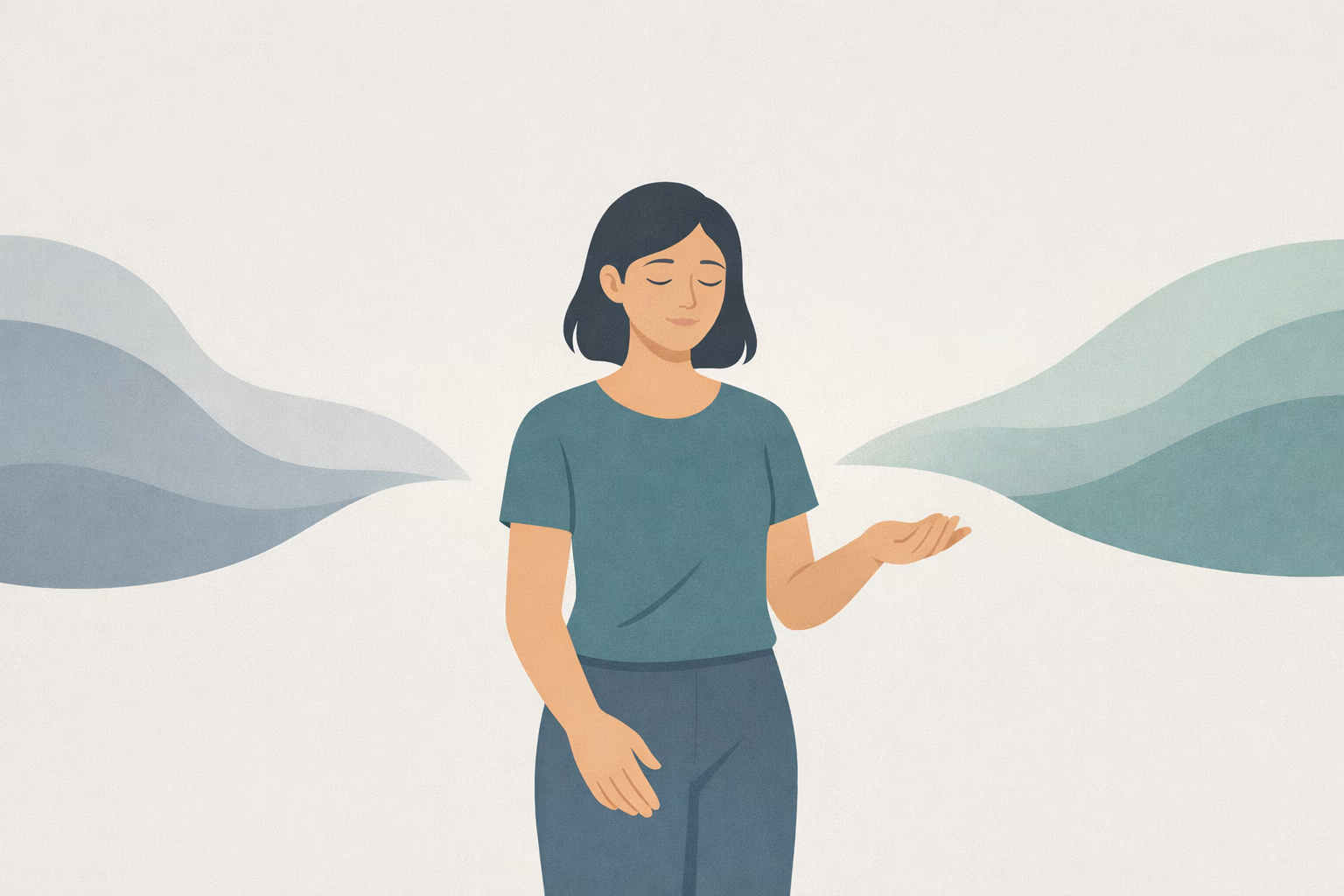
In short: Most people don’t struggle because they “lack willpower.” They struggle because life moves faster than the body can complete what it starts—stress responses, social moments, unfinished conversations, unresolved demands. When the system stays loaded, it defaults to speed: react, secure, protect, numb, push, or fix.
Most people don’t struggle because they “lack willpower.” They struggle because life moves faster than the body can complete what it starts—stress responses, social moments, unfinished conversations, unresolved demands. When the system stays loaded, it defaults to speed: react, secure, protect, numb, push, or fix.
That’s why the idea of a gap between stimulus and response matters. Not as a motivational slogan, but as a real biological opening—sometimes tiny—where an automatic loop doesn’t fully close, and choice becomes possible again.
What if your “overreactions” are not your character—just your nervous system running without enough space to finish?
There’s a particular kind of frustration that comes from watching yourself do something you didn’t mean to do: snap, scroll, shut down, over-explain, over-spend, say yes too fast, or go quiet and disappear. Afterward, you may recognize what mattered to you—respect, honesty, calm, clarity—yet the moment moved as if it had its own momentum. [Ref-1]
In a Meaning Density frame, this isn’t a personal defect. It’s what happens when the body is carrying more activation than it can process to completion. Under load, the system prefers the shortest route to “safety” or relief, even when that route creates regret later.
When the pressure is high, speed can masquerade as certainty.
What we call the stimulus–response gap is often the moment executive control networks begin to participate: monitoring, inhibiting, updating context, and keeping multiple options online. It’s not abstract “self-control.” It’s a measurable shift from reflexive circuits toward flexible coordination. [Ref-2]
When that coordination comes online, the body can register more information at once: internal cues (tension, heat, urgency), external cues (tone, timing, facial expression), and longer-term consequences. That widened signal field is what makes a different response possible—because the system is no longer forced into a single, preloaded pathway.
Many animals act quickly because quick action is protective. Humans also have that wiring, but we carry an additional capacity: we can hold a moment inside a larger storyline. We can weigh what this moment will mean later, how it fits our identity, what kind of person we are becoming, and what we want a relationship to stand for. [Ref-3]
This is not “thinking your way out” of reaction. It’s a different kind of coordination: the present moment is linked to a broader narrative, and the body gets permission to wait long enough for more signals to arrive.
In other words: the gap is where time returns.
A pause doesn’t have to be dramatic to matter. The difference between reacting and responding can be a single beat where the nervous system receives a “not yet” message. That small delay often reduces the chain reaction: one sharp word becomes ten, one impulse becomes a cascade, one defensive move becomes a week-long rupture. [Ref-4]
What changes isn’t your morality; it’s the trajectory. The body gets a chance to stand down from immediate defense long enough for context and consequence to re-enter the room.
It can feel like reactions are just “who you are.” But automaticity is often what the brain does when it’s efficient, overloaded, or trained by repetition. In the right conditions, the same brain that fires quickly can also de-automatize—interrupting a sequence that would otherwise run to completion. [Ref-5]
Agency isn’t always a dramatic choice. Sometimes it’s simply the reappearance of options. When options return, you haven’t become a new person; you’ve regained access to more of your system.
In Meaning Density terms, the collapse of the freedom gap is a meaning-loop disruption: what you do stops matching what you value, not because you don’t care, but because the loop can’t complete under load. The system goes with what’s immediate—relief, dominance, retreat, reassurance—because those are short routes to a temporary state change. [Ref-6]
Over time, this creates a specific kind of disorientation. You can still name your values, but they don’t reliably steer behavior in the moments that count. And when values don’t steer action, identity starts to feel blurry—less coherent, less trustworthy, less “yours.”
When your actions don’t land where your values live, you don’t just lose control—you lose continuity.
When stress load is high, the body tends to pick familiar pathways that reduce uncertainty quickly. These pathways can look like personality, but they often function like short-term regulators—fast, repeatable, and narrow. A cognitive control view helps explain why these patterns intensify under pressure: flexible control decreases, and default responses become more dominant. [Ref-7]
Some common patterns include:
These aren’t identities. They’re what a system does when it can’t access a wider range of responses.
Response inhibition and conflict control are not only “internal skills.” They shape social safety. When pauses shrink, micro-moments change: tone sharpens, interruptions increase, facial expressions harden, repair takes longer. Even if everyone has good intentions, the interaction becomes more reactive because the nervous system is prioritizing speed over nuance. [Ref-8]
Over time, this can affect:
This is why the gap matters: it protects connection by restoring a little room for context.
Brains learn what they do repeatedly. When stress is frequent, the nervous system practices fast responses more than thoughtful ones. With repetition, the “shortcut” becomes easier to access than the “scenic route” of waiting, checking, and choosing. Research on response inhibition and impulse-control difficulties highlights how reduced inhibitory control can make reactions more dominant, especially in emotionally charged contexts. [Ref-9]
This is not a story about blame. It’s a story about pathways. The more often a pattern resolves immediate tension—even imperfectly—the more the system tags it as useful. The result can be a life that feels like it keeps happening “to you,” even when you’re intelligent and sincere.
The gap tends to widen when two things are available at the same time: (1) enough nervous-system safety for the body to tolerate a delay, and (2) enough cognitive control for more than one option to remain possible. Better cognitive control is associated with more adaptive regulation—not by suppressing life, but by coordinating it. [Ref-10]
Importantly, this is not the same as insight. Understanding your pattern can be helpful, but understanding alone doesn’t create the physiological “stand-down” that makes space usable. The gap becomes dependable when the body repeatedly experiences completion—moments that fully resolve without needing the old emergency exits.
Freedom here isn’t intensity. It’s availability.
A reliable pause changes the social field. It gives room for timing, tone, and proportion. Instead of the nervous system treating every trigger as an emergency, it can treat some moments as information. That shift is often what people mean when they say they feel “heard” or “met”—not because someone performed the right technique, but because the interaction had space. [Ref-11]
In that space, repair becomes more likely. Not perfect repair—human relationships still have friction—but repair that lands. The body senses follow-through: a moment rises, is handled, and resolves. That completion is a kind of relational closure that builds trust over time.
When the gap is present more often, the change is usually concrete. It can look like a longer fuse, fewer spirals, fewer “how did I get here?” moments, and quicker return to baseline after stress. Some descriptions of response flexibility include noticing earlier cues, staying oriented during conflict, and choosing a response that fits the moment rather than the reflex. [Ref-12]
This isn’t about feeling more or expressing more. It’s about capacity coming back online: the ability to stay with complexity without collapsing into speed. The system can receive a stimulus, register it fully, and still remain organized enough to select what happens next.
Calm isn’t the absence of triggers. It’s the presence of options.
The deepest payoff of the stimulus–response gap isn’t “better behavior.” It’s restored coherence: actions begin to match what you say matters, and that match settles into identity. Over time, the body learns that it can meet strong stimuli without abandoning its own values, which reduces internal conflict and increases stability. [Ref-13]
In a Meaning Density sense, this is how meaning becomes lived rather than merely stated. Moments complete. Loops close. You don’t have to constantly re-decide who you are, because your responses keep confirming it.
Freedom point, in practice, is where your life becomes more yours.
It’s easy to imagine agency as a grand, heroic force. But for most humans, agency returns as something smaller: a pause that lets consequences reappear, a breath of time where values can enter, a fraction of a second where the body doesn’t have to sprint toward relief. [Ref-14]
Seen this way, responsibility isn’t punishment. It’s a form of dignity—because it assumes there is a real “you” in there, not just a set of reactions. And when that “you” has space, meaning becomes a practical orientation again, not a concept you try to remember under pressure.
The stimulus will still arrive: an email, a look, a memory, a craving, a loud sound, a sharp tone. The point isn’t to eliminate triggers. The point is that there can be a moment—sometimes brief, sometimes growing—where your system doesn’t have to surrender the steering wheel. [Ref-15]
That moment is not perfection. It’s a freedom point. And over a lifetime, those points are where a coherent identity is built: not through constant effort, but through completed moments that let the nervous system settle, and let your values become real.
From theory to practice — meaning forms when insight meets action.
Because the system is carrying more activation than it can process to completion. Under load, the body prefers the shortest route to safety or relief, even when that route creates regret. You can recognize what mattered — respect, honesty, calm — yet the moment moves with its own momentum because executive control networks haven't fully come online. This isn't a willpower failure or a character flaw. It's what happens when life moves faster than the body can finish what it starts. When pressure is high, speed masquerades as certainty, and reaction collapses into the path that delivered the fastest state change last time.
It's a real shift in brain and body coordination, not an abstract self-control concept. The gap is the moment when executive control networks begin to participate — monitoring, inhibiting, holding multiple options online. When that coordination comes online, the body registers more information at once: internal cues like tension and urgency, external cues like tone and timing, and longer-term consequences. That widened signal field is what makes a different response possible because the system is no longer locked into one preloaded pathway. The gap is where time returns. Freedom here isn't intensity. It's availability — having more of your system back.
Because flexible cognitive control decreases under load, and default responses become more dominant. The brain practices fast reactions more than thoughtful ones when stress is frequent — repetition tags the shortcut as useful. In Meaning Density terms this is a Meaning Loop disruption: what you do stops matching what you value, not because you don't care, but because the loop can't complete under pressure. The system goes with whatever's immediate — relief, dominance, retreat, reassurance. Over time, when actions don't land where values live, you don't just lose control of moments. You lose continuity of identity.
When two things are available at once: enough nervous-system safety for the body to tolerate a delay, and enough cognitive control for more than one option to remain possible. Insight alone doesn't create that — understanding your pattern helps, but the gap becomes dependable when the body repeatedly experiences completion, moments that fully resolve without needing the old emergency exits. The change is concrete: longer fuse, fewer spirals, faster return to baseline. Calm isn't the absence of triggers — it's the presence of options. When responses align with values, identity stops feeling blurry. Loop Sovereignty rebuilds one completed moment at a time.
From Science to Art.
Understanding explains what is happening. Art allows you to feel it—without fixing, judging, or naming. Pause here. Let the images work quietly. Sometimes meaning settles before words do.
One Quiet Window, one insight, one reflection — every Sunday