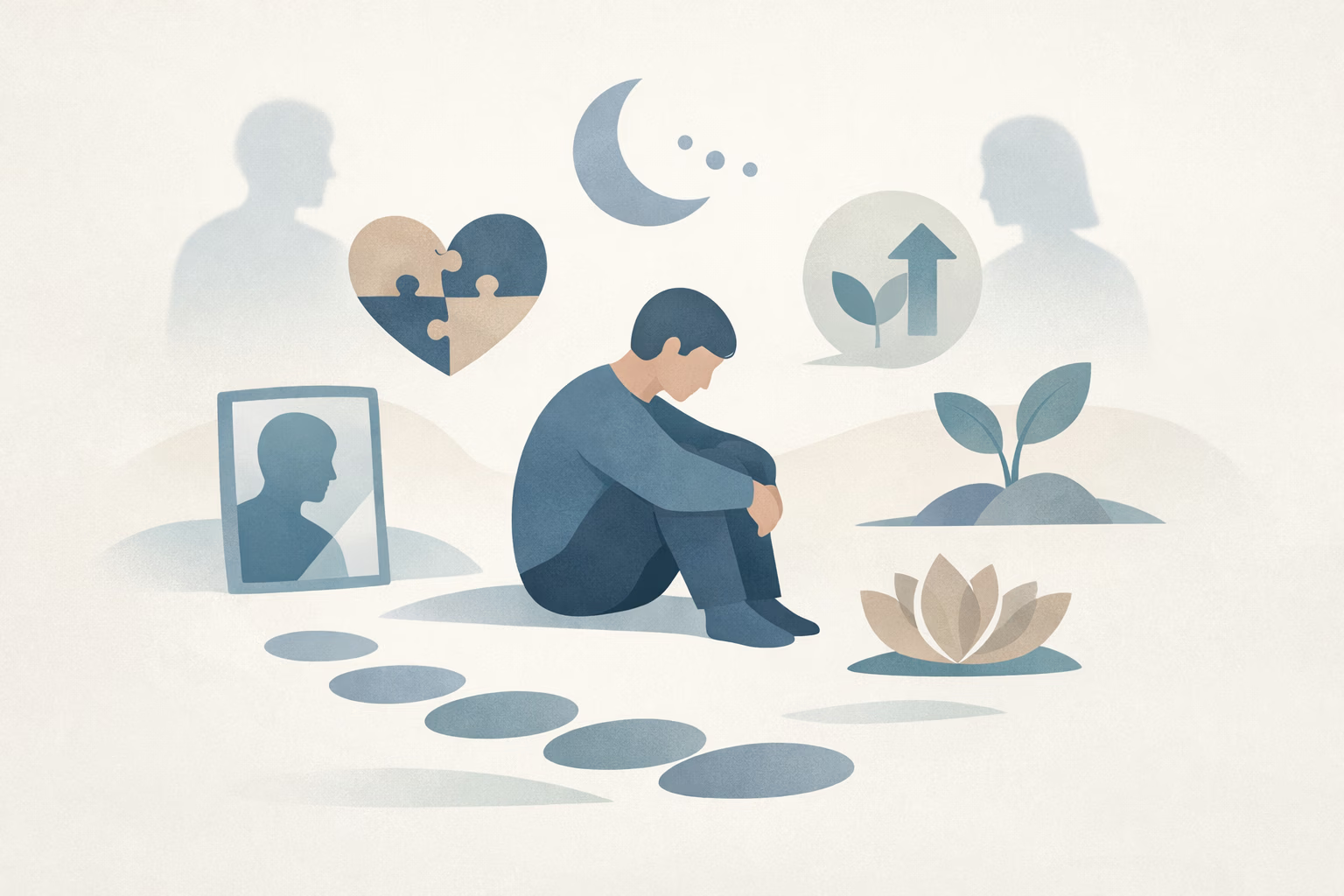
Reflection That Deepens Self-Understanding

In short: Reflection can sound like a luxury—something you do when the inbox is empty and your mind is calm. But for many people, the absence of reflection isn’t a character flaw; it’s what happens when life moves faster than the nervous system can complete experiences.
Reflection can sound like a luxury—something you do when the inbox is empty and your mind is calm. But for many people, the absence of reflection isn’t a character flaw; it’s what happens when life moves faster than the nervous system can complete experiences.
When days stack up without being digested, the mind doesn’t necessarily feel “busy.” It can feel oddly blank, jittery, or stuck in repetitive loops: the same conversations replaying, the same decisions repeating, the same sense that you’re living—yet not quite landing anywhere.
What if “not thinking about your life” is less about avoidance—and more about missing closure?
Autopilot is often a sign of high load. When demands keep arriving, attention naturally prioritizes what’s urgent and visible: tasks, messages, logistics, other people’s needs. Reflection—quietly reviewing what happened and what it meant—doesn’t compete well with immediacy.
Over time, this can create a specific kind of mental clutter: not lots of thoughts, but lots of unfinished mental threads. The nervous system stays slightly mobilized because nothing has fully concluded. Without a “done” signal, even good days can feel incomplete. [Ref-1]
From a brain-and-body perspective, reflection isn’t simply “thinking about feelings.” It’s a coordination process that helps experiences move from raw input into organized memory and usable meaning—so the system can stand down. Executive attention helps select what matters, the hippocampal memory system helps integrate episodes into context, and prefrontal networks help reduce reactivity by linking events to interpretation and choice. [Ref-2]
When that coordination happens, life feels less like a pile of moments and more like a storyline with chapters. Not because everything becomes clear, but because the mind can file what happened where it belongs. That filing is not mere insight; it’s the beginnings of closure—an internal sense that something has been sufficiently processed to stop demanding bandwidth.
Across cultures and time, people have used storytelling, reflection, and shared recounting to make experience coherent. This isn’t sentimental—it’s functional. A coherent narrative supports long-term planning, social learning, and identity continuity: “This happened, so I learned that; I became this kind of person; I belong with these people.” [Ref-3]
Without narrative coherence, the body may still be safe, but the system can feel unanchored. The mind becomes more reactive because it has fewer integrated reference points. In other words: when the storyline is missing, the nervous system leans harder on immediate signals—urgency, control, stimulation, or withdrawal—to manage the uncertainty.
When your life doesn’t feel like it’s forming a story, even small choices can feel heavier than they should.
Anxiety often rises when the system can’t predict what comes next, or when too many loops remain open. Reflection can temporarily organize inputs—clarifying what happened, what mattered, and what is still unresolved. That organization doesn’t magically remove uncertainty, but it can reduce noise.
This is one reason reflection is associated with steadier leadership and decision-making: not because reflective people are superior, but because their internal signals are less scrambled by unfinished meaning. [Ref-4]
What changes when your mind can say, “That part is complete enough for now”?
Many people “think all the time” and still feel unclear. Rumination is active, but it rarely produces closure. Likewise, journaling can be meaningful, but writing pages of content does not guarantee that experience has integrated into identity.
Deliberate reflection is different from mental spinning. It tends to include a review of events, an honest accounting of consequences, and a linking of actions to values—so the system can update its internal map. In workplace and wellbeing contexts, structured reflection is often described as a way to turn experience into learning rather than repetition. [Ref-5]
When reflection is missing, it’s tempting to assume the cause is emotional avoidance. Often, it’s structural: modern life offers powerful bypass routes that prevent experiences from completing.
Distraction provides immediate state change—scrolling, snacking, switching tabs, chasing new inputs. Busyness provides social legitimacy—proof that you are needed or productive. Over-optimization provides a sense of control—new systems, new trackers, new plans. None of these are moral failures; they are regulatory responses that reduce discomfort in the short term while quietly delaying closure. [Ref-6]
In a high-velocity environment, unfinished loops can feel safer than stillness. Not because stillness is “scary,” but because stillness allows previously muted signals to return—fatigue, regret, pride, grief, longing, relief. When capacity is low, the system may keep moving simply to keep those signals from becoming unmanageable.
When reflection is consistently bypassed, patterns start to appear. They can look like personality traits, but they’re often the nervous system doing its best under incomplete closure.
These patterns aren’t evidence of laziness or lack of depth. They’re evidence of unprocessed experience accumulating faster than it can be completed.
Identity coherence is not a slogan or a mindset. It’s the lived sense that your actions, values, and story belong to the same person. Reflection supports that by letting experiences become part of “who I am” rather than floating fragments.
When reflection is absent, learning can remain episodic: you know what happened, but it doesn’t reliably change what you do next. Under stress, this makes people more susceptible to drift—toward whatever is loudest, fastest, or most socially rewarded. The environment becomes the author, and the self becomes a responder. [Ref-8]
Stress doesn’t just make life harder. It can make life less yours.
Fragmentation is not only about attention; it’s also about memory. When experiences aren’t revisited and consolidated, they can remain “hot”—easy to trigger, hard to place in context. That raises baseline reactivity, which makes it even harder to pause, which further reduces the chance of reflection.
Over time, this becomes a meaning deficit: not the dramatic sense that life is pointless, but the quieter sense that nothing is finishing. You’re always midstream. Reflective practice literature often describes reflection as a mechanism for transforming experience into knowledge—turning what happened into something that can guide the next moment rather than haunt it. [Ref-9]
When nothing feels complete, how could the nervous system ever fully rest?
Many approaches describe structured reflection sessions, journaling formats, or guided prompts. Those tools can be helpful, but their deeper function is easier to miss: they create conditions where experience can move toward completion. [Ref-10]
In that sense, reflection isn’t a performance of self-knowledge. It’s a container where events can be sequenced, consequences can be acknowledged, and values can be named—so the internal system can update its map. The point is not to extract perfect answers; it’s to restore coherence: “This happened. It mattered in these ways. It changed me here. This is what I’m carrying forward, and this is what can stand down.”
Notice the difference: insight can be instantaneous, but coherence tends to arrive as a settling—less internal argument, fewer repeated replays, more stable signals about what fits and what doesn’t.
Humans don’t integrate meaning only in private. Conversation can support reflection because another nervous system provides pacing, reality-checking, and social completion. In practical terms, a reflective partner—mentor, peer, therapist, coach, or trusted friend—can help experiences become speakable, sequenced, and less tangled.
This isn’t about being “held accountable” through pressure. It’s about having a shared space where your story can become organized enough to feel real. Educational and executive-function perspectives often emphasize that reflection improves when it is scaffolded—made more structured through dialogue and feedback. [Ref-11]
Sometimes the missing ingredient isn’t motivation. It’s a witness.
As reflection becomes part of life—not as a habit to maintain, but as a regular route to closure—several shifts often follow. They’re subtle, but they change everything.
Importantly, this isn’t a constant calm. It’s increased capacity for signal return: the ability to notice what matters without being overwhelmed by it, and to let experiences conclude rather than keep escalating. Some writing-based reflection practices are discussed as supporting executive functioning and regulation—not through willpower, but through organization and consolidation. [Ref-12]
When meaning is coherent, goals don’t have to be forced. They feel like continuations of identity: the next step in a story you recognize as yours. Reflection supports this by linking past experience to future direction—so action becomes less reactive and more aligned. [Ref-13]
This is not about “finding your purpose” as a single discovery. It’s about repeatedly reconnecting actions to values until your life produces its own guidance. In that state, agency increases—not because life is easier, but because your choices have an internal backbone.
What changes when your direction comes from lived coherence rather than external pressure?
Neglecting reflection often signals that your system has been running at capacity for a long time. The absence of deep thinking isn’t proof you don’t care about your life; it can be proof that your life has required constant response.
From that lens, reflection is less a self-improvement task and more a way the nervous system completes loops: connecting events to values, consequences to learning, and days to identity. Many self-awareness frameworks emphasize that reflection strengthens orientation when it is given real space and structure—because meaning requires room to form. [Ref-14]
Agency doesn’t arrive by pushing harder. It often returns when your experience is allowed to become whole enough to guide you.
Reflection matters because humans aren’t designed to endlessly accumulate experience without integration. We stabilize when life is allowed to settle into memory, identity, and relationship—when the nervous system can register, “I understand enough to move forward.”
That kind of coherence is not a mood and not a mindset. It’s a real shift in internal organization—less fragmentation, more continuity, more dependable signals about what fits. Research on self-reflection and self-awareness often links these processes to better psychological outcomes, not as perfection, but as steadier functioning over time. [Ref-15]
In a world that keeps speeding up, the simple act of letting your life make sense again is a form of dignity.
From theory to practice — meaning forms when insight meets action.
The absence of reflection isn't a character flaw; it's what happens when life moves faster than the nervous system can complete experiences. When demands keep arriving, attention prioritizes what's urgent and visible — tasks, messages, logistics, other people's needs. Reflection doesn't compete well with immediacy. Over time, this creates not lots of thoughts but lots of unfinished mental threads. The system stays slightly mobilized because nothing has fully concluded. Events happen but don't consolidate into learning; decisions are made but don't settle into confidence. Without a Done Signal, even good days can feel incomplete.
No — they're structurally different. Many people think all the time and still feel unclear. Rumination is active but rarely produces closure. Likewise, journaling can be meaningful, but writing pages doesn't guarantee integration into identity. Deliberate reflection includes a review of events, an honest accounting of consequences, and a linking of actions to values — so the system can update its internal map. Passive thinking is more motion, little settling. Surface journaling is documentation without completion. Deliberate reflection is when experiences become organized enough to stop escalating. Insight can be instantaneous; coherence arrives as settling — fewer replays, more stable signals about what fits.
Modern life offers powerful bypass routes that prevent experiences from completing. Distraction provides immediate state change. Busyness provides social legitimacy. Over-optimization provides a sense of control through new systems and trackers. None are moral failures; they're regulatory responses that reduce discomfort short-term while delaying closure. In a high-velocity environment, unfinished loops can feel safer than stillness — not because stillness is scary, but because stillness allows previously muted signals to return: fatigue, regret, pride, grief, longing. When capacity is low, the system keeps moving simply to keep those signals from becoming unmanageable. That's an Avoidance Loop dressed as productivity.
Reflection's deeper function isn't extracting answers — it's creating conditions where experience can move toward completion. It's a container where events get sequenced, consequences acknowledged, and values named, so the system updates its map: 'this happened, it mattered here, this is what I'm carrying forward, this is what can stand down.' Reflective conversation amplifies this because another nervous system provides pacing and reality-checking. Sometimes the missing ingredient isn't motivation; it's a witness. When reflection becomes integrated, priorities are easier to feel rather than just list, decisions carry less aftertaste, and signals become more consistent across contexts. Coherence is the quiet reward of a life that gets to finish its sentences.

From Science to Art.
Understanding explains what is happening. Art allows you to feel it—without fixing, judging, or naming. Pause here. Let the images work quietly. Sometimes meaning settles before words do.
One Quiet Window, one insight, one reflection — every Sunday