Why Meaning Must Be the Core of Any Wellness Platform
In short: The Missing Link in Modern Mental Health Many people are doing “all the right things” for wellness—tracking sleep, meditating, cutting back on sugar, exercising, journaling—and still feel strangely unfilled. Not dramatically unwell.
Many people are doing “all the right things” for wellness—tracking sleep, meditating, cutting back on sugar, exercising, journaling—and still feel strangely unfilled. Not dramatically unwell. Just not settled. Like life is managed, but not integrated.
If you can get relief, why doesn’t it last?
A meaning-based view doesn’t blame motivation or mindset. It looks at how humans regulate: we stabilize when experiences reach closure and actions connect to values and identity. Without that completion, the system stays slightly on—seeking, scanning, optimizing—because it never receives a true “done” signal.
It’s common to build a careful routine and still feel a low-grade pressure underneath it. The routine may reduce discomfort, but it can also start to feel like continuous maintenance: keeping stress from spilling over, keeping symptoms at bay, keeping up with the plan.
In that state, wellness can turn into a set of state-changes—calming down, pepping up, distracting, resetting—without a deeper settling. The nervous system learns, “We can feel better for a moment,” but it doesn’t learn, “This part of life is complete.”
This isn’t a personal shortcoming; it’s a mismatch between what the tools can provide (temporary relief) and what the organism is actually asking for (closure and coherence). [Ref-1]
Humans don’t only regulate through comfort; we also regulate through orientation. When an action clearly belongs to a value (“this matters to me”) and fits into identity (“this is who I am becoming”), the brain can coordinate effort without the same internal friction.
Meaning-linked behavior tends to recruit planning, inhibition, and long-range context—functions often associated with prefrontal networks working in partnership with emotion and threat circuitry. The result isn’t constant calm; it’s steadier capacity. Signals can rise and return without needing as much emergency management.
In research, meaning in life is repeatedly associated with psychological well-being and protective effects across mental and physical health contexts. [Ref-2]
One reason modern distress feels so personal is that it lands in the “story-making” part of us. Humans organize experience into narrative: what happened, what it meant, what it asks of us, and where we go from here. This isn’t just philosophy—it’s a biological orientation system.
When experiences don’t integrate into a coherent narrative—when there’s no ending, no lesson that settles, no role that feels earned—the body often stays mobilized. Not because someone is “avoiding feelings,” but because the loop didn’t complete: consequences stayed muted, decisions stayed partial, and identity didn’t get to update.
Large bodies of work link meaning with functioning and resilience, suggesting that narrative coherence is not optional decoration—it’s part of how humans stay regulated under load. [Ref-3]
Symptom-focused wellness often works exactly as designed: it reduces discomfort. Breathing practices, sleep hygiene, supplements, workouts, soothing content—many of these can downshift arousal, lower stress load, and improve day-to-day functioning.
But relief is not the same as completion. Relief can quiet the alarm without resolving what the alarm is organizing around. When the underlying loop remains open—an unresolved decision, a value conflict, a life direction that doesn’t feel owned—the system may resume scanning soon after the soothing ends.
Meaning is widely described as a protective factor in mental health, not because it “cheers people up,” but because it supports endurance, coherence, and recovery capacity when stressors continue. [Ref-4]
Superficial wellness isn’t “fake”; it’s simply operating on a different level. It often targets symptoms and states—tension, fatigue, restlessness, low mood—through tools that shift physiology in the short term.
Meaning-based wellness operates more like an internal alignment process. When daily life reflects values and identity, the nervous system gets clearer safety cues: “My effort fits,” “I know what I’m doing this for,” “This chapter has a shape.” That coherence supports resilience because it reduces internal contradiction and constant self-monitoring.
Research on meaningful living and complete mental health highlights that meaning contributes to well-being in a way that is not fully explained by symptom reduction alone. [Ref-5]
In a high-pressure environment, it makes sense that people lean on quick relief. The nervous system learns that certain inputs reliably change state: a routine, a product, a scroll, a treat, a podcast, a reset ritual. These can be genuinely helpful.
The structural risk is that relief becomes the primary completion signal. Instead of closing loops through lived decisions and identity-level coherence, the body closes discomfort by swapping states. Over time, this can train a pattern: activation → relief → activation, without the deeper “stand down” that comes from completion.
Meaning-oriented interventions—even relatively simple ones—have been associated with increased well-being, suggesting that the system responds differently when the organizing principle is meaning rather than momentary soothing. [Ref-6]
When meaning is thin, regulation often becomes tool-dependent. That doesn’t mean the person is weak; it means the environment is demanding and the system is seeking reliable off-ramps.
Common patterns can include:
These are regulatory responses to incomplete closure—where the system doesn’t receive a stable signal that life direction and identity are cohering. Studies connecting meaning in life with psychological well-being support the idea that meaning is not a luxury variable; it changes stability. [Ref-7]
When wellness is built mostly around symptom management, people can become impressively functional while quietly losing orientation. The cost often shows up as burnout—not only from external workload, but from internal friction: constant self-correction, constant evaluation, constant pressure to maintain a state.
Without meaning, resilience can become brittle. You can be “fine” until a stressor hits, and then there’s less buffer—less reason, less narrative, less inner continuity to absorb the impact. Over time, this can look like diminished motivation, reduced patience, and a sense that life is happening nearby rather than being lived.
Associations between meaning in life and psychological well-being suggest that when meaning is lower, vulnerability to depressive symptom patterns and reduced well-being increases. [Ref-8]
When distress rises, the most immediate question becomes, “How do I get this down?” That’s understandable. But if the whole system organizes around symptom reduction, value-driven action can be postponed indefinitely—not due to fear, but due to structure: urgency crowds out identity.
In that structure, even helpful tools can become a way to delay closure. The person stays busy regulating, but the unresolved parts of life—decisions, boundaries, belonging, contribution, direction—remain un-integrated. The loop stays open, so the nervous system keeps generating signals that call for attention.
Meaning in life is often framed as central to well-being and recovery, in part because it helps people locate themselves in a larger context that can carry discomfort without constant avoidance-by-relief. [Ref-9]
Meaning-based wellness isn’t a motivational speech. It’s a different organizing center. Instead of asking the body to calm down first and live later, it recognizes that coherence itself can reduce background load.
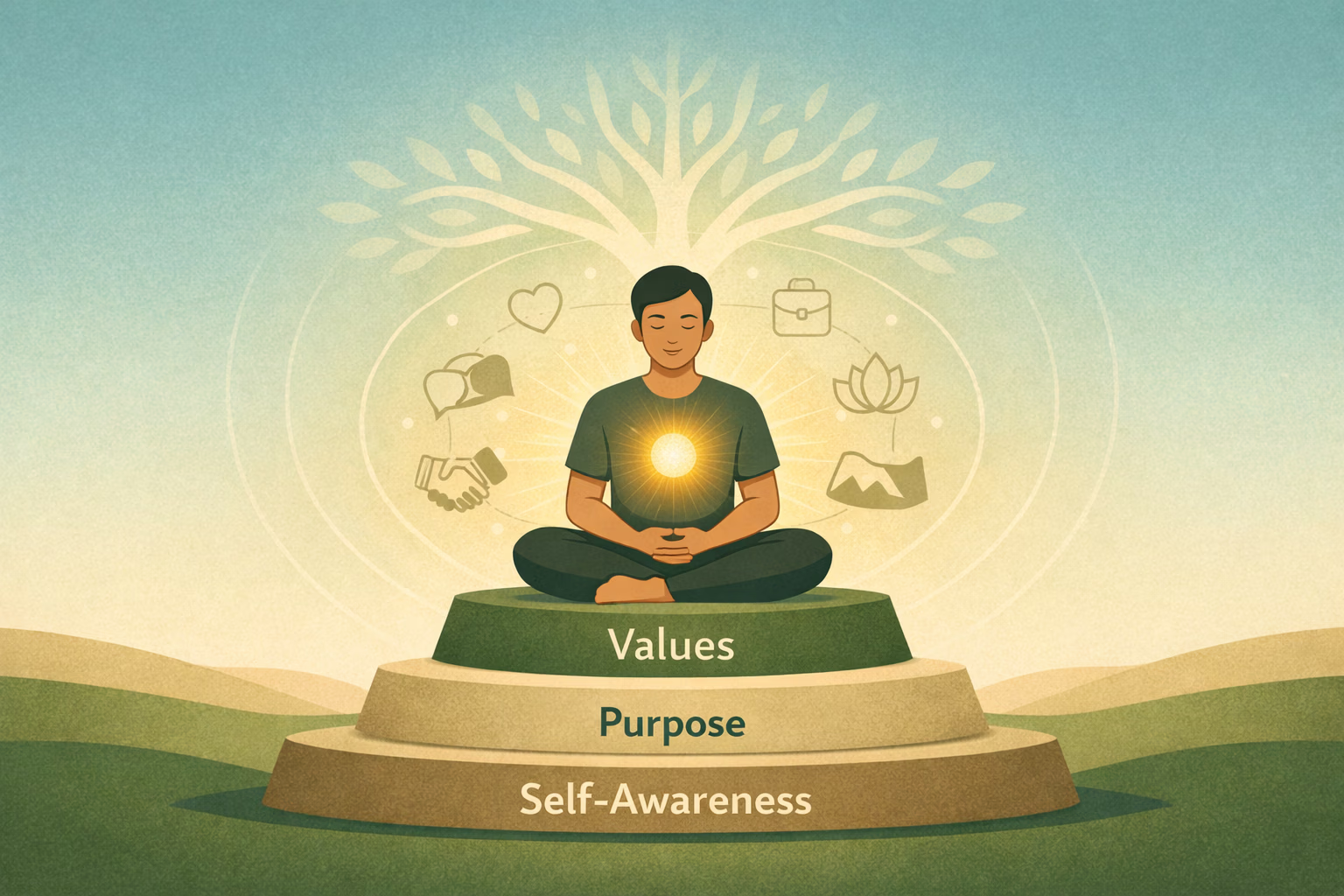
In this frame, words like “values,” “purpose,” and “identity” aren’t abstract ideals; they are orientation signals. When they become embodied through completed choices and lived roles, the nervous system receives clearer closure cues: what matters is not endlessly negotiable, and effort has a place to land.
Relief can be a pause. Coherence is what tells the system the chapter is actually closing.
Research reviews link meaning in life with health and well-being outcomes, supporting the idea that meaning is not merely a comforting idea—it correlates with durable functioning. [Ref-10]
Meaning rarely stabilizes in isolation. Humans are social nervous systems: we calibrate what matters through shared language, shared rituals, and being witnessed in roles that feel real. A community doesn’t “fix” anyone; it provides structure where identity can become believable and consistent over time.
Peers, mentors, and meaning-oriented groups can reduce fragmentation by offering continuity: repeated contact, shared standards, and a place where contribution is recognized. That recognition is not about praise; it’s about closure—evidence that effort had consequence and belongs somewhere.
Integrative perspectives that bring together meaning and acceptance highlight how belonging and existential orientation can support well-being without turning life into a performance. [Ref-11]
When meaning becomes central, many people don’t report being “happy all the time.” More often, they describe a quieter form of stability: less internal arguing, fewer emergency resets, and more consistent follow-through without constant self-threat.
Restored coherence often shows up as increased capacity for signal return. Stress can rise, but it resolves more cleanly because the system isn’t also carrying the extra load of identity conflict and unfinished loops.
Meaning-centered approaches in existential positive psychology emphasize enduring well-being that includes reality, responsibility, and direction—not constant positivity. [Ref-12]
Once meaning is treated as a core ingredient of wellness, daily choices can begin to organize around a steadier axis. Not because every day feels inspired, but because life starts to have a recognizable shape: priorities that repeat, relationships that reflect values, and commitments that gradually become identity.
This is where agency returns in a specific way. Agency isn’t just “trying harder”; it’s experiencing that choices actually connect—today to tomorrow, behavior to values, effort to self-respect. As those connections accumulate, the nervous system receives more closure signals and fewer chronic alerts.
Meaning-oriented frameworks emphasize living intentionally in the presence of difficulty, using values and purpose as orientation rather than as pressure. [Ref-13]
When your routines help but don’t hold, it can be a signal—not that you’re broken, but that your system is underloaded in one place and overloaded in another. You may have plenty of techniques for changing state, and not enough structure for completing loops that update identity.
In a meaning-based frame, the “gap” is dignified information: a sign that your nervous system is seeking coherence, closure, and a life that feels internally consistent. The question shifts from “What’s wrong with me?” to “What part of my life is waiting to become real and complete?”
Existential approaches often treat meaning as something built through lived responsibility and chosen direction, not something you think your way into. [Ref-14]
Temporary relief has its place. But lasting stability tends to arrive when life stops feeling like a set of disconnected coping tactics and starts feeling like a coherent story you can inhabit—where values, choices, and identity match often enough for the body to trust the direction.
Meaning-based wellness doesn’t demand constant intensity. It supports a quieter kind of regulation: the stand-down that happens when experiences complete, roles become believable, and the self no longer has to be held together through effort alone. [Ref-15]
From theory to practice — meaning forms when insight meets action.
Most wellness tools are designed to change state, not finish loops. Sleep tracking, meditation, exercise, journaling — these can downshift arousal and provide temporary relief, but relief isn't completion. If the underlying issue is an unresolved decision, a value conflict, or a life direction that doesn't feel owned, the system resumes scanning soon after the soothing ends. Your nervous system is asking for something the routine can't provide: closure and coherence. That's not a willpower failure. It's a structural mismatch between what symptom-management offers (state changes) and what a meaning system needs (a Done Signal that says this part of life is actually complete).
Symptom-focused wellness operates on physiology — calming tension, lifting mood, restoring sleep. It works exactly as designed, but it targets state. Meaning-based wellness operates on alignment: when daily life reflects values and identity, the nervous system gets clearer safety cues like 'my effort fits' and 'this chapter has a shape.' That coherence reduces internal contradiction, which lowers background load. It's not that one is fake and the other is real — they operate on different mechanisms. Relief changes how you feel right now; coherence changes whether your system has to keep working so hard to hold itself together at all.
Not a red flag — more like dignified information. Feeling oddly flat after something 'healthy' often means the action didn't land as identity-level evidence. It got logged as a task, not integrated as 'this is who I'm becoming.' That's common when wellness becomes a Pleasure Loop of state-swapping: activation, relief, activation, with no deeper stand-down. The flatness is your system noticing that the loop didn't actually close. It doesn't mean the practice is wrong. It means the question may have shifted from 'how do I do this better?' to 'what part of my life is waiting to become real and complete?'
Community provides something solo work usually can't: continuity. Humans are social nervous systems — we calibrate what matters through shared language, shared rituals, and being witnessed in roles that feel real over time. A peer group or mentor doesn't fix anyone; it offers structure where identity can become believable through repetition. The recognition that matters isn't praise. It's closure: evidence that effort had consequence and belongs somewhere. That's why meaning rarely stabilizes in isolation, and why even simple meaning-oriented groups tend to reduce fragmentation more reliably than another solo protocol.
From Science to Art.
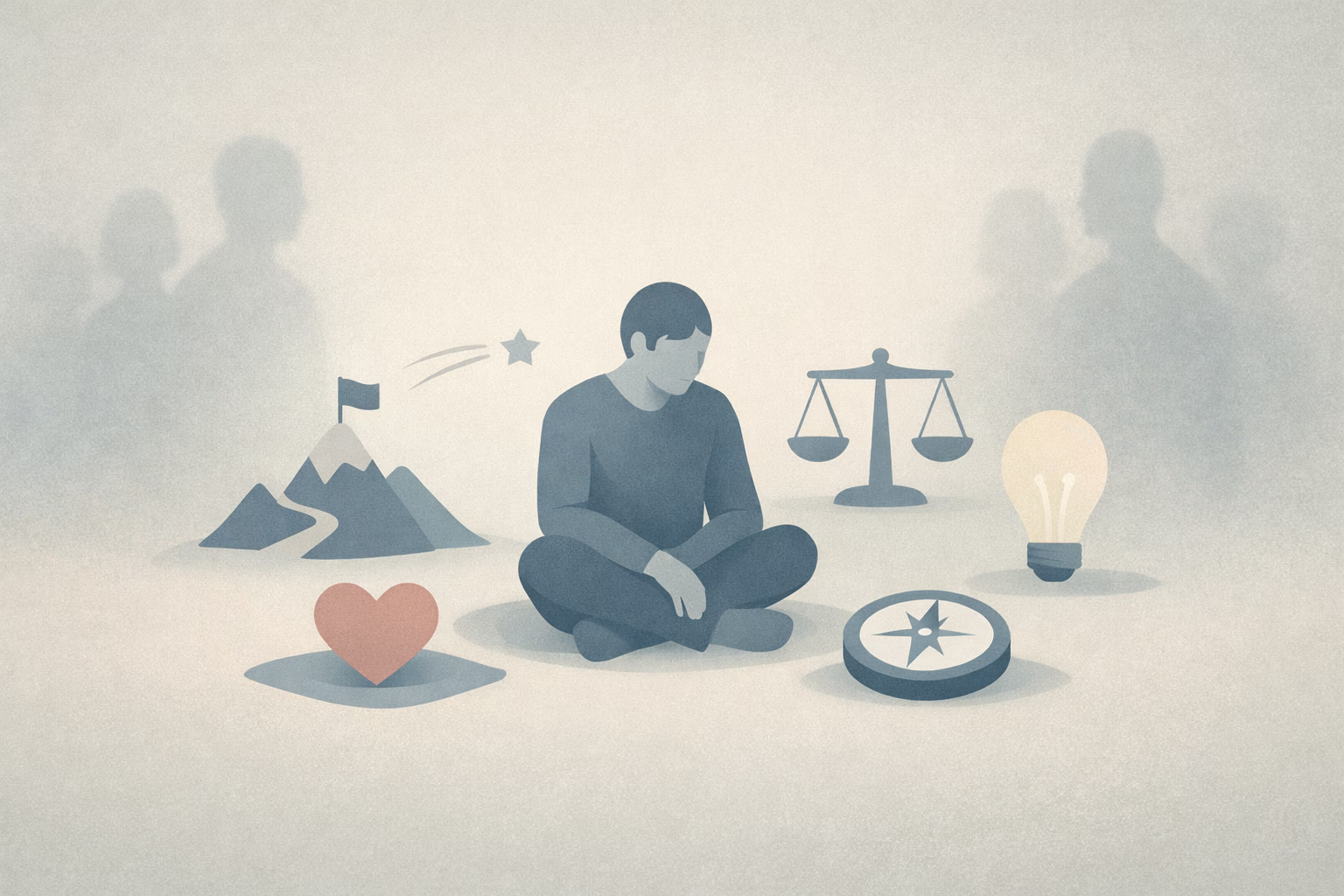
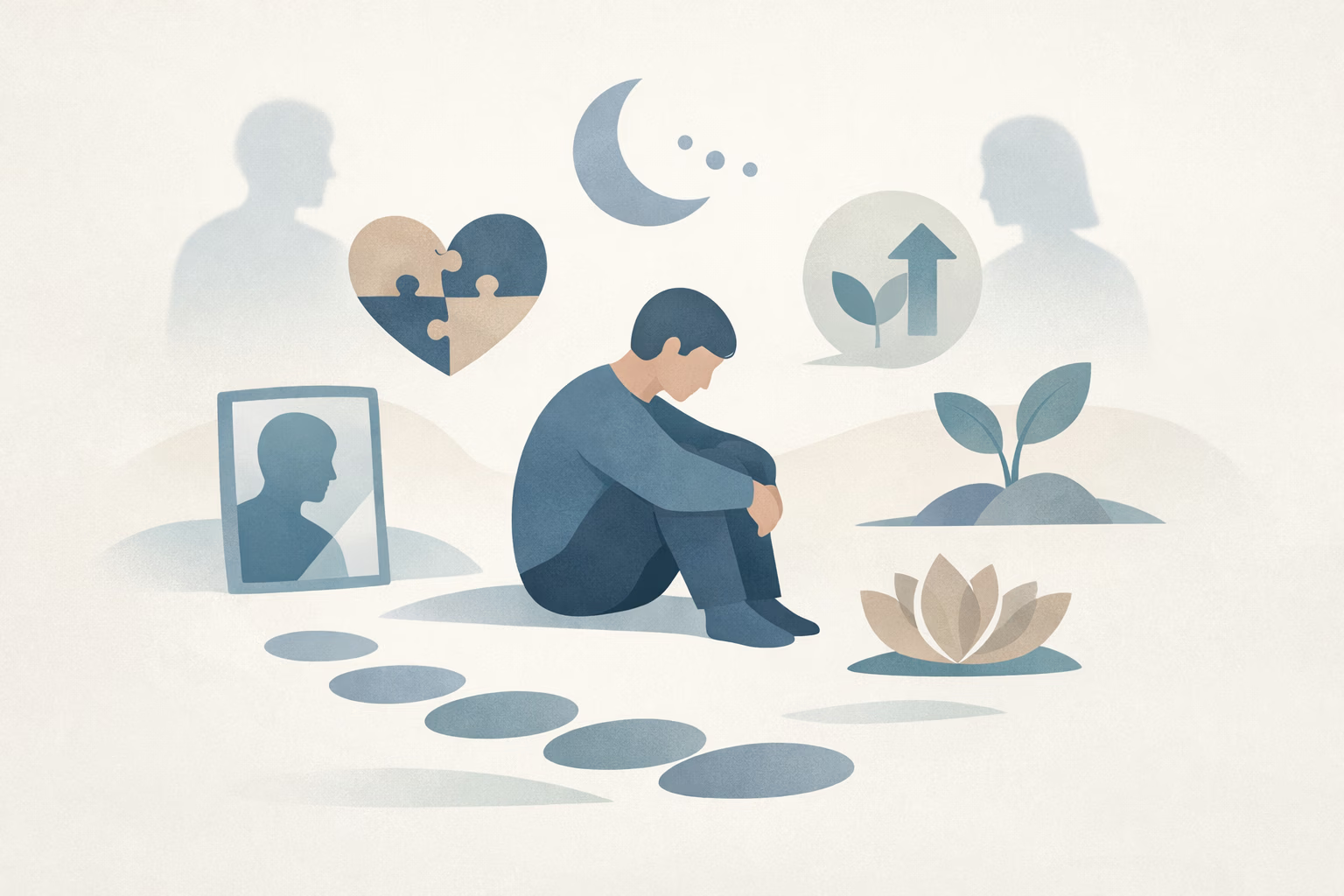
Understanding explains what is happening. Art allows you to feel it—without fixing, judging, or naming. Pause here. Let the images work quietly. Sometimes meaning settles before words do.
One Quiet Window, one insight, one reflection — every Sunday