

Reflection Practices: The Lost Art of Thinking About Your Life

In short: Many people are living with a familiar kind of confusion: you can explain what you did, but not why it felt inevitable. You can describe your week, yet still feel uncertain about what matters, what you need, or what your reactions are trying to accomplish.
Many people are living with a familiar kind of confusion: you can explain what you did, but not why it felt inevitable. You can describe your week, yet still feel uncertain about what matters, what you need, or what your reactions are trying to accomplish.
In a Meaning Density frame, this isn’t a personal defect. It’s what happens when a nervous system carries too many open loops—unfinished conversations, incomplete recoveries, partial decisions—while life keeps moving. Reflection, at its best, isn’t “thinking harder.” It’s a deliberate pause that helps experiences complete enough to become usable orientation.
What if your mind isn’t broken—just lacking the conditions for closure?
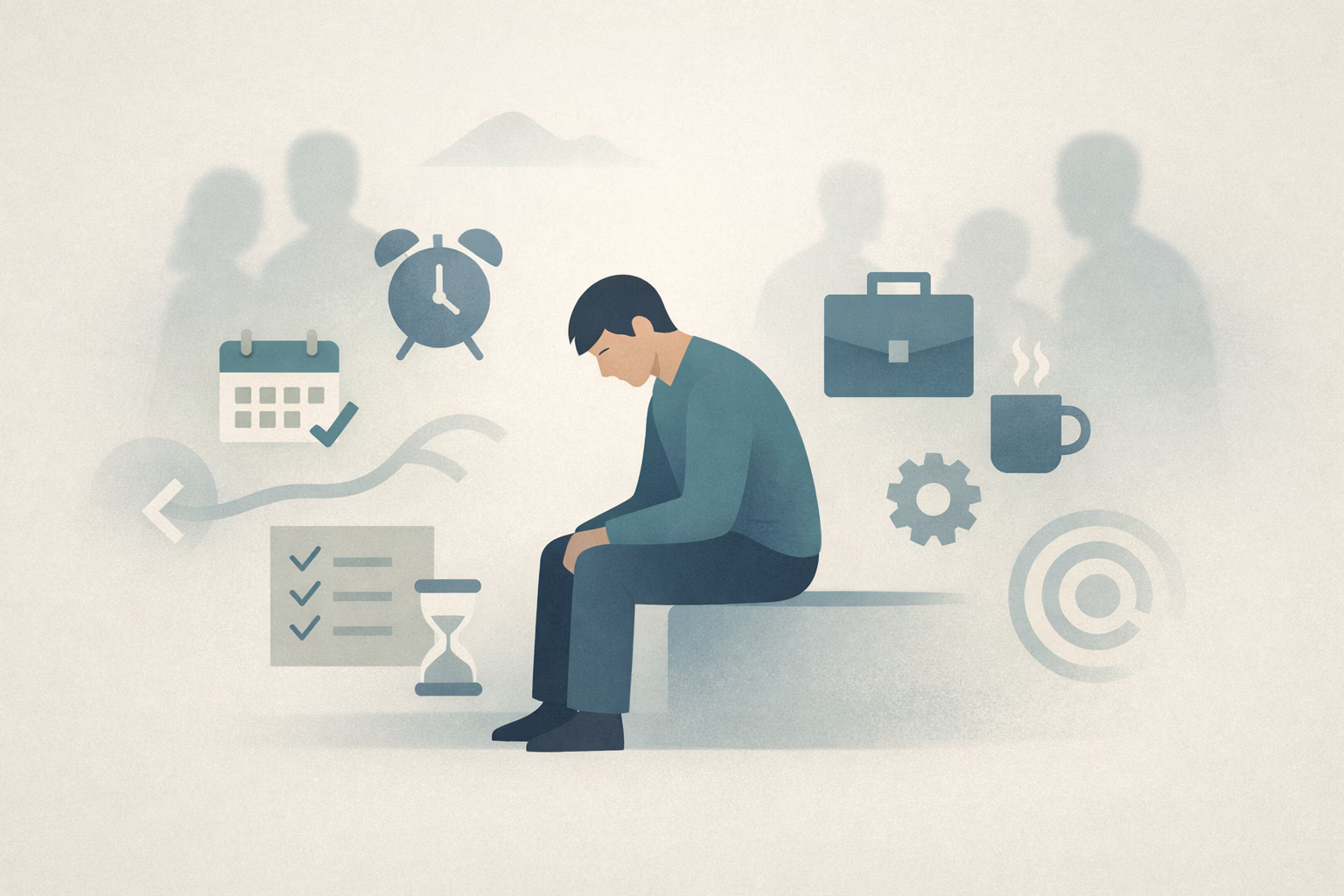
There’s a specific kind of disorientation that shows up when your days are full of action, but your inner map stays blurry. You might make choices quickly, respond to other people’s needs, keep up with tasks—and still feel oddly unanchored afterward.
This can look like “I don’t know what I want,” but the deeper structure is often: the system is updating faster than it’s integrating. Without enough space for completion, motives and values don’t consolidate into a stable sense of self. So behavior can become reactive, even when it’s competent. [Ref-1]
In that state, people often describe:
Reflection is sometimes framed as a purely mental skill, but it also has a regulatory function. When pace slows even briefly, the executive system has a chance to coordinate multiple streams of information—context, memory, body cues, social consequence—rather than defaulting to the loudest or fastest signal.
This matters because many modern reactions aren’t “wrong.” They’re efficient. They prioritize speed, safety, and quick resolution. A reflective pause doesn’t force feelings to appear; it simply allows more signals to return online when load is lower, so decisions can be based on a wider internal dataset. [Ref-2]
Sometimes clarity isn’t something you discover. It’s something that becomes possible when the system is no longer rushing.
Humans don’t just experience events—we weave them into a story about who we are, what’s happening, and what to do next. This narrative capacity is part of how identity forms and how meaning stabilizes across changing circumstances.
But narrative isn’t just “insight.” It becomes stabilizing when experiences are digested enough to take their place in the story without constantly re-triggering the system. When that happens, the past stops demanding repeated attention, and the present becomes easier to inhabit. This is one reason meaning and well-being often move together: coherence reduces internal friction. [Ref-3]
When life is complex, the nervous system can hold competing action tendencies at once: reach out and withdraw, work harder and stop, speak up and stay quiet. This isn’t indecision as a flaw—it’s simultaneous partial signals with no clear “done” marker.
Reflection can temporarily reduce that conflict by organizing experience into a more coherent sequence: what happened, what it cost, what it protected, what mattered. The goal is not perfect explanation. The stabilizing effect comes when the system senses enough organization to stand down from constant scanning. [Ref-4]
What changes when your experience has a beginning, middle, and end?
Not all “thinking about yourself” is reflective. Rumination often has speed and repetition: the mind circles the same node, trying to generate certainty through volume. It can feel like work, but the loop doesn’t complete; it tightens.
Reflection is different in texture. It slows cognition, increases context, and makes room for complexity without escalating threat. It tends to produce a clearer sense of sequence and meaning rather than more alarm. In research terms, metacognitive reflection is associated with better integration of information and more adaptive self-regulation than repetitive negative thinking. [Ref-5]
In high-pressure environments, many people don’t “avoid” reflection because they’re afraid of it. They skip it because constant action reliably produces short-term resolution signals: completion dopamine, social approval, distraction, or simple relief from stillness.
Over time, action can become a structural replacement for integration. The system learns: keep moving and you won’t have to feel the friction of incomplete loops. But the cost is that experiences don’t consolidate; they remain active in the background, resurfacing as tension, irritability, or mental noise. [Ref-6]
This is how a person can be highly functional and still feel internally uncollected.
When reflection is crowded out, the signs are often practical rather than dramatic. The mind may still generate lots of thoughts, but they don’t form orientation. Words feel available, yet meaning feels out of reach.
Some common patterns include:
These aren’t character issues. They’re what it looks like when the system hasn’t had enough time, safety cues, or closure to integrate competing signals into a unified direction. [Ref-7]
Identity isn’t a slogan you choose. It’s a lived accumulation of completed experiences: what you survived, what you repaired, what you stood for, what you declined, what you returned to. When experiences don’t complete, identity can start to feel thin—more like a set of roles than an internal base.
Without reflection, the story of “me” can become overly dependent on external metrics: performance, responsiveness, likeability, productivity, being needed. That can work for a while, but it often reduces flexibility. The nervous system then relies on control, urgency, or withdrawal to manage load—because those are available even when meaning is not. [Ref-8]
A coherent identity isn’t constant confidence. It’s a reliable sense of where you stand when the day gets loud.
When a pattern repeats—overcontrol, checking, scrolling, appeasing, disappearing—it’s easy to label it as “bad habit.” Structurally, repetition often means the behavior is still completing a short-term regulatory job: reducing uncertainty, creating a boundary, numbing overload, restoring predictability.
Without reflection, the system may never update the cost-benefit ledger. The immediate relief registers clearly; the longer-term consequence stays muted. So the loop persists, even when the person is intelligent and sincere.
Over time, this can create a specific kind of distance from self: “Why do I keep doing this?” That question is often a sign not of brokenness, but of missing integration—experience hasn’t settled into a coherent, identity-level “this is what happens when…” understanding. [Ref-9]
It helps to reframe reflection away from self-optimization and toward meaning. Meaning, in this context, isn’t a belief you force. It’s what emerges when experiences are connected to values and given enough closure to become part of who you are.
When reflection is paced and grounded, attention becomes less scattered because it has a place to return. Emotions don’t need to be amplified or mined; they simply don’t have to keep interrupting once their message has been registered within a coherent story of what matters. This is one reason meaning-making is repeatedly associated with well-being: it reduces internal contradiction and supports steadier regulation. [Ref-10]
What if the point isn’t to analyze yourself—only to let your experience become coherent?
Self-understanding doesn’t form in isolation. Humans are regulated by social signals: being seen accurately, feeling received, having our inner experience mirrored without being hijacked. When that happens, the nervous system often relaxes its defensive predictions.
Shared reflection—conversation that makes space for context—can reduce misattunement. It helps update the story not only of “what happened,” but of “what it meant between us,” which is often where the loop stays open. This is also why a bit of distance in perspective (“seeing from the balcony”) can support meaning-making without spiraling. [Ref-11]
People often expect self-understanding to feel like a dramatic breakthrough. More commonly, it feels like reduced internal drag. Less mental replay. Fewer competing impulses firing at once. A steadier ability to choose without negotiating with five different internal committees.
Clarity tends to show up as:
Expressive forms of reflection, including structured writing, have been associated with benefits to well-being, especially when they support organized meaning rather than repetitive distress. [Ref-12]
Agency often gets framed as willpower. In real life, agency is easier when identity coherence is intact—when you know what you’re protecting, what you’re building, and what you’re no longer available for.
As self-understanding consolidates, decisions can start to feel less like constant tradeoffs and more like expressions of a stable center. Not because the world becomes simple, but because your internal signals have a clearer hierarchy: values at the top, urgency lower down.
This is how reflection supports meaningful direction: it turns lived experience into orientation, so choices don’t have to be re-decided from scratch every time. Some people find that narrative practices like journaling support this sense of continuity and direction when done in a way that creates closure rather than churn. [Ref-13]
In a fragmented culture, it’s common to carry yourself like an ongoing draft—never finished, never caught up, always behind your own life. Reflection, at its most dignified, is a way experiences become “done enough” to stop demanding constant processing power.
When meaning forms, it’s not just an idea. It’s a physiological easing: less scanning, fewer replay loops, more capacity for signal return. The story of you becomes less performative and more inhabited.
And from that place, agency isn’t something you force. It’s something that becomes available because your life feels more coherent from the inside. [Ref-14]
Deepening self-understanding doesn’t mean you become perfectly consistent or endlessly insightful. It means your experience has a better chance of completing—so it can join your identity instead of chasing you as unfinished noise.
When that ground is present, direction doesn’t need to be dramatic. It can be quiet, steady, and real: a life that makes sense to the nervous system you live inside. [Ref-15]
From theory to practice — meaning forms when insight meets action.
Texture and direction. Rumination has speed and repetition — the mind circles the same node trying to generate certainty through volume. It feels like work, but the loop tightens rather than completes. Reflection slows cognition, increases context, and makes room for complexity without escalating threat. The article frames reflection as contextual, paced, and organizing while rumination is repetitive, urgent, and narrowing. Reflection produces a clearer sense of sequence and meaning rather than more alarm. The point isn't to analyze yourself but to let experience become coherent enough to stand down from constant scanning — clarity arrives when the system isn't rushing.
Because the system is updating faster than it's integrating. The article frames this not as 'I don't know what I want' but as a structural mismatch: without enough space for completion, motives and values don't consolidate into a stable sense of self, so behavior becomes reactive even when it's competent. People describe doing the right thing but not feeling aligned, repeating the same arguments with different people, being surprised by their own intensity. In high-pressure environments, action becomes a structural replacement for integration — keep moving and you don't have to feel the friction of incomplete loops, but experiences resurface as tension and mental noise.
Because structurally they're still doing a regulatory job. Overcontrol, checking, scrolling, appeasing, disappearing — these aren't 'bad habits' so much as behaviors completing short-term tasks: reducing uncertainty, creating a boundary, numbing overload, restoring predictability. The immediate relief registers clearly while the longer-term cost stays muted, so the cost-benefit ledger never updates. The article frames the repeating 'why do I keep doing this?' question not as brokenness but as missing integration — experience hasn't settled into an identity-level 'this is what happens when…' understanding. Reflection provides the space where that ledger can finally rebalance.
Less like a dramatic breakthrough and more like reduced internal drag. Less mental replay, fewer competing impulses firing at once, a steadier ability to choose without negotiating with five internal committees. The article frames this as a physiological easing: less scanning, fewer replay loops, more capacity for signal return. People describe more accurate self-description without harshness, better recall of what matters under stress, less urgency to resolve uncertainty immediately, a quieter baseline even when life remains full. Identity stops being an ongoing draft. Decisions become less like constant tradeoffs and more like expressions of a stable center — values at the top of the hierarchy, urgency lower down.
From Science to Art.
Understanding explains what is happening. Art allows you to feel it—without fixing, judging, or naming. Pause here. Let the images work quietly. Sometimes meaning settles before words do.
One Quiet Window, one insight, one reflection — every Sunday