
Cognitive Unhooking: Detaching From Thoughts That Trap You

In short: Most people don’t get stuck because they “don’t know better.” They get stuck because the mind is doing what minds evolved to do: run fast, familiar sequences that keep things moving when life is complex. In a high-load environment, those sequences can become so automatic that you only notice them after they’ve already shaped your day.
Most people don’t get stuck because they “don’t know better.” They get stuck because the mind is doing what minds evolved to do: run fast, familiar sequences that keep things moving when life is complex. In a high-load environment, those sequences can become so automatic that you only notice them after they’ve already shaped your day.
What changes when you can see the pattern while it’s happening?
Pattern awareness isn’t about fixing your thoughts, judging them, or replacing them with “better ones.” It’s the capacity to notice recurring inner events—thoughts, bodily urgency, interpretations, default choices—without immediately merging with them. That small shift in viewpoint can restore perspective, reduce self-blame, and create room for completion: the “done” signals that let a nervous system stand down.
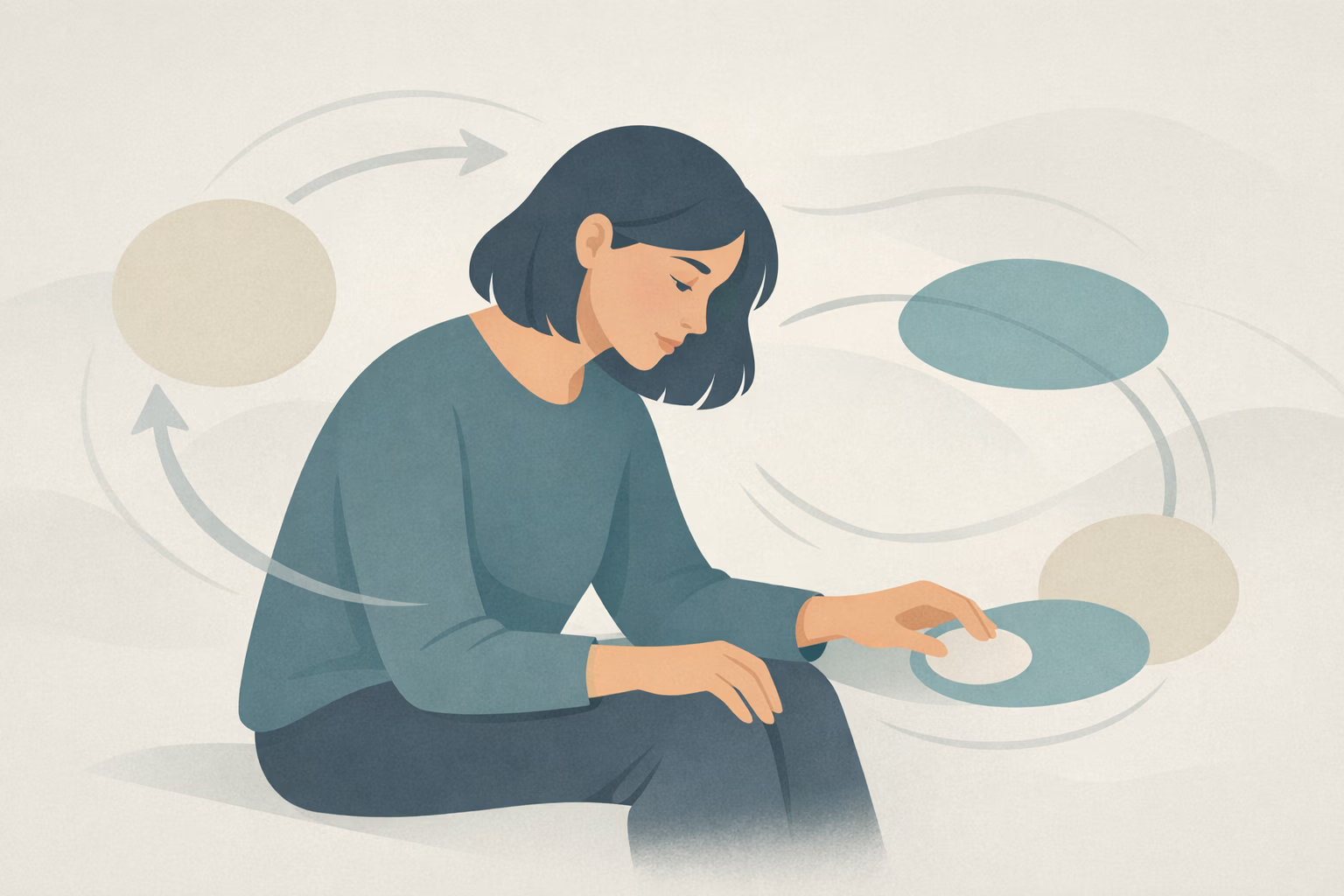
There’s a particular kind of tired that comes from watching yourself do the same thing again: the same argument script, the same late-night scrolling, the same over-explaining, the same avoidance of one specific task—followed by the same aftermath. It can feel like you’re present for your life, but not fully steering it.
Often the most disorienting part isn’t the behavior itself. It’s the sense that something unseen is organizing it—an internal “structure” that keeps reappearing, even when you genuinely want something different. That sense of invisibility is part of the load: when the pattern is running in the background, your system can’t locate where the loop begins or ends. [Ref-1]
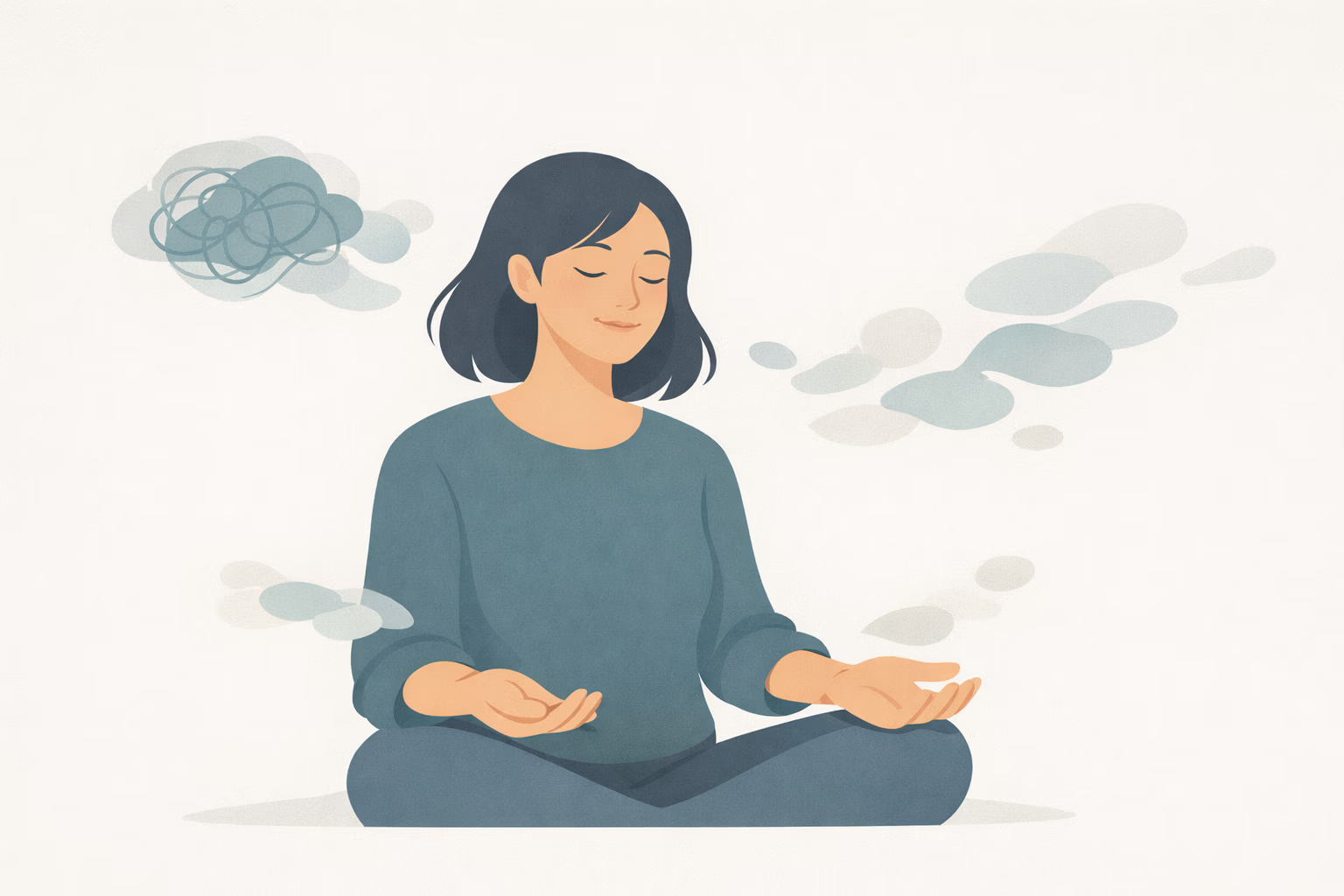
Meta-awareness is attention that notices attention. It’s the mind registering, “A thought is happening,” rather than only living inside the thought’s storyline. When that happens, automatic sequences can briefly lose their grip—not because you forced them away, but because the system updates its position: observer and event are no longer the same thing. [Ref-2]
This isn’t an intellectual trick. It’s a shift in how executive attention is allocated. The brain can hold a thought in view instead of treating it as an instruction. Even a small increase in that capacity can interrupt the chain reaction where a thought becomes certainty, certainty becomes urgency, and urgency becomes behavior.
Seeing the pattern doesn’t end it instantly. But it changes what it’s allowed to be: an event, not a verdict.
Human cognition is built for efficiency. When a response works—reduces uncertainty, creates quick relief, preserves social standing, avoids costly conflict—the nervous system tags it as useful. Over time, the response becomes streamlined: fewer steps, less deliberation, faster execution.
That efficiency is protective in a complicated world. But it also means your mind will reuse familiar storylines and rules, especially under stress load. When you’re depleted, the brain reaches for pre-made interpretations and default solutions. If a person then treats those interpretations as “who I am” or “the truth,” the loop tightens: the thought gains authority, and the body prepares to act as if it’s non-negotiable. This fusion between thought and identity is a known amplifier of worry and distress. [Ref-3]
Shame thrives in confusion. When you can’t see the structure, it’s easy to conclude the problem is you: lack of discipline, lack of insight, lack of will. Pattern awareness changes the frame. Instead of “I keep failing,” the mind can register, “A familiar loop is trying to regulate load.” That reorientation reduces moral weight and increases clarity. [Ref-4]
Importantly, perspective is not the same as integration. You can recognize a pattern and still be pulled by it. But seeing the pattern does something foundational: it restores proportion. The thought is no longer the entire room. It becomes one object in the room—noticeable, influential, but not all-consuming.
A common modern belief is that recurring thoughts reveal a fixed identity: “I’m an anxious person,” “I’m avoidant,” “I’m just like this.” But patterns are often repeatable because they are efficient, not because they are essential. They’re procedures the nervous system learned, usually under specific conditions.
When awareness is present, a gap appears between the thought and the next step. That gap isn’t willpower. It’s a change in how tightly the mind is bound to its own outputs. Research on mindfulness and meta-awareness suggests that increasing this observing capacity is associated with less automatic immersion in mental content and more specificity in recall—less “global fog,” more detail and differentiation. [Ref-5]
If a thought is repeatable, does it have to be authoritative?
Many so-called “avoidance” patterns aren’t driven by a single emotion. Structurally, they often form when resistance is repeatedly bypassed and consequences are muted. If a loop reliably reduces immediate friction—through distraction, overplanning, reassurance-seeking, overcontrol, or numbing—your system learns that the fastest way to regulate is to route around the unfinished piece.
Automation then replaces intentional living, not because a person lacks values, but because the environment keeps preventing completion. Unfinished conversations, unresolved ambiguity, and constant partial attention leave the nervous system without a clear “done” signal. In that state, the brain prioritizes short-cycle regulation: anything that quickly changes state. Meta-cognitive skills can make this automation more visible—like turning on the lights in a room where you’ve been moving by memory. [Ref-6]
Pattern awareness is often subtle at first. It usually shows up as earlier detection—catching the sequence closer to its beginning. In cognitive science, this is part of metacognition: the mind noticing its own processes. [Ref-7]
This isn’t about becoming hyper-self-monitoring. It’s about the system gaining a clearer map of its own routes, so fewer turns happen in the dark.
When awareness is low, the mind tends to experience its thoughts as the immediate situation, not as interpretations of it. The body then mobilizes accordingly, and behavior follows. Because the loop runs quickly, it can feel like “that’s just what happened,” even when it was a predictable sequence.
Over time, this limits growth not through lack of potential, but through lack of variation. If the same internal sequence keeps producing the same external outcome, identity begins to congeal around it: “This is my personality,” “This is my relationship pattern,” “This is how my days go.” Some popular explanations frame this as simply “not being mindful,” but the deeper issue is load and fragmentation: when attention is constantly pulled, it’s harder to maintain the continuity required to notice the loop as a loop. [Ref-8]
Repetition trains the nervous system. If a thought pattern repeatedly precedes action—catastrophizing before checking, self-criticism before improving, mental rehearsal before speaking—the brain learns that this sequence is part of “how we survive this.” Automatic thoughts then become quicker and more persuasive, not because they’re accurate, but because they are practiced.
This is why the same pattern can intensify over time. The system isn’t trying to sabotage you; it’s trying to reduce uncertainty with a known route. And because automatic thoughts often arrive as complete, confident sentences, they can feel like reality rather than mental activity. Naming them as “automatic” is one way people begin to see their constructed nature. [Ref-9]
What repeats without being noticed often starts to feel like fate.
When a thought is taken as a command, the body prepares for impact: muscles brace, breathing shifts, attention narrows. When the same thought is held in view as an event, the body’s prediction can change. The nervous system is less likely to mobilize at full volume because the signal is no longer interpreted as immediate danger or urgent instruction.
This is one reason “defusion” language can be helpful: not because it solves the content, but because it reduces the binding between thought and action. The thought can still be present, yet less determinative. Over time, this can restore balance: fewer spikes, less whiplash, more capacity for signals to return to baseline after they rise. [Ref-10]
What if the goal isn’t to win against thoughts, but to stop being recruited by them?
Humans regulate in relationship. Another person’s steady attention can function like a mirror with better lighting: it reflects sequence, timing, and tone—elements that are hard to detect from inside the loop. This is not about being “fixed” by someone else. It’s about the nervous system receiving clearer feedback and safer pacing.
Sometimes a pattern becomes visible only when it’s spoken out loud: the repeated justification, the familiar self-story, the automatic dismissal of needs, the way urgency rises at predictable moments. Approaches that emphasize an “observing self” and values-based orientation often use this relational mirroring to separate personhood from mental content—reducing fusion and making room for a more coherent identity stance. [Ref-11]
When pattern awareness grows, people often report something simpler than dramatic transformation: more inner space. Thoughts still arrive, but they don’t fill the whole channel. The mind becomes less sticky. Decisions can be made with more context, and the body spends less time bracing for imagined outcomes.
This steadiness isn’t produced by constant self-analysis. It tends to appear when loops complete more cleanly—when fewer cycles are interrupted by distraction, and fewer moments are forced into immediate resolution. In that steadier state, mental clarity improves because attention is less fragmented. You may notice more continuity across your day: fewer hard resets, fewer “How did I get here again?” moments. Frameworks that combine defusion with values language often describe this as increasing flexibility and psychological space. [Ref-12]
Meaning is difficult to live from when the system is constantly recruited by urgency. Pattern awareness doesn’t create meaning by itself, but it can reopen the doorway: it allows values to become relevant again in the moment where a default pattern would normally take over.
Over time, this can shift identity from “I am my patterns” to “I am the one who can relate to my patterns.” That stance supports a quieter kind of agency—less dramatic, more dependable—because actions can align with what matters even when the mind is noisy. Models like Acceptance and Commitment Therapy emphasize this link between awareness, flexibility, and values-based living as a pathway to well-being. [Ref-13]
When the pattern is seen, you don’t have to argue with it to stop obeying it.
In a fragmented world, pattern awareness is less a self-improvement skill and more a form of orientation. It helps the nervous system locate what is happening, what is old, what is present, and what is actually being asked of you. That locating reduces false alarms and restores proportion.
As awareness grows, meaning has more traction—not as a slogan, but as a lived organizing principle. When thoughts are recognized as events rather than identity, values can guide behavior with less force. This is one reason metacognitive awareness is associated with better functioning across demanding contexts: it supports steadier attention and clearer selection of what matters. [Ref-14]
Patterns don’t run your life because you are broken. They run because they are practiced, efficient, and often formed under conditions that required speed more than coherence. Seeing them is not the finish line, and it’s not the same as completion—but it is the moment the script becomes readable.
And once the script is readable, your life is no longer only the next automatic line. It becomes a place where choice can re-enter, where closure can eventually arrive, and where identity can be shaped by what you live—not just by what your mind repeats. Research on metacognition and automatic thoughts aligns with this: when the relationship to thoughts changes, distress often shifts with it. [Ref-15]
From theory to practice — meaning forms when insight meets action.
Meta-awareness is attention that notices attention — the mind registering 'a thought is happening,' rather than only living inside the thought's storyline. When that happens, automatic sequences briefly lose their grip, not because you forced them away, but because the system updates its position: observer and event are no longer the same thing. It's not an intellectual trick; it's a shift in how executive attention is allocated. The brain holds a thought in view instead of treating it as an instruction. Even a small increase interrupts the chain where a thought becomes certainty, certainty becomes urgency, and urgency becomes behavior.
Because human cognition is built for efficiency. When a response works — reduces uncertainty, creates quick relief, preserves social standing — the nervous system tags it as useful and streamlines it: fewer steps, less deliberation, faster execution. Under stress load, the brain reaches for pre-made interpretations. If you treat those interpretations as 'who I am,' the loop tightens — the thought gains authority, and the body prepares to act as if it's non-negotiable. Repetition isn't proof of a fixed identity; patterns are repeatable because they're efficient, not because they're essential. They're procedures the nervous system learned, usually under specific conditions.
Not instantly — but it changes what the thought is allowed to be: an event, not a verdict. Seeing the pattern doesn't end it; it restores proportion. The thought is no longer the entire room — it becomes one object in the room, noticeable but not all-consuming. When a thought is taken as a command, the body prepares for impact. When the same thought is held in view as an event, the body's prediction changes — the nervous system is less likely to mobilize at full volume because the signal is no longer interpreted as urgent instruction. The goal isn't to win against thoughts; it's to stop being recruited by them.
Shame thrives in confusion. When you can't see the structure, it's easy to conclude the problem is you — lack of discipline, lack of insight, lack of will. Pattern awareness changes the frame: instead of 'I keep failing,' the mind registers 'a familiar loop is trying to regulate load.' That reorientation reduces moral weight and increases clarity. The Loop Sovereignty here isn't 'control your mind harder' but 'see the pattern as a pattern.' Over time, identity shifts from 'I am my patterns' to 'I am the one who can relate to my patterns' — a quieter, more dependable agency where values can guide action even when the mind is noisy.
From Science to Art.
Understanding explains what is happening. Art allows you to feel it—without fixing, judging, or naming. Pause here. Let the images work quietly. Sometimes meaning settles before words do.
One Quiet Window, one insight, one reflection — every Sunday