Avoidance Thinking: The Mind’s Trick to Delay What Matters

In short: Detaching From Thoughts That Trap You Some thoughts don’t arrive like passing weather. They arrive like alarms: urgent, authoritative, and oddly sticky. They seem to demand a response—an explanation, a decision, a reassurance, a plan.
Some thoughts don’t arrive like passing weather. They arrive like alarms: urgent, authoritative, and oddly sticky. They seem to demand a response—an explanation, a decision, a reassurance, a plan. When that happens, the mind can feel less like a tool and more like a room you can’t leave.
What if the problem isn’t that you’re having the thought—but that the thought is being treated like a command?
Cognitive unhooking is the capacity to notice mental content without merging with it. Not by arguing with it, replacing it, or forcing calm—but by letting a thought be recognized as a thought: a transient internal event, not a binding contract. Over time, this shift can reduce strain and restore a quieter kind of agency.
A “trapping” thought often carries a special texture: it feels believable before it’s even examined. It doesn’t present itself as a hypothesis—it presents itself as the situation. In those moments, the nervous system can behave as if the thought has already been confirmed by the world. [Ref-1]
This is why thought spirals can feel so exhausting. The mind isn’t simply generating language; it’s generating urgency, consequences, and a sense of narrowing time. The thought is experienced less like “something I’m thinking” and more like “what’s happening.”
When a thought fuses with emotion, the body doesn’t wait for evidence. The stress system can mobilize based on an internal signal alone—tightness, vigilance, scanning, rehearsal. That reaction isn’t a character flaw; it’s a protective physiology doing what it does when something reads as important. [Ref-2]
Unhooking is not a “positive thinking” move. It’s a widening of cognitive distance: the mind can still generate content, but the system no longer has to treat each sentence as an emergency. With distance, regulation becomes more available because the body is no longer being asked to execute every storyline.
Sometimes relief begins when your system realizes it is allowed to receive a thought without turning it into a task.
Attention systems evolved to prioritize signals that might require action. In ancestral conditions, ambiguous cues were often safer to treat as meaningful than to ignore. That bias doesn’t disappear just because the signal is internal. A vivid thought can be processed like a relevant cue—especially when it implies threat, loss, rejection, or responsibility. [Ref-3]
This helps explain why some minds feel “loud” under pressure. When load is high, the system becomes more sensitive to cues and more motivated to resolve uncertainty. Thoughts that promise certainty or prevention can become especially magnetic, even when they don’t actually produce closure.
There is a reason the mind leans toward literalness. If a thought is treated as true, it can justify immediate action: plan, avoid, check, rehearse, decide. In the short term, that can create a temporary sense of control—like the system is staying ahead of danger. [Ref-4]
Why does the mind cling harder when you’re already tired?
Because literalness can mimic safety. It turns ambiguity into a single track, and a single track into a mission. The cost is that the nervous system stays online—perpetually “on call”—even when the situation doesn’t require it.
A central mismatch in distressing overthinking is the assumption that thoughts must be obeyed, solved, or neutralized. But thoughts are not inherently directives. They’re mental events: generated, edited, repeated, amplified, and sometimes recycled—often without new input. [Ref-5]
This doesn’t mean thoughts are meaningless. It means their meaning is not automatic. A thought can be informative, irrelevant, or simply a residue of high load. Cognitive unhooking is the recognition that “having a thought” and “needing to act on a thought” are different categories.
Thought loops can function like an avoidance loop structurally: mental narration replaces contact with what’s actually occurring. Not because a person is “afraid of feelings,” but because narration can mute consequence. It creates activity without completion. It offers motion without closure. [Ref-6]
In that loop, the mind keeps generating “almost answers” that prevent a done-signal. The system stays engaged because the loop never resolves into something that can settle into identity—something finished, metabolized, and no longer requiring monitoring.
Fusion often shows up less as “a thought” and more as a shift in behavior: automatic reacting, internal bargaining, repetitive checking, or sudden urgency. The pattern isn’t proof that you’re broken; it’s proof that your system is treating mental content as high priority. [Ref-7]
People often describe it as being “dragged.” Not by the world—by a sentence. The thought becomes the environment.
When fusion becomes chronic, choice can shrink. Attention gets recruited into repeated scanning and internal debate, which increases cognitive load. Paradoxically, the more the system tries to think its way to safety, the more the mind learns that “worrying is required.” [Ref-8]
This is part of why thought spirals can become self-reinforcing: repetition creates familiarity, familiarity creates credibility, and credibility creates more repetition. Meanwhile, the body stays in a semi-mobilized state, because the loop keeps signaling “not finished.”
It’s not that you can’t stop thinking. It’s that the system has not received closure.
Emotional intensity is a powerful validator. When a thought triggers a surge—tight chest, heat, urgency—the reaction can be interpreted as evidence that the thought is accurate. The mind reads the body’s mobilization as confirmation: “If I feel this strongly, it must be real.” [Ref-9]
Some people also experience a form of thought-action fusion: the sense that having a thought is morally or practically equivalent to doing it, or that a thought increases the likelihood of an event. That can intensify responsibility and lead to more checking, mental reviewing, or self-surveillance.
Unhooking is not winning an argument against your mind. It’s changing what the nervous system believes it’s being asked to do. When a thought is observed as a mental event—rather than treated as a command—mobilization becomes less necessary. The body can stand down because the “assignment” has changed. [Ref-10]
This is why unhooking often feels less like insight and more like a quiet downgrade of urgency. The thought may still be present, but it has less authority. The system is no longer required to complete a task that never actually ends.
What changes when a thought becomes information instead of a verdict?
Many people notice that a thought feels different when it’s expressed externally—spoken, written, or reflected with someone safe. This isn’t because externalizing “fixes” anything. It’s because the thought is no longer occupying the entire field of attention. It becomes an object in the room instead of the room itself. [Ref-11]
When a thought is named, it often loses some of its fused quality. The mind is less able to masquerade as reality when the content is held at a slight distance and recognized as “something the mind is producing.” This shift can reduce compulsion to respond automatically.
As fusion softens, people often report a specific kind of change: more space between stimulus and response, less reflexive urgency, and fewer moments where a thought instantly becomes behavior. This isn’t emotional catharsis. It’s increased capacity—more ability for signals to come and go without commandeering the whole system. [Ref-12]
That space can show up in small, concrete ways: the mind is still active, but it’s not as adhesive. Attention can move again. The body can return to baseline more easily because fewer internal cues are being treated as emergencies.
When thoughts stop running the whole show, something else can re-enter: values. Values are not slogans or motivation. They’re orientation—what tends to feel coherent to live from, even when the mind is noisy. Detachment makes room for that orientation to be felt again as a steadying reference point. [Ref-13]
In a fused state, identity can collapse into the loudest thought of the day. In a more unhooked state, identity is less reactive. Attention can align with what matters without needing perfect certainty first. Over time, coherence grows when choices settle into lived patterns—when life generates more “done” signals and fewer unfinished loops.
Cognitive unhooking isn’t about eliminating thoughts or proving the mind wrong. It’s about restoring authorship: the ability to hold mental content without being compelled by it. That shift matters because attention is where meaning is assembled—through what you repeatedly return to, what completes, and what becomes part of lived identity. [Ref-14]
When thought loops dominate, meaning gets fragmented. When attention can move freely again, meaning can re-form around what is real, relational, and complete. Agency becomes less about force and more about coherence—about your system being able to stand down when nothing needs to be fought.
You don’t need a mind that never generates scary, critical, or urgent sentences. You need a system that can recognize those sentences without handing them the steering wheel. Over time, that recognition can become a quiet kind of stability: the mind still speaks, but it no longer decides who you are or what your life must become. [Ref-15]
From theory to practice — meaning forms when insight meets action.
Because they arrive carrying urgency, authority, and stickiness — not as hypotheses, but as the situation itself. The article calls this thought-emotion fusion: a vivid sentence triggers the stress system before any evidence is examined, so the body mobilizes as if the thought has already been confirmed. Tightness, scanning, and rehearsal show up because the nervous system is treating internal content as a relevant cue. That reaction isn't a character flaw; it's protective physiology doing what it does when something reads as important. The thought feels like a command because, internally, the system has already promoted it to one.
No — and the article is firm about this. Unhooking isn't an argument with the mind, a replacement of bad thoughts with good ones, or a forcing of calm. It's a widening of cognitive distance: the mind can still generate content, but the system no longer has to treat each sentence as an emergency. With distance, regulation becomes available because the body isn't being asked to execute every storyline. Relief begins when your system realizes it's allowed to receive a thought without turning it into a task — that having a thought and needing to act on it are different categories.
Because the thought stops occupying the entire field of attention. The article describes this as turning the thought into an object in the room rather than the room itself. When content is held at a slight distance — spoken, written, or reflected with someone safe — it loses some of its fused quality. The mind has a harder time masquerading as reality when you can recognize it as something the mind is producing. This isn't because externalizing fixes the content; it's because the nervous system gets a different assignment, and the compulsion to respond automatically softens.
Yes, even without obvious fear driving it. The article frames thought spirals as structurally avoidant: mental narration replaces contact with what's actually occurring. Narration mutes consequence — it creates activity without completion, motion without closure. The mind keeps generating 'almost answers' that prevent a Done Signal, so the system stays engaged rehearsing, analyzing, self-evaluating, and searching for certainty in conditions that can't provide it. It looks like productive thinking, but it's really the system substituting cognitive movement for the lived completion that would let the body stand down.
From Science to Art.
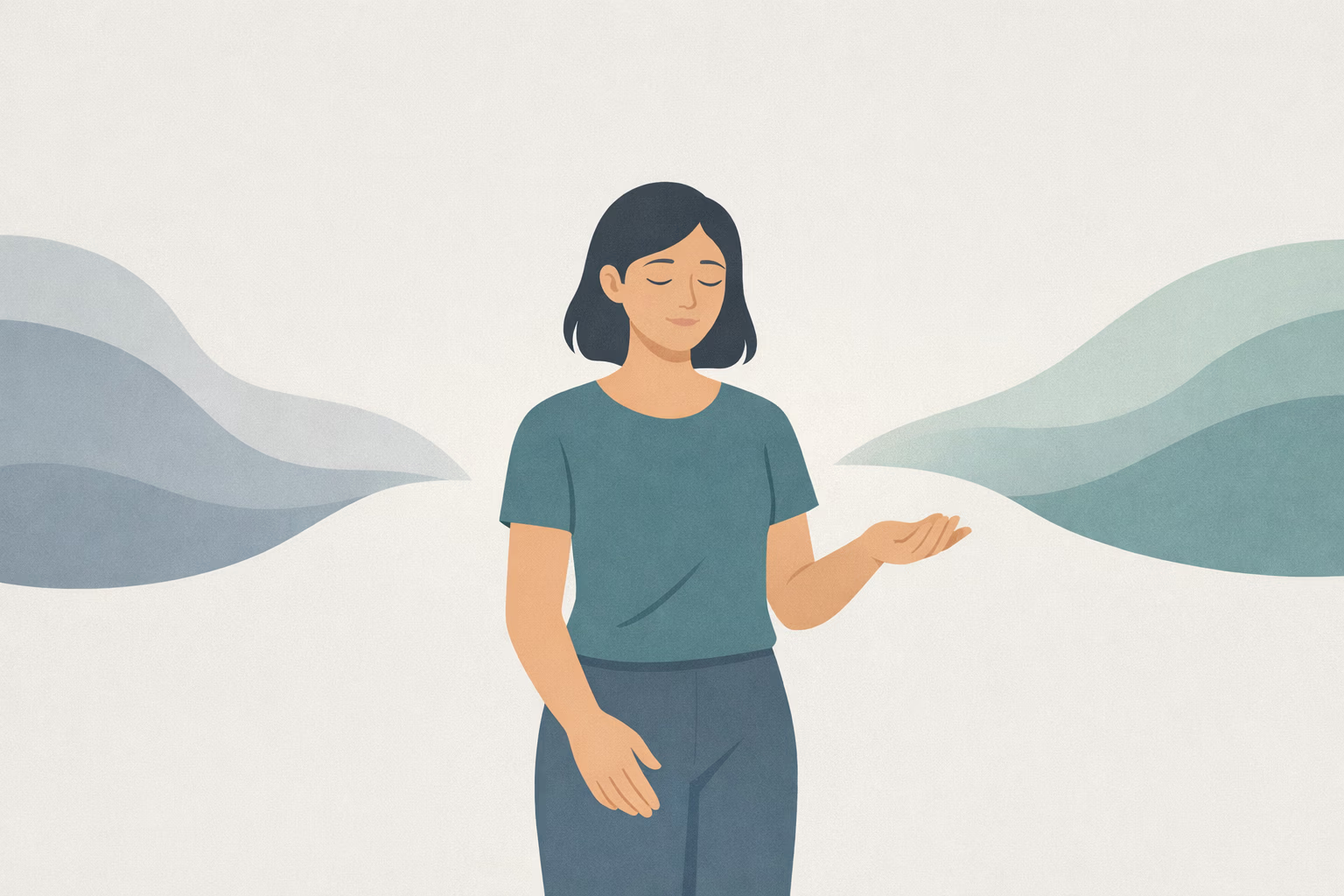
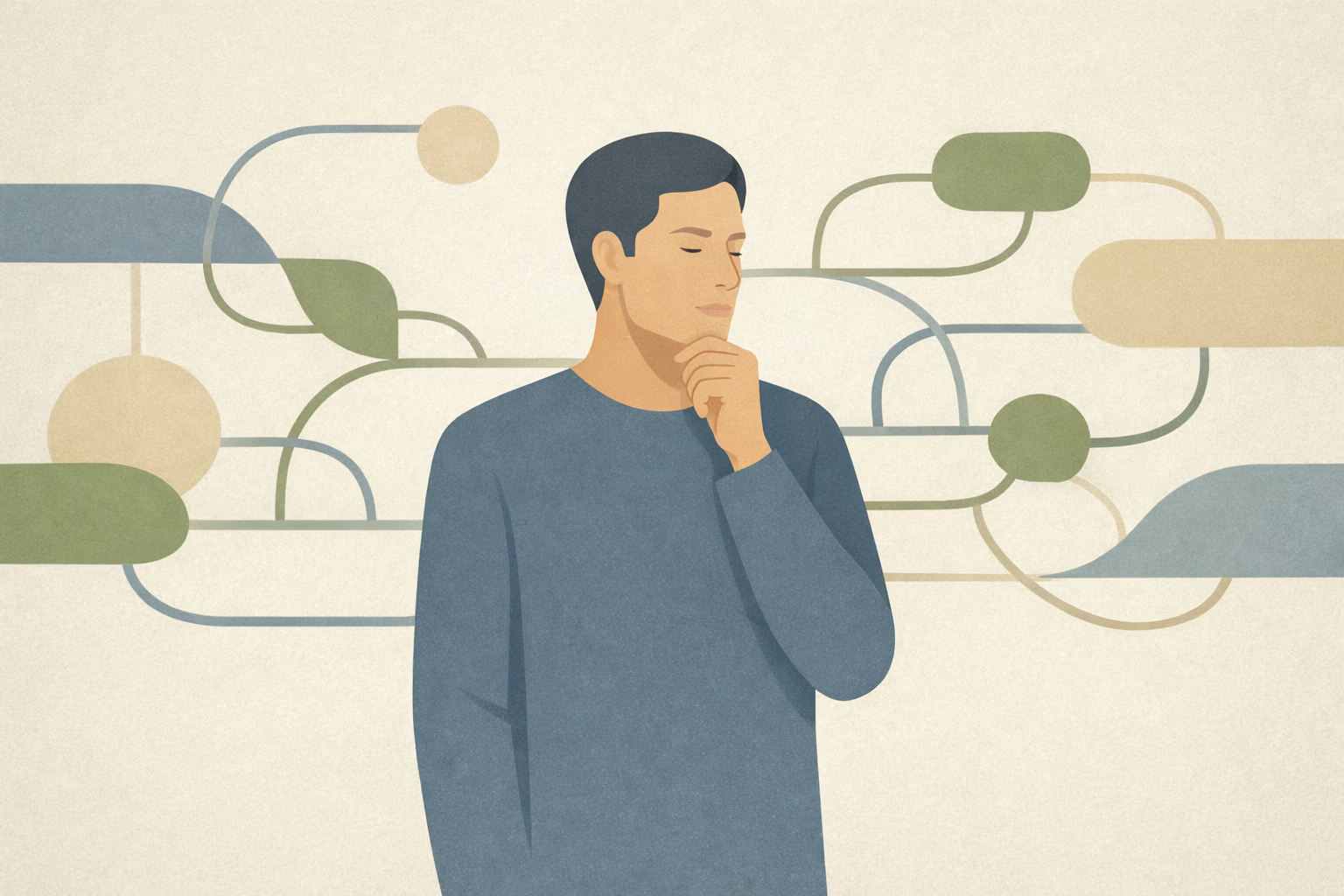
Understanding explains what is happening. Art allows you to feel it—without fixing, judging, or naming. Pause here. Let the images work quietly. Sometimes meaning settles before words do.
One Quiet Window, one insight, one reflection — every Sunday