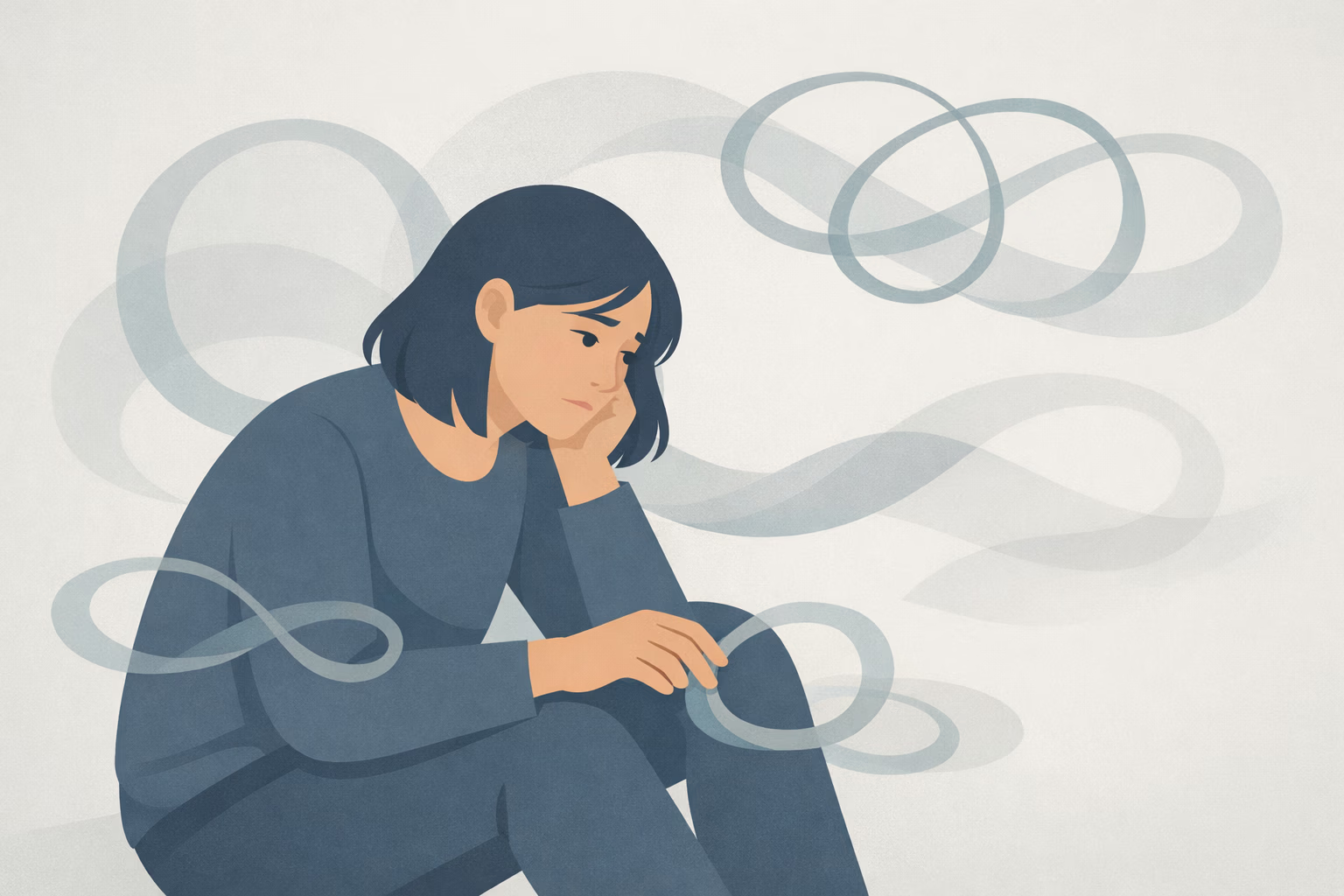
Overthinking Loops: When the Mind Won’t Quiet Down
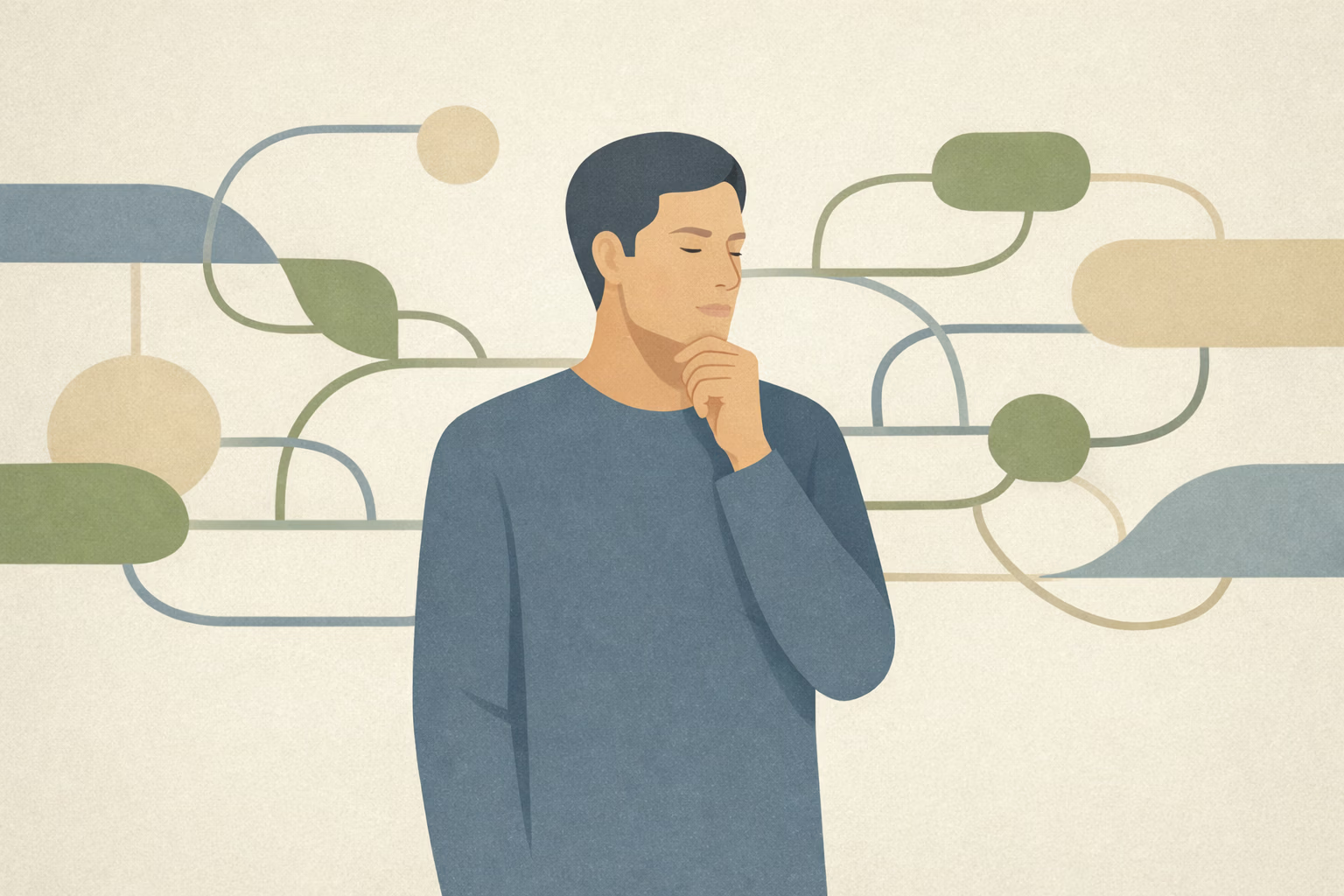
In short: The mind stays busy with planning, researching, organizing, and refining—while the thing that matters remains untouched. From the outside it can look like “being responsible.” From the inside it often feels like pressure without movement.
Avoidance thinking is a familiar modern pattern: the mind stays busy with planning, researching, organizing, and refining—while the thing that matters remains untouched. From the outside it can look like “being responsible.” From the inside it often feels like pressure without movement.
This isn’t a character flaw. It’s a regulatory response. When uncertainty is high and the nervous system is carrying load, thinking can become a way to create a quick sense of safety—without stepping into the part of life that would actually complete the loop.
What if the problem isn’t that you don’t care—but that your system is trying to stay protected while still aiming for meaning?
Avoidance thinking often has a specific rhythm: intense cognition paired with delayed engagement. You can feel “on it” all day—writing lists, weighing options, imagining outcomes—yet end the day with a quiet sense of friction, like nothing truly landed.
This pattern tends to create two simultaneous experiences: (1) cognitive activation (spinning, rehearsing, forecasting) and (2) incomplete closure (no clear “done” signal). The result is a nervous system that stays online, because the situation never resolves into an experienced outcome. That ongoing activation can then be misread as a personal problem: “Why can’t I just start?” [Ref-1]
When thinking becomes the main activity, it can feel like progress—until your system notices there’s still no completion.
The executive system is designed to model the future: anticipate risk, sequence steps, prevent costly mistakes. Under strain, that same system can lean harder on words and plans because cognition is controllable. Thoughts can be started, paused, revised, and repeated.
In many people, worry and planning become predominantly verbal—an internal narration that can dampen spikes in arousal in the short term, while also postponing the moment of real contact with uncertainty. It’s not “lying” to you; it’s choosing the channel that feels safest and most manageable right now. [Ref-2]
So the mind keeps preparing—not because you’re incapable, but because preparation can temporarily substitute for exposure to the unknown.
In uncertain environments, extended planning had clear survival value: conserve energy, reduce unnecessary risk, coordinate with others, and wait for better conditions. The capacity to simulate scenarios is one of our species’ strengths.
But today, many “threats” are low-danger and high-ambiguity: social evaluation, email consequences, identity choices, career direction, dating, creative work. They aren’t solved by one perfect plan. They’re solved by contact with reality over time—small completions that teach the system what happens next.
When avoidance becomes a default process, cognition can keep looping without the feedback that would update it. Research on experiential avoidance processes helps explain how avoidance can narrow behavior and maintain repetitive mental activity instead of effective engagement. [Ref-3]
Planning produces a particular kind of relief: the relief of structure. A plan has edges. It has steps. It gives a sense of preparedness and reduces the immediate intensity of ambiguity.
And yet, planning can also generate a “progress-like” sensation without the nervous system receiving the completion signal it actually needs. In rumination research, repetitive thinking is often linked with avoidance processes that keep the system in a low-resolution holding pattern—active enough to feel busy, but not resolved enough to stand down. [Ref-4]
Avoidance thinking often carries an assumption: “Once I think this through enough, I’ll feel ready.” The problem is that readiness isn’t only cognitive. It’s also physiological—capacity, steadiness, and tolerance for imperfect outcomes.
When thinking replaces engagement for too long, uncertainty doesn’t shrink; it can expand. The mind generates more branches, more contingencies, more criteria. Over time, this can raise anxiety and dilute confidence, not because you’re fragile, but because you’re accumulating unfinished loops. Rumination and avoidance-linked thinking patterns are frequently associated with greater distress and dysfunctional thinking styles. [Ref-5]
Some kinds of thinking clarify. Other kinds of thinking delay closure.
In an avoidance loop, the system learns an association: thinking equals safety. The moment you return to planning, the body often experiences a small downshift in threat—less exposure, less consequence, less immediacy.
But meaningful action is where identity updates happen. Meaning becomes dense when experiences complete and settle into “this is what I did; this is what happened; this is who I am in motion.” When action is postponed, that settling can’t occur. The result is a cycle: more thinking to manage the discomfort of not finishing.
Research links experiential avoidance with rumination and depressive processes, suggesting that cognitive loops can function as avoidance rather than resolution. [Ref-6]
Avoidance thinking isn’t always obvious, because it often wears responsible clothing. It can look like diligence, thoroughness, or “being careful.” The giveaway is the repeated restart: the same decisions revisited, the same preparation repeated, the same threshold never crossed.
Common forms include:
Studies in student samples suggest cognitive avoidance can predict rumination, especially under stress and perfectionistic pressures—conditions that amplify “not yet” as a default state. [Ref-7]
Agency isn’t a mood. It’s a system-level expectation: “When I move, something completes.” Avoidance thinking interrupts that expectation. The more often the nervous system experiences planning without completion, the more “movement” can start to feel like a high-stakes event.
Over time, this can reduce trust in one’s own signal clarity. Not because intuition vanished, but because signals get buried under load: too many open tabs, too many unresolved narratives, too many unclosed commitments. Avoidance coping is often associated with increased long-term stress—precisely because the stressor remains present in the background while the system never receives an end-point. [Ref-8]
When life doesn’t deliver “done,” the mind compensates by trying to think its way to safety.
Avoidance thinking is reinforced by relief. Postponing the call, the application, the conversation, the draft—often produces an immediate easing in the body. That easing is real. It’s a nervous system responding to reduced exposure and muted consequence.
The difficulty is what that relief teaches: “Delay works.” Each time relief arrives through postponement, the system becomes more likely to route future uncertainty into cognition rather than contact. Over time, the avoided domain can start to feel increasingly unsafe—not because it objectively changed, but because the system has less recent evidence of completion in that area. This is one way avoidance can shrink life and intensify anxiety over time. [Ref-9]
Relief can change your state. Completion changes your baseline.
There’s a common misunderstanding that the way out of avoidance thinking is “more insight” or “a better mindset.” Insight can be useful, but it doesn’t automatically create the settling that comes from completion.
What changes the pattern is often more structural: internal safety cues increase, overall load decreases, and situations begin to reach real endpoints. In that context, thinking stops being a shield and becomes what it was designed to be: a support for direction.
Avoidance-focused coping is widely described as including procrastination, distraction, and withdrawal—moves that protect in the short term. When the system no longer needs that protection as intensely, overthinking naturally becomes less compelling. [Ref-10]
Human nervous systems regulate in context. When you feel witnessed, accompanied, or lightly held in a shared reality, uncertainty often becomes more tolerable. Not because someone “motivates” you, but because social cues can reduce threat load and create steadier momentum.
This can look like being around someone who is calmly doing their own tasks, having a conversation that makes a situation feel more real and less abstract, or feeling a sense of gentle accountability that turns a private loop into a shared timeline. Overthinking tends to intensify in isolation, where thoughts can multiply without external closure points. Resources describing overthinking and anxiety commonly note that rumination can function as avoidance and can block forward movement—especially when a person is stuck alone with “what ifs.” [Ref-11]
Sometimes the most stabilizing thing isn’t a better plan—it’s a steadier context.
When coherence begins to return, decisiveness tends to show up as a capacity shift: you can hold uncertainty and still move. Thoughts still appear, but they don’t hijack the whole system. The mind can plan and the body can proceed.
This isn’t a dramatic emotional breakthrough. It’s often quieter: fewer internal negotiations, less restarting, more follow-through, and a clearer sense of sequence—first this, then that. In anxiety-and-avoidance cycles, short-term relief can reinforce avoidance; the reversal often looks like tolerating the in-between long enough for a new outcome to register. [Ref-12]
At its best, thinking is a tool for alignment: clarifying what matters, anticipating reasonable obstacles, coordinating with others, and building a path that fits your values. It helps create coherence between identity (“who I am”), direction (“where I’m going”), and behavior (“what I do”).
When avoidance loops dominate, thinking serves protection—reducing exposure while keeping the story active. When closure returns, thinking can serve meaning—helping experiences complete and settle into a stable sense of self. Many descriptions of avoidance cycles emphasize this difference between short-term relief and long-term expansion: avoidance can feel protective now, but it often increases future fear and constricts life over time. [Ref-13]
In a coherent system, thought supports movement—and movement produces the “done” signal that lets the system rest.
Avoidance thinking is rarely about laziness or not wanting your life. More often, it’s a sign that the nervous system is trying to manage uncertainty with the most controllable material it has: language, analysis, rehearsal.
In periods of transition—new roles, new relationships, new stakes—anticipatory anxiety can increase, and the mind may try to build certainty in advance. That’s a human response that reflects conditions, not defect. [Ref-14]
Meaning tends to return when life becomes more complete—when situations end, choices land, and identity can update from lived outcomes rather than simulated ones. Agency grows from coherence, not pressure.
Your mind’s ability to imagine, analyze, and plan is not the enemy. It’s a strength that can get recruited for protection when completion feels too costly or too uncertain.
Over time, what many people discover is simple: thought stabilizes when it supports movement toward what matters—and when movement generates real closure that the nervous system can recognize as finished. In that state, planning becomes guidance, not delay. [Ref-15]
From theory to practice — meaning forms when insight meets action.
Because thinking offers controllability — you can revise the story, but the world doesn't have to answer back. The article describes this as cognitive activation paired with incomplete closure: the mind feels 'on it' all day, but the nervous system never receives the Done Signal that would let it stand down. Planning produces the relief of structure without the integration that comes from completion. Over time, this reads as 'I'm working hard,' but the body is still carrying every unfinished loop in the background.
Often, yes. The system learns: thinking equals safety. Each return to planning produces a small downshift in threat — less exposure, less consequence. Meanwhile, identity updates only happen through lived completion, so meaning stays postponed. Research on experiential avoidance and rumination suggests cognitive loops can function as avoidance rather than resolution. The kicker is that delay actively works in the short term, which is why it's so sticky. Relief changes your state. Completion changes your baseline.
Because readiness isn't only cognitive — it's also physiological capacity, steadiness, and tolerance for imperfect outcomes. When thinking replaces engagement for too long, uncertainty doesn't shrink; it expands. The mind generates more branches, more contingencies, more criteria. You're accumulating unfinished loops, not building confidence. The illusion is that one more analysis will deliver certainty. The reality is that contact with reality — small completions — is what teaches the nervous system that depth is survivable.
Human nervous systems regulate in context. When you feel witnessed or accompanied, uncertainty becomes more tolerable — not because someone motivates you, but because social cues lower threat load via co-regulation. Overthinking intensifies in isolation, where 'what ifs' can multiply without external closure points. A calm presence, a real conversation that turns abstraction into shared timeline, gentle accountability — these change the conditions that were keeping the loop alive. Sometimes the most stabilizing thing isn't a better plan; it's a steadier context.
From Science to Art.
Understanding explains what is happening. Art allows you to feel it—without fixing, judging, or naming. Pause here. Let the images work quietly. Sometimes meaning settles before words do.
One Quiet Window, one insight, one reflection — every Sunday