Journaling for Emotional Clarity and Identity Discovery
In short: Journaling is often described as “getting your thoughts out.” But for many people, the page quickly turns into a loop: the same worries, the same story, the same unresolved tension—just written in different words. That isn’t a character flaw.
Journaling is often described as “getting your thoughts out.” But for many people, the page quickly turns into a loop: the same worries, the same story, the same unresolved tension—just written in different words. That isn’t a character flaw. It’s what happens when a nervous system is carrying too many open tabs without a reliable way to close them.
What if the problem isn’t that you don’t have anything to say—what if the system simply doesn’t know where to start?
Guided journaling uses structured prompts to create a clear starting point and a clear shape. Not to force insight, but to support completion: the kind that lets an internal signal settle and reduces the need for urgency, overthinking, or shutdown.
A common experience with journaling is either not knowing what to write, or writing a lot without feeling any “landing.” The words may be accurate, even thoughtful—but the body still feels keyed up, foggy, or restless afterward.
This can look like a block, but it’s often a workload issue: the mind is trying to protect limited capacity by avoiding unbounded exploration. An empty page has no edges, and without edges, the system can’t tell what “done” would even mean.
In that sense, the struggle is not a lack of self-awareness. It’s a lack of closure cues.
Prompts work because they narrow the field. Instead of “tell me everything,” they ask one specific angle of the nervous system to report back. That specificity lowers the cognitive cost of starting and reduces the tendency to spin or scatter.
Structured questions can also recruit the brain’s organizing capacities—especially the systems involved in sequencing, labeling, and perspective-taking. That doesn’t automatically create integration, but it can create a more regulated corridor in which experience becomes more trackable and less diffuse. [Ref-2]
When the question is precise, the mind doesn’t have to defend against infinity.
People aren’t wired to hold endless, unprocessed experience. We orient by making meaning—by linking events to values, relationships, and identity in a way that feels internally consistent. When that linking doesn’t happen, the system stays “on,” scanning for what’s missing.
Reflective writing can support this orientation because it creates a container where details can be named, ordered, and related to a larger story. Prompts are essentially scaffolding for metacognition: a way to notice what you’ve been carrying without needing perfect insight on demand. [Ref-3]
Without some structured reflection, identity can become reactive—built from whatever is loudest today rather than what is truest over time.
Many people notice that after writing, there’s a brief sense of space: less mental noise, less pressure, a clearer next breath. That can happen because putting experience into language reduces internal ambiguity and compresses competing signals into a more legible form.
This kind of relief is not the same as integration. It’s closer to decluttering a desk: you can see what’s there, and the system stops working so hard to hold it all at once. For some nervous systems, that temporary clarity is itself a safety cue. [Ref-4]
Why does “naming it” help at all?
Because uncertainty is metabolically expensive. Clarity—however partial—reduces the cost of constant monitoring.
There’s a popular idea that journaling automatically produces insight. But unstructured journaling can easily become a transcript of activation: you record what’s loud, not necessarily what’s foundational.
Guided prompts introduce an intentional constraint. They help reveal patterns that don’t announce themselves—values conflicts, recurring roles, unfinished conversations, or mismatched expectations. In other words, prompts don’t make you “try harder.” They make the signal easier to find. [Ref-5]
Structure is not rigidity here. It’s an on-ramp.
Without guidance, journaling can accidentally preserve the very fragmentation it’s meant to soothe. The page becomes a place where tension is rehearsed rather than completed—not because a person is avoiding feelings, but because the writing never reaches a boundary where consequence, meaning, and resolution can link up.
Repetition isn’t always rumination in a moral sense. It can be the nervous system returning to the same topic because the loop still lacks a “finished” signal. And if the writing stays broad (“everything is too much”), the system gets no new coordinates. [Ref-6]
Sometimes the journal becomes a mirror of overload, not a bridge out of it.
People often blame themselves when journaling doesn’t help. But the patterns are usually structural: the writing is missing the ingredients that allow completion to register.
Prompts can interrupt these grooves by inviting a different angle than the one your stress system automatically chooses. [Ref-7]
When reflection stays unstructured, the cost is not only emotional clutter. It’s meaning development. Over time, the system may become better at describing distress than at updating identity.
Guided journaling is one way to support coherence: connecting experience to values, choices, and relational context so life stops feeling like disconnected episodes. When those links don’t form, people often report a persistent sense of “I should know myself better by now,” even while working hard. That gap can be painful—and unnecessary. [Ref-8]
Without some guided pathway, the nervous system may keep prioritizing short-term stabilization (numbing, urgency, control) over longer-term integration.
Avoidance doesn’t have to look like refusing to write. It can look like writing a lot—while skirting the points that would create closure. The page stays busy, but the core loop remains open.
Often this is because unstructured writing follows the brain’s easiest routes: familiar stories, well-practiced explanations, or globally negative summaries. Those routes reduce friction in the moment, but they can mute consequence and block completion. A prompt that asks for specificity—what changed, what mattered, what was needed—can make the loop visible enough to resolve later. [Ref-9]
What keeps a loop open?
Not a lack of effort. More often: too much ambiguity, too many competing meanings, and no stable endpoint.
Structured prompts are less about “digging deeper” and more about restoring sequence. They guide attention through a path the nervous system can follow: context → impact → value → choice → meaning. That sequence helps the brain stop treating experience as random noise.
When prompts are consistent, they also create comparability over time. Patterns become trackable: not as labels, but as repeated conditions—when you feel most scattered, what reliably restores steadiness, where identity tightens, where it softens. This is how internal guidance forms: through repeated, coherent mapping, not through intensity. [Ref-10]
Clarity isn’t a breakthrough. It’s the quiet result of experiences being put in the right order.
Some parts of meaning consolidate more readily when they’re not held alone. Sharing reflections with a trusted person—mentor, coach, therapist, spiritual leader, or grounded friend—can function as an external safety cue that helps the system stay with complexity long enough for it to organize.
This isn’t about getting advice or being corrected. It’s about reality-testing and validation: “Yes, that makes sense,” “No wonder that landed hard,” “I see what you’re protecting.” That kind of attunement can reduce internal argument and make the story more coherent in the body. [Ref-11]
In many cultures, narrative has always been communal. Private journaling is powerful, but it’s not the only container humans evolved to use.
When guided journaling is integrated—meaning the reflections reach completion often enough that the system starts expecting closure—people commonly report a different quality of mind. Not constant calm, and not permanent insight, but more return of signal after stress.
This isn’t about writing perfectly. It’s about your nervous system learning that experience can be processed to a meaningful endpoint. [Ref-12]
As coherence returns, agency tends to feel less like self-pressure and more like orientation. Decisions become simpler—not because life is easy, but because values are clearer and internal signals are less contradictory.
In that state, goals can start to reflect identity rather than compensations. You’re less likely to chase relief through constant change, and more likely to choose what actually belongs to you. The journal becomes less of a confessional and more of a compass—quietly organizing your next right direction. [Ref-13]
Agency is what shows up when your inner story stops fighting itself.
A journaling block often isn’t resistance to self-knowledge. It’s a sign that the system needs more structure, more safety, or a smaller entry point. In that sense, prompts are not “training wheels.” They’re a humane way to meet the brain where it is.
Guided journaling works best when it’s understood as a tool for completion: a way to help experience take a shape that can eventually settle. If writing has felt circular, that circularity can be informative—evidence of an unfinished loop, not evidence of personal failure. [Ref-14]
Over time, structure can make self-understanding feel less like effort and more like an environment your nervous system can actually use.
Guided journaling doesn’t offer a new personality or a better attitude. It offers something quieter and more biological: a path for scattered experience to become ordered enough that the body can stand down.
When writing supports closure—when it helps life events connect to values, relationships, and identity—awareness becomes less like constant monitoring and more like stable orientation. That stability is not willpower. It’s integration showing up as coherence. [Ref-15]
From theory to practice — meaning forms when insight meets action.
Because the page stays blank or repetitive when there's no closure cue, not because you lack self-awareness. An empty page has no edges, and without edges, the system can't tell what 'done' would even mean. Repetition isn't moral failure — it's the nervous system returning to the same topic because the loop still lacks a finished signal. If writing stays broad ('everything is too much'), the system gets no new coordinates. The struggle isn't insight; it's missing structure. The journal becomes a mirror of overload rather than a bridge out of it because the writing never reaches a boundary where consequence and meaning link up.
Prompts work by narrowing the field. Instead of 'tell me everything,' they ask one specific angle to report back. That specificity lowers the cognitive cost of starting and reduces spinning or scattering. Structured questions recruit the brain's organizing capacities — sequencing, labeling, perspective-taking — so experience becomes more trackable and less diffuse. Prompts don't make you try harder; they make the signal easier to find. They guide attention through a path the nervous system can follow: context → impact → value → choice → meaning. Clarity isn't a breakthrough — it's the quiet result of experiences being put in the right order.
Because unstructured writing follows the brain's easiest routes — familiar stories, well-practiced explanations, globally negative summaries. Those routes reduce friction in the moment but mute consequence and block completion. Surface recounting describes events without linking to needs or values. Endless problem-mapping collects details that increase load. Identity fog produces many observations and no stable 'so what.' Relief-chasing stops the writing right when pressure drops, before anything consolidates. The Avoidance Loop hides here in plain sight: the page stays busy, but the core loop remains open. A prompt that asks for specificity makes the loop visible enough to resolve.
Not constant calm and not permanent insight — more return of signal after stress. Less reactivity to the same triggers because the loop no longer surprises the system. More specific language for needs and boundaries, which reduces internal scrambling. Fewer 'mystery moods' because patterns become legible earlier. A steadier sense of self across changing days. The journal becomes less of a confessional and more of a compass. Co-regulation amplifies this — sharing reflections with a trusted witness functions as an external safety cue. Awareness becomes less like constant monitoring and more like stable orientation: integration showing up as coherence.
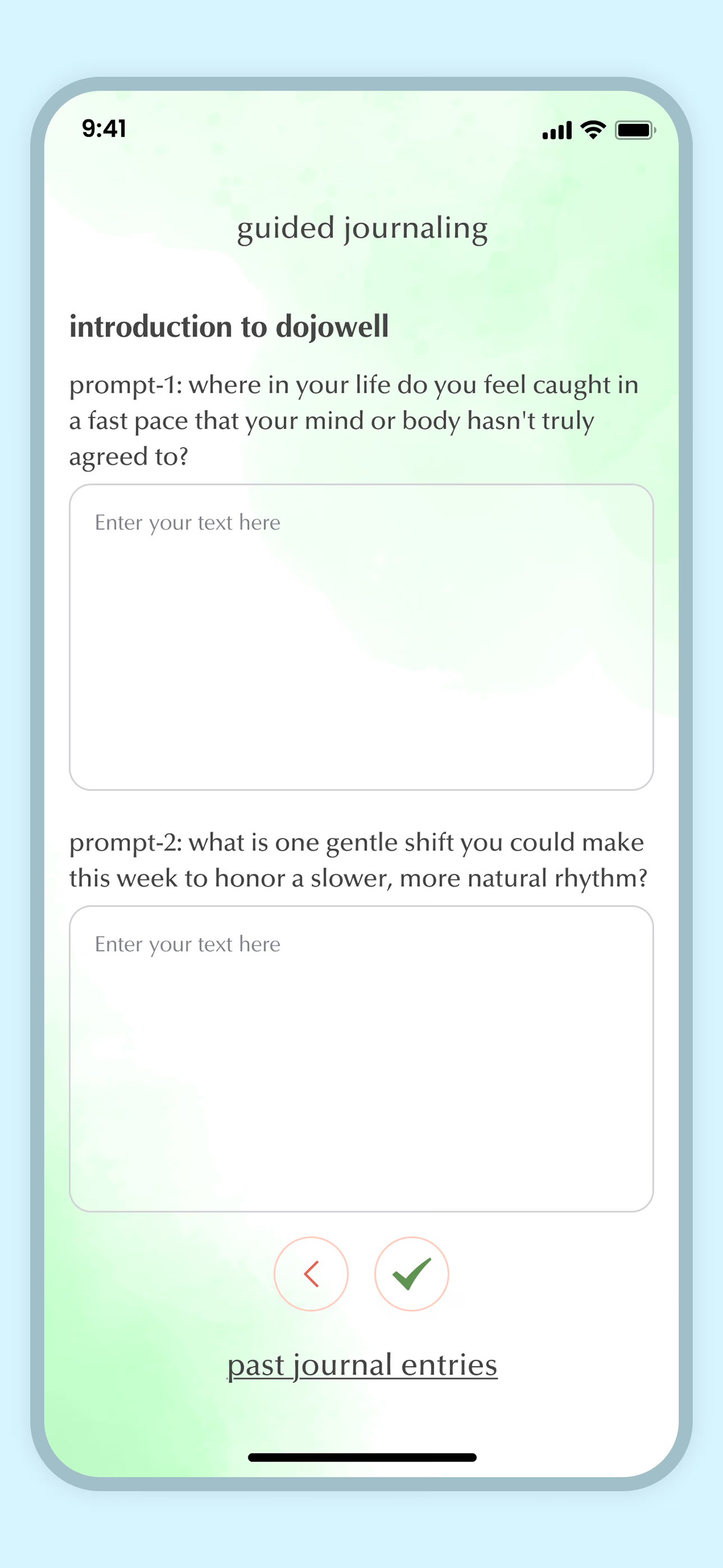
From Science to Art.
Understanding explains what is happening. Art allows you to feel it—without fixing, judging, or naming. Pause here. Let the images work quietly. Sometimes meaning settles before words do.
One Quiet Window, one insight, one reflection — every Sunday