Guided Journaling: When Writing Becomes a Path to Awareness

In short: When your mind feels crowded, it’s rarely because you’re “bad at coping.” More often, it’s what happens when a high-capacity nervous system is carrying too many unclosed loops at once—unfinished conversations, unclear priorities, half-processed days, and constant input. Journaling is one way people externalize that load.
When your mind feels crowded, it’s rarely because you’re “bad at coping.” More often, it’s what happens when a high-capacity nervous system is carrying too many unclosed loops at once—unfinished conversations, unclear priorities, half-processed days, and constant input.
Journaling is one way people externalize that load. Not as a magical solution, and not as a performance. More like moving swirling thoughts from a private, high-speed inner space onto a stable surface where patterns can be seen and gradually completed.
What if clarity isn’t something you force—what if it’s something that returns when your system finally gets a “done” signal?
Confusion and stuckness often come from accumulation, not incapacity. When thoughts and emotional signals keep cycling internally, they compete for attention in the same limited workspace. The result can feel like mental fog, urgency without direction, or a sense that you’re behind on your own life.
This is not a character issue. It’s an attentional and regulatory issue: too many active tabs, too few completions. In that state, the nervous system tends to keep scanning for what’s missing—what hasn’t been resolved, named, or placed—so it doesn’t fully stand down. [Ref-1]
Writing can function as a kind of external workspace, where internal “noise” becomes visible enough to organize, sequence, and eventually settle.
Putting words on a page isn’t just self-expression; it changes how attention is allocated. Writing narrows focus, slows the stream, and gives executive attention something concrete to hold. That shift can reduce the sense of being flooded by undifferentiated input. [Ref-2]
Importantly, this isn’t the same as “thinking harder.” The page becomes a boundary: ideas can be separated, compared, and revised without having to keep the whole load active at once. Over time, this can make it easier to distinguish what’s urgent from what’s loud, and what’s meaningful from what’s merely repetitive.
Sometimes the relief is simple: the mind no longer has to be the only place where the story lives.
Humans have unusually strong self-referential cognition: we can simulate futures, replay past scenes, and narrate what things “mean” about us. This capacity is useful for learning and social belonging—but it also makes it easy to get stuck in self-looping thought when there’s no externalization.
Without a stable place to “set down” the material, the brain can re-run the same fragments (phrases, images, regrets, hypothetical arguments) with little new information. The loop isn’t happening because you secretly enjoy it or because you’re choosing it; it’s often what a system does when it’s trying to arrive at closure with insufficient structure. [Ref-3]
Writing provides a container where fragments can become sequences—beginning, middle, end. And sequences are easier for the nervous system to complete.
People often notice a reduction in stress load after writing, even if the situation is unchanged. That can be a sign that the internal pressure wasn’t only about the external problem—it was also about carrying it in an unformed state. [Ref-4]
Structured expression can lower mental clutter because it converts diffuse signals into defined representations: named concerns, specific events, clearer wants, clearer limits. This doesn’t equal integration by itself. But it can create short-term stand-down: fewer active tabs competing for attention at the same time.
A common disappointment is expecting journaling to produce instant answers. But writing is usually better at pattern revelation than problem eradication. It can show you what keeps repeating, what keeps escalating, and what keeps going silent. [Ref-5]
That matters because many people aren’t missing effort—they’re missing coherence. When daily life is pressurized and fragmented, you can work very hard and still feel internally unassembled. Journaling can clarify what’s actually being carried, and what kind of closure your system is repeatedly trying (and failing) to reach.
What if “I don’t know what I feel” is sometimes “I have too many signals at once”?
Not all writing reduces load. If the page becomes another place where the same unresolved loop repeats—without new boundaries, without sequence, without completion—it can keep activation running.
This is less about “doing journaling wrong” and more about how attention works under strain. When the nervous system is overloaded, it naturally returns to whatever feels unresolved, and it may circle it repeatedly because the “done” signal never arrives. In that state, reflection can become a form of prolonged activation rather than closure. [Ref-6]
The difference is often structural: is the writing producing clearer edges and endpoints, or extending the same open loop with more words?
Sometimes journaling starts to feel repetitive, flat, or strangely avoidant—not because you’re dishonest, but because the system is protecting capacity. When load is high, the mind may default to familiar scripts that maintain activation without resolution.
These patterns are not failures. They’re signals about what kind of closure is missing and what the current capacity can hold. [Ref-7]
Identity isn’t a slogan; it’s a lived coherence that forms when experiences land, complete, and become part of “this is who I am.” When life moves fast and reflection stays unstructured, it’s easy to collect impressions without consolidation.
In that state, the self can start to feel like a set of inconsistent drafts: one version at work, another online, another in private. The problem isn’t that you’re inauthentic; it’s that modern conditions can prevent integration from occurring. Without completion, identity signals remain provisional—always updating, never arriving. [Ref-8]
When nothing feels finished, even the self can feel like an ongoing emergency.
Many people live with near-constant micro-interruptions: notifications, rapid media, quick social feedback, continuous evaluation. These environments don’t just take time; they fragment the brain’s ability to form longer arcs of meaning.
When attention is repeatedly pulled away, inner signals may not get the sustained space needed to resolve into a stable sense of preference, limit, or value. Over time, this can reduce the felt experience of authenticity—not as a moral failure, but as a structural outcome of interrupted self-contact and incomplete closure. [Ref-9]
Avoidance, in this frame, is often just a bypass: the system reaching for fast relief or fast stimulation when slower completion is unavailable.
There’s a meaningful distinction between dumping and detecting. Dumping can change state—sometimes it relieves pressure. Detecting changes structure: it makes repeated patterns visible enough to map.
When writing includes gentle structure—questions that locate context, sequences that mark beginnings and endings, language that differentiates wants from obligations—it can rebuild a sense of internal order. That order isn’t integration yet, but it can be the bridge that makes integration possible: the mind starts to recognize themes and turning points rather than only reactions. [Ref-10]
In other words, the page becomes less like a spill and more like a mirror with edges.
Humans don’t build identity alone. We calibrate through relationship—through being seen accurately enough that our internal sense of reality can settle. When private writing is paired with trusted, respectful witnessing (a mentor, a peer, a clinician, a grounded friend), it can create a feedback loop that reduces distortion and isolation. [Ref-11]
This is not about needing permission to be yourself. It’s about nervous system economics: when something important is held by more than one mind, it often requires less internal effort to keep it coherent. The story becomes less fragile. The insights become less easy to dismiss.
Sometimes clarity arrives not from being told what’s true, but from having your own truth reflected back without pressure.
As patterns become visible, people often report a different kind of quiet confidence—not the confidence of certainty, but the confidence of orientation. The mind stops sprinting in circles and begins to move in lines.
Clarity here doesn’t mean constant calm. It can look like: quicker recognition of what belongs to you vs. what you absorbed, less reactivity to old triggers, and more consistent decision-making because the internal criteria are clearer. Expressive writing has been associated with improved well-being and processing, likely because it helps experiences become more organized and less physiologically “live.” [Ref-12]
When meaning is fragmented, behavior tends to become reactive—pulled by urgency, reward, or avoidance of load. As coherence rebuilds, behavior can begin to organize around values: what you stand for, what you won’t trade away, what kind of person you are becoming.
This shift is not powered by motivation. It’s powered by completion: the nervous system no longer needs to keep re-running the same unresolved material, so more capacity becomes available for deliberate choice. Reflection paired with attention training has been linked with improved executive function, which can support steadier follow-through when the internal map is clearer. [Ref-13]
In that sense, journaling can be less about “expressing feelings” and more about restoring authorship—so your life reads less like a feed and more like a story you recognize as yours.
In a culture that demands constant updates, journaling can be one of the few places where you don’t have to be impressive, optimized, or instantly resolved. Its deeper function isn’t to produce perfect insight on demand—it’s to give experience a place to land long enough to become integrated into a coherent sense of self.
Venting can be part of it, especially when pressure is high. But over time, the real gift is meaning: seeing what repeats, what matters, what you protect, what you abandon, and what you’re ready to complete. That kind of clarity tends to support well-being because it reduces internal fragmentation and returns a sense of direction. [Ref-14]
Identity discovery is rarely a single breakthrough. More often, it’s the slow accumulation of completed moments—named experiences, clarified edges, and stories that no longer need to shout to be remembered.
Journaling can support that process because it respects how humans actually stabilize: not through constant activation, but through closure, coherence, and lived alignment. Over time, reflection can become less about managing distress and more about inhabiting your life with greater continuity and dignity. [Ref-15]
From theory to practice — meaning forms when insight meets action.
Because confusion comes from accumulation, not incapacity. The article explains it directly: when thoughts and emotional signals keep cycling internally, they compete for attention in the same limited workspace. Mental fog, urgency without direction, feeling behind on your own life — these are symptoms of too many active tabs and too few completions. The nervous system keeps scanning for what's missing — what hasn't been resolved, named, or placed — so it doesn't fully stand down. The mind becomes a storage unit instead of a workspace. Writing externalizes load by giving experiences a stable surface where patterns can be seen and gradually completed.
Yes — and the article distinguishes the two carefully. Venting can change state; detecting changes structure. Writing recruits the brain's organizing systems: it narrows focus, slows the stream, and gives executive attention something concrete to hold. The page becomes a boundary where ideas can be separated, compared, and revised without holding the whole load active at once. Stress load can drop after writing even when the situation is unchanged, because the pressure wasn't only about the external problem — it was about carrying it in unformed state. Diffuse signals become defined representations. Less background hum, more distinct edges, clearer sequences.
Sometimes — and the article is honest about this. Not all writing reduces load. If the page becomes another place where the same unresolved loop repeats — without new boundaries, without sequence, without completion — it can keep activation running. This isn't doing journaling wrong; it's how attention works under strain. When the system is overloaded, it returns to whatever feels unresolved and circles it because the Done Signal never arrives. Signs the page has become another loop: entries that re-tell the same scenario without new angle, scattered feeling afterward, performing insight without subsequent settling. The difference is structural — clearer edges and endpoints, or extending the same open loop with more words.
By giving experience a place to land long enough to integrate. The article makes this central: identity isn't a slogan — it's a lived coherence that forms when experiences land, complete, and become 'this is who I am.' When life moves fast and reflection stays unstructured, you collect impressions without consolidation. The self can feel like inconsistent drafts: one version at work, another online, another in private. The deeper function of journaling isn't producing perfect insight — it's restoring authorship. Over time, reflection can become less about managing distress and more about inhabiting your life with greater continuity and dignity. Steadier self is often a completed self.
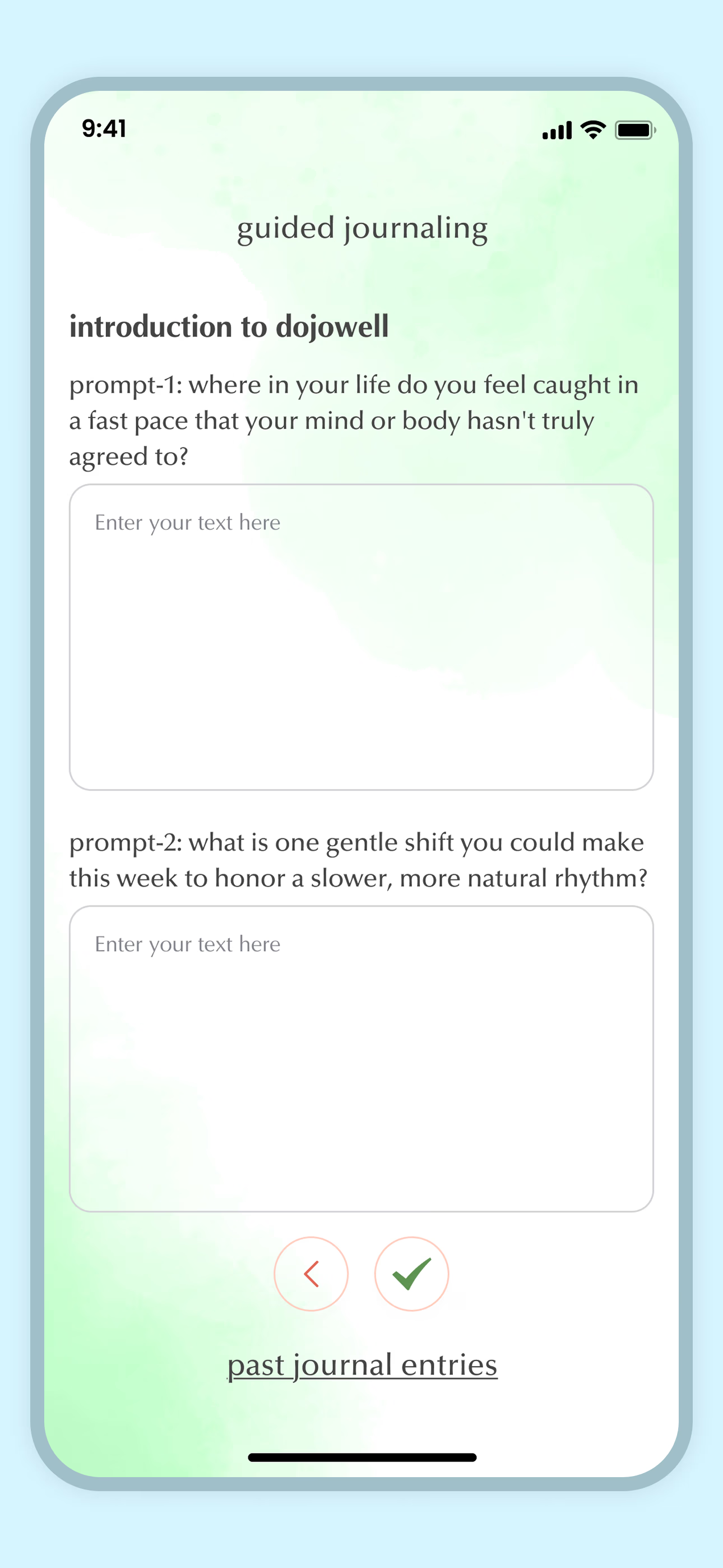
From Science to Art.
Understanding explains what is happening. Art allows you to feel it—without fixing, judging, or naming. Pause here. Let the images work quietly. Sometimes meaning settles before words do.
One Quiet Window, one insight, one reflection — every Sunday