

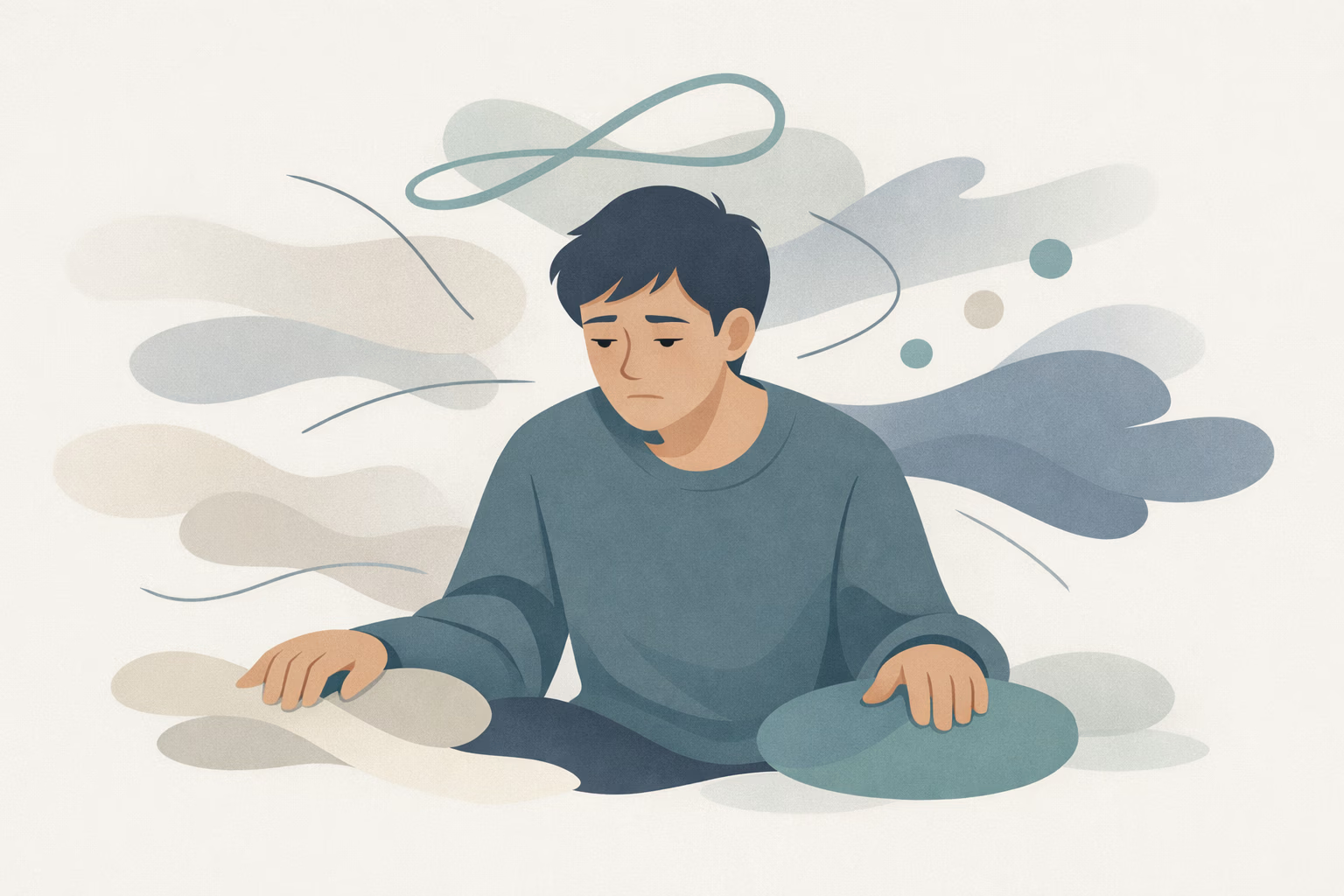
Internal Mental Chaos & Fragmented Thoughts
Learn why your thoughts pull in opposite directions and how to restore internal clarity.
In context: This happens when “experience has no edges.“ Overload compresses your internal boundaries until the different areas of your life lose their distinct “Meaning Density.“ In the Meaning Density Model™, “edge-less experience“ is a sign of extreme structural compression. Your Narrative system can no longer tell where one story ends and another begins.

Experience has no edges.
Feelings bleed into thoughts.
Thoughts spill into tasks.
Boundaries soften under load.
This is not confusion— it is compression.
The system reduces separation when space is limited.
Naming the lack of edges restores orientation.
You are not losing clarity.
You are operating inside density.
Boundaries return when space returns.
Name boundary loss gently with DojoWell.
Explore DojowellArticles exploring the psychology behind these patterns.
Learn why your thoughts pull in opposite directions and how to restore internal clarity.
Learn why emotions feel heavier on certain days.
Understand why minor stressors hit hard when you're overwhelmed.
This happens when "experience has no edges." Overload compresses your internal boundaries until the different areas of your life lose their distinct "Meaning Density." In the Meaning Density Model™, "edge-less experience" is a sign of extreme structural compression. Your Narrative system can no longer tell where one story ends and another begins. This "blur" makes it impossible for any single event to feel significant, leading to a sense of "hollow overwhelm."
You create edges through "Rituals of Completion." When you finish work, do something physical—change your clothes, wash your face, or take a specific route home—to signal the end of that loop. These "transition rituals" provide the structural markers your Narrative system needs to categorize experiences. By building clear "gates" between the different parts of your day, you restore the boundaries that allow meaning to land and your identity to feel coherent again.
One Quiet Window, one insight, one reflection — every Sunday