Stress Threshold: Why Some Days You Break Faster Than Others
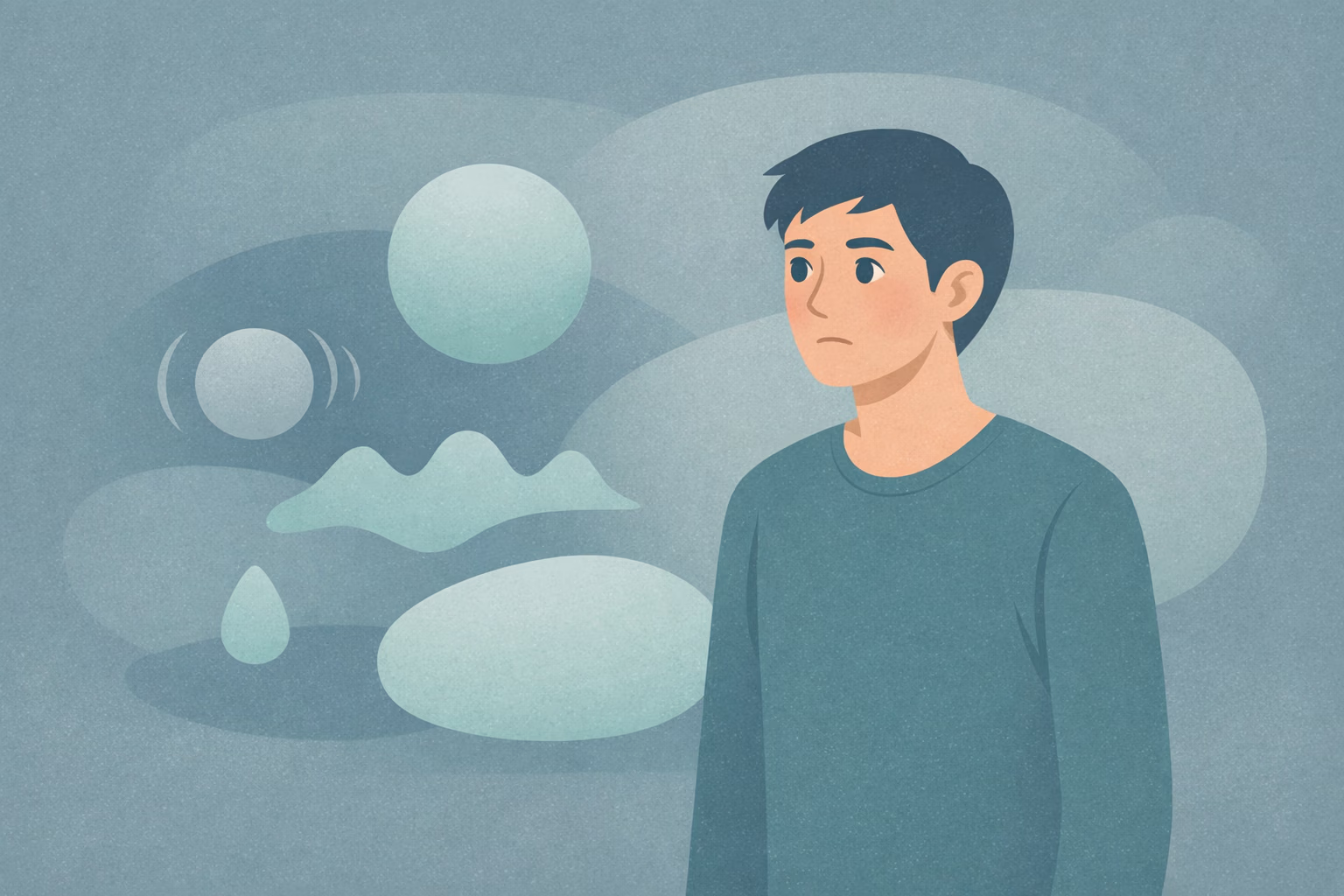
In short: There are seasons when a minor inconvenience—an email tone, a spill on the floor, a slow checkout line—lands like a heavy blow. The reaction can feel immediate and out of proportion, and afterward you might wonder what happened to your usual patience.
There are seasons when a minor inconvenience—an email tone, a spill on the floor, a slow checkout line—lands like a heavy blow. The reaction can feel immediate and out of proportion, and afterward you might wonder what happened to your usual patience.
What if “too sensitive” isn’t your personality—what if it’s your capacity talking?
Stress sensitivity is often a sign that your system is running close to its limit. When the body is carrying more load than it can comfortably complete, it becomes efficient: it flags smaller inputs as urgent, because it has less room to absorb anything extra.
Stress sensitivity often shows up as a sudden mismatch between the size of the event and the size of the reaction. A small frustration can trigger a sharp surge of heat, tears, snapping, shutting down, or a need to escape the moment.
What makes it especially disorienting is the “second wave” that can follow: self-critique, embarrassment, confusion, or the sense that you’re becoming someone you don’t recognize. In reality, this pattern often reflects wear-and-tear in the body’s stress systems—an overload state where the margin for error has gotten thin. [Ref-1]
When your buffer is small, everything feels louder.
Your nervous system doesn’t react only to the current moment; it reacts with the resources you have available in the current moment. When restorative inputs have been limited (sleep, safety cues, time, nourishment, steadiness), the threshold for “this is manageable” drops.
In higher-capacity states, your system can hold more friction before it needs to mobilize. In lower-capacity states, the same friction can trigger a full-body response because your physiology is already busy maintaining baseline stability. This is one reason burnout and high allostatic load are associated with reduced tolerance and increased reactivity. [Ref-2]
Under strain, the brain and body shift toward protection. That shift isn’t a moral verdict; it’s a biological budgeting decision. When internal resources are limited, the system allocates more attention to scanning, predicting, and preventing additional cost.
This can make neutral inputs feel pointed, ambiguous inputs feel risky, and normal demands feel heavier. The aim is not to “overreact,” but to reduce uncertainty and keep the organism intact. Stress biology is designed to keep you safe first—and coherent later. [Ref-3]
A strong reaction can function like an emergency lever. It may push distance into a situation (leaving the room, ending the conversation, canceling plans), or it may create a burst of discharge (crying, anger, urgency) that briefly changes state.
From the nervous system’s perspective, that response can be protective because it interrupts accumulating load. It can also signal to others—and to your own body—that something needs to stop. In that sense, heightened reactivity can be a short-term strategy for preventing further overload when more subtle signals weren’t able to land. [Ref-4]
Not “why am I like this?” but “what is my system trying to prevent?”
Many people interpret stress sensitivity as a character change: “I’m getting fragile,” “I can’t handle anything,” “I used to be chill.” But sensitivity often rises when demands outpace completion—when there are too many open loops and not enough “done” signals.
Allostatic load describes how chronic stress accumulates in the body through repeated activation without sufficient recovery or closure. [Ref-5] When load stays high, sensitivity is not a flaw; it’s a sign that the system is working closer to its red line and protecting its remaining capacity.
Stress sensitivity can unintentionally form a loop. When small inputs trigger big outputs, the day becomes more expensive: there are more ruptures, more cleanup, more repair, more social friction, more mental replay. That extra cost further reduces capacity.
Then, with less capacity available, the threshold drops again. The system becomes even quicker to mobilize, because it is trying to prevent the next overload event. Over time, this creates a self-reinforcing pattern: reactivity drains reserves, drained reserves increase reactivity. [Ref-6]
Because this is about load and thresholds, not personality, it can look different across people and across weeks. The pattern is often recognizable by its speed: you go from “fine” to “flooded” quickly, with little middle ground.
Some common forms include: [Ref-7]
These are regulatory responses—ways the system tries to manage incoming demand when the margin is small.
Persistent sensitivity doesn’t just make moments harder; it can narrow the range of life that feels workable. You may begin to avoid certain places, conversations, tasks, or types of feedback—not because you’re incapable, but because the cost-to-capacity ratio no longer makes sense to the body.
Over time, this can change relationships and self-trust. People may not know what version of you they’ll meet, and you may start to pre-emptively manage everything to prevent activation. Chronic stress is strongly linked to autonomic dysregulation and heightened reactivity, which can make this shrinking feel both physical and interpersonal. [Ref-8]
It’s hard to feel in control when your system is trying to prevent collapse.
Even when a reaction is understandable, it still costs the body. Mobilization takes energy: heart rate changes, muscle tension rises, attention narrows, digestion shifts, and the mind starts running prediction loops. When that activation happens repeatedly, the baseline can start to feel keyed-up or brittle.
This is why stress sensitivity can feel like it “spreads.” You’re not only responding to today’s stressor; you’re also carrying the residue of yesterday’s activation that never fully completed into a settled “done.” Safety and threat cues shape physiology moment by moment, and when safety cues are scarce, the system stays on guard more easily. [Ref-9]
Restoring tolerance is less about forcing calm and more about the conditions that allow activation to complete. When experiences can finish—when the body receives enough safety and time to stand down—thresholds gradually widen.
This is a different kind of change than insight. Understanding why you snapped can be clarifying, but it isn’t the same as the physiological settling that happens when the system can close loops and return to baseline. Over time, with repeated opportunities for regulation to complete, the body begins to treat more of life as non-emergency. [Ref-10]
Coherence is the feeling of having enough room inside for life to be life-sized again.
Stress sensitivity often improves when the interpersonal environment becomes easier to metabolize—when there is less pressure to perform stability, explain quickly, or “be fine.” This isn’t about being handled; it’s about reducing the number of extra tasks your nervous system must run while it’s already under load.
When people around you respond with steadiness and clear boundaries, your body receives cleaner signals. Interoceptive pathways—how the brain reads the body’s internal state—help shape what feels safe, doable, and coherent in real time. [Ref-11] Less social threat and less ambiguity can translate into more internal room.
As capacity returns, a subtle shift happens: you can notice a stressor without immediately becoming it. The reaction still exists, but it’s more proportional, and it resolves with less aftermath.
People often describe this as patience returning, a longer fuse, or fewer “spikes” across the day. It can also look like being able to stay connected during small conflicts, or recovering faster after a hard moment. Supportive social conditions can buffer stress physiology, making regulation less costly. [Ref-12]
When stress thresholds widen, avoidance loses its job. Not because you “push through,” but because the body no longer needs distance as urgently. Challenges can become workable again: a difficult conversation, a crowded place, a messy house, a complex decision.
This is also where identity begins to feel more coherent. You can make choices that align with your values because your system has enough stability to stay present with effort and uncertainty. Connection matters here: supportive relationships reduce perceived isolation and help the nervous system hold stress without tipping into emergency mode. [Ref-13]
Agency returns when your system can afford participation.
Stress sensitivity is often a form of honest data: your system is signaling that the cost of living has exceeded the available buffer. That message can be uncomfortable, but it is not shame-worthy. It points to capacity, not character.
In a culture that rewards constant output and quick recovery, it can be easy to interpret sensitivity as failure. Another interpretation is simpler: your nervous system is trying to create closure and prevent further overload. When self-criticism rises, it often adds load rather than coherence; a kinder internal stance can reduce the secondary hit and support steadier regulation over time. [Ref-14]
There is a particular relief in noticing that the world hasn’t gotten harsher—you’ve just been carrying too much for too long. As load decreases and more experiences are allowed to complete, your reactions tend to regain proportion.
Small stressors return to their rightful scale. And in that steadier space, it becomes easier to recognize yourself again—not as a problem to solve, but as a human system built for protection, connection, and eventual settling. [Ref-15]
From theory to practice — meaning forms when insight meets action.
Because capacity changes the threshold for stress. Your nervous system doesn't react only to the current moment; it reacts with the resources you have available in the current moment. When restorative inputs have been limited — sleep, safety cues, time, nourishment, steadiness — the threshold for this is manageable drops. In higher-capacity states, your system can hold more friction before it needs to mobilize. In lower-capacity states, the same friction triggers a full-body response because physiology is already busy maintaining baseline stability. When your buffer is small, everything feels louder. Sensitivity is information about load, not about character.
Often it's a story rather than the reality. Sensitivity rises when demands outpace completion — too many open loops and not enough Done Signals. Allostatic load describes how chronic stress accumulates through repeated activation without sufficient recovery, and high load is consistently linked with reduced tolerance and increased reactivity. So when you feel like you're getting fragile or used to be more chill, that's usually not a character change. It's a sign that the system is working closer to its red line and protecting its remaining capacity. The story too sensitive misses what the body is actually communicating about resource depletion.
Through compounding cost. When small inputs trigger big outputs, the day becomes more expensive: more ruptures, more cleanup, more repair, more social friction, more mental replay. That extra cost further reduces capacity. With less capacity available, the threshold drops again, and the system becomes even quicker to mobilize, trying to prevent the next overload event. Reactivity drains reserves; drained reserves increase reactivity. The Avoidance Loop here doesn't require dramatic fear — just lower buffer, bigger reaction, more downstream consequences, less capacity tomorrow. Over time, life can shrink as you avoid places, conversations, or tasks because the cost-to-capacity ratio no longer makes sense.
Something subtle: you can notice a stressor without immediately becoming it. The reaction still exists, but it's more proportional, and it resolves with less aftermath. People describe it as patience returning, a longer fuse, or fewer spikes across the day. More space between trigger and response. Less urgency to escape or control. Fewer residual loops after the moment ends. It can also look like staying connected during small conflicts and recovering faster after a hard one. With more tolerance, avoidance loses its job — not because you push through, but because the body no longer needs distance as urgently. Coherence is the feeling of having enough room inside for life to be life-sized again.
From Science to Art.
Understanding explains what is happening. Art allows you to feel it—without fixing, judging, or naming. Pause here. Let the images work quietly. Sometimes meaning settles before words do.
One Quiet Window, one insight, one reflection — every Sunday