Notification Addiction: How Alerts Control Your Attention
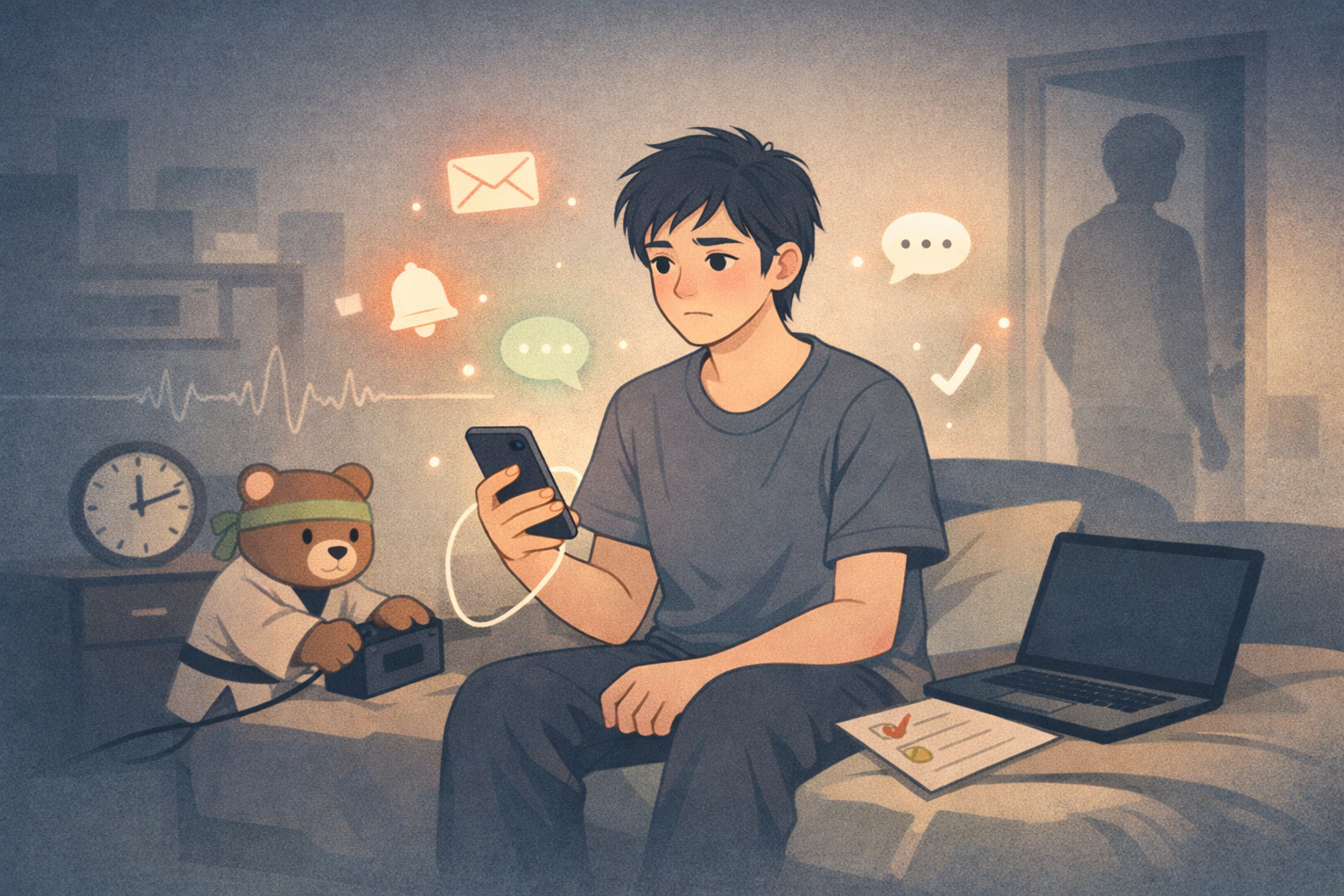
In short: Always-available pressure is the modern expectation that you can be reached, respond, and stay coordinated at nearly any moment. It can look ordinary—just “staying on top of things”—but inside the body it often functions like a low-grade alarm that rarely gets a true stand-down.
Always-available pressure is the modern expectation that you can be reached, respond, and stay coordinated at nearly any moment. It can look ordinary—just “staying on top of things”—but inside the body it often functions like a low-grade alarm that rarely gets a true stand-down.
What happens to a human nervous system when “later” stops being an option?
This isn’t about lacking discipline, caring too much, or being “bad at boundaries.” Many people are responding exactly as a social nervous system would respond when reachability becomes tied to safety, belonging, and professional survival.
Always-on pressure isn’t only the time spent answering messages. It’s the ongoing monitoring: the quick scan of the screen, the mental tab left open, the half-listening for a ping even while doing something else.
In that state, “free time” can still feel occupied. A delayed reply can carry a subtle guilt signal, not because you did something wrong, but because the system senses an unresolved social thread that hasn’t reached closure. Over time, this creates a vigilance loop—attention keeps returning to what might be waiting. [Ref-1]
It can feel like you’re not working, but you’re not truly finished either.
Human threat detection is not only about physical danger. It also tracks social stability: whether you’re in good standing, whether coordination is intact, whether anything urgent could cost you status, income, or connection.
When responsiveness is expected at any time, the nervous system has fewer reliable safety cues. Messages can arrive unpredictably, and the brain treats unpredictability as “keep checking.” That can elevate stress physiology and make downshifting harder—not as a personal failing, but as a logical output of a system trained to stay ready. [Ref-2]
For most of human history, being reachable—within your group, your home base, your shared rhythms—was part of staying safe. Coordinating quickly could prevent loss, reduce conflict, and keep resources moving. In that context, responsiveness was not “productivity.” It was social survival.
Modern connectivity stretches that survival logic across the entire day. The nervous system still interprets reachability as a safety factor, even when the actual “threat” is an email thread, a client expectation, or an unread message count. [Ref-3]
Fast responses often create immediate relief: the open loop closes, the potential consequence is muted, and control feels restored. That relief is real—physiologically, the system receives a quick “resolved” signal.
The catch is that relief and integration are not the same. Relief is a state change; it reduces tension in the moment. Integration is a deeper settling that happens when experiences complete in a way that the body and identity both register as done.
In always-on culture, many loops “close” just enough to stop the discomfort, but not enough to restore true stand-down. The system learns: stay close to the inbox, because that’s where relief lives. [Ref-4]
In many workplaces and social circles, quick replies get interpreted as competence, care, and dependability. The story becomes: if you’re reachable, you’re reliable.
But the body keeps its own accounting. Chronic readiness consumes attention, and attention is not infinite. When it’s repeatedly diverted by monitoring and micro-responding, it becomes harder to sustain depth, creativity, and recovery. The appearance of reliability can coexist with an internal sense of depletion. [Ref-5]
Always-available pressure often operates like a Power Loop: an environment rewards a narrow signal (fast responsiveness), and that signal becomes a substitute for deeper measures of value—craft, integrity, contribution, or steadiness.
In a Power Loop, the nervous system starts treating responsiveness as a safety behavior. Not because someone is “people-pleasing,” but because consequences feel immediate, ambiguous, and socially loaded. The body adapts by staying prepared, even off-hours. Research on after-hours connectivity links this pattern with fatigue and emotional exhaustion over time. [Ref-6]
When being reachable becomes the proof of being safe, what gets squeezed out?
These patterns aren’t identities. They’re regulatory responses that make sense under conditions of unclear expectations and continuous incoming demands.
Instant reply pressure, even when no one explicitly asked for it
Compulsive checking (a quick scan that doesn’t feel like a choice)
Unease when unreachable, even briefly
“Just in case” monitoring before sleep or upon waking
Overexplaining delays to pre-empt perceived consequence
Many models of after-hours connectivity show a split pathway: when connectivity is experienced as autonomous it lands differently than when it is experienced as compelled. The nervous system can feel the difference, even when the behavior looks the same. [Ref-7]
When the system stays on watch for long stretches, the costs often show up indirectly: irritability, shallower focus, reduced patience, a quicker startle, and a thinner margin for everyday friction. This isn’t “becoming a worse person.” It’s a signal that capacity is being spent on readiness rather than restoration.
After-hours connectivity is consistently associated with more work–family conflict and reduced psychological detachment—meaning the mind and body have a harder time registering that the workday is truly complete. Without that completion signal, recovery stays partial. [Ref-8]
Always-available culture is sticky because it is socially reinforced. Quick responders get thanked, labeled dependable, or simply relied upon more. Meanwhile, the costs of slowness can feel vague but serious: missing a decision, losing a chance, being seen as disengaged.
This creates a double bind: being reachable reduces perceived risk, and being unreachable increases uncertainty. Even when no one is explicitly demanding 24/7 access, the environment can teach the nervous system that delay equals danger. Over time, the loop maintains itself through both praise and fear-of-missing-out consequence. [Ref-9]
One of the most disorienting parts of always-on pressure is that “rest” may not register as rest. You can be sitting still while the nervous system remains oriented outward, waiting for the next interruption.
In that state, what helps isn’t more insight or better self-talk. What helps is the presence of credible safety cues—signals that nothing is being demanded right now, that the loop can complete, that consequences are not imminent. When safety cues return, the body’s readiness can soften without needing to be forced. [Ref-10]
Sometimes the most powerful shift is not doing less, but finally being allowed to be done.
Always-available pressure intensifies when response expectations are ambiguous. Ambiguity keeps the nervous system guessing: Is this urgent? Will silence be punished? Did I miss something?
When groups share clearer norms—response windows, escalation paths for true emergencies, and explicit permission for offline time—the perceived threat decreases. The mind doesn’t have to constantly simulate outcomes. Attention can return to the present moment with less scanning. Many discussions of notification overload emphasize how quickly “pings” pull the system into alert mode and how relief increases when expectations are predictable. [Ref-11]
As load reduces and closure becomes more available, a subtle shift occurs: attention stops behaving like a reflex and starts behaving like a choice. Focus deepens not through pressure, but because fewer loops are demanding immediate resolution.
In practical terms, this often looks like longer stretches of uninterrupted thought, less compulsive checking, and more reliable transitions between roles—work, home, rest—because each context can complete more cleanly. Variable notification patterns can drive vigilance and stress spikes; when those cues quiet, the nervous system can re-learn a calmer baseline. [Ref-12]
When availability is driven by vigilance, it tends to feel endless—because the goal is “prevent anything bad from happening,” and that goal has no finish line. When availability is guided by values, it can become more specific: who you want to be for the people you serve, the relationships you protect, the work you want to stand behind.
This is not about becoming unreachable. It’s about restoring authorship. In a more coherent system, responsiveness can be real and generous without being constant. The body’s stress response is sensitive to perpetual alert cues; persistent notifications and hypervigilance have been associated with measurable stress-hormone changes in some contexts. [Ref-13]
What changes when being “reliable” includes being reliably human?
In always-on culture, stepping back can be misread as indifference. But there is another interpretation: preserving the conditions that allow your attention, care, and thinking to remain intact.
From an autonomy perspective, after-hours connectivity tends to be less exhausting when it is experienced as chosen rather than compelled. When choice and meaning are present, the nervous system reads the same behavior differently. In that light, limits aren’t a moral stance; they’re a way of protecting coherence—so your yes actually means yes. [Ref-14]
Always-available pressure can make a person feel perpetually behind, even when they are constantly responding. That sensation is not a character flaw; it’s what happens when closure is repeatedly interrupted and the system is trained to stay on watch.
A meaningful life requires more than responsiveness. It requires intervals where the body can register completion, where identity isn’t being continuously appraised, and where attention belongs to you again. Research linking after-hours connectivity with emotional exhaustion underscores what many already sense: without real detachment, the system keeps paying. [Ref-15]
From theory to practice — meaning forms when insight meets action.
Because the Threat & Safety System reads reachability as a stand-in for social safety. Historically, being reachable kept you tied to your group; modern connectivity stretches that survival logic across the entire day. When responsiveness is expected at any time, the nervous system has fewer reliable safety cues, and unpredictable messages get treated as 'keep checking.' What looks like compulsive checking is often a regulatory response to ambiguous expectations. The body isn't being neurotic — it's calculating that delay equals danger because the environment hasn't taught it otherwise.
On the outside, yes — quick responders get labeled dependable. Internally, it's a different story. Constant readiness consumes attention, and attention is finite. The body keeps its own accounting: chronic monitoring drains the depth and recovery needed to actually do good work. This is the Power Loop dynamic where a narrow signal (fast responsiveness) becomes a substitute for deeper measures of value like craft, integrity, or steadiness. You can appear reliable while running low on the very capacity reliability requires.
Because relief and integration are not the same. Replying fast closes the immediate loop — the system gets a quick 'resolved' signal. But that's a state change, not a true Done Signal. Real stand-down requires credible safety cues that nothing is being demanded right now. In always-on environments, the nervous system stays oriented outward even while you're sitting still, waiting for the next interruption. You can be technically off the clock and still not registered as off by the body.
Ambiguity is the real activator — when expectations are unclear, the nervous system has to constantly simulate consequences. Shared norms (response windows, escalation paths for true emergencies, explicit permission for offline time) collapse that ambiguity. The mind no longer has to guess whether silence will be punished. From there, attention can return to the present without scanning. Boundaries in this frame aren't withdrawal; they're a way of preserving the conditions that let your yes actually mean yes.
From Science to Art.
Understanding explains what is happening. Art allows you to feel it—without fixing, judging, or naming. Pause here. Let the images work quietly. Sometimes meaning settles before words do.
One Quiet Window, one insight, one reflection — every Sunday