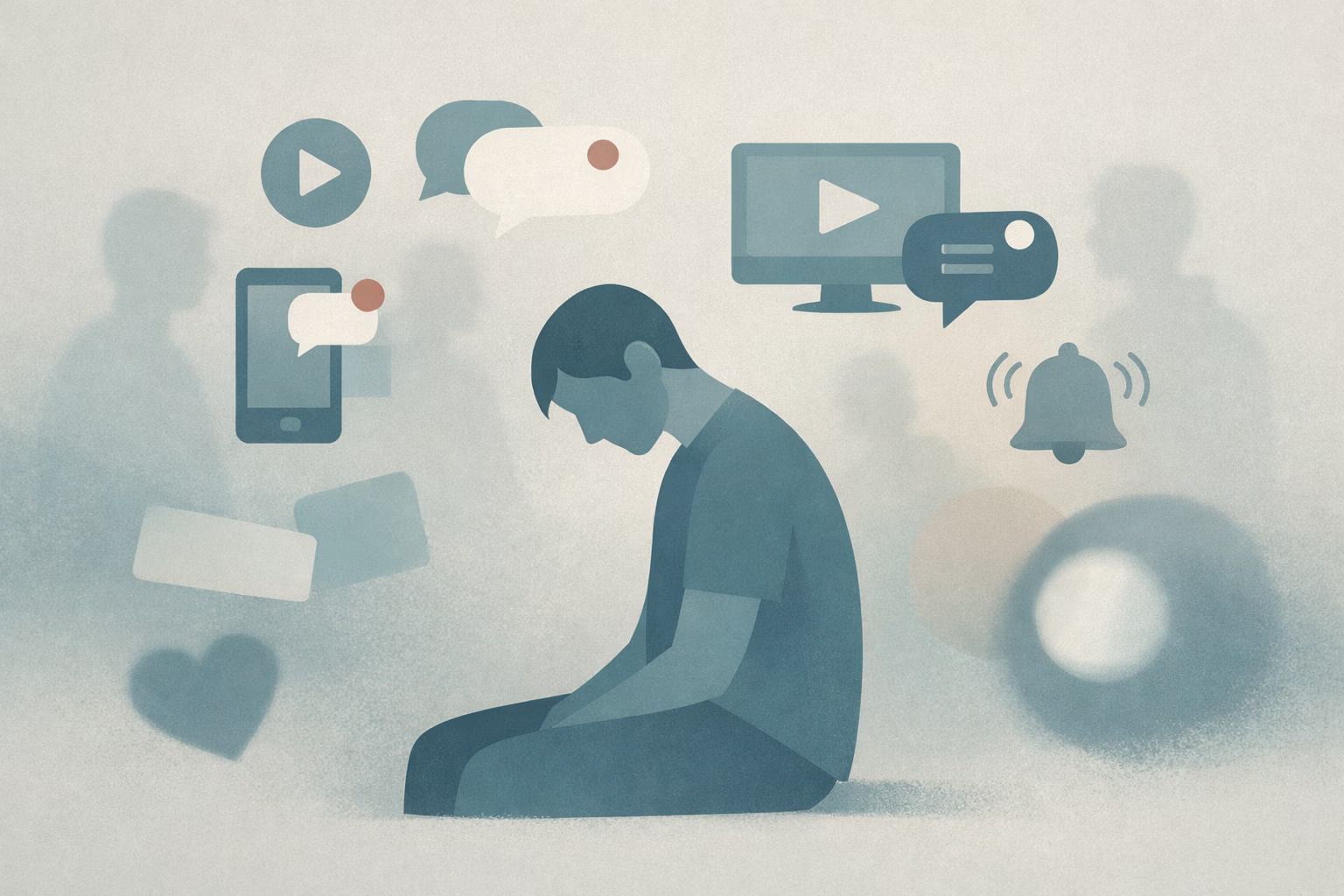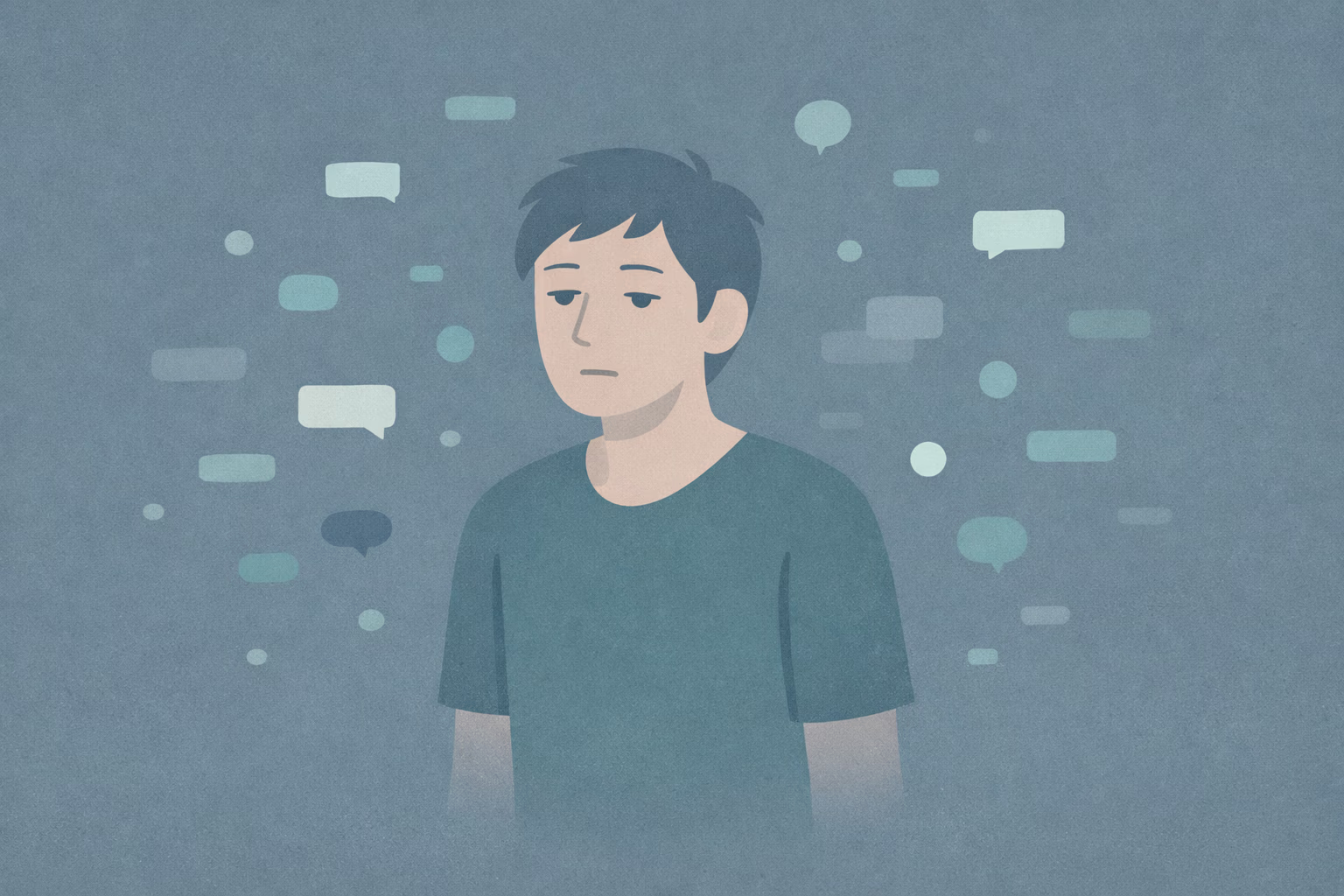
Constant Notifications: Micro-Dopamine Hits That Exhaust Your Mind
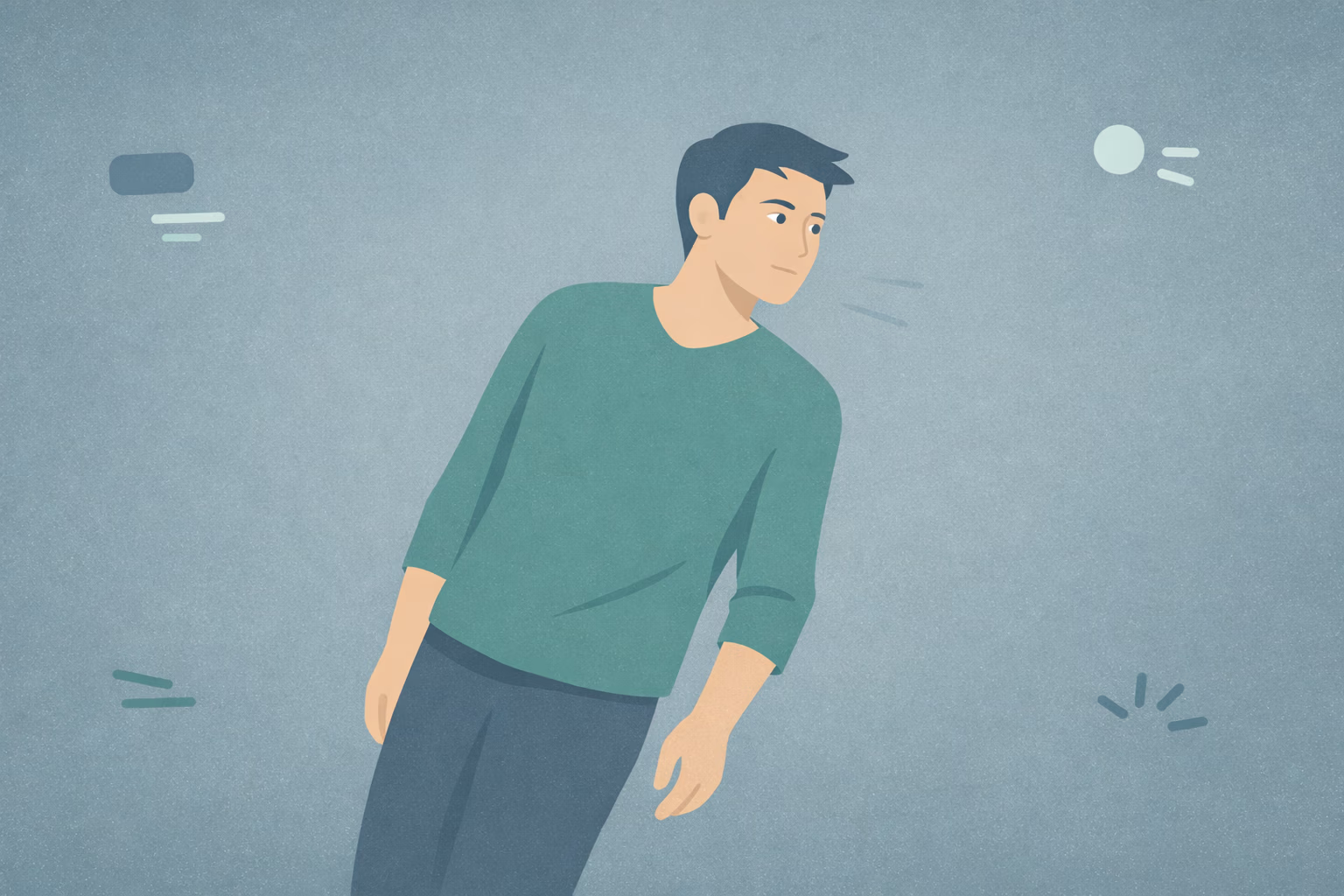
In short: Notifications don’t only deliver information. They arrive as tiny, high-priority signals that your nervous system is designed to treat as relevant—sometimes before you’ve even decided what you care about in that moment.
Notifications don’t only deliver information. They arrive as tiny, high-priority signals that your nervous system is designed to treat as relevant—sometimes before you’ve even decided what you care about in that moment.
When checking becomes automatic, it can feel like you’re living “on call” for devices, work threads, group chats, and apps that never truly close. That experience often carries shame: Why can’t I stop? But the pattern is less about personal weakness and more about how modern alert systems interact with attention, anticipation, and unfinished loops.
What if the problem isn’t your willpower—what if your day is being organized by cues that never let your system complete?
Many people recognize the same micro-sequence: a ping, a buzz, a banner—and the body shifts before the mind catches up. The hand moves. The eyes look. The moment you were in breaks apart. You may even feel a subtle pressure to respond quickly, as if silence might create consequences.
This isn’t simply distraction. It’s a conditioned attentional reflex: alerts become signals that the nervous system ranks as “must-check,” even when the content turns out to be trivial. Over time, the gap between cue and response shrinks, and “choosing” starts to feel like a luxury you don’t reliably have. Research on smartphone notifications has linked them with measurable effects on attention and cognitive control, consistent with this felt loss of autonomy. [Ref-1]
It can feel like you’re not using your phone—you’re responding to it.
A notification is not neutral to the brain. It acts as a conditioned cue: a learned signal that something potentially rewarding, urgent, or socially relevant might be waiting. That “might” is crucial. Uncertain rewards tend to create strong anticipation, which can pull attention away from whatever is already underway.
When anticipation spikes, the brain’s control systems have to work harder to hold the current task in place. This is one reason alerts can degrade task performance even when the message itself is not important—the interruption isn’t only the time spent checking, but the cognitive switching cost and the unfinished thread left behind. Studies on push notifications and task performance describe these kinds of disruptions in measurable ways. [Ref-2]
It’s not that you “lack focus.” It’s that your environment keeps injecting new starting lines.
Long before phones, sudden cues mattered. A crack in the brush could mean threat. A distant call could mean opportunity. Systems that quickly oriented to unexpected signals had survival value, so modern nervous systems still treat abrupt, salient stimuli as important—even when the “brush” is a pocket vibration.
Notifications mimic the profile of biologically meaningful events: they are brief, unpredictable, and interruptive. In a world of constant digital signaling, that ancient bias gets recruited repeatedly, producing a background state of readiness that can be hard to stand down from. Commentary on how constant notifications tax the brain often points to this persistent load and the attentional cost of repeated interruptions. [Ref-3]
Checking a notification often creates a momentary “done” feeling: uncertainty collapses into clarity. Even when the content is mundane, the act of resolving the unknown can briefly settle the system. That can register as reassurance, social validation, or a sense of being needed.
Importantly, this relief is a state change, not integration. Relief can quiet the tension of “something might be happening,” but it doesn’t complete the deeper loops that keep attention on standby—like the sense that more signals could arrive at any time, from any direction.
For many people, the checking response also carries a subtle identity cue: I’m responsive. I’m available. I’m included. That can make the habit feel meaningful even when it’s exhausting. [Ref-4]
Modern notification culture often frames rapid response as competence: quick replies, constant availability, immediate updates. From the outside, it can look like efficiency. From the inside, it can feel like your attention is never fully yours.
When attention is repeatedly redirected by external cues, autonomy erodes in small, almost invisible increments. You may still “get things done,” but the day can lose continuity—less like a lived arc and more like a series of reactive jumps. Over time, that fragmentation can make it harder to feel oriented, because orientation requires sustained contact with what you’re doing and why it matters. Overviews of why notifications are hard to ignore often emphasize this involuntary pull on attention. [Ref-5]
Notification “addiction” is often less about the phone itself and more about a loop the nervous system learns quickly. An alert arrives, anticipation rises, checking resolves uncertainty, and relief follows. That relief becomes reinforcing: the body learns that checking is a fast route back to steadiness.
The catch is that the loop doesn’t create closure in a lasting way. Because alerts keep coming, the system learns to stay ready for the next cue. The relief becomes shorter-lived, and the dependency on the next check can increase—not because you’re seeking pleasure in a simple way, but because the loop offers rapid downshifts from activation.
This is a classic stimulation-regulation pattern: stimulation triggers urgency, checking provides temporary settling, and the environment supplies endless new triggers. Descriptions of how notifications affect the brain commonly outline this repeating cycle of anticipation and reinforcement. [Ref-6]
Because this is a conditioned reflex, it often shows up in predictable patterns. People notice themselves checking without a clear reason, reaching for the phone in transition moments, or feeling unsettled when notifications are muted—not because something bad will happen, but because the system has learned to expect an incoming cue.
Some also experience “phantom” sensations: thinking they heard a ping or felt a vibration that wasn’t there. This isn’t mysterious; it can be a sign that the brain is running a high-sensitivity detection setting, scanning for signals it has come to treat as important. Digital wellbeing writing often notes these patterns as common consequences of frequent notification exposure. [Ref-7]
Each interruption is small; the cumulative effect is not. When attention is repeatedly split, the mind has to re-locate the task, re-load context, and re-establish momentum. That re-orienting costs energy, even if it happens quickly.
Over time, the system may adapt by holding less in working memory and staying closer to the surface—shorter cycles, quicker pivots, more scanning. This can reduce deep-focus capacity not because you “lost discipline,” but because your environment trained your attention to expect disruption as the default setting. Research on digital interruption and cognitive outcomes has described these kinds of fragmentation effects at scale. [Ref-8]
When your day has no uninterrupted middle, it’s hard to feel like anything truly “lands.”
Frequent alerts can retrain the brain toward near-constant stimulation. Silence starts to feel unusually loud. Waiting starts to feel unusually uncomfortable. Not because quiet is inherently threatening, but because quiet no longer matches what the nervous system has been conditioned to expect.
In that state, the body may generate its own prompts—restlessness, scanning, compulsive checking—to recreate the familiar cycle of cue and resolution. Reports linking phantom alerts with phone dependency point to this sensitivity shift, where the system becomes primed to detect signals even when none exist. [Ref-9]
When the brain is trained on constant “incoming,” absence can feel like a problem to solve.
There’s an important distinction between managing notifications and what actually changes the pattern. The deepest shift is not an insight like “notifications are bad,” and it’s not a new rule. It’s when the nervous system gradually stops treating every cue as requiring immediate completion.
That shift involves reduced cue reactivity and a rebuilt tolerance for delayed resolution: the capacity to let a signal exist without instantly closing the loop. When that capacity returns, attention becomes less interruptible—not as a performance upgrade, but as a physiological settling where urgency no longer owns the steering wheel.
Work on phantom phone signals highlights how smartphones can shape perception itself, which helps explain why the change isn’t purely cognitive. When perception has been trained to anticipate alerts, steadiness requires more than “knowing better”; it requires the system to relearn what counts as relevant. [Ref-10]
Notification loops don’t form in isolation. Many workplaces, families, and social groups operate on an unspoken norm: fast replies signal care, reliability, competence, and belonging. The pressure isn’t always explicit, but it can be felt—especially when read receipts, typing indicators, and “seen” markers turn response time into a visible metric.
In that context, checking isn’t only about information. It can be a way to avoid social ambiguity: Am I falling behind? Did I miss something? Will they assume I’m ignoring them? This isn’t a “fear problem” so much as a structural one: communication systems that keep consequences ambiguous can keep nervous systems on standby.
Writing on phantom notification experiences often notes how expectations and habituation interact, making the sensation feel personal even when it is widely shared. [Ref-11]
Sometimes the hardest part isn’t the ping—it’s what the silence might be interpreted as.
When alert-driven urgency loosens, people often describe a subtle but significant change: attention returns to the task more easily, transitions feel less jagged, and the body spends less time in that “waiting for the next thing” posture. This is not about becoming perfectly calm. It’s about having more available capacity—more room for the mind to stay with what it’s already doing.
Another sign is the reduction of false alarms: fewer phantom vibrations, fewer imagined pings, fewer moments of scanning the environment for cues. Research on phantom vibration syndrome and smartphone use supports the idea that these experiences can track with usage patterns and dependency. [Ref-12]
Coherence often feels like: “My attention comes back to me.”
Notifications are powerful because they offer immediate direction: look here now. But direction is not the same as meaning. Meaning has a different texture—it organizes attention around what actually matters to you over time, not what arrives most recently.
When life is fragmented by constant alerts, priorities can become harder to feel. Not because your values disappeared, but because the day doesn’t provide enough continuity for those values to translate into lived identity. As continuity returns, attention can start to follow a more internal compass: conversations that matter, work that has a throughline, rest that actually closes the day rather than merely pausing it.
Discussions of the psychological impact of constant notifications often point to this shift: from being interruption-led to being self-directed, where attention is less externally steered. [Ref-13]
If alerts have been steering your days, it doesn’t mean you’re broken. It often means your nervous system has been trained by repeated cues, unclear endpoints, and constant social evaluability. Under those conditions, reactivity is an understandable regulatory response.
What changes the story is not forcing yourself to “care less,” but recognizing that attention is one of the main ways a life gets shaped. When attention is constantly redirected, meaning can feel thin—not because you lack purpose, but because purpose needs uninterrupted space to become real and complete. Clinical and educational discussions about smartphone overuse frequently connect heavy notification exposure with attention strain and cognitive load, which helps normalize the experience. [Ref-14]
You’re not failing at focus. You’re responding to a system designed to keep you responding.
Over a week, your notifications create hundreds of small turns in your day. Some are useful. Some are noise. Many are simply unresolved pings that keep the system leaning forward.
Without judging yourself, it can be grounding to wonder: Who is deciding what my attention is for—my alerts, or my chosen meaning? When that question becomes more present, agency often begins to feel possible again, not as effort, but as orientation. [Ref-15]
From theory to practice — meaning forms when insight meets action.
Because alerts have become a conditioned attentional reflex, not a deliberate choice. The ping arrives and the body shifts before the mind catches up — hand moves, eyes look, the moment you were in breaks apart. Notifications are designed to land as high-priority signals, which the nervous system ranks as 'must-check' even when the content is trivial. Over time, the gap between cue and response shrinks until choosing feels like a luxury you don't reliably have. That's not a willpower problem. It's a Pleasure Loop the environment installs: alert, anticipation, check, relief, dependency. You're not using the phone — you're responding to it.
From the outside it can look that way. From the inside, it often means your attention is never fully yours. When external cues repeatedly redirect focus, autonomy erodes in increments small enough to ignore: efficiency looks like speed, but coherence feels like continuity, and the day becomes a series of reactive jumps instead of a lived arc. Each interruption carries a switching cost beyond the time spent checking — context has to be re-loaded, momentum re-established, the unfinished thread held in the background. Quick replies signal availability to others. Sustained attention signals direction to yourself. The trade is rarely as flattering as it feels.
Phantom vibrations and imagined pings happen because the brain has been running a high-sensitivity detection setting for so long it starts generating the signals it's been trained to find. After enough exposure to alerts, the system primes itself to detect cues even when none exist — a sensitivity shift, not a malfunction. People also notice reflex checking after opening the phone with no purpose, reaching for the device in tiny pauses (elevators, lines, walking between rooms), and irritability when alerts are off. None of this is mysterious. It's what conditioning produces when the cue has been linked to fast resolution thousands of times.
Less like dramatic calm, more like capacity returning. Attention comes back to the task more easily. Transitions feel less jagged. The body spends less time in that 'waiting for the next thing' posture. Phantom buzzes drop. False alarms drop. The Done Signal becomes available again — meetings end and stay ended, conversations close, the day finishes instead of bleeding into the evening. Underneath, what's shifting is delay tolerance: the capacity to let a signal exist without instantly closing the loop. When that capacity returns, attention follows priorities and meaning instead of whatever arrived most recently. Coherence often feels like: my attention comes back to me.
From Science to Art.
Understanding explains what is happening. Art allows you to feel it—without fixing, judging, or naming. Pause here. Let the images work quietly. Sometimes meaning settles before words do.
One Quiet Window, one insight, one reflection — every Sunday