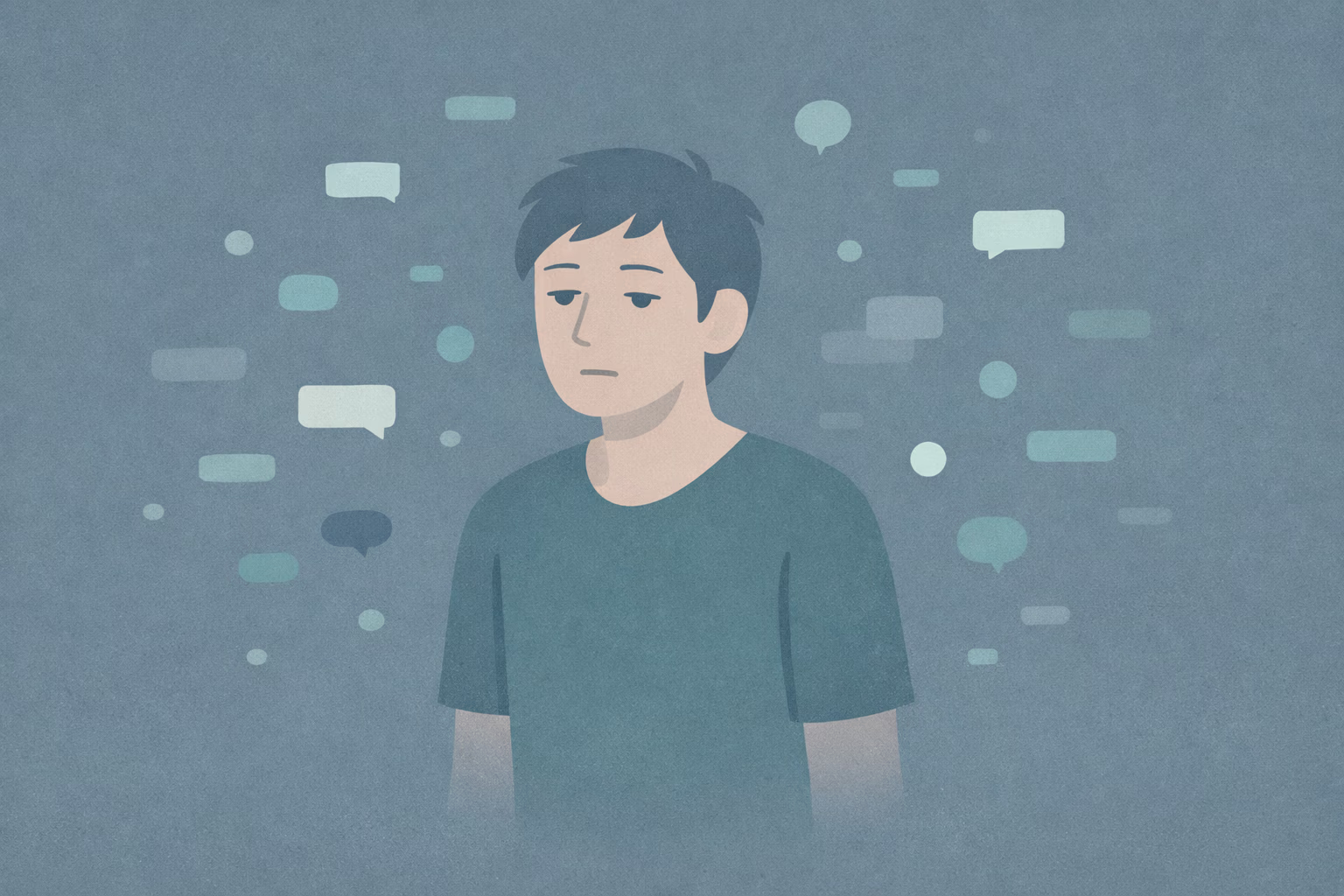
Constant Notifications: Micro-Dopamine Hits That Exhaust Your Mind

In short: That subtle “I should reply right now” feeling can show up even when you’re tired, busy, or technically off the clock. It can look like courtesy from the outside, but inside it often feels like vigilance—like your attention can’t fully stand down until every thread is resolved.
That subtle “I should reply right now” feeling can show up even when you’re tired, busy, or technically off the clock. It can look like courtesy from the outside, but inside it often feels like vigilance—like your attention can’t fully stand down until every thread is resolved.
Why can a simple unread message feel like unfinished business in your body?
In a high-velocity digital world, availability becomes a proxy for care, reliability, and belonging. When cues are incomplete—no tone of voice, no facial expression, no clear ending—your system may keep the loop open, scanning for social safety until it gets a “done” signal.
Many people recognize the specific mix of sensations: a quick pulse of urgency, a flicker of guilt for taking “too long,” and a mental checklist that keeps returning to the same conversation thread. That doesn’t mean you’re needy or overly sensitive. It often means your system is tracking connection like a live variable that could shift without warning. [Ref-1]
Digital messaging creates a strange kind of closeness: you can reach someone instantly, but you can’t see whether you’re landing well. When a message goes unanswered, the interaction doesn’t clearly complete—it suspends. Your attention may keep circling because the situation hasn’t resolved into certainty.
Unfinished communication can feel like a tab left open in the background—quiet, but still running.
Humans are built to detect social shifts quickly. Small cues—response time, short replies, silence—can register as meaningful because they can change how safe or supported a person feels in a group. When cues are ambiguous, the nervous system often increases vigilance rather than relaxing.
This is part of basic threat detection: when information is incomplete, the body can mobilize to reduce uncertainty. That mobilization may look like checking, refreshing, composing the “perfect” reply, or staying mentally on-call even when your day continues. Digital spaces amplify this because they provide partial signals (seen receipts, typing bubbles, silence) without full context. [Ref-2]
Long before phones, belonging wasn’t just emotional—it was practical. Being in good standing with others affected access to protection, shared resources, and cooperation. When connection felt shaky, it made sense for attention to tighten and track the relationship more closely.
Messaging platforms can recreate that ancient math in a new costume. A delayed response can feel like “something changed,” even when nothing has. In face-to-face life, micro-repairs happen naturally: a smile, a warm tone, a quick clarification. In text, the repair can be postponed, leaving the loop open longer than your body prefers. [Ref-3]
Quick replies often work—not because they solve everything, but because they create an immediate closing cue: the interaction moves forward, uncertainty drops, and the body gets a small stand-down signal. That relief can be real and measurable as a shift in internal load.
Over time, the nervous system can start to associate speed with safety: “If I answer now, nothing can go wrong.” The problem is that relief is not the same as integration. Relief changes state in the moment; integration is what happens when a loop completes in a way that settles into identity-level trust: “I can be a good person and still be unavailable sometimes.” [Ref-4]
What if the urgent feeling is your system seeking closure, not your personality demanding perfection?
Availability can initially feel like care and competence. But when responsiveness becomes the default requirement, your attention gets leased out in tiny fragments. The cost isn’t only time; it’s coherence. Your day stops feeling like one continuous life and starts feeling like a set of interruptions you must keep up with.
In that state, even neutral moments—waiting in line, cooking, transitioning between tasks—can become scanning zones. Instead of being natural recovery spaces, they turn into chances to “catch up.” This can erode the sense that you own your focus, which is a quiet but important part of feeling like yourself. [Ref-5]
Not power as domination—power as social positioning: staying in good standing, avoiding disapproval, preventing status loss, keeping access to belonging. In many social ecosystems (work, family, group chats), responsiveness gets interpreted as respect and loyalty, even when no one explicitly says that.
This creates a loop: perceived evaluation increases internal pressure; internal pressure drives faster responding; fast responding becomes proof that constant access is normal; and “normal” becomes the new baseline you’re measured against. Over time, it can feel less like a choice and more like a rule you didn’t agree to. [Ref-6]
When the body expects social consequences, it tends to keep the channel warm. That can look like behaviors that are easy to judge from the outside but make structural sense on the inside: they reduce uncertainty quickly, even if they increase load overall. [Ref-7]
These aren’t moral failures. They are coherence-seeking behaviors in an environment that rarely provides clean closure.
If your system is repeatedly mobilized for micro-social management, the result isn’t just tiredness—it’s cumulative load. You may notice irritability, reduced patience, or a quiet resentment that feels confusing: “I like these people, so why do I feel trapped?”
Boundary blur is a predictable outcome when interactions never fully end. Without clear off-ramps, relationships can begin to feel like ongoing obligations rather than chosen connections. Research on technoference links frequent digital interruption with overload and reduced life satisfaction, especially when it spills into home life. [Ref-8]
When every moment is potentially interruptible, rest stops feeling legitimate.
One reason the pressure intensifies is that responsiveness reshapes the environment. When you reply quickly most of the time, other people’s expectations naturally shift. They come to experience rapid access as the relationship’s “normal,” even if they never demand it out loud.
At the same time, your internal system learns a pattern: “Urgency works.” Each quick reply reduces uncertainty, which reinforces the habit. This is how a loop becomes self-sustaining: it stabilizes both external expectation and internal anxiety-reduction mechanics. Technoference research describes how cross-domain interruptions can build overload over time, especially when the phone becomes a recurring social portal that keeps attention partially allocated elsewhere. [Ref-9]
The deepest tension here isn’t really about messages. It’s about what messages have come to represent: proof of care, proof of reliability, proof that you still belong. When responsiveness becomes the evidence, delays can register as risk—even when your values haven’t changed.
There’s a different kind of stability that doesn’t depend on constant proof: when the body receives enough consistent safety cues—through predictable relational patterns and a coherent sense of self—gaps in contact stop reading as emergencies. This isn’t “thinking differently” your way out of it. It’s the slower, physiological settling that happens when repeated experiences complete cleanly and become part of lived identity: “I am connected even when I’m not immediately reachable.” Research on technoference emphasizes how pervasive device-mediated interruptions can alter relational climate, which helps explain why restoring a sense of safety often requires more than insight alone. [Ref-10]
Relationships tend to feel better when communication has structure: beginnings, middles, endings; clear expectations; and repair when timing doesn’t line up. When that shape is missing, each message can feel like a new evaluation moment instead of a simple exchange.
When people share reliable signals about availability, relationships often become less charged. Not because anyone becomes less caring, but because the system stops relying on constant access to confirm care. Research on technoference in families highlights how frequent device interruptions can affect relational experiences over time, suggesting that steadier patterns can protect connection quality. [Ref-11]
What changes when your relationships can tolerate “later” without meaning “loss”?
As load decreases and interactions complete more cleanly, urgency often reduces—not as a dramatic breakthrough, but as a quieter return of capacity. Attention becomes less sticky. Silence becomes less interpretive. The body spends less time in social surveillance.
In this state, delayed responses are more likely to read as neutral data rather than personal danger. You may notice that conversations can pause without feeling like they are collapsing, and that your mind returns to what you were doing with less effort. Many discussions of delayed replying emphasize that timing is often about context, not care—an idea that can become more believable when your nervous system is no longer running at high vigilance. [Ref-12]
Reactive availability is when the channel controls you: pings set the tempo, and your sense of steadiness depends on keeping the loop tight. Intentional responsiveness is different: contact becomes one part of life, not the supervisor of it.
This shift isn’t about becoming indifferent. It’s about belonging no longer being dependent on immediate performance. When your system trusts the relationship’s continuity, you can respond from orientation—who you are and what matters to you—rather than from urgency. In other words, responsiveness becomes an expression of identity, not a requirement for safety. [Ref-13]
Connection grows through reliability over time, not constant reachability in the moment.
The pressure to be available online often rides on a modern social fog: many channels, many people, and few clear endings. In that fog, the mind can overestimate the cost of a delay and underestimate the strength of the relationship itself—especially when “missing something” feels like a social risk. [Ref-14]
When connection is defined by instant access, everyone stays slightly on alert. When connection is defined by depth, consistency, and repair, the nervous system gets clearer closure cues. And with clearer closure, agency returns—not as a pep talk, but as a felt sense that your time and attention belong to a life that makes sense.
Healthy limits don’t have to mean distance. Often they protect the parts of you that make connection possible: steadier attention, less resentment, more presence when you are with someone. In that way, boundaries aren’t a rejection of relationship—they’re a protection of it.
If constant availability has been your nervous system’s way of keeping social life stable, it deserves respect, not shame. And if your system starts to accept that belonging can survive pauses, that’s not “giving up.” That’s your body learning that safety can be durable. [Ref-15]
From theory to practice — meaning forms when insight meets action.
Because the interaction hasn't clearly completed — it's suspended. Digital messaging creates a strange kind of closeness: you can reach someone instantly, but you can't see whether you're landing well. Without tone, facial cues, or a clear ending, your nervous system keeps the loop open and tracks connection like a live variable that could shift. That's not neediness; it's coherence-seeking under partial information. Seen receipts, typing bubbles, and silence supply just enough signal to keep attention engaged but not enough to land closure. Your attention circles back because the situation hasn't resolved into certainty, and the body treats unfinished communication like a tab still running in the background.
Through perceived social positioning. In many ecosystems — work, family, group chats — responsiveness gets read as respect, loyalty, and reliability, even when no one says so. Perceived evaluation increases internal pressure, pressure drives faster replying, fast replying becomes proof that constant access is normal, and normal becomes the baseline you're measured against. That's the Power Loop in availability form: not domination, but staying in good standing and avoiding status loss. Over time it stops feeling like a choice and starts feeling like a rule you didn't agree to. Each quick reply teaches the system that urgency works, which keeps the cycle self-sustaining.
Because it creates a closing cue: the interaction moves forward, uncertainty drops, and the body gets a small stand-down signal. The relief is real — measurable as a shift in internal load. The trap is that the nervous system starts to associate speed with safety: if I answer now, nothing can go wrong. But relief isn't the same as integration. Relief changes state in the moment; integration is what happens when a Done Signal lands deeply enough to settle into identity-level trust — the felt sense that I can be a good person and still be unavailable sometimes. Without that integration, each new message reopens the same urgency.
Yes — limits often protect the parts of you that make connection possible: steadier attention, less resentment, more presence when you are with someone. Reactive availability lets the channel control you; pings set the tempo, and your steadiness depends on keeping the loop tight. Intentional responsiveness is different — contact becomes one part of life, not the supervisor of it. When your system trusts the relationship's continuity, you can respond from orientation rather than urgency. Connection grows through reliability over time, not constant reachability in the moment. A relationship that can tolerate later without meaning loss is a relationship with real coherence.
From Science to Art.
Understanding explains what is happening. Art allows you to feel it—without fixing, judging, or naming. Pause here. Let the images work quietly. Sometimes meaning settles before words do.
One Quiet Window, one insight, one reflection — every Sunday