Emotional Exhaustion: When Your Tank Is Empty but Life Keeps Going
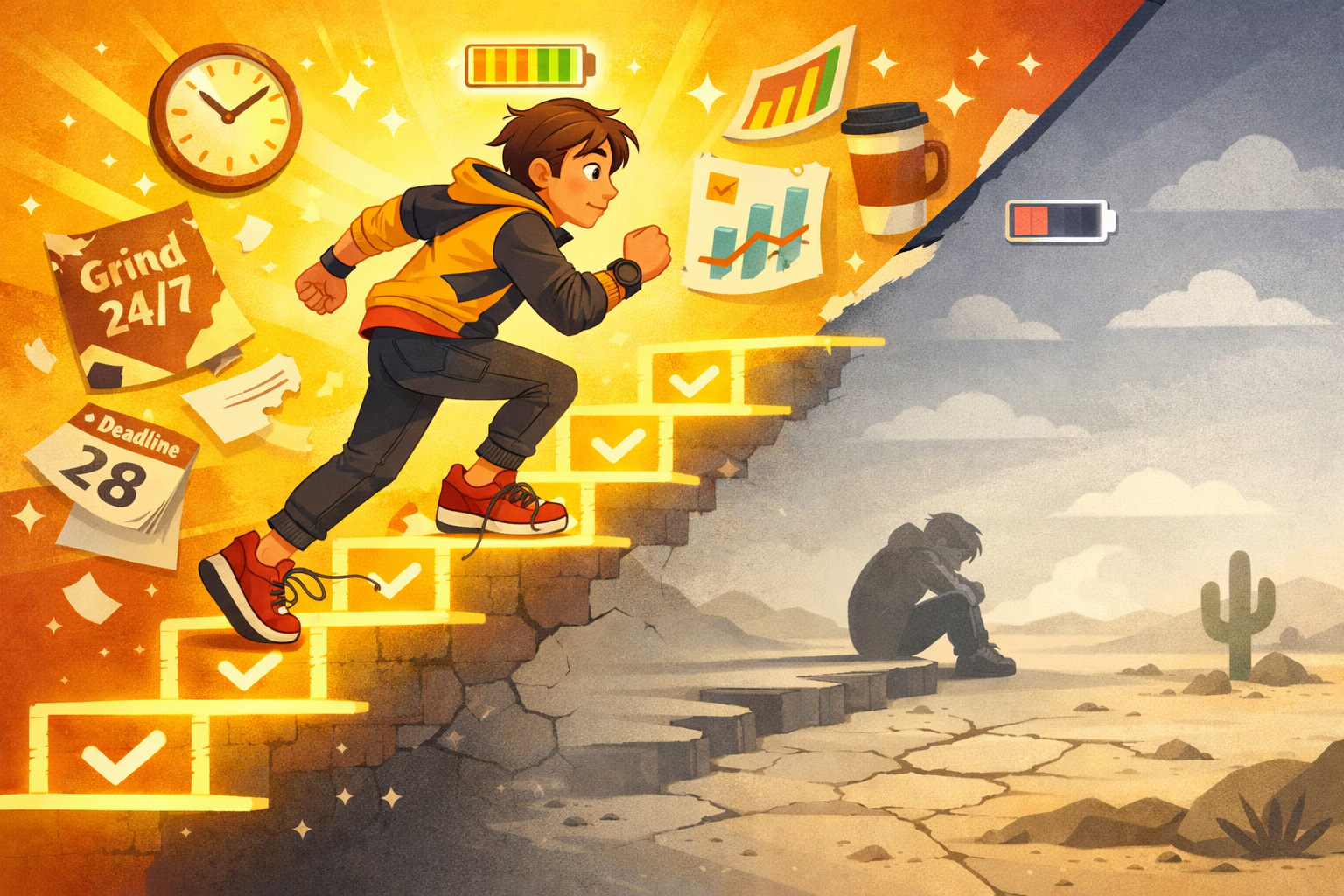
In short: “Hustle energy” often gets framed as ambition, drive, or having what it takes. But a lot of what people call high energy is actually a specific body state: urgency, narrowed focus, and a surge of control that can temporarily override fatigue.
“Hustle energy” often gets framed as ambition, drive, or having what it takes. But a lot of what people call high energy is actually a specific body state: urgency, narrowed focus, and a surge of control that can temporarily override fatigue.
What if the crash isn’t a character flaw—but a predictable nervous system consequence?
When your body is running on emergency chemistry, it can produce impressive bursts of output. The trouble is that this kind of energy doesn’t create stability. It creates momentum by postponing recovery, closure, and the internal “done” signals that let the system stand down.
Many people recognize the sequence: a sharp rise in focus, speed, and tolerance for stress—followed by a drop that can feel like exhaustion, irritability, brain fog, or emotional flatness. The contrast is part of what makes hustle energy so convincing: the “up” feels like competence, and the “down” feels confusing.
In the up-state, your system can temporarily mute signals that would normally guide pacing—hunger, fatigue, soreness, the need for sleep, even the sense that something is too much. When the push ends, those signals return, often all at once, because they were delayed rather than resolved. [Ref-1]
It can feel like you didn’t slow down—you just ran out of you.
Under pressure, the body can release adrenaline and cortisol to increase alertness, mobilize energy, and sharpen attention. In the short term, this response can support performance: you move faster, decide quicker, push through discomfort, and stay vigilant. [Ref-2]
The catch is that this chemistry is designed to prioritize immediate demands—not long-range repair. As it ramps up, recovery systems tend to get deprioritized: digestion, deep sleep cycles, immune maintenance, and the subtle internal feedback that helps you pace. The body is not “lying” to you when you feel energized; it is reallocating resources toward urgency.
So the later crash isn’t random. It’s the delayed arrival of what your system couldn’t fully process during the surge.
From an evolutionary perspective, surges of mobilized energy helped humans respond to short-lived threats and high-stakes moments: conflict, pursuit, scarcity, sudden danger. Brief activation followed by release is a coherent loop: mobilize → act → resolve → recover.
In modern life, the “threat” is often abstract and continuous: performance metrics, social evaluation, financial uncertainty, constant availability. The same emergency system gets recruited, but the loop doesn’t reliably complete. Instead of a clean stand-down, you get repeated activation with partial closure. Over time, the body treats everyday life like a prolonged incident. [Ref-3]
Hustle energy can produce visible results quickly: inbox cleared, project shipped, revenue increased, a late-night sprint that “saves” something at the last second. That speed creates a compelling story—especially in environments that reward urgency.
There’s also a psychological coherence to it: when life feels uncertain, urgency can feel like control. The nervous system tends to prefer a stressful plan over an unstructured unknown, because at least the plan produces immediate signals—movement, traction, proof. In that way, pressure can masquerade as stability.
Acute stress can sometimes enhance performance in the short run, which further reinforces the idea that this state is your best self. [Ref-4]
Threat-based output can look like extra energy, but it’s frequently a redistribution of energy. You’re not necessarily creating more capacity—you’re pulling forward what would have been used for repair, integration, and restoration later.
That’s why the bill tends to arrive after the deadline, after the launch, after the exam, after the busy season. The body can delay fatigue signals, but it can’t erase the need for completion. When recovery is postponed repeatedly, the baseline starts to change: you need more activation to do the same work, and you get less back from rest. [Ref-5]
In other words: urgency can produce output without producing “done.”
Hustle energy often runs as a self-reinforcing loop. Urgency narrows attention, control increases, and output rises. Then recovery gets deferred because there’s always one more thing to secure: one more email, one more improvement, one more risk to prevent.
This is less about personal choice and more about a body learning what works inside a specific environment. If your context consistently rewards crisis-response, your system adapts by staying closer to “ready” even when nothing is actively on fire.
Over time, rest can stop feeling like a natural downshift and start feeling like a loss of traction—because the body hasn’t received enough closure to safely stand down. [Ref-6]
Because this state is functional in the short term, it often becomes invisible until it breaks. The signs are usually structural patterns—recurring cycles that keep repeating despite good intentions.
These aren’t personality traits. They’re regulation strategies that work—until the recovery debt becomes too large. [Ref-7]
When activation becomes the default, the body has fewer opportunities to complete stress cycles and return to baseline. The result is often called burnout, but it can look like many things: diminished performance, increased sensitivity, sleep disruption, chronic tension, or a flat “nothing lands” quality in everyday life. [Ref-8]
Importantly, this isn’t just being tired. It’s a shift in capacity. The nervous system becomes less responsive to ordinary safety cues—because it’s trained to treat urgency as the signal for engagement. That can create a strange trap: the only time you feel focused is when you’re under pressure, and the only time you can rest is when you’re too depleted to do anything else.
When people describe “numbness” here, it often reflects load management: the system reduces signal intensity so you can keep functioning. That muting can be adaptive short-term, but it narrows life over time.
Hustle culture doesn’t just reward outcomes—it rewards the visible posture of urgency: being busy, being available, responding instantly, carrying more than your share. Praise can become a kind of external closure: “You did it” replaces the body’s own sense of completion.
Short-term wins also teach the nervous system a rule: effectiveness equals activation. If the moments you feel most competent are the moments you’re most stressed, your system learns to chase that state—especially when the environment provides intermittent reinforcement (sometimes you’re rewarded, sometimes you’re not, so you push harder to make it happen again). [Ref-9]
Over time, calm can start to feel suspicious, not because something is wrong with you, but because calm no longer matches what your body has been trained to associate with success.
There is a different kind of energy that doesn’t spike. It’s steadier, less dramatic, and easier to miss because it doesn’t come with the same intensity. But it has a distinct quality: it supports continuity.
When safety cues are stronger than evaluation cues, the nervous system doesn’t have to keep mobilizing to prove worth or prevent disaster. Effort becomes less about control and more about relationship: with time, with the task, with your own limits. In that state, energy isn’t “manufactured” by pressure—it’s available because fewer resources are being spent on scanning, bracing, and self-monitoring. [Ref-10]
Not everything has to feel urgent for it to matter.
Individual nervous systems don’t operate in isolation. Workplaces, families, and communities all create pacing norms—what counts as “enough,” how quickly people must respond, how mistakes are handled, and whether timelines reflect reality.
When leadership (formal or informal) relies on crisis to coordinate people, adrenaline becomes the management tool. When planning is realistic and responsibility is shared, urgency is less necessary as a coordination strategy. That shift reduces the need for overcommitment—doing more than the system can sustainably hold, just to keep belonging or maintain standing. [Ref-11]
This is not about lower standards. It’s about environments that allow completion rather than permanent activation.
As demands become less intensified and more workable, focus often changes character. It becomes less bursty and more consistent—less dependent on last-minute pressure to “turn on.” [Ref-12]
When the body isn’t repeatedly forced into emergency output, emotional and cognitive signals tend to return with more nuance: you can detect early fatigue, shifting interest, or the need for a boundary before collapse. This isn’t about becoming more emotional. It’s about restored signal return—your system can communicate in normal volume again because it’s carrying less unresolved load.
Sustainable effort has a different aftertaste. Instead of a hollow drop, there’s a sense of completion: not just finishing the task, but feeling finished in yourself.
When hustle energy runs the show, identity can start to fuse with output: if you’re not producing, you’re not safe; if you’re not accelerating, you’re falling behind. That’s a fragile way to live, because it requires constant proof.
Coherence grows when work connects to values and settles into a livable rhythm—when your efforts add up to a recognizable life, not just a sequence of emergencies. In that orientation, purpose becomes a stabilizer, not a slogan: it reduces the need for adrenaline to create meaning.
Research on overcommitment and effort–reward strain links chronic imbalance with burnout and broader distress, which makes the case that sustainability is not a soft preference—it’s a biological constraint. [Ref-13]
If you’ve been living on hustle energy, the crash isn’t evidence that you’re incapable. It’s evidence that your system has been doing something intense and expensive for a long time.
Emergency fuel has a rightful place: short windows, genuine crises, rare sprints. But when it becomes the default, it crowds out the very processes that create stability—closure, recovery, and the quiet consolidation that turns effort into a coherent sense of self.
There is relief in naming this accurately. When the story shifts from “Why can’t I keep up?” to “What kind of fuel am I running on?”, agency becomes possible without self-blame. [Ref-14]
The culture may celebrate urgency, but bodies keep their own records. Over time, regulated energy tends to build more reliable work, clearer relationships, and a steadier sense of identity than constant activation can provide.
You don’t have to prove you deserve rest by collapsing first. The crash is not a moral verdict—it’s a physiological accounting. And when the system is allowed enough closure to stand down, a quieter kind of strength becomes available: the kind that doesn’t require an emergency to show up. [Ref-15]
From theory to practice — meaning forms when insight meets action.
Because hustle energy is a specific body state, not a personality trait: urgency, narrowed focus, and a surge of control that temporarily overrides fatigue. In the up-state, your system mutes signals that would normally guide pacing — hunger, soreness, sleepiness, the sense that something is too much. When the push ends, those signals return all at once because they were delayed rather than resolved. Adrenaline and cortisol prioritize immediate demands, not long-range repair, so digestion, deep sleep, immune maintenance, and pacing feedback get deprioritized. The crash isn't random — it's the delayed arrival of what your system couldn't process during the surge. It can feel like you didn't slow down; you just ran out of you.
Because hustle energy produces visible results quickly and creates psychological coherence. When life feels uncertain, urgency feels like control — the nervous system prefers a stressful plan over an unstructured unknown because at least the plan produces immediate signals: movement, traction, proof. Pressure can masquerade as stability. Acute stress sometimes enhances performance short-term, which reinforces the idea that this state is your best self. But threat-based output isn't extra capacity — it's redistribution. You're not creating more energy; you're pulling forward what would have been used for repair, integration, and restoration later. The bill arrives after the deadline. Urgency can produce output without producing 'done.'
Because hustle culture rewards the visible posture of urgency: being busy, being available, responding instantly, carrying more than your share. Praise becomes external closure — 'you did it' replaces the body's own sense of completion. Short-term wins teach the system a rule: effectiveness equals activation. If the moments you feel most competent are the moments you're most stressed, the nervous system learns to chase that state. This is the Power Loop: urgency narrows attention, control rises, output increases, then recovery gets deferred. Over time, calm doesn't match what your body associates with success, so it feels like loss of traction rather than natural downshift.
Less dramatic and easier to miss because it doesn't come with the same intensity. But it has a distinct quality: it supports continuity. When safety cues are stronger than evaluation cues, the nervous system doesn't have to keep mobilizing to prove worth or prevent disaster. Effort becomes less about control and more about relationship — with time, with the task, with your own limits. Energy is available because fewer resources are being spent on scanning, bracing, and self-monitoring. Focus becomes consistent rather than bursty, less dependent on last-minute pressure to turn on. Sustainable effort has a different aftertaste: not just finishing the task, but feeling finished in yourself.
From Science to Art.
Understanding explains what is happening. Art allows you to feel it—without fixing, judging, or naming. Pause here. Let the images work quietly. Sometimes meaning settles before words do.
One Quiet Window, one insight, one reflection — every Sunday