
Financial Anxiety Loop: When Uncertainty Becomes a Daily Threat
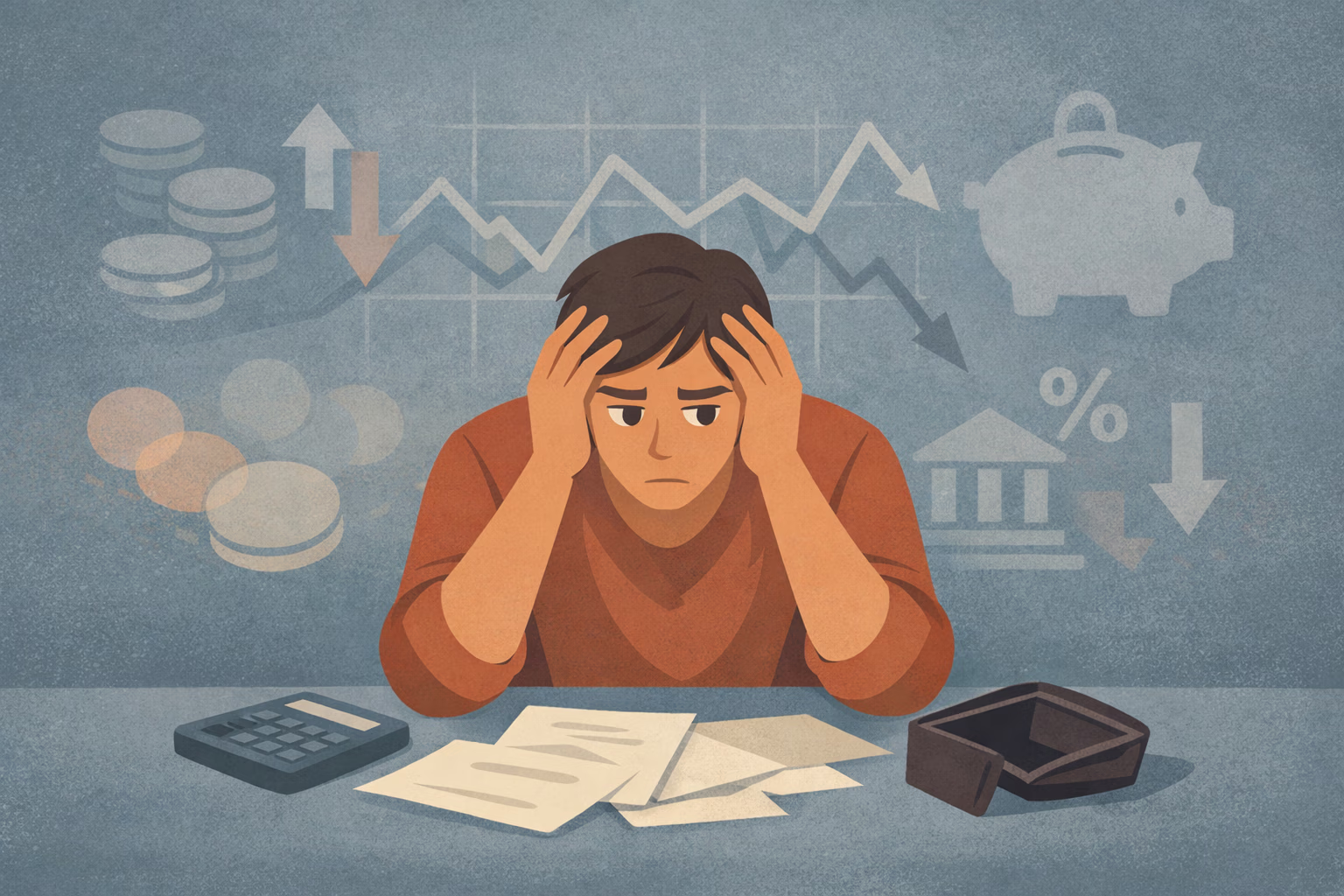
In short: Money stress can look like numbers and spreadsheets on the outside, but it often lands in the body as vigilance, urgency, and a sense that something could fall apart at any moment. That reaction isn’t drama or weakness.
Money stress can look like numbers and spreadsheets on the outside, but it often lands in the body as vigilance, urgency, and a sense that something could fall apart at any moment. That reaction isn’t drama or weakness. It’s a human system doing what it evolved to do when resources feel unstable: scan, brace, and minimize risk.
Why can a bill, a price increase, or a vague economic headline feel so physically heavy?
Because uncertainty doesn’t just create questions. It interrupts closure. When the brain can’t reliably predict “enough,” it keeps certain loops open—attention stays hooked, decisions get harder, and rest stops feeling like rest.
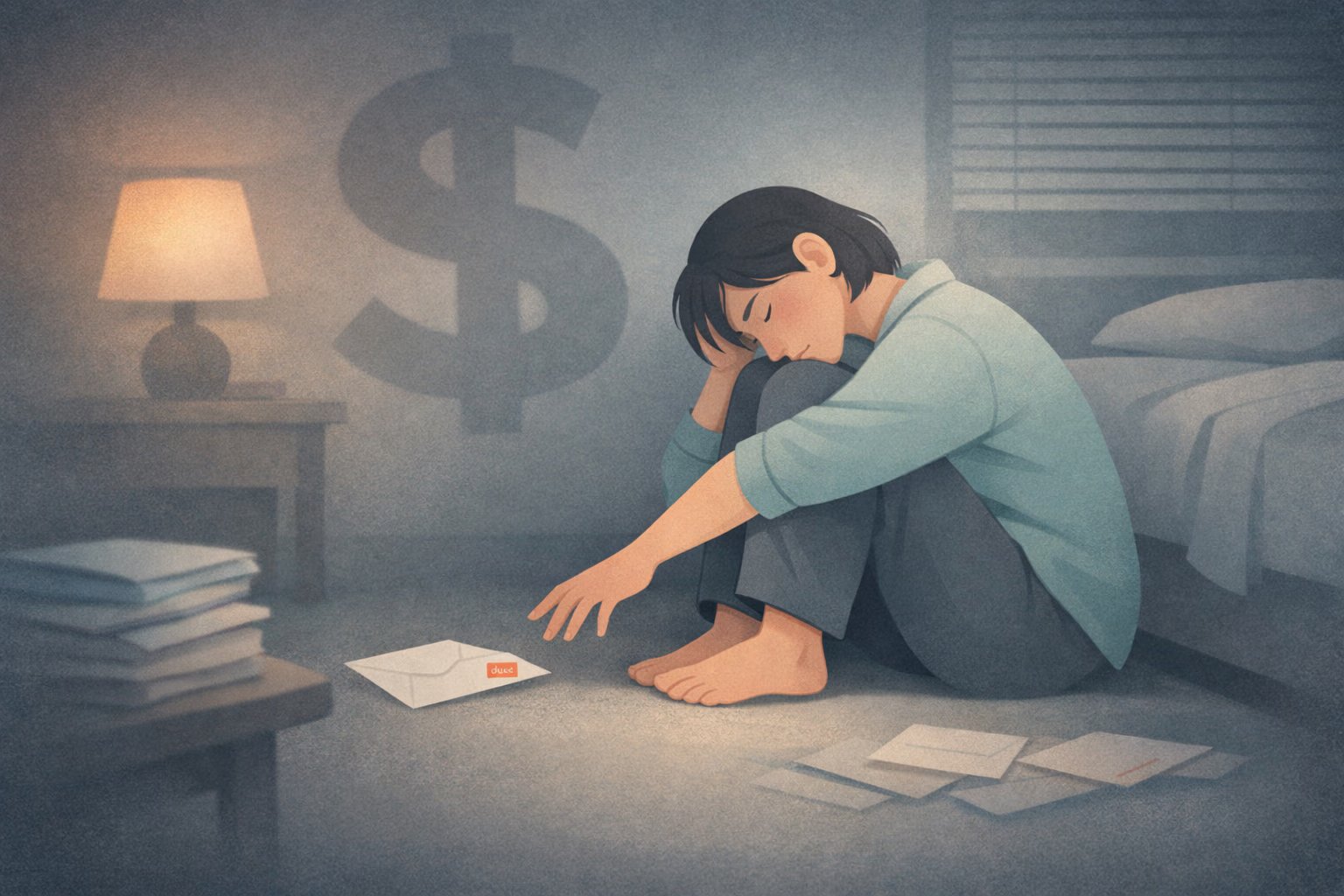
Financial uncertainty tends to create a specific kind of pressure: the sense that even small choices carry consequences you can’t fully see. A routine purchase can feel loaded. A normal email from a bank can spike alertness. The mind starts holding many “unfinished tabs” at once.
This isn’t simply thinking a lot. It’s vigilance—attention repeatedly returning to the same category of threat because the system hasn’t received a clear “done” signal. Research consistently links financial worries with psychological distress, which matches how strongly money-related unpredictability recruits threat physiology. [Ref-1]
When this is happening, it’s common to feel both over-responsible and strangely less capable at the same time. Not because you’re failing, but because capacity shrinks when load stays high.
When a nervous system detects instability around essentials, it tends to shift into a protective mode: stress hormones rise, attention narrows, and the body prioritizes short-term readiness. The result can feel like being “on” all the time—reactive, easily startled, or unable to settle even when nothing immediate is happening.
In that state, the brain becomes more sensitive to cues that confirm risk and less able to access wider context. You may notice reduced emotional flexibility, more irritability, or a lower threshold for overwhelm. Financial stress is also associated with downstream strain on health and immunity, which aligns with what chronic activation does to the body over time. [Ref-2]
The key point is structural: a system under continuous alert cannot easily generate closure. It keeps scanning because scanning is what “safety-seeking” looks like in biology.
In evolutionary terms, resource security was concrete: food stored, shelter stable, group support intact. In modern life, money often becomes the symbolic stand-in for all of that. It doesn’t just buy things; it represents access, continuity, and protection.
So when income is unpredictable, prices jump, or the economy feels volatile, the nervous system may register it as a threat to basic provisioning—even if you’re currently housed and fed. Economic insecurity is strongly associated with mental health strain, which fits this “symbolic survival” effect: the body responds to meaning, not just immediate circumstances. [Ref-3]
This is one reason money stress can feel confusing. The outside facts may look “manageable,” but the inside signal says “unsafe,” because the loop isn’t complete.
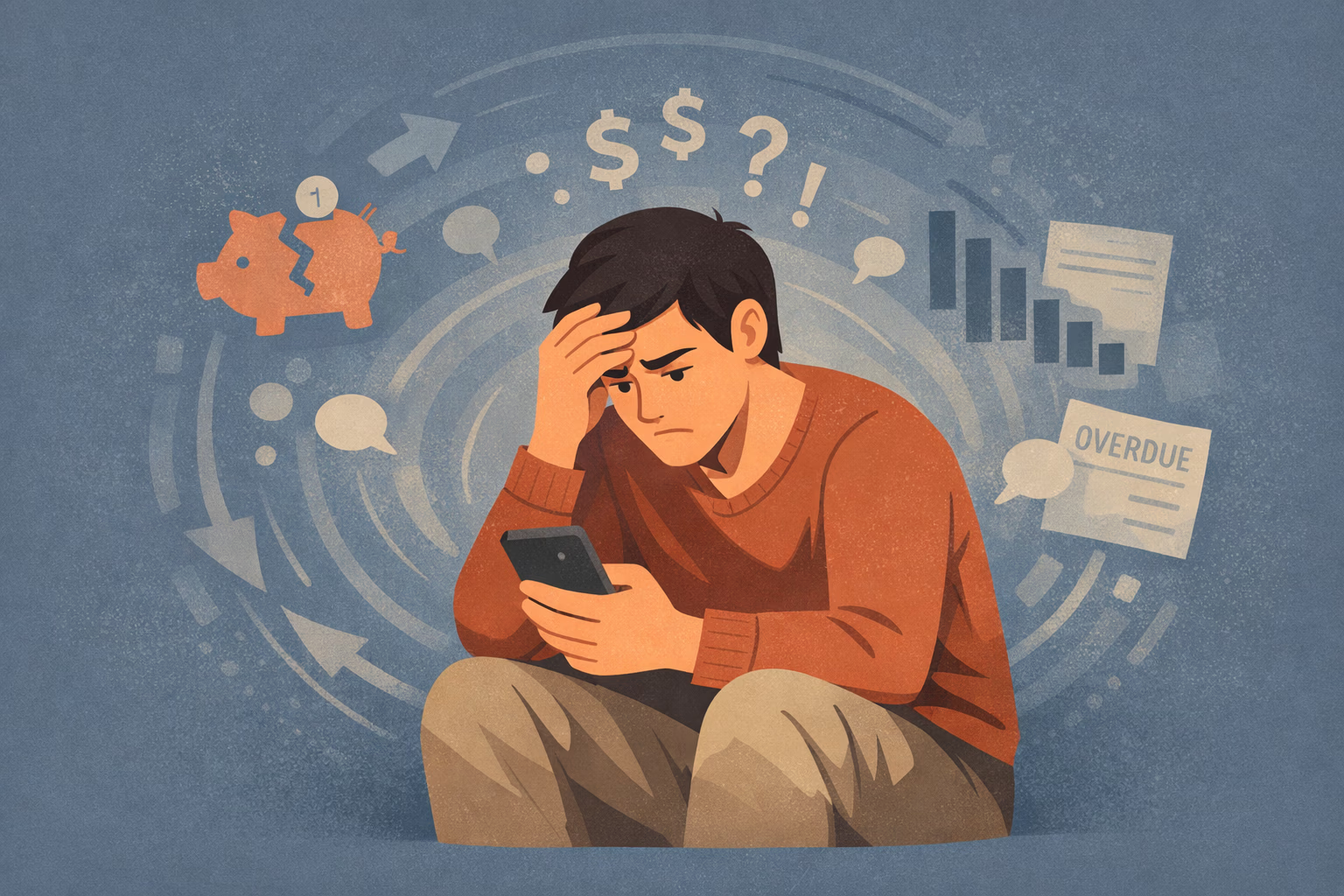
Under uncertainty, many people become more controlling in ways that are easy to misunderstand. Checking account balances repeatedly. Running the same numbers again. Re-reading financial news. Mentally rehearsing worst-case scenarios. These aren’t character flaws; they’re regulatory behaviors that can momentarily reduce the gap between “unknown” and “known.”
For a short time, monitoring can simulate preparedness. It creates a quick hit of orientation: “At least I’m tracking it.” But if the underlying environment remains unpredictable, the relief doesn’t consolidate into closure. The loop reopens, and the system asks for more checking.
Large-scale reports consistently show ties between financial stress and mental health strain—suggesting that the burden isn’t only the money itself, but the ongoing activation required to keep managing uncertainty. [Ref-4]
There’s a common illusion in scarcity conditions: that constant concern is what keeps you safe. In the short term, worry can function like a guardrail—keeping attention from drifting away from risk. But when it becomes continuous, it changes how the brain allocates bandwidth.
Scarcity psychology shows that persistent resource concern narrows focus and can impair higher-level reasoning and planning, not because people become less capable, but because attention is being taxed by an unresolved survival question. [Ref-5]
This is why financial uncertainty can create a painful paradox: the more you try to “stay on top of it” through mental pressure alone, the harder it can become to access the steadiness needed for clear decisions.
In an Avoidance Loop, the system learns that constant vigilance prevents surprise. The cost is that life becomes organized around not triggering the alarm. Not necessarily through conscious fear, but through structural narrowing: fewer options considered, fewer conversations initiated, fewer long-range commitments that might create new uncertainty.
Over time, engagement can shrink. Creativity fades. Long-term orientation becomes harder to access—not because you don’t care, but because threat physiology prioritizes immediate stabilization over expansion. This mental–financial connection is widely noted: financial strain and psychological load reinforce one another, creating a loop that can be hard to exit through effort alone. [Ref-6]
In this frame, avoidance isn’t a personality trait. It’s the system choosing the least activating path when closure is unavailable.
Financial stress has recognizable signatures. These patterns aren’t diagnoses; they’re ways a nervous system attempts to reduce uncertainty and conserve resources under load. Studies linking multiple financial stressors to serious distress reflect how cumulative and compounding these effects can be. [Ref-7]
Often, people judge themselves for these responses. A more accurate description is that the body is trying to keep the story from getting worse—and it uses the tools it has: attention, control, and constraint.
Prolonged financial strain doesn’t only affect mood; it can erode the ability to register stability when it appears. If the system has been trained that “good periods don’t last,” then calm moments may not produce the internal stand-down they normally would.
Economic insecurity is recognized as a socioeconomic determinant of mental health, associated with ongoing distress and reduced well-being over time. [Ref-8] This aligns with what many people feel: even when a paycheck arrives or a bill is paid, the relief can be thin, because the broader loop—predictability, continuity, future safety—still feels unresolved.
When uncertainty is constant, the nervous system may treat “okay for now” as “not safe yet.”
Relationships can also carry spillover. Not because anyone is “bad at communication,” but because stress load reduces the capacity to interpret neutral signals as neutral.
Uncertainty is uniquely activating because it blocks completion. If the brain can’t estimate the edges of a problem—how long it lasts, what it costs, what it affects—it can’t close the loop. The result is ongoing mobilization.
At the same time, threat activation changes perception. Under scarcity, attention is pulled toward immediate deficits, and the mind can become more time-pressured and tunnel-focused. The psychology of scarcity describes how this narrowing can reduce cognitive bandwidth, shaping what feels possible in the moment. [Ref-9]
This creates a structural trap: the calm state needed for broad assessment is the very state that’s hardest to access while the alarm is running. It’s not a willpower problem. It’s a state problem.
There’s a difference between reassurance and stability. Reassurance is a temporary state change: a number looks better, a headline calms down, a payment clears. Stability is what happens when the system can actually complete a loop and stand down—when the body learns, over time, that it can hold uncertainty without needing constant activation.
This doesn’t mean money stops mattering. It means financial challenges stop automatically translating into a full-body survival event. An internal anchor can form when experiences of coping, support, and continuity begin to accumulate into identity-level orientation: “I can face this without collapsing.”
Many wellness resources describe financial stress coping in practical terms, but underneath those strategies is a deeper principle: safety is not only the absence of threat; it’s the presence of enough coherence to return to baseline after activation. [Ref-10]
Money often becomes a proxy battleground for safety. Under threat activation, conversations can turn sharp or shut down quickly—because each detail feels like it might determine survival outcomes. In that mode, even gentle questions can land as evaluation.
When the alarm quiets, communication typically becomes more collaborative. People can share information without it automatically becoming blame, and problem-solving can feel like shared orientation rather than a test. Organizations focused on the money–mental health link emphasize how strongly finances can affect relationships and mental well-being. [Ref-11]
What changes when the system isn’t bracing?
More room appears for nuance: tradeoffs, timing, and mutual support start to register again. Not as optimism—more like restored bandwidth.
When financial stress is high, the mind often becomes more rigid and short-range. When it reduces, something surprisingly specific can come back online: the ability to prioritize, sequence, and tolerate “in-between” phases without constant urgency.
Research on financial stress during the pandemic period highlights how financial strain tracks with shifts in mental health over time—suggesting that when the load changes, the system’s capacity can change with it. [Ref-12]
This return isn’t just “feeling better.” It’s functional: better sleep continuity, clearer recall, fewer intrusive loops, and a more reliable ability to interpret ordinary life as ordinary. In other words, more signals can complete.
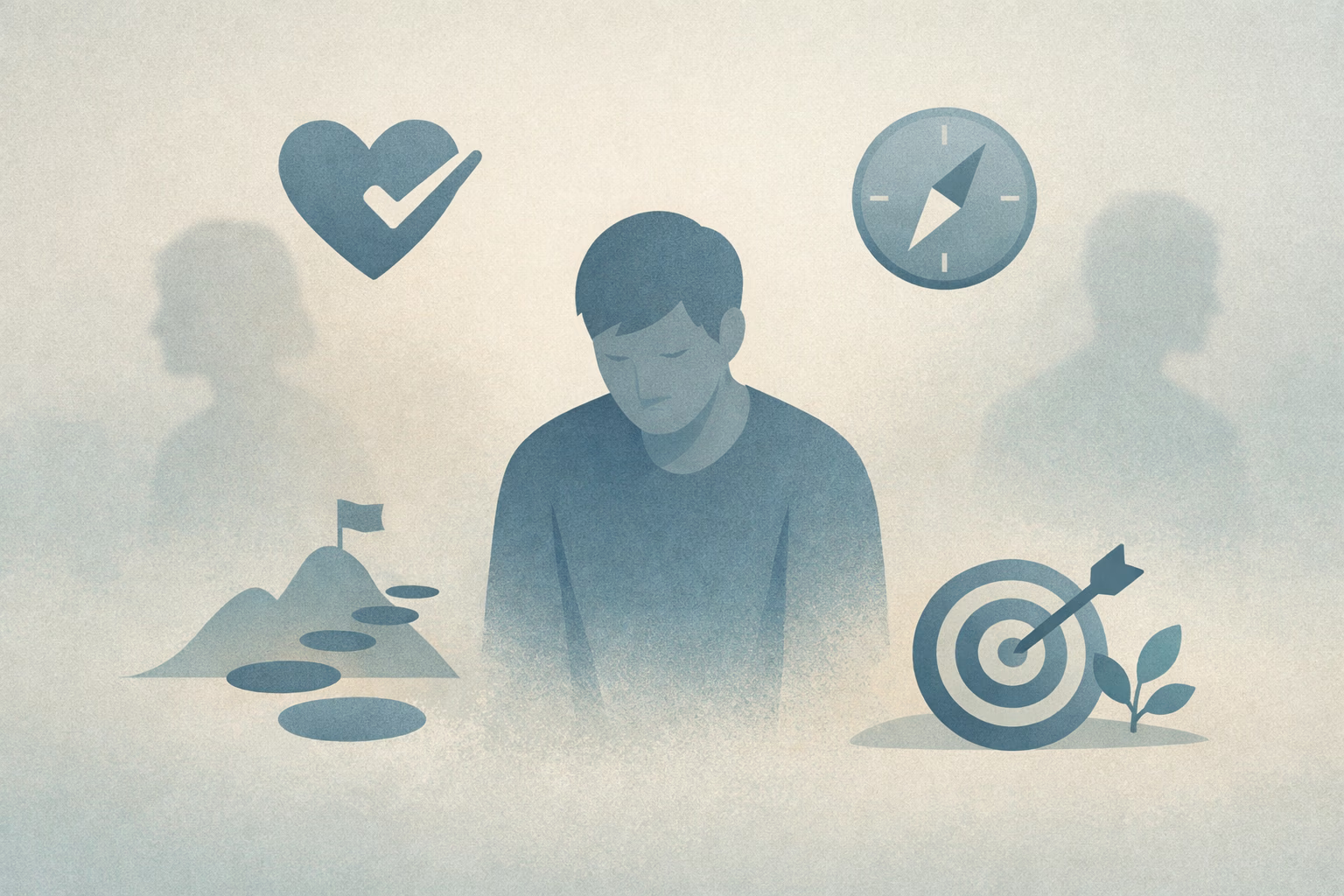
When a system is no longer dominated by near-term survival math, it can begin to orient by values again—what matters, what kind of person you’re becoming, what you want your life to stand for. This is not forced positivity; it’s a biological capacity that returns when threat isn’t consuming the channel.
Evidence linking financial scarcity to cognitive performance underscores a practical point: when scarcity pressure eases, the mind can access more complex thinking. [Ref-13] Over time, that broader capacity supports longer horizons—relationships, learning, health, contribution—because the nervous system isn’t constantly demanding proof of immediate safety.
Meaning, here, isn’t a motivational slogan. It’s what emerges when experiences can land, complete, and integrate into lived identity: “This is hard, and I have continuity.”
Economic uncertainty is a real condition, not an inner flaw. When money feels unstable, your nervous system may respond exactly as it was designed to respond to resource unpredictability: increase vigilance, narrow focus, and seek control. That response can be exhausting, but it is also intelligible.
From a meaning lens, chronic money stress often reflects a lack of closure more than a lack of effort. When the environment keeps changing, the system keeps the loop open—because it can’t confirm “secure enough” yet. Economic insecurity’s impact on mental health is well established, which helps locate the struggle in context rather than in character. [Ref-14]
Agency often grows not from pushing harder, but from restoring coherence: places where life feels more complete, more oriented, more “held” by what matters—so the body doesn’t have to keep proving safety through constant control.
Modern economies can be volatile, and none of us can fully control that. What can change, over time, is how thoroughly uncertainty hijacks the system. When internal stability increases, the same external unpredictability can register as a challenge instead of an emergency.
That shift is dignified and human: not a performance, not a mindset trick, not a permanent calm. More like a quieter baseline that returns more reliably after activation—because more experiences have been able to complete. In a world that often keeps people scanning and comparing, choosing coherence over constant alarm is a form of reclaiming your life as your own. [Ref-15]
From theory to practice — meaning forms when insight meets action.
Because money has become the modern symbol for shelter, food, and belonging. It represents access, continuity, and protection. So when income is unpredictable or the economy feels volatile, the Threat & Safety System registers it as a threat to basic provisioning — even if you're currently housed and fed. The body responds to meaning, not just immediate circumstances. Vigilance rises, attention narrows, and rest stops feeling like rest. The outside facts may look manageable, but the inside signal says unsafe because the loop isn't complete. Uncertainty doesn't just create questions; it interrupts closure.
Because monitoring simulates preparedness without producing closure. Repeated checking, mental math, re-reading financial news, rehearsing worst-case scenarios — these create a quick hit of orientation: "at least I'm tracking it." For a moment, the gap between unknown and known shrinks. But if the underlying environment stays unpredictable, the relief doesn't consolidate. The loop reopens, the system asks for more checking, and the burden becomes the ongoing activation required to keep managing uncertainty. It's not the money alone that exhausts you; it's running survival vigilance as a continuous background process.
Because scarcity narrows cognitive bandwidth. Persistent resource concern pulls attention toward immediate deficits and impairs higher-level reasoning and planning — not because people become less capable, but because attention is being taxed by an unresolved survival question. This creates a structural trap: the calm state needed for broad assessment is the very state that's hardest to access while the alarm is running. Decision paralysis, irritability, sleep disruption, and tunnel focus aren't personality flaws. They're the predictable shape of a nervous system trying to stabilize under continuous load. It's a state problem, not a willpower problem.
Stability isn't the absence of uncertainty; it's the ability to hold it without the body registering every fluctuation as a survival event. There's a difference between reassurance (a number looks better, a payment clears) and coherence — when experiences of coping, support, and continuity accumulate into identity-level orientation: "I can face this without collapsing." Money still matters. But financial challenges stop automatically translating into full-body alarm. As load reduces, conversations become collaborative rather than charged, longer horizons return, and values can guide choices instead of the survival math dominating every decision.
From Science to Art.
Understanding explains what is happening. Art allows you to feel it—without fixing, judging, or naming. Pause here. Let the images work quietly. Sometimes meaning settles before words do.
One Quiet Window, one insight, one reflection — every Sunday