Gig-Economy Uncertainty: Living in Permanent Instability
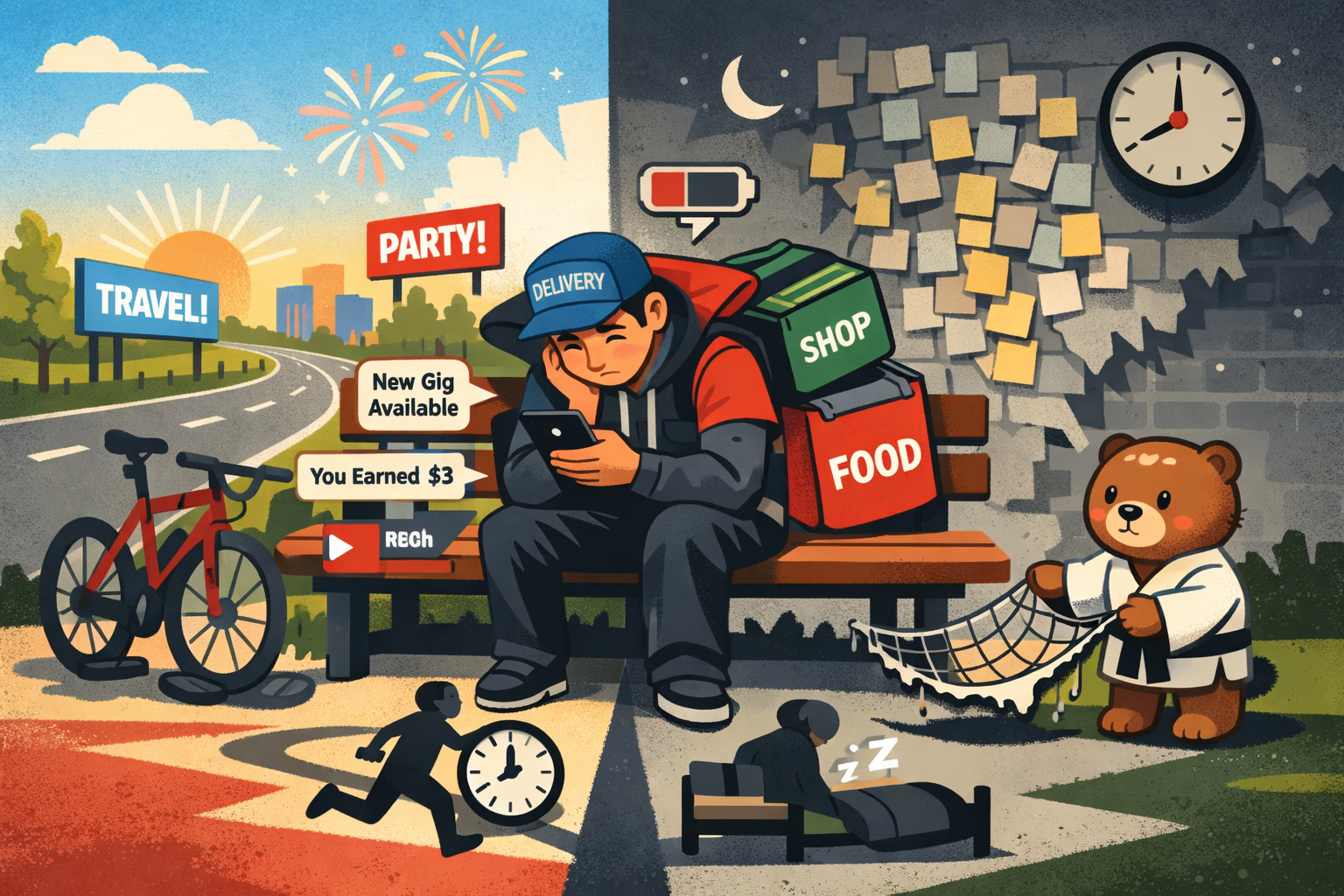
In short: The gig economy often gets described as “freedom”: flexible hours, self-direction, the ability to choose your work. But for many people, gig work also means living inside uncertainty—income that changes week to week, schedules that can dissolve overnight, and invisible rules set by ratings, algorithms, and demand spikes.
The gig economy often gets described as “freedom”: flexible hours, self-direction, the ability to choose your work. And sometimes it is. But for many people, gig work also means living inside uncertainty—income that changes week to week, schedules that can dissolve overnight, and invisible rules set by ratings, algorithms, and demand spikes.
What if what you call “burnout” is your nervous system doing exactly what it was designed to do—staying ready when safety isn’t reliable?
This kind of exhaustion isn’t a personal weakness or a motivation problem. It’s what can happen when your life requires continuous self-protection without enough closure: no clear “done” signal, no stable floor, and no guaranteed recovery time.
Gig burnout often has a particular texture: you might be technically “off,” but part of you is still scanning. A message might come in. A job might appear. A cancellation might hit. And because opportunities and losses can arrive at any hour, downtime doesn’t always register as downtime in the body.
This can look like background anxiety, restless checking, or a feeling of unfinishedness—like your day never quite closes. Even pleasant moments can carry a low hum of readiness, because the system is tracking: Is the next bill covered? Did I miss a booking? Am I still visible? [Ref-1]
When your livelihood is interruptible at any moment, “rest” can feel like a risk rather than a reset.
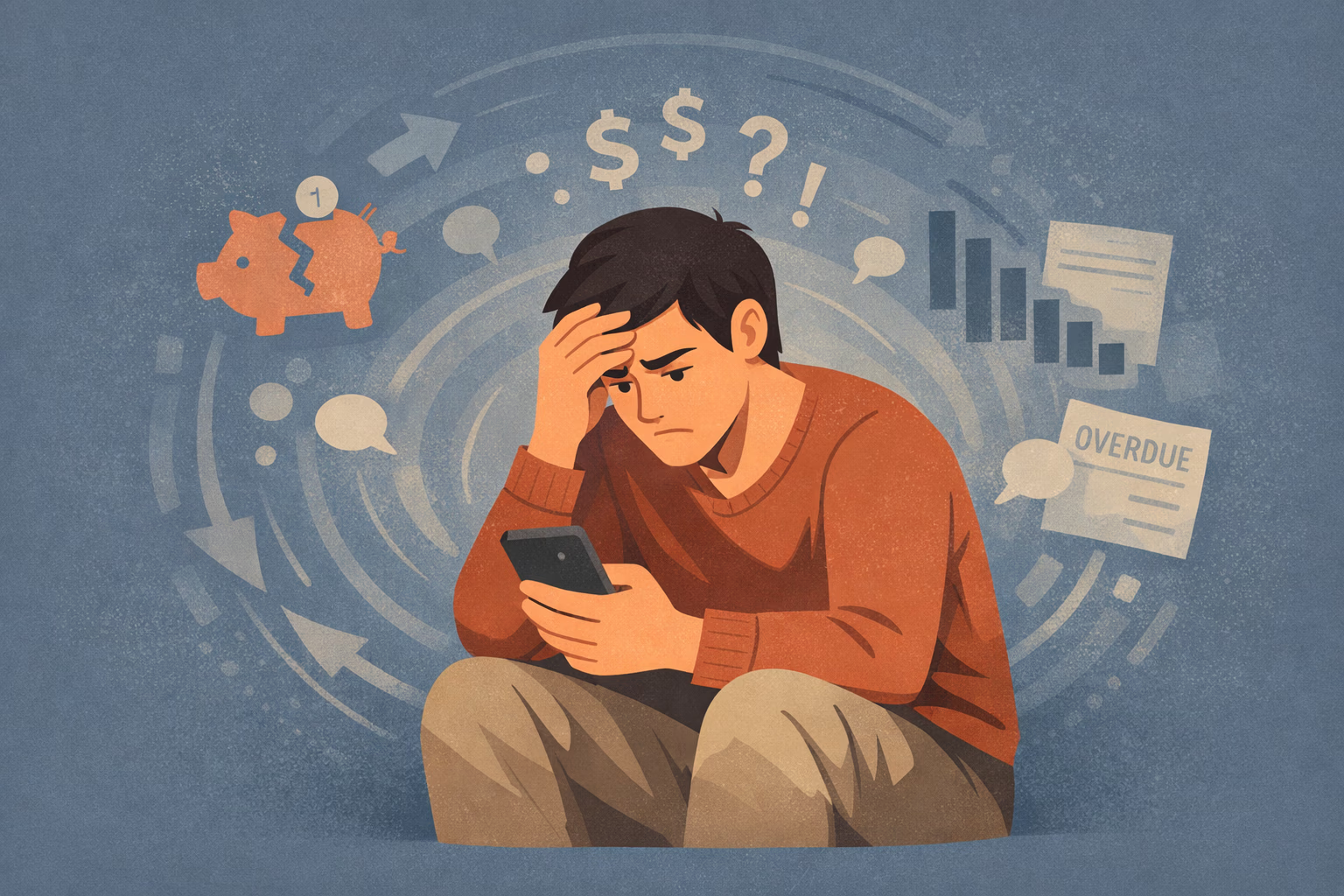
Uncertain income doesn’t just create practical problems; it creates physiological conditions. When basic resources feel variable, the body’s threat and safety systems tend to stay activated longer. Stress hormones and alertness patterns are useful in short bursts, but costly when they become the background setting.
In stable conditions, effort is followed by recovery: work ends, the system stands down, signals return. In volatile conditions, the nervous system may not receive enough “all clear” cues to downshift. That can interfere with sleep quality, digestion, and concentration—not because something is wrong with you, but because uncertainty is being processed as risk. [Ref-2]
For most of human history, survival depended on relatively predictable rhythms: seasons, shared roles, mutual reliance, and social structures that helped distribute risk. Even when life was hard, protection was often collective. Stability wasn’t luxury; it was information—evidence that the world was trackable.
The gig economy can remove some of those stabilizers. When resources are individualized and volatile, your nervous system may interpret everyday variability as a signal that you’re alone with the threat. Research on gig work has linked financial precarity and isolation with lower well-being, which fits this broader biological story: predictability and belonging reduce load. [Ref-3]
When the threat system is active, it looks for ways to reduce uncertainty quickly. In gig work, one of the fastest ways to lower immediate risk is to stay available: take the extra job, accept the late request, keep the app open, answer fast, maintain the rating.
This can create a short-term sense of relief—because action temporarily narrows the uncertainty. But the trade-off is that your life begins to organize around preventing loss rather than completing cycles. Over time, “being on” stops being a choice and becomes the default regulatory strategy. Precarious work is consistently associated with higher stress and worse health-related quality of life, which is another way of saying: vigilance has a cost. [Ref-4]
What happens when the only way to feel safe is to stay reachable?
Flexibility can be real—and still not feel safe. Freedom isn’t only about having options; it’s about having a floor. When the floor is missing (benefits, sick time, predictable demand, stable wages), “choice” often becomes a continuous negotiation with risk.
From the outside, gig work can look like autonomy. From the inside, it can feel like constant calibration: how much to take, how quickly to respond, how to stay visible, how to avoid gaps. Persistent precarious employment has been associated with poorer health outcomes, reflecting the cumulative burden of living without stability cues. [Ref-5]
One way to understand gig burnout is as an Avoidance Loop: a cycle where instability makes rest feel unsafe, and the lack of rest makes everything feel more precarious. The loop is structural. The nervous system doesn’t need a story like “I’m afraid” to keep running it; it only needs repeated evidence that pausing could cost you.
When rest is consistently interrupted or punished (lost opportunities, missed shifts, lower ranking), the system learns that recovery equals exposure. Avoidance coping in work settings is often less about denial and more about trying to keep consequences from landing all at once—staying busy so the threat doesn’t catch up. [Ref-6]
In a system that rewards immediacy and penalizes gaps, many “symptoms” are actually strategies. They are ways the body and mind try to create a substitute for safety: control, speed, and constant readiness.
These patterns can show up across many types of gig work—driving, delivery, creative freelancing, consulting, care work—and they often intensify when work requires emotional presentation (being pleasant, responsive, likable) under evaluation pressure. Emotional labor has been linked with burnout in multiple occupational contexts, especially when demands are high and control is limited. [Ref-7]
When vigilance becomes chronic, the body can’t keep paying at the same rate. Burnout here often includes not only fatigue, but flattening: reduced interest, reduced imagination, reduced capacity to initiate. It can feel like you’re working harder while becoming less able to access the very qualities your work depends on—presence, judgment, creativity, social ease.
This isn’t because you “lost your passion.” It’s because prolonged activation reduces signal return: the nervous system prioritizes detection and response over exploration and synthesis. Financial concern among self-employed workers has been associated with higher distress and reduced well-being, which fits with how persistent uncertainty can narrow cognitive and physiological bandwidth. [Ref-8]
Over time, people may notice:
One of the cruel dynamics of gig burnout is that the very strategy used to reduce risk can prevent the creation of buffers. When you’re continuously working, you may have less time, capacity, or clarity to build anything that would make work less urgent—whether that’s administrative organization, long-term client relationships, or simply the recovery that restores good decision-making.
In other words, overwork can become a substitute safety net, but it’s a fragile one: it requires constant input. And because exhaustion reduces cognitive flexibility, the system becomes more likely to choose the fastest relief option again. Financial instability among freelancers has been described as amplifying anxiety and burnout partly through this ongoing loop of pressure and depletion. [Ref-9]
When you’re running on fumes, “stability-building” can feel like a luxury—even if it’s what you need most.
There’s a meaningful distinction between feeling better in the moment and having the system actually stand down. Relief can happen through stimulation (a new gig, a payout, a five-star review). But stability looks different: it’s when the nervous system receives enough consistent cues that it can reduce readiness without immediately being punished.
This is not the same as insight or reframing. Understanding the loop doesn’t automatically end it. Internal safety is more like a settling at the level of identity and physiology—where “I can pause and still be okay” becomes an embodied expectation rather than a thought.
In the gig economy, that stand-down signal is often missing because the environment stays evaluative and interruptible. Many accounts of gig-related distress emphasize how ongoing performance pressure and uncertainty keep people from downshifting, even when they want to. [Ref-10]
Because humans are social regulators, isolation increases load. When you’re the only one holding the risk—no coworkers, no shared standards, no built-in coverage—your system has fewer external safety cues. Gig work can intensify this by turning peers into competitors and making “support” feel like one more thing to manage.
Community doesn’t erase uncertainty, but it can soften its physiological impact. Shared norms and mutual recognition reduce the sense that every disruption is yours alone to absorb. Discussions of gig worker mental health frequently highlight isolation and lack of support as key stress multipliers. [Ref-11]
What changes when your stress isn’t private anymore?
Often, it’s not that problems vanish—it’s that the nervous system stops interpreting them as solitary threats.
When load reduces and closure returns more often, people frequently report a shift that’s subtle but profound: decisions stop feeling like emergency maneuvers. Rest becomes more plausible because it no longer reads as immediate exposure. Attention comes back online—not as constant focus, but as the ability to return to signals without getting stuck in scanning.
This is the felt sense of coherence: not constant calm, but a more reliable rhythm of engagement and completion. In conversations about gig work and mental health, blurred boundaries and irregular income are repeatedly noted as factors that disrupt recovery—so the reverse is also meaningful: when boundaries and predictability increase, recovery becomes more accessible. [Ref-12]
The deepest shift isn’t just less stress; it’s a reorientation of identity. In a high-uncertainty system, work choices can become primarily about preventing downside: avoiding gaps, avoiding bad ratings, avoiding the next financial cliff. That’s understandable. But it can also thin out meaning, because life becomes organized around escape rather than direction.
When safety becomes more available—internally and externally—values have room to matter again. Sustainability, dignity, craftsmanship, creativity, care, family, learning: these can move from “nice ideas” to real organizing principles. That’s what makes flexibility actually feel like freedom: not just the ability to choose, but the capacity to choose without the body interpreting every option as danger. Discussions of gig economy stress often highlight this tension between flexibility and chronic strain, especially when benefits and protections are limited. [Ref-13]
Stability isn’t the opposite of freedom. It’s what allows freedom to be lived without constant self-protection.
Gig economy burnout is often portrayed as an individual problem: poor boundaries, low resilience, not enough discipline. A more accurate lens is structural: unstable income, unclear limits, constant evaluation, and limited protection create conditions where vigilance becomes rational. Your system adapted to the world it was given.
And because this is about conditions and coherence, shame is a poor tool for change. Meaning returns when life provides more completion and fewer open loops—when your efforts can land somewhere and become “enough,” even temporarily. Many conversations about freelancing and mental health emphasize how insecurity and isolation accumulate; naming that reality can restore dignity and agency without blaming the person who’s been carrying it. [Ref-14]
Flexibility can be a gift. But when it comes without protection—when every quiet hour carries the risk of loss—your nervous system will treat “freedom” as exposure. That isn’t a mindset problem. It’s a safety problem.
When safety cues increase and completion becomes more available, the body can finally stand down. And from that steadier place, gig work can become what it’s often promised to be: flexible, human-scaled, and connected to values rather than constant threat management. The hidden costs of insecurity and ongoing evaluation are real—and so is the possibility of a more sustainable kind of flexibility when stability is present. [Ref-15]
From theory to practice — meaning forms when insight meets action.
Because gig work removes the normal stand-down cues. The article describes the texture directly: you might be off, but part of you is still scanning. A message might come in, a job might appear, a cancellation might hit. Because opportunities and losses can arrive at any hour, downtime doesn't register as downtime in the body. Background anxiety, restless checking, a feeling of unfinishedness — even pleasant moments carry a low hum of readiness. Your nervous system is tracking whether the next bill is covered, whether you missed a booking, whether you're still visible. Rest reads as risk because the floor isn't reliable.
No, and the article reframes this directly. Gig burnout is often portrayed as poor boundaries or low resilience, but it's structural: unstable income, unclear limits, constant evaluation, and limited protection create conditions where vigilance becomes rational. Money becomes a proxy for ancient survival needs, and uncertainty keeps the Threat & Safety System online. Taking the extra job, accepting the late request, keeping the app open — these aren't character flaws. They're the fastest available way to lower immediate risk. The system adapted to the world it was given. Shame is a poor tool for changing structural conditions.
Through a specific cycle the article maps out: instability makes rest feel unsafe, and lack of rest makes everything feel more precarious. When rest is consistently interrupted or punished — lost opportunities, missed shifts, lower ranking — the system learns that recovery equals exposure. Avoidance coping in this context isn't denial; it's keeping consequences from landing all at once. Uncertainty rises, alertness rises, availability increases, recovery decreases, and uncertainty feels even sharper. The loop runs on evidence, not fear. Overwork can become a substitute safety net, but it's a fragile one — it requires constant input to maintain.
More than feeling better in the moment. The article distinguishes relief (a new gig, a payout, a five-star review) from real stand-down — when the nervous system receives enough consistent cues that it can reduce readiness without immediately being punished. This isn't insight or reframing; it's a settling at the level of identity and physiology where 'I can pause and still be okay' becomes embodied expectation. Co-regulation matters too: when stress isn't private, your system stops interpreting every disruption as a solitary threat. Stability isn't the opposite of freedom — it's what allows freedom to be lived without constant self-protection.
From Science to Art.
Understanding explains what is happening. Art allows you to feel it—without fixing, judging, or naming. Pause here. Let the images work quietly. Sometimes meaning settles before words do.
One Quiet Window, one insight, one reflection — every Sunday