
Pattern Awareness: Seeing the Thoughts That Guide Your Life
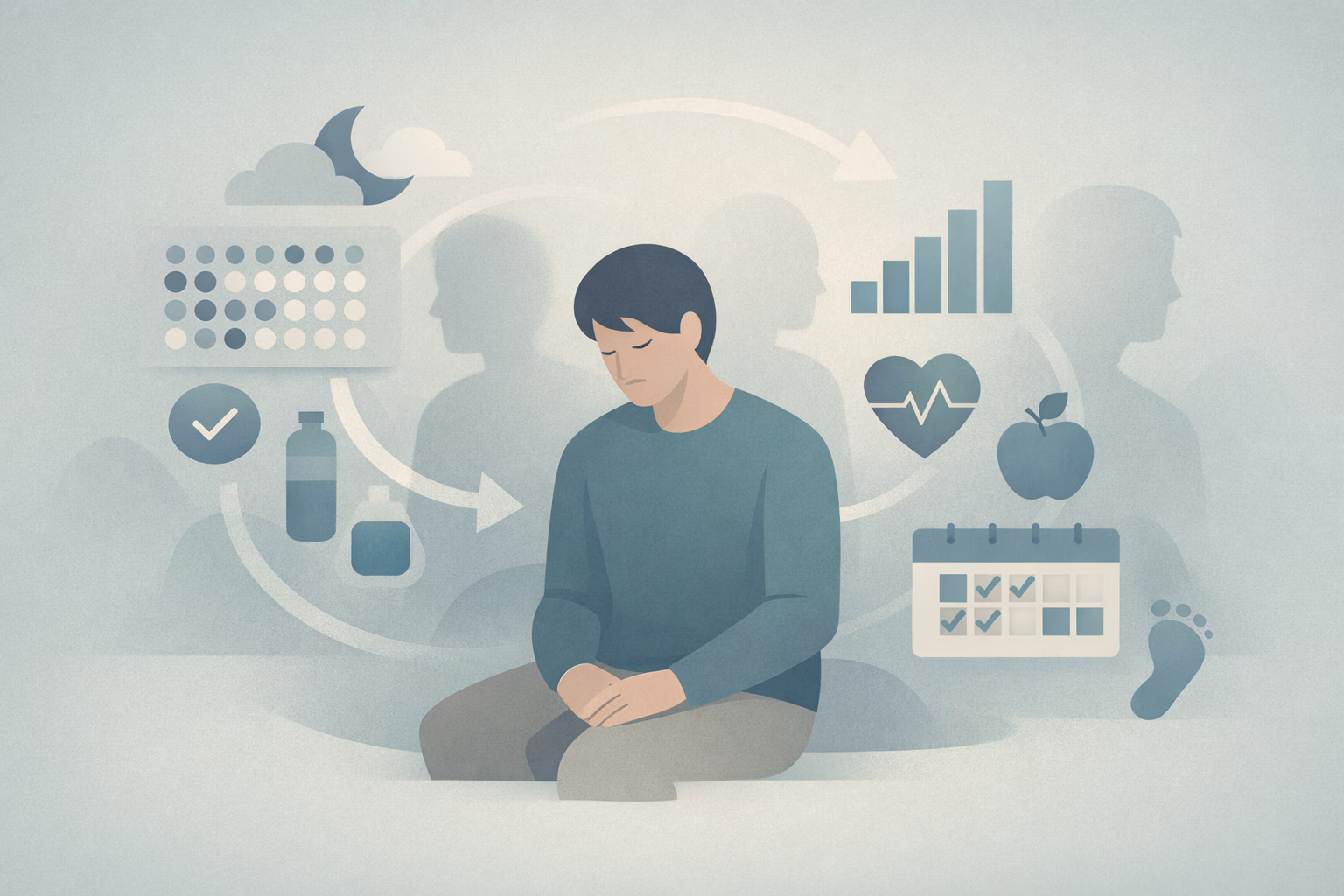
In short: Measure, improve, repeat. But many people discover something quieter and more human when they start tracking—an honest picture of what their days actually hold, not what they meant for them to hold.
Habit tracking is often framed as a discipline tool: measure, improve, repeat. But many people discover something quieter and more human when they start tracking—an honest picture of what their days actually hold, not what they meant for them to hold.
In that sense, tracking isn’t primarily about control. It’s a way to make patterns visible when attention is fragmented and the nervous system is carrying too many open loops to reliably “just remember” what’s happening.
What if tracking isn’t proof of willpower—what if it’s a way to restore orientation?
One of the first things tracking can bring up is discomfort: “I thought I did this more,” “I didn’t realize I skipped that so often,” “Why can’t I stay consistent?” That moment can feel personal, but it’s also biological. When intention and behavior don’t match, the brain registers conflict and increases monitoring. [Ref-1]
In modern life, that mismatch is common because conditions change faster than identity can update. Sleep debt, social load, unclear priorities, and constant evaluation can all shift behavior without a conscious decision. Tracking simply makes the shift visible.
Visibility can sting, but it also reduces guessing. And reduced guessing is one of the fastest ways to lower cognitive strain.
Awareness isn’t just “noticing more.” It’s having a clear feedback loop: a way your attention can connect actions to outcomes over time. Tracking externalizes that loop. Instead of relying on mood or memory, you see a pattern accumulate.
When the pattern is visible, the mind can compare it to the story you live by—your values, your self-image, your “this is who I’m becoming.” That comparison is where self-awareness often appears: not as judgment, but as contrast.
Importantly, tracking and reflection aren’t the same thing. Tracking is the signal; reflection is the meaning-making process that helps the signal land. [Ref-2]
Human attention and memory systems evolved to detect patterns because prediction lowers threat. The nervous system calms when it can forecast what comes next. Tracking supports this by turning scattered moments into a readable sequence—something the brain can learn from.
This is why even simple records (sleep times, movement, caffeine, screen use, medication consistency, creative minutes) can change how a week feels. The benefit isn’t moral. It’s informational: the brain gets a clearer map.
Many tracking tools lean into this pattern-detection appeal by making behavior legible at a glance—streaks, totals, trends. Used gently, that legibility can support self-observation. Used rigidly, it can become a new source of load. [Ref-3]
When life is busy, “remembering” becomes an invisible job. Tracking removes some of that job by storing information outside the mind. That can create a real sense of relief: fewer mental tabs, less rumination, less background uncertainty.
Even when behavior doesn’t change, structure can. A small record can provide a “done signal” for the day—evidence that you checked in with reality rather than negotiating with it all night.
That’s one reason habit tracking can feel stabilizing: it turns vague effort into something concrete, reducing the need for constant self-evaluation. [Ref-4]
It’s easy to assume that once you “know,” you’ll naturally “do.” But insight is not integration. A chart can reveal a pattern without completing the loop that keeps the pattern running.
Tracking produces information. Integration is what happens when a pattern resolves enough that your system no longer needs the same regulatory workaround (avoidance, urgency, craving, overcontrol) to get through the day. That kind of settling tends to require completion—real-world experiences that confirm a new identity in the body, not just in the mind.
This is why self-awareness practices are often helpful but not automatically transformative: they create orientation, and orientation is different from closure. [Ref-5]
Tracking can quietly shift from “seeing myself” to “managing myself.” When stress load is high, collecting data can become a way to stay busy with the problem without approaching completion. The mind stays activated because the loop never closes—there is always more to log, more to interpret, more to optimize.
In that state, numbers can function like a substitute for resolution: a sense of progress without the physiological stand-down that comes from something truly finishing.
This doesn’t mean tracking is harmful. It means that without reflection and closure, self-monitoring can reinforce analysis paralysis—more watching, less settling. [Ref-6]
“If the tracking itself becomes the task, the original life you wanted to support can get crowded out.”
People rarely start tracking because they’re calm and spacious. They start because something feels inconsistent, slippery, or hard to hold. Under that pressure, tracking can take on a regulatory role—creating temporary certainty.
Some common patterns show up across self-monitoring practices: [Ref-7]
These are not personality defects. They’re often signs that the system is trying to regain predictability in a fragmented environment.
Habits become easier to sustain when they are cue-linked and context-supported—when the environment and identity both agree on what happens next. Repetition matters, but repetition alone doesn’t guarantee that a behavior becomes self-maintaining. [Ref-8]
Tracking can highlight inconsistency, but if the underlying context stays mismatched (too many demands, unclear values, unstable routines), the behavior may remain effortful. Effortful behaviors tend to require ongoing monitoring, which can keep the system in “management mode.”
When identity and context align, the need for intense monitoring often decreases—not because you care less, but because the loop closes more reliably.
Self-monitoring sometimes changes behavior simply because attention is on it. In research, being assessed in the moment can shift cravings, thoughts, and choices—sometimes in helpful ways, sometimes by increasing preoccupation. [Ref-9]
This is an important nuance: tracking can produce movement without producing completion. You may smoke less, snack differently, or scroll with more hesitation—yet still feel internally unsettled, because the deeper loop (what the behavior was regulating) hasn’t resolved.
When people feel stuck despite “good data,” it’s often because the metric is generating friction but not closure. The nervous system stays online, scanning.
There’s a middle space between raw data and real change. It’s not willpower, and it’s not mere insight. It’s the process of letting patterns become intelligible within a larger story: “Given my current load, this makes sense,” and “This is the direction I recognize as mine.”
Self-compassion matters here, not as a feel-good overlay, but as a condition for accurate perception. When the system expects punishment, it distorts the data (minimizes, inflates, rationalizes) to protect itself. When the system expects respect, it can tell the truth with less defensiveness.
People using momentary interventions often describe the value as feeling more supported by the process itself—less alone with the data, more able to translate signals into next understanding. [Ref-10]
What changes when tracking becomes a witness instead of a judge?
Humans regulate in relationship. When patterns are held with someone else—through mentorship, accountability, or simple conversation—the nervous system often reads more safety cues. That can reduce the need for hyper-monitoring and create more space for honest appraisal.
Shared reflection also helps convert private observations into socially anchored identity: “This is real, it’s happening, and it makes sense.” That kind of witnessing can make the pattern feel more complete, less like an endless personal project.
Research on momentary self-regulation highlights that regulation is dynamic and context-dependent—strengthened by supportive structures rather than isolated effort. [Ref-11]
As patterns become clearer and less charged, many people notice a specific shift: fewer internal arguments. Not because life becomes perfect, but because the system isn’t constantly renegotiating identity. You start to know what tends to happen, what tends to help, and what tends to derail—without needing to shame yourself into attention.
This can increase self-efficacy in a grounded way: not “I can control everything,” but “I can predict myself under certain conditions.” That predictability is calming. It creates room for steadier choices and fewer emergency corrections.
Studies using ecological momentary assessment often show how self-attitudes fluctuate with lapses—and how understanding context can reduce the spiral of self-criticism that keeps stress load high. [Ref-12]
Over time, the most meaningful transition is often this: tracking stops being a way to chase certainty and becomes a way to confirm alignment. The question quietly changes from “Did I do enough?” to “What does this pattern say about what my life is currently built to produce?”
When identity leads, tracking becomes lighter. You don’t need constant surveillance if your environment, commitments, and values are more coherent. The record becomes occasional orientation, not a daily referendum on your worth.
In fast-changing conditions—sleep disruption, attention fragmentation, variable symptoms—momentary tracking can still be useful because it captures real-time context. But the long-term stability tends to come from meaning: a lived sense of “this is me” that reduces the need for constant correction. [Ref-13]
Habit tracking can be a tool for self-awareness when it serves a humane purpose: helping you see the relationship between load, context, and behavior. In that role, it’s less like a gradebook and more like a map.
Maps don’t walk the terrain for you—and they don’t scold you for detours. They simply reduce confusion. And reduced confusion is often what restores agency: the ability to choose with more clarity and less pressure.
In feedback-loop terms, the value isn’t the number; it’s the timely signal that helps a system recalibrate toward what matters. [Ref-14]
Tracking is most powerful when it doesn’t just collect evidence—it helps experiences complete into identity. When patterns are seen with dignity, and when life provides enough closure for the nervous system to stand down, self-awareness stops feeling like scrutiny and starts feeling like coherence.
In that way, a simple log can become something surprisingly meaningful: a feedback loop that supports a steadier relationship with yourself—one where behavior is information, not a verdict. [Ref-15]
From theory to practice — meaning forms when insight meets action.
Because tracking makes patterns visible — and visibility can sting when intention and behavior don't match. 'I thought I did this more,' 'I didn't realize I skipped that often.' That mismatch isn't personal; the brain registers conflict and increases monitoring when intention and action diverge. In modern life, mismatch is common because conditions change faster than identity can update. Sleep debt, social load, unclear priorities all shift behavior without conscious decision. Tracking simply makes the shift visible. Visibility stings, but it also reduces guessing — and reduced guessing is one of the fastest ways to lower cognitive strain.
Because insight isn't integration. A chart can reveal a pattern without completing the loop that keeps the pattern running. Tracking produces information; integration is when a pattern resolves enough that your system no longer needs the same regulatory workaround (avoidance, urgency, craving, overcontrol) to get through the day. That settling typically requires real-world experiences that confirm new identity in the body, not just the mind. This is why self-awareness practices are often helpful but not automatically transformative — they create orientation, and orientation is different from closure.
Yes — when collecting data becomes a way to stay busy with the problem without approaching completion. The article calls this the accumulation loop: more logging, more interpreting, more optimizing, with the loop never closing. Numbers can function as a substitute for resolution — progress without physiological stand-down. Compulsive checking, streak protection that matters more than what the behavior was meant to support, metric drift across more and more categories. These aren't personality defects; they're signs the system is trying to regain predictability in a fragmented environment by managing rather than seeing.
When it functions as a witness rather than a judge. The bridge from data to change is gentle reflection plus self-respect: letting patterns become intelligible within a larger story — 'given my current load, this makes sense,' 'this is the direction I recognize as mine.' When the system expects punishment, it distorts the data to protect itself. When it expects respect, it can tell the truth with less defensiveness. Tracking serves self-awareness most when it helps you see relationships between load, context, and behavior — less like a gradebook, more like a map. Self-awareness grows where loops can close.
From Science to Art.
Understanding explains what is happening. Art allows you to feel it—without fixing, judging, or naming. Pause here. Let the images work quietly. Sometimes meaning settles before words do.
One Quiet Window, one insight, one reflection — every Sunday