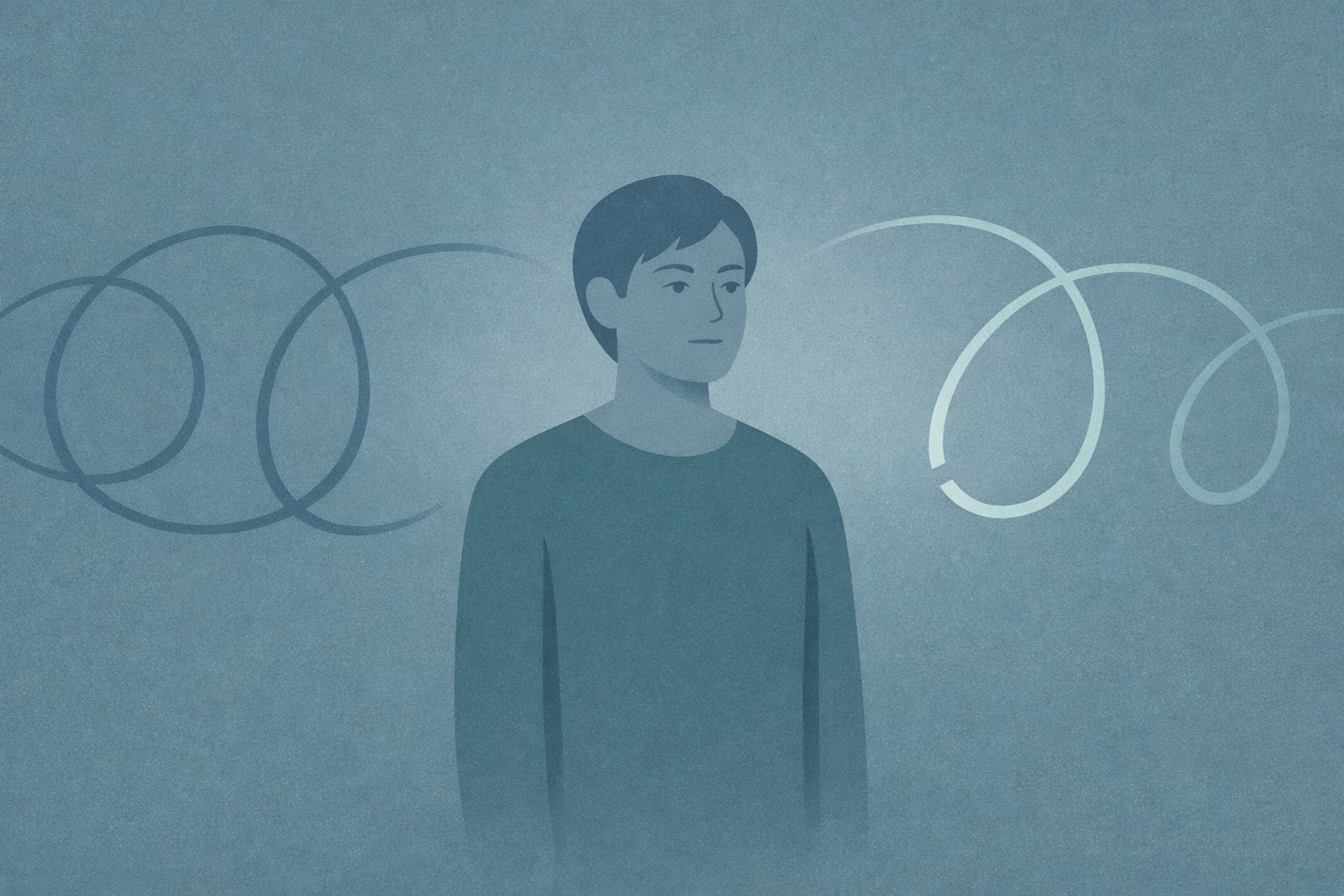
Stress Loop Awareness: Catching the Cycle Before It Controls You

In short: Avoidance rarely announces itself. More often it arrives as a tiny pivot: an urge to “just check” something, a sudden need to reorganize, a convincing reason to wait, a subtle sense that your mind can’t quite find the next step.
Avoidance rarely announces itself. More often it arrives as a tiny pivot: an urge to “just check” something, a sudden need to reorganize, a convincing reason to wait, a subtle sense that your mind can’t quite find the next step.
What if the most important part of avoidance is the moment before it becomes a behavior?
In a Meaning Density view, this isn’t about character. Avoidance is often a regulatory move: a system under load choosing the fastest path back to steadiness. When you learn to recognize the early shifts, you’re not becoming stricter with yourself—you’re noticing where closure is missing, where your nervous system is reaching for a “done” signal, and where your attention is trying to protect capacity.
A common experience is looking up and realizing an hour (or a day) is gone, and the thing you meant to do never truly began. The confusing part is that it often doesn’t feel like a decision. It feels like you were “in it,” and then suddenly you weren’t.
This is one reason avoidance can carry so much shame: the timeline doesn’t match the conscious story. If your mind only “comes online” after the detour has already happened, it can seem like you didn’t have a say.
But that gap is meaningful. It suggests the early stages of the loop are subtle, fast, and designed to be efficient—not dramatic. The system found a path of reduced strain and took it, before you got a clear internal marker that anything had shifted. [Ref-1]
Before full avoidance, there is often an appraisal—sometimes so quick you only notice its footprint. A task, conversation, or decision carries an “edge”: complexity, uncertainty, evaluation, or the risk of getting stuck.
When that edge is detected, attention tends to narrow. Not because you are fragile, but because narrowing is one of the nervous system’s simplest ways to reduce load. The mind starts scanning for the nearest exit ramp: a smaller task, a simpler stimulus, a familiar loop.
In that narrowed state, relief becomes persuasive. The brain weights immediate stand-down signals more heavily than long-range meaning, not as a flaw, but as a state-dependent bias toward what reduces strain fastest. [Ref-2]
Human executive attention didn’t evolve for endless open tabs and permanent ambiguity. It evolved to allocate limited resources: focus here, disengage there, conserve energy for what matters next.
When something registers as high-cost (mentally, socially, or contextually), the executive system can initiate a redirect before you have words for it. This redirect may look like “I’ll do it later,” but underneath it is often a conservation move—spending fewer cognitive resources in the moment.
In that sense, early avoidance signals aren’t evidence that you don’t care. They can be evidence that the system is trying to protect capacity—especially when experiences don’t reliably complete and provide closure. [Ref-3]
Avoidance doesn’t always start with leaving. It often starts with micro-withdrawals: small reductions in contact with the task, the conversation, or the moment.
These can include shifting to a side-question, focusing on a minor detail, rereading without taking in meaning, or mentally “stepping back” while still appearing present. The immediate effect is decreased strain—like lowering the volume before you even realize it was loud.
Because micro-withdrawals reduce intensity quickly, they can happen before discomfort becomes obvious. The system gets the benefit (less load) without a clear internal alarm, which is why avoidance can feel like it “just happened.” [Ref-4]
From the inside, avoidance often feels instantaneous: one moment you intend to engage, the next you’re elsewhere. But when you zoom in, there are often small choice points—tiny thresholds where attention could have stayed, shifted gently, or asked for a different kind of support.
The issue is not that you lack willpower. The issue is that the thresholds can be nearly invisible when you’re already carrying load. A busy nervous system favors speed over reflection, and relief over complexity.
Seeing that there were thresholds—even if you missed them—is not a moral lesson. It’s a structural insight: the loop has a beginning, and beginnings can be subtle. [Ref-5]
Many people assume the loop starts when they open the app, walk away from the desk, cancel the plan, or postpone the call. Often it starts earlier: the first internal argument, the first mental fog, the first “not now,” the first drift of attention away from contact.
When that early redirection goes unnoticed, the loop runs on automatic. The mind may even produce helpful-sounding narratives (“I need better conditions,” “I’ll be more efficient later”) that smooth the transition into relief.
Research on metacognitions and procrastination points to how beliefs about thinking (for example, that delay will improve readiness or reduce distress) can strengthen postponement patterns over time. [Ref-6]
Early avoidance cues are often ordinary and easy to dismiss. They can look like practicality or preference, but they share a common feature: they reduce contact with the “edge” of the situation before anything has completed.
Some common early indicators include:
Models of procrastination highlight how these cognitive shifts—especially around uncertainty and self-evaluative pressure—can amplify delay by making relief feel necessary and immediate. [Ref-7]
When the beginning of the loop is consistently invisible, the middle and end can start to feel like fate. Over time, the nervous system learns a simple association: edge → redirect → relief. The person learns a different association: intention → disappearance → self-critique.
This is where agency can feel eroded. Not because you are incapable, but because the system has practiced the redirect more than it has practiced completion. What’s repeated becomes more automatic, and what’s automatic becomes harder to “catch” in real time.
Work on metacognition and procrastination suggests that reduced monitoring of early cognitive cues—and increased reliance on relief-based reasoning—can contribute to patterns that feel increasingly inevitable. [Ref-8]
Relief is a powerful teacher. When you exit a demanding moment and your body softens even slightly, the nervous system tags the exit as protective. That tag can be stronger than the abstract value of the task, especially when the task doesn’t reliably end in closure.
In modern life, many tasks don’t complete cleanly. They smear across days: ongoing inboxes, ambiguous projects, social comparison without resolution. Without completion, the system doesn’t get a “done” signal—so it keeps scanning for ways to stand down.
Metacognitive beliefs (such as “I work best under pressure” or “I need to feel ready first”) can make relief-based exits feel not only soothing, but rational, further reducing conscious access to choice. [Ref-9]
Noticing avoidance early isn’t the same as controlling yourself. In fact, harsh control often increases load, which can make redirection faster and more covert.
Early signals become easier to detect when the internal environment is steadier—when attention has enough room to register small shifts without immediately needing to fix, justify, or override them. In this state, a cue like “I’m drifting” can be informational rather than accusatory.
When there’s less inner pressure to perform, the first signs of leaving can show up as simple data: a shift in breath, a jump in thinking, a reach for an easier loop.
Research on attention and mindfulness-related mechanisms suggests that a more stable attentional stance can improve detection of subtle internal events, especially under stress load. [Ref-10]
Avoidance thrives in isolation—not because you’re hiding, but because the loop runs quieter when no one else is co-orienting with you. Shared awareness can act like an external “mirror” that makes early shifts easier to notice.
This might look like someone reflecting back a pattern (“I notice we drift right before decisions”), or simply being in the presence of a person who brings steadiness. The key is tone: when the social field is non-punitive, noticing becomes safer, and the nervous system doesn’t need to escalate into defense or performance.
Many therapeutic frameworks emphasize that mindful noticing and wiser choice points are more accessible when self-judgment is reduced and support is relational rather than evaluative. [Ref-11]
When early cues become visible, a specific experience often appears: a pause. Not a dramatic stop, but a small gap where the system can register what’s happening before it has to run the old sequence.
In that gap, the task may still feel effortful. The difference is that the person is present enough to perceive the moment as a moment—rather than being carried forward by automatic redirection. That presence is not an emotional deep dive; it’s an increase in signal return: more accurate information arriving from body, context, and attention.
Mindfulness “observe” skills are often described as a way to notice internal and external events without immediately reacting to them—supporting that tiny gap where automaticity can loosen. [Ref-12]
Early detection doesn’t guarantee a perfect outcome. What it changes is the shape of the moment. Instead of the next move being predetermined by relief, there is room for direction—however small.
Direction is where meaning re-enters. Meaning isn’t a pep talk; it’s what emerges when your actions can land and complete, when attention stays connected long enough for experience to integrate into identity. Even brief contact—staying with the edge long enough to understand what’s being asked—can begin to restore coherence.
Training in presence often emphasizes that being “in the moment” is less about forcing focus and more about returning to contact when you notice you’ve left. In that sense, catching the beginning is a doorway back to participation. [Ref-13]
When you notice avoidance before it begins, you’re not diagnosing yourself. You’re witnessing a protective system doing what it learned to do under pressure: reduce load, seek safety cues, find quick relief.
And you’re also meeting something deeper: the human need for completion. When life offers too few “done” signals—too much evaluation, too many unfinished loops—attention naturally searches for exits. Seeing that process clearly is one way authorship returns, not through force, but through coherence.
Over time, moments of noticing can become moments of meaning: not because you push harder, but because you can sense where you are, what matters, and what kind of closure your system has been missing. [Ref-14]
It’s easy to confuse noticing with self-management. But noticing, at its best, is simpler than that: it’s the moment your attention comes back online.
Avoidance patterns are not identities. They are regulatory pathways that often form when completion is unreliable and nervous system load stays high. When the early signals become visible, the story changes—not into perfection, but into participation.
Choice doesn’t have to be loud to be real. Sometimes it begins as a quiet recognition: “I’m about to leave.” And in that recognition, meaning has a place to land. [Ref-15]
From theory to practice — meaning forms when insight meets action.
Because the early stages of the loop are subtle, fast, and designed to be efficient — not dramatic. Before a behavior shows up, there's usually a quick appraisal: a task carries an edge of complexity or evaluation, attention narrows, and the system finds a low-strain exit ramp. That redirection happens before discomfort fully registers, so by the time your conscious mind catches up, an hour has slipped past and you don't remember choosing. The shame comes from a timeline mismatch, not a moral failure. Micro-withdrawals reduce intensity quickly, which is exactly why avoidance can feel like it just happened.
Earlier than most people assume — long before you close the laptop, cancel the plan, or open the app. It often begins with the first internal argument, the first moment of mental fog, the first not-now, the first small drift of attention away from contact with the task. Helpful-sounding narratives like I need better conditions or I'll be more efficient later smooth the transition into relief, so the loop runs on automatic. When that early redirection goes unnoticed, the middle and end of the pattern can feel like fate. Catching the beginning is what reopens choice.
They tend to look ordinary: subtle task-switching like opening a tab for a second; fast justifications about timing or readiness; body-level bracing such as jaw tension, held breath, or shallow breathing; sudden urgency for low-stakes actions like cleaning or snacking; and loss of sequencing — knowing what matters but not feeling a next step you can actually enter. Each one reduces contact with the edge of the situation before anything completes. They're easy to dismiss as practicality. Recognizing them as cues, not arguments to act on, is what moves the early signal into the window of tolerance where choice is possible.
No, and that's an important distinction. Harsh control increases load, which makes redirection faster and more covert. Early signals become easier to detect when the internal environment is steadier — when attention has enough room to register small shifts without immediately needing to fix or override them. Noticing isn't a verdict; it's the moment your attention comes back online. A small pause appears, the next move is no longer predetermined by relief, and direction becomes possible. Co-regulation helps too: a non-punitive social mirror makes the pattern easier to see. Choice doesn't have to be loud to be real.
From Science to Art.
Understanding explains what is happening. Art allows you to feel it—without fixing, judging, or naming. Pause here. Let the images work quietly. Sometimes meaning settles before words do.
One Quiet Window, one insight, one reflection — every Sunday