


Life Hack Culture: The Productivity Illusion
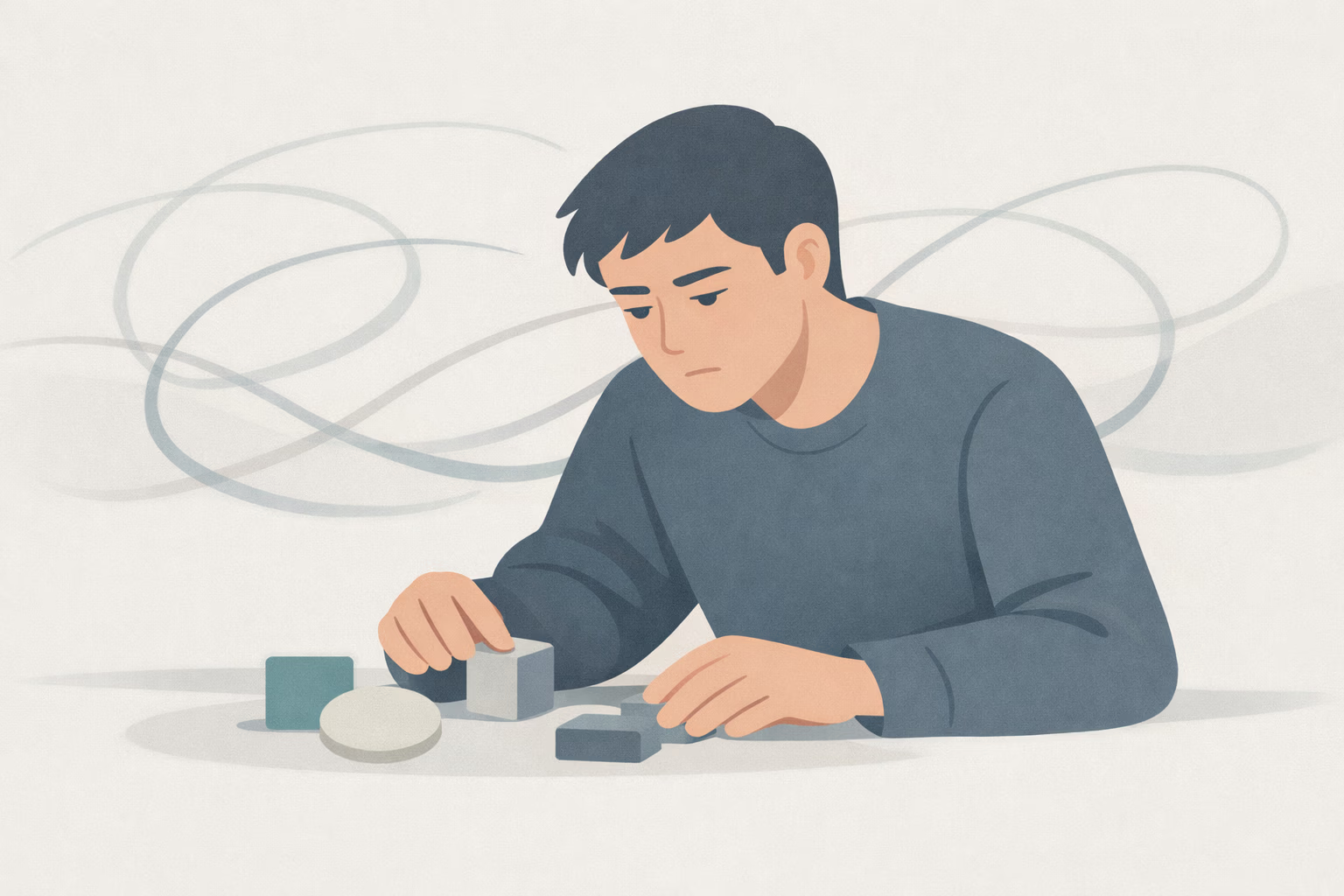
In short: Refining routines, tracking choices, improving health, perfecting work, streamlining relationships. But from the inside, it often feels tense—like life is a dashboard that never stops blinking.
Hyper-optimization can look responsible from the outside: refining routines, tracking choices, improving health, perfecting work, streamlining relationships. But from the inside, it often feels tense—like life is a dashboard that never stops blinking.
What if the urge to perfect everything isn’t a personality flaw, but a nervous system trying to create closure in a world that won’t let anything feel finished?
In the Meaning Density Model™, patterns like overcontrol or relentless self-improvement aren’t identities. They’re regulatory responses under load—ways the system tries to reduce uncertainty and restore coherence when life keeps arriving in pieces.
In a hyper-optimization loop, “better” isn’t a direction—it’s a requirement. Even when things are going well, there can be a background sense that something is unfinished: a routine that could be tighter, a plan that could be smarter, a body that could be more efficient, a mindset that could be cleaner.
The signature feeling isn’t simply ambition. It’s the absence of completion. You do the thing, you improve the thing, and the system still doesn’t receive the internal message: we’re safe now; we can stand down. So the mind returns to scanning and refining. [Ref-1]
It’s not that you can’t succeed. It’s that success doesn’t land.
Your executive system—planning, prioritizing, evaluating—helps you navigate complexity. Under sustained pressure, it can start treating ordinary living as a continuous problem to solve. Meals become macros, sleep becomes a protocol, conversations become performance reviews, rest becomes “recovery strategy.” [Ref-2]
When that system is chronically engaged, the body may carry a subtle mobilization: a readiness to adjust, correct, and prevent future regret. Not because you’re broken, but because your brain is doing what it evolved to do under uncertainty—keep options open, reduce error, and maintain control.
And if everything is a decision, when does your system get to stop deciding?
Human attention evolved to detect what’s missing, what’s risky, and what could go wrong. That bias is useful when danger is real and immediate. In modern settings, the same machinery can attach to status, health, productivity, and self-image—domains where the “threat” is rarely resolved with one clear outcome. [Ref-3]
Optimization can become a form of continual vigilance: monitoring signals, updating strategies, and pre-empting discomfort. The loop persists not because you “like control,” but because the environment keeps supplying partial information and fresh comparisons—conditions that prevent the nervous system from receiving closure.
Optimization offers something the body craves under load: order. A plan reduces ambiguity. A metric makes progress feel visible. A rule cuts down the number of choices. In the short term, this can create real relief—less mental noise, more direction, a temporary sense of solidity. [Ref-4]
But relief is not the same as integration. Relief changes state for a moment; integration is what happens when an experience completes and settles into identity-level coherence. Without completion, the system keeps reaching for the next tweak as a substitute for the “done” signal.
So the loop is understandable: control produces a brief exhale, and the nervous system learns to chase that exhale again.
Optimization culture often carries an unspoken promise: if you perfect enough inputs, you’ll finally feel peace. But uncertainty isn’t a bug in life—it’s a condition of being alive. When the mind treats uncertainty as something to eliminate, it turns normal variability into a chronic alert.
Perfection then becomes a moving target. Each improvement raises the standard, and each standard creates more opportunities to notice what isn’t perfect yet. The result can be amplified dissatisfaction—not because you’re ungrateful, but because the system is trained to highlight gaps. [Ref-5]
In that climate, “good enough” doesn’t register as safety; it registers as unfinished.
In the Power Loop, control becomes the main route to stability. Instead of life being guided by values and lived identity, it becomes guided by risk reduction: prevent mistakes, prevent decline, prevent judgment, prevent regret.
When control is doing the job that meaning used to do, even positive goals can feel hollow. You may accomplish a lot and still feel unanchored—because the organizing principle is not “this matters to me,” but “this keeps me from falling behind.” Decision-making can become heavier, not lighter, as each choice is treated like a referendum on the self. [Ref-6]
Control can look like clarity, but it often comes from the fear of having no resting place.
Hyper-optimization doesn’t always look dramatic. Often it’s quiet and constant: checking, adjusting, researching, re-evaluating. The body can be sitting still while the mind runs laps.
Common patterns include:
These aren’t character defects. They’re what happens when closure is repeatedly bypassed: the system doesn’t receive completion, so it stays engaged. [Ref-7]
Over time, relentless improvement can flatten experience. When attention is trained to evaluate, it has less capacity left to simply register what’s here. Meals become analysis. Movement becomes optimization. Social time becomes image management. Even hobbies can turn into “skill acquisition.” [Ref-8]
This erosion isn’t about being “too in your head” as a personal failing. It’s structural: a nervous system kept in managerial mode has fewer resources for play, novelty, and effortless connection. Spontaneity requires a baseline of safety. Constant evaluation signals the opposite.
When everything is measured, what is allowed to simply be lived?
Hyper-optimization often intensifies when imperfection becomes more visible—through comparison, feedback, aging, life transitions, or sheer fatigue. The more the system notices gaps, the more it tries to close them through control.
This is how the loop tightens: increased checking creates more data; more data creates more discrepancy; more discrepancy creates more urgency. The person may look “high functioning,” but internally the cost can be high: persistent tension, reduced satisfaction, and a narrowing life-world that revolves around managing risk. [Ref-9]
In this spiral, the aim quietly shifts from living well to preventing the feeling of being unfinished.
There’s a difference between understanding that perfection is impossible and having the nervous system truly stand down around imperfection. The second isn’t an insight—it’s a shift in load and closure. It’s the system learning, through lived completion, that “imperfect” can still be safe and coherent.
Research links perfectionistic tendencies with intolerance of uncertainty in ways that can amplify compulsive checking and control cycles. [Ref-10] In everyday terms: if uncertainty is treated as an alarm, optimization becomes the silencing mechanism.
When uncertainty is allowed to exist without immediate correction, something physiological can change: the body receives more safety cues, the mind doesn’t have to keep updating, and the internal “done” signal has a chance to appear—not as a pep talk, but as a settling.
Humans regulate in connection. When relationships feel contingent—approval based on output, image, or constant improvement—optimization becomes socially reinforced. When relationships feel accepting, the nervous system gets a different message: you can belong without being perfected.
This isn’t about forcing self-kindness as a technique. It’s about the stabilizing effect of warmth, common humanity, and non-judgment—signals that reduce threat load and make it easier for the body to exit constant self-evaluation. [Ref-11]
Being met without a scorecard is a form of closure the body recognizes.
When the hyper-optimization loop loosens, the first change is often not dramatic happiness—it’s capacity. More room in attention. Less urgency. Fewer internal negotiations. Choices become simpler because they aren’t carrying the weight of proving worth.
With reduced load, the system can return signals more reliably: hunger and fullness, fatigue and recovery, interest and disinterest, closeness and boundaries. Life becomes less of a management task and more of a contact experience—imperfect, but livable. [Ref-12]
Enjoyment tends to reappear in ordinary places: doing something without tracking it, being with someone without evaluating it, finishing a day without needing to justify it.
Letting go of perfection doesn’t mean letting go of care. It means shifting the organizing principle from control to meaning—from “avoid error” to “move toward what matters.” Meaning is not a mood or a motivational speech; it’s what emerges when experiences complete and start to belong to your life story.
In that orientation, choices don’t need to be optimal to be coherent. They need to be aligned enough to settle into identity: this is the kind of person I am; this is the life I’m living. That settling is stabilizing in a way optimization rarely is. [Ref-13]
What if your life is not a system to perfect, but a path to inhabit?
Imperfection is often framed as a threat: a sign you’re behind, exposed, or not doing life correctly. But imperfection can also be a space where reality finally fits—where life can complete instead of being endlessly edited.
When everything has to be optimized, nothing is allowed to land. When something is allowed to be “good enough,” the nervous system may finally receive the message that this moment can be lived, not fixed. That’s where authenticity has room to appear—not as a performance, but as a natural byproduct of reduced strain and restored closure. [Ref-14]
Hyper-optimization is often an honorable attempt to create safety in a fast, evaluative world. It makes sense that your system reached for control.
But life gets richer when it’s allowed to be real—when days can end, choices can settle, and you can belong to your own experience without constant upgrading. Not perfect. Not maximized. Lived. [Ref-15]
From theory to practice — meaning forms when insight meets action.
Because the issue isn't ambition; it's the absence of completion. You do the thing, you improve the thing, and the system still doesn't receive the internal message: we're safe now, we can stand down. So the mind returns to scanning and refining. In the Power Loop, control becomes the main route to stability, replacing meaning. Even positive accomplishments feel hollow because the organizing principle isn't this matters to me — it's this keeps me from falling behind. It's not that you can't succeed; it's that success doesn't land. Without closure, every win is just preparation for the next gap to close.
It's adjacent, and the article frames hyper-optimization as a regulatory response, not a personality. Optimization offers something the body craves under load: order. A plan reduces ambiguity, a metric makes progress visible, a rule cuts down choices. In the short term, this creates real relief — less mental noise, more direction. But relief isn't the same as integration. The loop persists because control produces a brief exhale, and the system learns to chase that exhale again. Each improvement raises the standard, which creates more opportunities to notice what isn't perfect yet — amplified dissatisfaction, not gratitude failure.
Because attention trained to evaluate has less capacity left to simply register what's here. Meals become analysis, movement becomes optimization, social time becomes image management, hobbies turn into skill acquisition. This isn't being too in your head as a personal failing — it's structural. A nervous system kept in managerial mode has fewer resources for play, novelty, and effortless connection. Spontaneity requires a baseline of safety; constant evaluation signals the opposite. When everything is measured, what is allowed to simply be lived? The loop tightens because checking creates data, data creates discrepancy, discrepancy creates urgency.
By shifting the organizing principle from control to meaning — from avoid error to move toward what matters. This isn't giving up on care; it's letting Meaning Density do the work that control was trying to do. Letting go of perfection means choices don't need to be optimal to be coherent; they need to be aligned enough to settle into identity. The deeper change isn't understanding that perfection is impossible — it's the nervous system learning, through lived completion, that imperfect can still be safe. When uncertainty is allowed to exist without immediate correction, the Done Signal finally has room to appear.
From Science to Art.
Understanding explains what is happening. Art allows you to feel it—without fixing, judging, or naming. Pause here. Let the images work quietly. Sometimes meaning settles before words do.
One Quiet Window, one insight, one reflection — every Sunday