

Meaning Anchors: Small Practices That Keep You Grounded

In short: The Practices That Keep You Grounded in Yourself During change—new work, relationships shifting, health transitions, moving cities—it’s common to feel oddly unplaced inside your own life. Not necessarily sad. Not necessarily confused.
During change—new work, relationships shifting, health transitions, moving cities—it’s common to feel oddly unplaced inside your own life. Not necessarily sad. Not necessarily confused. More like your inner “compass” keeps recalibrating, and everyday decisions start to feel heavier than they should.
What if that wobble isn’t a personal flaw, but a nervous system without enough stable reference points?
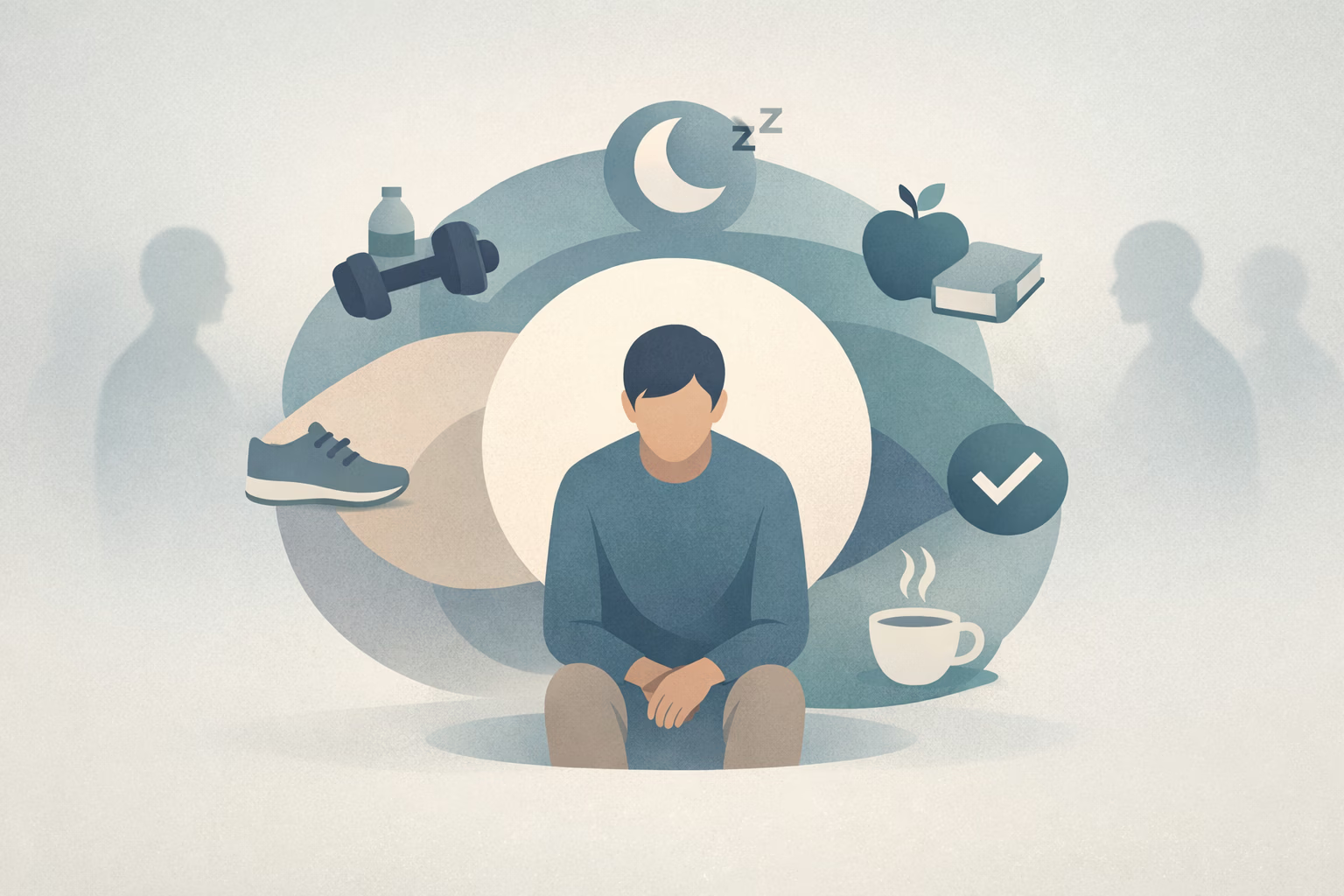
Identity anchors are those reference points. They can look like small rituals, consistent reflection, or reliable ways you return to what matters. Their function isn’t to “improve” you. It’s to help your system register continuity—so your choices can settle into something coherent instead of constantly re-negotiated.
Disorientation often shows up when your outer life has changed but your inner continuity hasn’t had time to consolidate. The mind can generate many plausible narratives—who you are now, what you want next, what you “should” become—yet the body doesn’t automatically receive a clear “done” signal.
This can feel like self-doubt, inconsistency, or a subtle instability: you can act confident in one context and uncertain in another, not because you are fake, but because your system is still collecting evidence of what’s stable. Without grounding practices, identity becomes more reactive—organized around what’s loudest, newest, or most evaluated in the moment. [Ref-1]
Human brains learn safety and orientation through recurrence. When something repeats—especially in similar conditions—it becomes easier to predict. That prediction reduces load. And reduced load creates room for clearer signal return: values, preferences, and boundaries become easier to feel and act from.
In this way, anchor practices aren’t about “discipline.” They’re more like well-worn paths through the nervous system. They make it less costly to remember what matters, and less effortful to behave in ways that match your self-concept. Over time, repeated rituals can become a form of psychological continuity: “this is how I return to myself.” [Ref-2]
Stability isn’t a personality trait. It’s often what happens when your life provides enough reliable cues to settle.
Humans are narrative organisms. We don’t only react to what’s happening; we continually stitch events into a story about who we are, what kind of world this is, and what is likely next. That story supports social predictability—both for other people and for ourselves.
Under rapid change, the narrative system can become overworked: too many updates, too few completions. Add modern cognitive offloading—outsourcing memory, decisions, and even interpretation to devices—and the sense of “inner authorship” can thin out. The result is not moral weakness; it’s a continuity system running without enough stable inputs. [Ref-3]
Transitions create open loops: unresolved conversations, unfinished grief, new roles not yet lived into, choices made without enough feedback. Open loops keep the system scanning. Scanning keeps the body in a partial mobilization state—even when nothing is “wrong.”
Identity anchors help because they offer repeatable moments of closure. Not closure as in “everything is solved,” but closure as in “something returns to baseline.” A familiar ritual, a consistent way of checking in with your lived experience, or a patterned reflection can lower uncertainty just enough for the day to feel inhabitable. [Ref-4]
We often assume identity will adapt automatically: new environment, new habits, new confidence—eventually it all clicks. Sometimes it does. But when life is fast and feedback is noisy, adaptation can remain fragmented: you’re changing, but not integrating.
Without anchors, you may carry multiple “versions” of yourself that don’t talk to each other—work-self, relationship-self, online-self, survival-self. Each one makes sense in context. The strain comes from switching without a stable throughline.
Rituals and traditions have long helped humans create belonging and continuity, especially during role changes. That isn’t sentimental; it’s structural support for identity coherence. [Ref-5]
When identity signals fluctuate, decisions become harder. When decisions become harder, you delay or default. When you delay or default, you get less clean feedback about what fits you. And with less clean feedback, identity signals fluctuate even more.
In that loop, avoidance isn’t best explained as “fear of being wrong.” It’s often the nervous system protecting capacity: postponing a costly choice when the internal data feels inconsistent. External validation then becomes a temporary stabilizer—not because you’re needy, but because the environment offers clearer signals than your overloaded inner map.
Anchors interrupt this loop by adding predictable structure. Rituals can support mental health partly because they reduce the number of variables your system has to solve at once. [Ref-6]
Without identity anchors, many people don’t feel “lost” all the time. They feel fine—until a decision, a social interaction, or a quiet moment exposes how much is being held together by effort.
Some patterns that can emerge:
Small daily rituals are often described as supportive not because they make life perfect, but because they provide a stable rhythm that reduces cognitive and regulatory load. [Ref-7]
Resilience isn’t only about grit. It’s also about having a stable inner frame that can absorb stress without reorganizing your whole sense of self. When that frame is thin, even ordinary challenges can feel identity-relevant—like they say something definitive about you.
In practical terms, lack of anchors can reduce decision clarity and prolong internal instability. Not because you lack insight, but because your self-concept doesn’t have enough repetition-based reinforcement to feel reliable under load. In that state, the system keeps re-checking basics: “Is this me? Is this safe? Is this worth it?” [Ref-8]
When your behavior and your evolving self-concept don’t line up, the result is often a quiet, persistent stress signal. It’s not necessarily dramatic. It can feel like internal friction—like you’re constantly translating yourself to yourself.
This is where dependence on others’ cues can intensify. If your inner narrative is not yet coherent, external feedback becomes a substitute for internal closure: “Tell me who I am in this season.” The cost is that agency feels outsourced, and meaning becomes contingent—more about approval or avoidance than lived alignment.
Narrative coherence has been associated with psychological well-being, in part because a coherent story reduces contradiction and improves predictability inside the self. [Ref-9]
Reflection, journaling, or structured self-inquiry can function less like “figuring yourself out” and more like giving your experience a container. A container is different from insight. Insight can arrive quickly. Coherence settles slowly, after enough experiences have been held, named, and completed.
When reflection is consistent, it can support narrative organization: events start to link into sequences, values start to show up as patterns, and contradictions become less destabilizing because they have context. This doesn’t mean you feel inspired all the time. It means your system gets more consistent signals about who you are becoming—signals strong enough to reduce constant re-evaluation. [Ref-10]
What changes when your story doesn’t have to restart every morning?
Identity is personal, but it isn’t formed in isolation. Safe relationships provide mirroring, continuity, and reality-testing that can reduce internal churn. Not as instruction—more as steady witness.
Mentoring, peer support, and accountability structures can reinforce anchors because they add reliable social cadence: someone remembers what you said mattered, notices what repeats, and reflects back patterns over time. That longitudinal witnessing helps identity feel durable.
Programs focused on values clarification and identity stability suggest that structured support can strengthen consistency in self-perception—especially when life contexts are changing. [Ref-11]
As anchors take hold, many people notice a particular kind of clarity: not constant certainty, but reduced internal argument. Decisions become less like emergency problems to solve and more like selections from a known set of priorities.
This often comes with increased congruence—behavior matching values more often, with fewer dramatic swings. Values clarity and congruence have been linked with better functioning because they reduce the energy cost of contradiction. [Ref-12]
Coherence can feel like a soft “yes” that doesn’t require a speech.
Without anchors, a surprising amount of energy goes toward re-establishing identity: rechecking decisions, reinterpreting interactions, re-litigating what you meant, re-reading your own life for proof. With anchors, that energy can shift toward more intentional, values-aligned action—not as a performance, but as a natural next step from a stable base.
This is also where craving, overcontrol, or compulsive stimulation can soften: not through willpower, but because the system gets more closure and fewer unfinished loops. When identity feels coherent, you don’t need as much external intensity to feel real or oriented.
Values clarity has been associated with more consistent behavior and better well-being partly because it reduces indecision and increases follow-through without relying on constant pressure. [Ref-13]
Identity anchors are easy to misunderstand as “habits for better living.” But their deeper role is leadership: they help you hold a steady relationship with yourself while life changes around you.
When you have anchors, you’re less dependent on urgency, evaluation, or someone else’s certainty to know what matters. That doesn’t make life simple. It makes it more coherent—and coherence is often what restores agency.
Values clarification frameworks exist because humans don’t automatically live from values under load; we live from whatever is loudest. Anchors help values stay audible. [Ref-14]
You don’t have to “discover” a final, fixed identity to feel grounded. In real life, identity evolves—yet it can still be steady when it has enough continuity cues and enough completion for the nervous system to stand down.
Identity anchors support that steadiness by letting your days tell a consistent story: not a perfect story, but one that matches your values often enough to become believable from the inside. Over time, self-trust tends to look less like hype and more like quiet alignment—your life making sense as you live it. [Ref-15]
From theory to practice — meaning forms when insight meets action.
Because identity needs continuity to stay coherent, and your inner narrative may not have caught up with how fast life is changing. Disorientation often shows up when your outer life has changed but your inner continuity hasn't had time to consolidate. The mind generates many plausible narratives — who you are now, what you want next — yet the body doesn't automatically receive a clear Done Signal. Without grounding practices, identity becomes more reactive: organized around what's loudest, newest, or most evaluated in the moment. The wobble isn't a personal flaw; it's a system without enough stable reference points.
Because human brains learn safety and orientation through recurrence. When something repeats in similar conditions, it becomes easier to predict, and prediction reduces load. Reduced load creates room for clearer signal return — values, preferences, and boundaries become easier to feel and act from. Anchor practices aren't about discipline. They're more like well-worn paths through the nervous system: less costly to remember what matters, less effortful to behave in ways that match your self-concept. Repeated rituals become a form of psychological continuity — 'this is how I return to myself.'
Self-reinforcing instability. When identity signals fluctuate, decisions become harder. When decisions become harder, you delay or default. When you delay or default, you get less clean feedback about what fits. With less feedback, signals fluctuate more. In that loop, avoidance isn't best explained as 'fear of being wrong' — it's the nervous system protecting capacity by postponing costly choices when internal data feels inconsistent. External validation then becomes a temporary stabilizer because the environment offers clearer signals than your overloaded inner map.
By providing repeatable moments of closure — not closure as in 'everything is solved,' but as in 'something returns to baseline.' A familiar ritual, a consistent way of checking in with your lived experience, a patterned reflection lowers uncertainty just enough for the day to feel inhabitable. As anchors take hold, clarity feels quieter, not louder — not constant certainty, but reduced internal argument. Decisions become less like emergency problems and more like selections from a known set of priorities. Identity anchors are self-leadership, not self-improvement: they help you hold a steady relationship with yourself while life changes around you.
From Science to Art.
Understanding explains what is happening. Art allows you to feel it—without fixing, judging, or naming. Pause here. Let the images work quietly. Sometimes meaning settles before words do.
One Quiet Window, one insight, one reflection — every Sunday