Leading Yourself Through Discomfort: The Skill of Self-Leadership
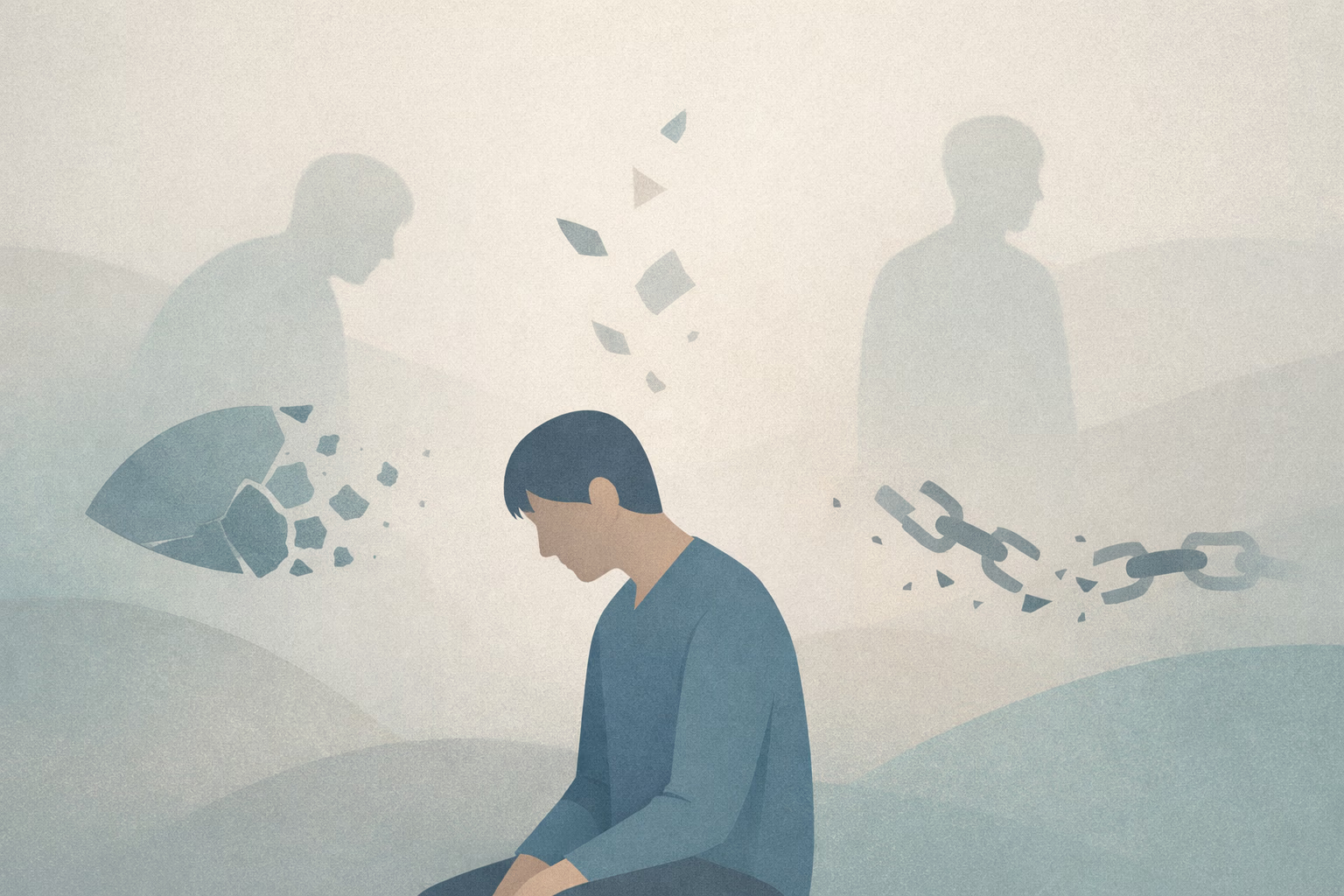
In short: Many people carry an identity that once made life workable: the dependable one, the easygoing one, the high-achiever, the “not needy” one, the one who never causes trouble. Over time, that identity can start to feel less like a home and more like a narrow hallway—functional, but tight.
Many people carry an identity that once made life workable: the dependable one, the easygoing one, the high-achiever, the “not needy” one, the one who never causes trouble. Over time, that identity can start to feel less like a home and more like a narrow hallway—functional, but tight.
What if the stuckness isn’t who you are, but a system still protecting an older version of safety?
Identity liberation isn’t about reinventing yourself overnight. It’s about noticing when a past-shaped self-concept is still organizing your choices, and recognizing that your nervous system may be prioritizing predictability and belonging over coherence and personal authorship.
When a person is constrained by an old identity, the tension often shows up as friction: you do what’s expected, but it costs more than it used to. The internal experience can be a mix of pressure, restlessness, and a low-grade sense of “not quite landing.”
This isn’t evidence of weakness. It’s what happens when the nervous system keeps using a familiar pattern to reduce uncertainty—while your current life is asking for a different shape of response. What once created stability can start creating strain, because the pattern no longer matches the reality you’re living. [Ref-1]
“I can still perform the role, but I don’t feel inside it anymore.”
Social and relational conditioning doesn’t just teach behaviors; it trains prediction. Over years, your system learns what leads to approval, what leads to friction, what leads to being overlooked, and what leads to connection. Those lessons can become a self-concept that feels like “me,” even when it’s essentially a map of past consequences.
In this way, identity constraints aren’t primarily philosophical. They’re procedural: a set of defaults that help you move through people and environments with fewer surprises. And because the brain is built to conserve energy, the old map can keep running long after the original context has changed. [Ref-2]
Humans evolved in groups where social cohesion mattered. Being readable, acceptable, and predictable to others often meant access to resources, protection, and place. So it makes sense that identities shaped by family, culture, or hierarchy can feel oddly calming—even when they’re limiting.
In evolutionary terms, an imposed identity can function like a shelter: it reduces ambiguity. In modern life, that shelter can become too small, but the nervous system may still treat it as a safety cue. This is part of why self-authorship can feel both compelling and strangely “risky,” even when nothing dramatic is happening. [Ref-3]
It’s not that you don’t want freedom.
It’s that your system may still be measuring freedom against earlier costs.
Following an imposed identity often gives an immediate payoff: fewer difficult conversations, fewer uncertain outcomes, fewer moments of social ambiguity. In nervous-system terms, it can reduce activation in the short term. The day moves forward. The relationship stays steady. The conflict doesn’t happen.
This matters because humans stabilize through closure. When you do the “known” thing, your system gets a small “done” signal: situation handled, role performed, threat minimized. That closure is real—even if it’s borrowed closure that comes from repeating the old script rather than completing what’s current. [Ref-4]
The cost is subtle: the body stands down, but the person doesn’t fully settle. Something remains unfinished because the action didn’t represent the present self.
Conforming is often framed as stability. But when your life changes—new responsibilities, new relationships, aging, shifting priorities—the old identity can start to create internal mismatch. You can look stable from the outside and still feel privately compressed.
This is one reason certain life phases feel turbulent: not because you are broken, but because older roles stop fitting. The discomfort can be the nervous system registering that the current reality isn’t being met with a current response. When the gap grows, meaning thins out: actions happen, but they don’t integrate into a coherent sense of self. [Ref-5]
“Nothing is ‘wrong,’ but I can’t keep living like this.”
Identity constraints tend to form self-reinforcing loops. The pattern often goes like this: a role keeps social surfaces smooth, smooth surfaces reduce immediate load, reduced load makes the role feel “right,” and the system repeats it. Over time, the loop can become a kind of outsourced authority—your orientation comes more from anticipated reactions than from chosen values.
This isn’t a character issue. It’s a structural outcome of living under continuous evaluation, whether that evaluation is explicit (criticism, standards, performance) or ambient (status, comparison, unspoken expectations). In that context, “who I am” can quietly become “what keeps things workable.” [Ref-6]
When an inherited identity stays in place too long, the nervous system often compensates with strategies that keep the loop intact. These are frequently mislabeled as personality traits. They’re better understood as adaptations to ongoing social load and incomplete closure.
In digital environments, upward comparison can amplify these patterns by raising the felt standard for what counts as acceptable or successful, increasing self-evaluation pressure. [Ref-7]
Autonomy isn’t just a belief. It’s a capacity: the ability to sense, select, and commit without constant internal negotiation. When an imposed identity stays dominant, autonomy can fade—not dramatically, but gradually. The person becomes good at running the script and less practiced at authoring the next line.
Creativity often declines in the same way. Not because imagination disappears, but because novelty requires room—room for unfinished drafts, imperfect attempts, mixed feedback. If your system is constantly preserving a role, it treats novelty as extra load.
Research on social media and well-being suggests that certain forms of social comparison and evaluative exposure can be associated with lower well-being for some people, especially when the environment increases self-monitoring and perceived standards. [Ref-8]
External validation can function like a fast-acting stabilizer: a quick cue that you’re safe, acceptable, “on track.” The problem isn’t validation itself. The problem is when it becomes the main source of closure—so the system learns to keep producing the version of you that reliably earns that cue.
In that structure, conflict avoidance isn’t driven by an internal flaw; it’s driven by muted consequence. If the immediate consequence of conformity is relief, and the consequence of self-definition is uncertainty, the nervous system does what nervous systems do: it chooses the path with the clearest short-term settling.
Daily social media use can intensify this by increasing opportunities for upward comparison and continuous self-evaluation, which can shift well-being and reinforce identity performance. [Ref-9]
Identity liberation often begins not with insight, but with a shift in what your system treats as credible. Performed identity is organized around other people’s expected meanings. Internal authority is organized around coherence: what holds steady across contexts, what you repeatedly recognize as yours, what remains when the audience changes.
Reflective practices like journaling or self-inquiry can be useful here—not as a cure, and not as “figuring yourself out,” but as a way to create continuity over time. In a fast environment, continuity is rare. And without continuity, experiences don’t complete; they just stack.
In the digital age, identity development is shaped by constant feedback, multiple audiences, and rapid context switching—conditions that can make self-definition feel more like managing impressions than living a stable narrative. [Ref-10]
“The question isn’t ‘Who should I be?’ It’s ‘What feels coherent enough to stand on?’”
People often imagine identity liberation as a solo act. But nervous systems are social. When relationships offer consistent safety cues—respect, room for complexity, reduced punishment for mismatch—the body is more willing to loosen old roles.
Supportive relationships and mentorship can act like a stabilizing mirror: not telling you who you are, but reflecting you in a way that doesn’t require performance. Over time, that kind of feedback helps the system update what “belonging” can look like.
Work on authenticity within self-determination theory emphasizes the role of environments that support autonomy and psychological needs—conditions that make it easier for people to live in alignment rather than under pressure. [Ref-11]
When outdated identity constraints start to release, the change is often quieter than people expect. It can look less like dramatic reinvention and more like reduced internal drag. Choices become a bit simpler. Self-explanation takes less effort. The system spends less energy anticipating reactions.
This isn’t about feeling “more” all the time. It’s about capacity returning: the ability to register signals, make contact with preference, and recover after social complexity. The person becomes more reachable to themselves because the load is lower and more experiences are allowed to complete.
In environments where comparison pressure is reduced, well-being can improve for some people, consistent with broader findings on social media exposure and mental health variability. [Ref-12]
Maintaining an outdated identity takes energy: constant monitoring, constant calibration, constant story-keeping. When that maintenance demand drops, energy becomes available—not necessarily as excitement, but as usable bandwidth. The person can move toward chosen values with fewer internal detours.
This is one reason meaning can return quickly once coherence increases. Meaning isn’t manufactured through motivation. It emerges when actions and identity fit well enough that experiences can close and settle into “this is my life, and it makes sense from the inside.”
Because social comparison can pull attention toward ranking and performance, reducing its influence can support a shift from identity management to value-aligned action. [Ref-13]
“I’m not becoming someone new. I’m becoming harder to pull away from what’s true for me.”
If you feel constrained by an old identity, it may help to recognize the dignity in how it formed. Many imposed or inherited self-concepts began as intelligent adaptations to the social world: ways to stay connected, reduce conflict, and keep life navigable.
Identity liberation, then, isn’t a battle against yourself. It’s a gradual updating of what your system uses as orientation—moving from externally stabilized belonging toward internally stabilized coherence. In modern conditions of rapid feedback and shifting audiences, that update can take time because the environment keeps reopening the loop. [Ref-14]
When the pressure to perform eases, even slightly, the possibility of self-authorship becomes less like a leap and more like a return.
Old identities often persist because they once reduced load. Releasing them isn’t about proving independence or forcing transformation. It’s about letting your life become more internally consistent—so your choices can land as yours.
Over time, that kind of coherence tends to strengthen autonomy and make growth feel less like pressure and more like direction. For many people, this shift becomes especially relevant in life transitions, when the old scripts no longer match what matters now. [Ref-15]
From theory to practice — meaning forms when insight meets action.
Because what once created stability can start creating strain. The dependable one, the easygoing one, the high-achiever, the 'not needy' one — these identities once made life workable. Over time, they can feel less like home and more like a narrow hallway: functional, but tight. The nervous system keeps using a familiar pattern to reduce uncertainty, while your current life is asking for a different shape of response. The friction isn't weakness; it's the gap between an old map and present reality. 'I can still perform the role, but I don't feel inside it anymore.'
Through procedural learning. Social and relational conditioning doesn't just teach behaviors — it trains prediction. Over years, your system learns what leads to approval, what leads to friction, what leads to being overlooked. Those lessons become a self-concept that feels like 'me,' even when it's essentially a map of past consequences. Identity constraints aren't primarily philosophical; they're a set of defaults that help you move through people and environments with fewer surprises. Because the brain conserves energy, the old map keeps running long after the original context has changed. Roles become reflexes.
Because your nervous system may still be measuring freedom against earlier costs. Following an imposed identity gives an immediate payoff: fewer difficult conversations, fewer uncertain outcomes, less social ambiguity. Conformity reduces activation in the short term — the day moves forward, the relationship stays steady. Doing the 'known' thing produces a small Done Signal: situation handled, role performed, threat minimized. That closure is real, even if it's borrowed closure that comes from repeating the old script rather than completing what's current. The system stands down briefly, but the person doesn't fully settle.
Quieter than people expect. Often it looks less like dramatic reinvention and more like reduced internal drag. Choices become a bit simpler. Self-explanation takes less effort. The system spends less energy anticipating reactions. Less rehearsing, more directness. Less self-surveillance, more presence. Less role-protection, more flexible response. Maintaining an outdated identity takes energy — constant monitoring, calibration, story-keeping. When that demand drops, energy returns. The shift is from externally stabilized belonging toward internally stabilized coherence: 'I'm not becoming someone new. I'm becoming harder to pull away from what's true for me.'
From Science to Art.
Understanding explains what is happening. Art allows you to feel it—without fixing, judging, or naming. Pause here. Let the images work quietly. Sometimes meaning settles before words do.
One Quiet Window, one insight, one reflection — every Sunday