Identity Renewal: Choosing the Next Version of Yourself
In short: Wanting to become someone different is often framed as a motivation problem: try harder, be more consistent, believe in yourself. But many people aren’t failing because they lack desire. They’re trying to build a new identity inside conditions that keep life unfinished—too many inputs, too much evaluation, too little closure.
Wanting to become someone different is often framed as a motivation problem: try harder, be more consistent, believe in yourself. But many people aren’t failing because they lack desire. They’re trying to build a new identity inside conditions that keep life unfinished—too many inputs, too much evaluation, too little closure.
What if the “gap” between who you are and who you intend to be is a signal of load and incompletion, not a verdict on your character?
An identity shift isn’t just a new idea about yourself. It’s what happens when repeated experiences reach completion and settle into “this is who I am now”—in your body, your routines, your relationships, and the story your mind can trust.
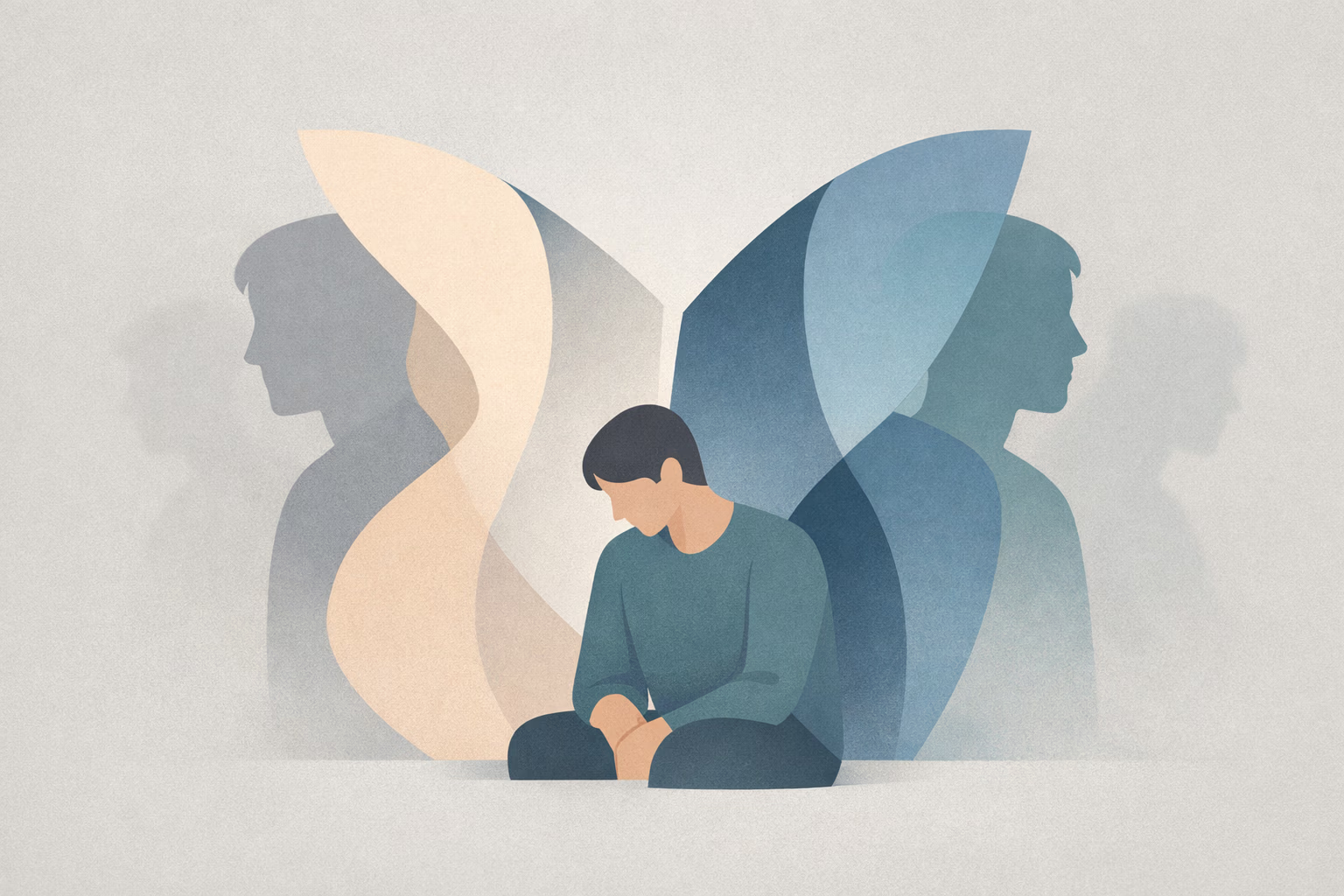
Internal conflict often shows up when your daily behaviors, roles, or constraints don’t line up with the person you mean to be. That mismatch can feel like friction: you know what matters, but your week tells a different story.
This isn’t just a mental disagreement. A nervous system uses consistency as a safety cue. When your actions repeatedly contradict your values or self-image, the system stays slightly “on,” scanning for what’s unresolved. Many people name this as guilt or self-criticism, but structurally it’s often an incomplete loop: something important isn’t landing, finishing, or becoming reliable. [Ref-1]
“I’m not confused about what I value. I’m confused about why my life won’t hold it.”
Brains update through experience. Not through one decisive moment, but through patterns that repeat long enough to be treated as dependable. Over time, what you do (and what results) becomes data your system uses to predict who you are.
When a behavior repeats under similar conditions—especially when it produces a clear “done” signal—neural pathways strengthen and the self-concept adjusts to match. This is one reason identity can feel stubborn: it’s not merely an opinion about yourself; it’s a prediction model built from what has reliably happened. [Ref-2]
Importantly, understanding your patterns is not the same as integration. Integration is the quieter, physiological settling that comes after experiences complete—when your system no longer has to keep checking whether this change is real.
Identity isn’t only private. It’s also a social signal: a way to be legible to others and to yourself. Stable self-narratives reduce uncertainty—helping people coordinate, choose roles, and make commitments without constant re-negotiation.
That dependence on coherence is part of why identity shifts can feel vulnerable. If your story about yourself is in transition, it can temporarily increase social and internal “noise”: more second-guessing, more scanning for feedback, more sensitivity to mixed signals. In this sense, a steady identity functions like a shared language between your nervous system and your environment. [Ref-3]
Imagining the person you intend to be can create a short-lived sense of orientation. For a moment, the mind organizes around a clearer “north star.” It can feel energizing, even relieving.
But that early lift is often a bridge state—useful for direction, not proof of transformation. When the imagined self and the lived self sit side by side, the system may also register dissonance: not as punishment, but as a coherence check. The tension is information: “this isn’t integrated yet.” [Ref-4]
Why does it feel so real in your head, and so hard in your week?
Modern culture often treats visualization or intention as if it were the main ingredient of change. But identity isn’t installed by insight. It consolidates when behavior, context, and narrative reinforcement keep agreeing long enough for the brain to stop keeping the old model “on standby.”
Research on intentional change suggests that lasting shifts tend to involve sustained patterns over time, not isolated bursts of resolve. The system needs repeated confirmation that the new direction holds under ordinary pressure, not only on good days. [Ref-5]
This is where many people get stuck: not because they don’t care, but because their environment keeps interrupting the very conditions that allow experiences to complete.
When you repeatedly attempt to change at the surface—new plans, new rules, new identity statements—without the deeper loop completing, the system collects a specific kind of evidence: “we start, we don’t finish.” Over time, that pattern can harden into self-doubt, not as a belief choice, but as a prediction based on history.
This is a meaning loop: you invest effort, but the loop doesn’t close. The lack of closure keeps activation high, which makes follow-through harder, which produces more incompletion. The result can look like stagnation, but structurally it’s a system protecting itself from unstable commitments. [Ref-6]
“It’s not that I won’t change. It’s that my body doesn’t trust the change yet.”
When identity isn’t settled, your system often recruits short-term regulation to manage uncertainty and load. These aren’t personality flaws. They’re ways the nervous system tries to reduce demand, regain predictability, or avoid repeated “false starts.”
Notice how none of these require a story about deficiency. They make sense when the system is overloaded and trying to prevent more unfinished experience. [Ref-7]
Misalignment often persists not because values are unclear, but because the system can’t consistently convert values into completed experiences. You may care deeply about health, creativity, honesty, or steadiness—yet the week keeps producing fragments: partial starts, interrupted routines, relationships that don’t support follow-through.
When loops remain open, the brain maintains competing models: the intended self (values) and the demonstrated self (what keeps happening). That “out of phase” feeling can show up as chronic tension, numb urgency, or a sense of being split into roles that don’t talk to each other.
In many frameworks of behavior change, integration is supported when internal signals and external contingencies become more coherent—when what matters can reliably meet consequences and completion. [Ref-8]
Partial changes can be especially destabilizing. You do enough to taste a new self, but not enough for your system to stand down. That can create a repeating cycle: hope → effort → interruption → self-questioning → renewed pressure.
In “possible selves” language, the mind can generate vivid future versions of you. That imagination can guide attention, but it can also intensify the gap if the lived environment doesn’t allow repetition and closure. The more often the future self is activated without completion, the more the future self can start to feel like a taunt rather than a guide. [Ref-9]
What if the problem isn’t your ambition, but the repeated experience of “almost”?
Identity change is often described as a mindset shift, but the bridge is usually more basic: reduced load and increased stability allow the brain to update. When attention is constantly pulled, when sleep is thin, when social evaluation is high, the nervous system prioritizes short-term regulation over long-term consolidation.
In this light, “emotional stability” isn’t about feeling a certain way. It’s about capacity returning: your system can receive signals, hold a direction, and complete loops without needing constant stimulation or constant self-monitoring. Reflective awareness can help with orientation, but it is not integration on its own. Integration shows up after repeated completion—when the new pattern becomes the default prediction. [Ref-10]
“A calmer baseline isn’t a reward for changing. It’s often the condition that lets change stick.”
Because identity is partly social, feedback matters—not as approval-seeking, but as environmental confirmation. When people around you respond consistently to your emerging roles, the brain gets cleaner data: “this is real; this holds here.”
Modeling also reduces the cognitive cost of change. Seeing a path embodied by others can lower uncertainty, making it easier for the nervous system to stay with the process long enough for loops to close. In identity-based motivation research, social cues can either reinforce current action or keep it unstable by constantly changing the standards. [Ref-11]
This is why some environments make you feel like “yourself” and others make you feel like you’re performing. Coherence is not just internal; it’s relational.
As intention and action come into closer alignment, many people notice a particular kind of confidence: not hype, but reduced internal negotiation. Decisions require less force because the system has fewer competing predictions to manage.
Classic descriptions of dissonance highlight how mismatch creates psychological strain and how alignment reduces that strain over time. When actions repeatedly confirm values, the need for internal debate drops, and the self-story simplifies. [Ref-12]
Early change can feel like trying on clothes in a harsh mirror—everything judged, nothing settled. As coherence builds, energy often shifts. Less energy is spent proving, defending, or re-starting. More energy becomes available for deliberate growth that feels internally owned.
Values matter here because they create continuity across time. When identity is anchored in values rather than performance, it becomes easier for experiences to integrate: the nervous system can recognize the same “you” across different days and imperfect conditions. In possible-selves work, a future identity becomes most stabilizing when it connects to lived cues and consistent meaning, not just inspiration. [Ref-13]
“Agency isn’t pushing harder. It’s when your life starts agreeing with itself.”
If becoming the person you intend to be has felt slow or inconsistent, it may not be a personal deficiency. It may be the predictable result of trying to form a stable identity in a world that keeps experiences fragmented, accelerated, and unfinished.
Identity is dynamic, not brittle. It updates through structured repetition, social reinforcement, and—most importantly—completion that the nervous system can register as real. Over time, the story of “who I am” changes less through pressure and more through coherence: when values, actions, and environment stop contradicting each other so often. [Ref-14]
In that frame, an identity shift isn’t a makeover. It’s a gradual settling: fewer open loops, a clearer narrative, and a body that no longer needs to stay on alert around your own intentions.
Most people are not resisting change. They are living inside conditions that make integration difficult: high load, constant comparison, and not enough “done.” When the conditions support closure and coherence, the intended self becomes less of an idea and more of a lived baseline.
Across a lifetime, identity naturally shifts as the brain updates to new roles, relationships, and meaning. The dignified truth is that you are allowed to evolve—and that evolution becomes sustainable when your nervous system and your narrative can finally agree: this is real now. [Ref-15]
From theory to practice — meaning forms when insight meets action.
Most people aren't failing because they lack desire. They're trying to build a new identity inside conditions that keep life unfinished — too many inputs, too much evaluation, too little closure. Identity changes through repetition that becomes believable, not through one decisive moment. The brain treats your self-concept as a prediction model built from what has reliably happened, so it updates only when patterns repeat long enough to be treated as dependable. The gap between current life and intended self is a signal of load and incompletion, not a verdict on character. The body doesn't trust the change yet.
It can create a brief lift — a useful bridge state — but it isn't the same as transformation. Identity isn't installed by insight. It consolidates when behavior, context, and narrative reinforcement keep agreeing long enough for the brain to stop keeping the old model on standby. Lasting shifts involve sustained patterns over time, not isolated bursts of resolve. The system needs repeated confirmation that the new direction holds under ordinary pressure, not only on good days. Imagining the future self is direction; integration is what happens after experiences complete in real conditions enough times for the new prediction to stick.
Because partial change creates a specific feedback loop: hope, effort, interruption, self-questioning, renewed pressure. You do enough to taste a new self, but not enough for the system to stand down. The mind generates vivid possible selves, and when the lived environment doesn't allow repetition and closure, the future self can start to feel like a taunt rather than a guide. Over time, repeated effort without closure produces evidence the system files as 'we start, we don't finish' — which can harden into self-doubt. The problem usually isn't ambition; it's the repeated experience of 'almost.'
Reduced load and increased stability. When attention is constantly pulled, sleep is thin, and social evaluation is high, the nervous system prioritizes short-term regulation over long-term consolidation. Emotional stability isn't a reward for changing — it's often the condition that lets change stick. Supportive social fields matter too: when people respond consistently to your emerging roles, the brain gets cleaner data that this is real and holds here. As alignment increases, confidence becomes a byproduct rather than a project. The day-to-day debate quiets because the system has fewer competing predictions to manage. Agency arrives when life starts agreeing with itself.
From Science to Art.
Understanding explains what is happening. Art allows you to feel it—without fixing, judging, or naming. Pause here. Let the images work quietly. Sometimes meaning settles before words do.
One Quiet Window, one insight, one reflection — every Sunday